How do we foster in college students the cognitive complexity, ethical development, and personal resolve that are required for living in this "sustainability century"? Tackling these complex and highly interdependent problems requires nuanced interdisciplinary understandings, collective endeavors, systemic solutions, and profound cultural shifts. Contributors in this book present both a rationale as well as a theoretical framework for incorporating reflective and contemplative pedagogies to help students pause, deepen their awareness, think more carefully, and work with complexity in sustainability-focused courses. Also offering a variety of relevant, timely resources for faculty to use in their classrooms, Contemplative Approaches to Sustainability in Higher Education serves as a key asset to the efforts of educators to enhance students' capacities for long-term engagement and resilience in a future where sustainability is vital.
eBook - ePub
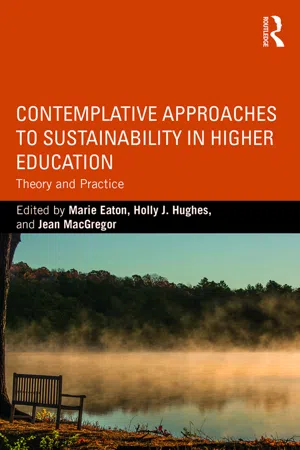
Contemplative Approaches to Sustainability in Higher Education
Theory and Practice
- 200 pages
- English
- ePUB (mobile friendly)
- Available on iOS & Android
eBook - ePub
Contemplative Approaches to Sustainability in Higher Education
Theory and Practice
About this book
Information
PART I
Theoretical Underpinnings
1
Why Sustainability Education Needs Pedagogies of Reflection and Contemplation
Marie Eaton, Kate Davies, Sarah Williams, and Jean MacGregor
Our seminar text—Alice Walker’s Overcoming Speechlessness—closed slowly within a student’s hands as her words faltered, and tears began to fall. The tears were accompanied by a long period of silence, others’ averted eyes, and a palpable sense of collective unease.
At last, another student spoke into the silence, “At least people—even people in the worst of circumstances such as Walker describes in this book—even those people have a chance to learn and make change. But, what about the trees in disappearing forests or the irradiated marine life off the coast of Japan? What about other species and the planet?”
This response was followed by more silence, an even more awkward and uncomfortable silence. Another student finally spoke, but his voice did not have the usual confidence, nor did he provide an analysis with his characteristic sword-like precision. As his body hunched over in his chair, his eyes remained downcast, he said: “My biggest issue is just showing up for class, what’s the point when we’re headed for extinction?”
In our undergraduate and graduate classrooms, we see more and more students with this “what’s the point?” response. Today’s college and university students might be the first generation to face such intense economic, political, and ecological instability simultaneously while also realizing humanity’s growing inability to sustain living systems on the earth. A host of courses confront students with bad news: global problems for which solutions seem beyond their ability—or anyone’s ability—to resolve. Moreover, we might be the first generation of faculty members challenged to respond to such overwhelming emotions in our students, not to mention ourselves.
At the same time, under a host of banners—Slow Food, transition towns, Sustainable Livelihoods, post-carbon economies, The Natural Step, Cradle to Cradle design, voluntary simplicity—thousands of innovators, most of them at the grass roots, are beginning to steer communities, if not yet the world, in new directions. Even as we help students face the dangerous realities of an unsustainable world, we also can introduce them to the profound potential and possibility that fuel these emerging initiatives and thus plant seeds of inspiration, purpose, and agency.1
This volume is the result of a series of gatherings of the Sustainability and Contemplative Practice faculty learning community of the Curriculum for the Bioregion2 project, an initiative in Washington State that supports the integration of sustainability education across the academic disciplines. Coming together in 2009, our faculty community recognized the powerful emotional and cognitive load our various classes were placing on students—complex content coupled with newfound emotional turmoil at the enormity of their realizations. From our own experience with different forms of reflection and contemplation, we were convinced that these practices can aid deep exploration of meaning, provide insight, and open to creative possibilities. We had introduced and experimented with some of these practices in our classes, but in different contexts and with different goals for students’ learning. We felt the need to share and deepen our work. Thus began several years of conversations about what is needed to make sustainability education more meaningful and effective in engaging students and motivating them beyond despair. Our earliest discussions focused on two questions: What are the critical dimensions and goals of sustainability education? And how might we develop pedagogies of reflection and contemplation in our classes in order to foster these goals? This chapter synthesizes that first step in our work.
Dimensions of Sustainability Education
Sustainability as Adaptive Challenge
Beginning in the 1990s, recognizing the growing seriousness and interrelatedness of global problems, college and university leaders began to recognize the need to prepare both professionals and citizens to shape a more sustainable future. They also began to envision their campuses as models of sustainable practices. “Sustainability” emerged as a new field, reframing many environmental studies programs, which had historically housed the study of humanity’s social and ecological problems, and enlivening other areas of the curriculum. Campuses across the country established sustainability task forces and created offices of sustainability, and several national and international initiatives emerged, recruiting campus leaders to make public commitments to integrate sustainability practices in all aspects of campus life.3
Sustainable practices often focus on ways to reinvent how we feed and clothe ourselves, make and build things, meet our electricity needs, and travel from place to place. However, as it is taught and communicated on campuses, sustainability is too often cast as a set of problems for which there are technical solutions and policy fixes. For students not majoring in environmental or sustainability studies, the message they often glean is that working toward sustainability requires relatively easy individual actions to trim their excesses—recycling, taking shorter showers, using energy-saving lightbulbs and mass transit, buying green products—or by applauding the search for new technologies.
However, pressing global sustainability imperatives such as mitigating climate change, alleviating poverty, and improving human health ask more of all of us. They require new ways of thinking and problem solving. Ronald Heifetz and Marty Linsky (2009) call such formidable issues “adaptive challenges” and distinguish them from “technical problems.” In their view, technical problems, while complex, are solvable with known information and expertise. The solution, or goal, is often tangible, like “putting a man on the moon.” Addressing technical problems is a matter of marshaling enough resources and expertise. In contrast, adaptive challenges are problems whose solutions are elusive because the problems themselves are so large, so highly complex, and so continuously evolving. Addressing these challenges throws into question not only our taken-for-granted problem-solving methods; they often challenge deep-seated habits of mind and values. Adaptive challenges require continuous learning at all levels of organizations because the needed knowledge to address the problem—or just improve the situation—is not fully known. Knowledge and creativity must be mobilized from disparate quarters. Careful, inclusive listening, experimentation and mentoring are essential. That is not to say that sustainability problems do not require technical expertise; obviously, they do. But much more is required: “changes in values, belief, and behavior,” as Heifetz (1998, 22) says.
Therefore, embracing the sustainability imperative as an adaptive challenge, and creating a healthy future—that includes both healthy human communities and healthy ecosystems—calls for an enhanced sense of moral purpose and long-term commitment to transition to a dramatically different trajectory than what we are on today. Concerted action is needed at both individual and societal levels to create new ways of thinking, acting, and being in the world. Therefore, sustainability education—and indeed all of education in the twenty-first century—needs to become much more capacious to help students understand what adaptive challenges require and to explore what it will take to completely reinvent how we go about living in the world and, fundamentally, how we think about the world we live in. As Daniel Sherman asserts, “Sustainability must become a pedagogical big idea, capable of complementing and connecting avenues of inquiry across the academic disciplines that organize and prioritize teaching and learning on campus” (Sherman 2008, 188).
Sustainability as an Emergent and Contested Concept
Notions of sustainability have broadened and deepened since the term was first introduced by the World Council of Churches and the International Union of Nature and Natural Resources forty years ago. The term “sustainable development” acquired international momentum and prominence in 1987, with the publication of Our Common Future, a report commissioned by the United Nations and led by Norwegian prime minister Gro Harlem Brundtland (World Commission on Environment and Development). What came to be known as the “Brundtland definition” of sustainable development emphasized the balance of economic development with the need to conserve resources for future generations. Many in the Western world criticized this term, arguing that the phrase “sustainable development” was an oxymoron. They preferred using the term “sustainability,” although at first, they limited it mostly to ecological sustainability.
Today, the concept of sustainability is seen in broader terms than either sustainable development or ecological sustainability, and it includes community, organizational, cultural, economic, personal, and social sustainability. But because these different types of sustainability are often in tension with each other, it is important to ask: “What exactly are we trying to sustain and why?” and “What exactly are we trying to develop and why?”4 and to acknowledge that our fears about our own human mortality reside within these questions. Moreover, these types of sustainability are not equal in importance because all human life and activity ultimately depend on sustaining the health of the earth’s systems.
Although Our Common Future discussed the need to conserve resources for future generations, most economic development efforts favor short-term, technical solutions and fail to consider our responsibility to ensure that our children and grandchildren inherit a livable planet. Ignoring this ethical imperative for intergenerational equity and the impact of economic growth has precipitated environmental destruction. In contrast, some indigenous cultures seriously consider the long-term impacts of their decisions. For example, the Bemidji Statement on Seventh Generation Guardianship, prepared by the Indigenous Environmental Network, states that “the first mandate … is to ensure that our decision-making is guided by consideration of the welfare and wellbeing of the seventh generation to come” (2012). Additionally, not only do we need to “think globally and act locally” we need to “think locally and act globally” in order to negotiate the inevitable tensions that arise when local actions have global impacts and global actions have local ones.
Sustainability is framed in different ways depending on different groups’ goals and values, which are socially constructed, emergent, and often contested. For instance, in our classrooms, as in our culture, there is a natural tendency to think of sustainability as a fixed, unchanging state that can be attained at some point, a goal that human societies should aspire to achieve. But is this view always helpful? Does it lead to seeing sustainability as an adaptive challenge or instead, something that can be realized through technological innovation alone? Does it lead to capacious thinking or a narrow-minded approach? John Robinson (2004) has argued it is helpful to see sustainability as an emergent process rather than a fixed state, taking into account the systemic and complex challenges we face and engaging people and communities in the search for resilient solutions in new and exciting ways.5 Perhaps more importantly, this viewpoint allows students to see sustainability as an ever-unfolding path full of possibility and potential.
But perhaps most challenging, concepts of sustainability and sustainability education are too often explored in the context of the historically dominant Western cultures that have now become a globally capitalist set of beliefs and values, including emphases on progress, reason, competition, individualism, and materialism. These tacit, and often unconscious, collective understandings profoundly influence how we treat the earth and how we treat each other, and perhaps most devastatingly, how we view our own capacities to contribute to the creation of a better world.
Sustainability as Wellspring of Creativity and Innovation
As mentioned above, thousands of organizations and experiments aimed at transforming our industrial, social, and economic systems are springing up throughout the world. The study of sustainability cannot only be an encounter with intractable, adaptive problems and the cliff that humanity seems to be hurtling toward. It must equally emphasize new and innovative ideas, exemplified by promising initiatives devoted to community well-being, poverty alleviation, ecological restoration and biodiversity protection, and the transition to a post-fossil fuel future, any of which students could join and augment.
Multiple Ways of Learning in Sustainability Studies
Addressing these dimensions of sustainability requires a kind of teaching and learning that reaches beyond the norms of most undergraduate curricula. Sustainability studies are often interdisciplinary or present interdisciplinary dimensions to issues, often moving beyond campus boundaries into community-based research and community projects. Sustainability education not only asks us and our students to understand new concepts and think through complex problems, but also to challenge our taken-for-granted assumptions and worldviews regarding our cultural and political systems. We ar...
Table of contents
- Cover-Page
- Half Title
- Title
- Copyright
- Dedication
- Series
- Contents
- Foreword by Paul Wapner
- Preface
- Acknowledgments
- Part I: Theoretical Underpinnings
- Part II: Teaching Contexts and Practices
- Afterword
- Contributors
- Index
Trusted by 375,005 students
Access to over 1.5 million titles for a fair monthly price.
Study more efficiently using our study tools.
Frequently asked questions
Yes, you can cancel anytime from the Subscription tab in your account settings on the Perlego website. Your subscription will stay active until the end of your current billing period. Learn how to cancel your subscription
No, books cannot be downloaded as external files, such as PDFs, for use outside of Perlego. However, you can download books within the Perlego app for offline reading on mobile or tablet. Learn how to download books offline
Perlego offers two plans: Essential and Complete
- Essential is ideal for learners and professionals who enjoy exploring a wide range of subjects. Access the Essential Library with 800,000+ trusted titles and best-sellers across business, personal growth, and the humanities. Includes unlimited reading time and Standard Read Aloud voice.
- Complete: Perfect for advanced learners and researchers needing full, unrestricted access. Unlock 1.5M+ books across hundreds of subjects, including academic and specialized titles. The Complete Plan also includes advanced features like Premium Read Aloud and Research Assistant.
We are an online textbook subscription service, where you can get access to an entire online library for less than the price of a single book per month. With over 1.5 million books across 990+ topics, we’ve got you covered! Learn about our mission
Look out for the read-aloud symbol on your next book to see if you can listen to it. The read-aloud tool reads text aloud for you, highlighting the text as it is being read. You can pause it, speed it up and slow it down. Learn more about Read Aloud
Yes! You can use the Perlego app on both iOS and Android devices to read anytime, anywhere — even offline. Perfect for commutes or when you’re on the go.
Please note we cannot support devices running on iOS 13 and Android 7 or earlier. Learn more about using the app
Please note we cannot support devices running on iOS 13 and Android 7 or earlier. Learn more about using the app
Yes, you can access Contemplative Approaches to Sustainability in Higher Education by Marie Eaton, Holly J. Hughes, Jean MacGregor, Marie Eaton,Holly J. Hughes,Jean MacGregor in PDF and/or ePUB format, as well as other popular books in Education & Education General. We have over 1.5 million books available in our catalogue for you to explore.