- 256 pages
- English
- ePUB (mobile friendly)
- Available on iOS & Android
eBook - ePub
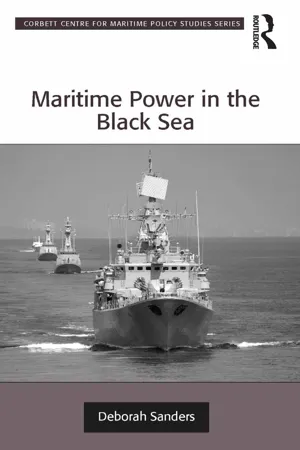
Maritime Power in the Black Sea
About this book
Maritime Power in the Black Sea provides the first comprehensive assessment and evaluation of the comparative maritime power of the six littoral states in the Black Sea - Turkey, Russia, Ukraine, Georgia, Romania and Bulgaria. This book examines the maritime capabilities and assets of each of the six littoral Black Sea states and also considers the implications of the distribution of maritime power on both regional and international security. As such it makes an important contribution to the debate about what constitutes maritime power in the twenty first century and provides a thematic comparative study of the ability of each of the littoral states of the Black Sea to project maritime power.
Information
Chapter 1
Maritime Power in the Black Sea
This chapter examines two related questions: what do we mean by the term ‘maritime power’; and, how do we measure maritime power? As this book examines maritime power in the context of the Black Sea the answers to these two questions provide an important organising framework for the remainder of this book. As this chapter explains, maritime power is a much broader and more inclusive concept than sea power or naval power. As such, a review of the Black Sea states that focuses on the narrow technical issues of the size and nature of their navies or coast guards would be insufficient. As maritime power, the ability to use the maritime domain to achieve a political effect, is an element of military power, it is also shaped and influenced by internal political issues such as economic development and investment in the defence industries and political stability. As such maritime power has important political, economic, and social foundations, and unless these are part of the investigation, no meaningful conclusions on the current and future dimensions of maritime power in the Black Sea can be reached. As will be discussed in section three, the utility and application of maritime power by the Black Sea states will also depend on the particular context provided by the Black Sea security environment.
This chapter begins by examining the nature of maritime power: the discussion is concerned, in particular, with developing themes that are used in subsequent chapters as the means to compare the maritime potential of the Black Sea states. Drawing on the extensive body of literature on maritime power, this chapter outlines three criteria that will be used to examine each of the littoral state’s maritime power: quantitative factors, qualitative factors and the context in which they use the maritime domain. Quantitative and qualitative factors are the means or resources available for use in the maritime domain and a states capacity to use them including such issues as the levels of military professionalism, service personnel morale and training. The third factor used to examine maritime power is the context or environment in which each of the six littoral states use the maritime domain. As will be discussed, relations with neighbours and key players in the Black Sea can play an important role in shaping the parameters and possibilities of individual littoral state’s maritime power.
What is Maritime Power?
Defining maritime power requires defining two elements: power; and what it is that constitutes a ‘maritime’ context. Power can be defined in simple terms as the capacity of an individual, group or nation ‘to influence the behaviour of others in accordance with one’s own ends’.1 However, this simple definition obscures the very real complexities in the operation of power in the international system. For example, in the early 1970s, Britain found itself in conflict with Iceland over maritime zones of economic exploitation, in a dispute known as the Cod War.2 Britain’s naval capabilities dwarfed those of Iceland and yet Britain found itself unable to coerce Iceland into compromising its political position: in the end Britain lost the Cod War in the sense that it did not achieve its political objectives. However, in the 1982 Falklands War between Britain and Argentina, the balance of military advantage was much less favourable to the United Kingdom and yet the outcome was a decisive success.3 Clearly, there are many complexities associated with defining and exercising power.
One central attribute of power is that it is relational – a state may have more or less capacity to influence or coerce depending upon the context in which it is exercised. Maritime power is an ‘output’: the ability to get an actor to do something they would not necessarily do using the maritime domain.4 Maritime power is the ability or capacity to achieve an effect and as such is relative and context specific. Maritime power is ultimately the attempt to use coercion to persuade a potential or actual adversary to achieve a desired effect. How much maritime power a state has will therefore depend on what they are trying to achieve, when, where and against who or what. Maritime power is determined by the desired effect and the likelihood of achieving this effect. An effective evaluation of a state’s power would have to include an examination of other navies in the region as well as their commitments and missions.5
Another implication of the breadth of maritime power is the need to investigate the variety of different contexts through which this power is exercised in the Black Sea. This context may be shaped by a diverse range of factors including the international political context, domestic politics, the nature of the issues in dispute, the objectives being pursued and the character of the adversary. In consequence, another, related, attribute is that the sources of power are diverse. Power and capability are not always the same thing – for example, a state may have a large navy, but if there is no willingness domestically to see that capability used, then the power exerted by that capability will be diminished. Conversely, small navies can exert considerable power in many contexts: for example, if potential adversaries are risk averse. A state with a given set of military capabilities can therefore simultaneously be very powerful in one context and very weak in another. A third attribute of power is that it does not necessarily require the use of force. ‘Influencing’ other political actors in the international system can be carried out in many nebulous ways. For example, Georgian or Ukrainian cooperation with other regional actors such as the US, through activities such as maritime exercises or exchange visits may send powerful signals to other littoral states that may influence their calculations. The nature of power itself thus requires that whilst any analysis of Black Sea states must be sensitive to military capabilities, it must also be sensitive to both the international and domestic context in which those capabilities may or may not be used.
If power in general is a relational commodity that determines the degree to which a state can obtain what it wants, what it peculiar about a specifically ‘maritime’ concept of power? Maritime power describes the ability of a state to influence or coerce others at, or from, the sea.6 Traditional maritime theorists such as Alfred Thayer Mahan, the dominant naval commentator of the late nineteenth century, tended to talk of ‘naval power’, rather than maritime power, which necessarily focused thinking on navies as the prime instrument of influence and coercion at or from the sea. The broader concept of ‘maritime’ power has emerged over the last few years to describe the multi-dimensional and complex relationship a state or organisation has with the seas and oceans. Maritime power, unlike ‘sea’ or ‘naval’ power, is a more accurate reflection of the varied military and non-military means required to advance the wide and diverse array of political objectives that states seek to achieve in the maritime domain. In the twenty-first century the concept of maritime power is more than the ability of a state to engage in war-fighting or the projection of force at or from the sea. Maritime power includes the ability and capacity to engage in non-military maritime tasks and functions such as preserving maritime resources, ensuring the safe transit and passage of cargoes and people at sea, protecting maritime borders, upholding maritime sovereignty, rescuing those in peril and preventing misuse of the oceans.7
As well as taking a more inclusive and holistic approach to the study of the ways in which the maritime environment is used, the evolving body of literature on maritime power has also developed a broader understanding of the means or resources necessary for states to use the oceans and seas for political effect. There is a growing recognition that traditional military maritime measures need to be expanded to provide a better picture of a state’s maritime power. Traditional military measures have tended to focus on the size, function and sustainability of a state’s navy.8 This is because, while most maritime experts recognise that there is more to maritime power than navies, the number and quality of naval platforms do still matter and must remain central to any analysis of maritime power. As maritime power is ultimately a subset of military power, the military assets and capabilities a state has will affect and shape its ability to use the sea for political effect.9 An examination of maritime power in the Black Sea must therefore start by examining not only the size, function and sustainability of individual states navies, but also the other military assets and capabilities that directly affect its ability to use the sea, such as land-based aircraft and forces as well as coastal artillery and missiles.10
As part of this attempt to broaden our understanding of what constitutes maritime power in the twenty-first century, contemporary writers have also argued that non-military assets and resources have also assumed much greater importance and must therefore be included in any comprehensive examination of a state’s ability to use the maritime domain to achieve a desired effect.11 Non-military maritime assets include a state’s merchant fleet, fishing industry and fishing stocks, oil platforms and reserves, ports and infrastructure. Two of the Black Sea littoral states, the Russian Federation and Turkey have large merchant fleets. The Russian Federation with more than 20,000 deadweight tonnage and 1,787 commercial ships and Turkey, with over 23,000 deadweight tonnage, and 1,174 ships have larger fleets than the United Kingdom.12 In recognition of the importance of its merchant fleet and its steady decline since the 1990s, the Russian President signed a federal law in 2011 that outlined measures of state support for domestic commercial shipping and ship building industries in Russia. These new measures, such as tax breaks, are aimed at making the registration of commercial ships under the Russian flag more attractive and increasing international interests in Russia’s shipping market.13 Other Black Sea states, however, have much smaller merchant navies. Romania’s merchant fleet, for example, was all but destroyed by corruption in the early years of independence. An additional non-military factor that influences a states ability to use the maritime domain is the size of a state’s fishing industries and its reliance on the sea for resources. It is clear that while the dwindling supply of key fish stocks, a lack of state subsidies to the fishing industry, privatisation, aging fishing fleets and the rising cost of fuel and maintenance have led to a rapid reduction of many of the Black Sea littoral states active fishing fleets, the ability to use the maritime domain for fishing remains important.14 For instance, although Bulgaria’s fishing fleet is about a third of the size of Turkey’s fleet, it is considerably bigger than Ukraine’s, Georgia’s or Romania’s fishing fleet and employs over 2,000 people. Bulgaria’s fishing industry also generates almost 5 million Euros annually and supports 26 fish processing plants.15 Lending further support to the necessity of considering more than military maritime assets when looking at maritime power in the Black Sea, the littoral states also have important interests in using the maritime environment for commercial reasons. In particular, the Black Sea is an important medium for transporting and supplying energy. For instance, while there are only 100 oil wells in the Black Sea, as against 7,000 in the North Sea, there has been an increase in interest in drilling for energy amongst littoral states over the last few years in light of Romania’s recent opened gas fields. In a sign of the growing importance of energy, Exxon Mobil Corp plans to invest almost 100 million dollars drilling two deep-water oil wells off Ukraine’s Black Sea coast.16 Other non-military assets such as maritime infrastructure can also play a decisive role in shaping a state’s ability to use the maritime domain and needs to be included in any analysis of a state’s maritime power. For instance, Ukraine’s maritime power was affected by the government’s decision in 2010 to continue to lease port facilities in Sevastopol to the Russian Black Sea Fleet until 2042.17 The non-military elements of maritime power like the control of key ports and supporting infrastructure are important determinants of a state’s ability to use the sea for political effect. The Headquarters of the Ukrainian Navy was in Sevastopol, and, until Russia’s annexation of the Crimea in 2014, the Ukrainian Navy had to share port facilities with the Russian Black Sea Fleet. The joint basing of the Ukrainian and Russian Black Sea navies in the Crimea therefore provided practical limitations on Ukraine’s maritime power. The presence of the Russian BSF in Sevastopol hampered Ukraine’s ability to control effectively its main port and its infrastructure – key elements of maritime power.
Domestic factors can also affect a state’s potential capacity to exert influence at or from the sea. These include, geography such as access to ports and infrastructure and industrial capacity. For traditional theorists such as Mahan, geographical considerations are also crucial: naval strength was dependent on factors such as the relative position of a state, its physical characteristics including climate, and coastline and the distribution of such primary resources as coal and wood. Contemporary naval theorists also agree that geography matters. For example, Ken Booth notes how geography influences the shape of a state’s maritime logistical requirements, a consideration that will have an impact ultimately on its maritime power. Geographical factors impact on maritime power because they determine such issues as the quality and quantity of harbours and the degree of their contiguity; a state’s location relative to maritime choke points; the distribution of potential allies and enemies; and a state’s distance from its core responsibilities and areas of national interest.18 Despite their tangibility, geographical issues are not without their difficulty as explanatory variables. Whilst recognising the importance of physical factors many writers have been cautious about using these explicitly to explain and understand a state’s seapower not least because they have a subjective quality. For instance, in his analysis of ‘medium navies’, J.R. Hill recognises the importance of physical factors, but does not systematically include them in his analysis because they are difficult to weight. Factors such as the length of a state’s coastline, the size of its offshore zones, a state’s strategic position, port facilities and the size and quantity of off-shore traffic are left out of his comparative tables as they involve ‘difficult data management’.19
In an attempt to get round these problems, Harold J. Kearsley develops a lis...
Table of contents
- Cover Page
- Title Page
- Copyright Page
- Contents
- Acknowledgements
- Introduction
- 1 Maritime Power in the Black Sea
- 2 Turkey’s Maritime Power in the Black Sea
- 3 Russia’s Maritime Power in the Black Sea
- 4 Ukraine’s Maritime Power in the Black Sea
- 5 Georgia’s Maritime Power in the Black Sea
- 6 Romania’s Maritime Power in the Black Sea
- 7 Bulgaria’s Maritime Power in the Black Sea
- Conclusion
- Epilogue
- Bibliography
- Index
Trusted by 375,005 students
Access to over 1.5 million titles for a fair monthly price.
Study more efficiently using our study tools.
Frequently asked questions
Yes, you can cancel anytime from the Subscription tab in your account settings on the Perlego website. Your subscription will stay active until the end of your current billing period. Learn how to cancel your subscription
No, books cannot be downloaded as external files, such as PDFs, for use outside of Perlego. However, you can download books within the Perlego app for offline reading on mobile or tablet. Learn how to download books offline
Perlego offers two plans: Essential and Complete
- Essential is ideal for learners and professionals who enjoy exploring a wide range of subjects. Access the Essential Library with 800,000+ trusted titles and best-sellers across business, personal growth, and the humanities. Includes unlimited reading time and Standard Read Aloud voice.
- Complete: Perfect for advanced learners and researchers needing full, unrestricted access. Unlock 1.5M+ books across hundreds of subjects, including academic and specialized titles. The Complete Plan also includes advanced features like Premium Read Aloud and Research Assistant.
We are an online textbook subscription service, where you can get access to an entire online library for less than the price of a single book per month. With over 1.5 million books across 990+ topics, we’ve got you covered! Learn about our mission
Look out for the read-aloud symbol on your next book to see if you can listen to it. The read-aloud tool reads text aloud for you, highlighting the text as it is being read. You can pause it, speed it up and slow it down. Learn more about Read Aloud
Yes! You can use the Perlego app on both iOS and Android devices to read anytime, anywhere — even offline. Perfect for commutes or when you’re on the go.
Please note we cannot support devices running on iOS 13 and Android 7 or earlier. Learn more about using the app
Please note we cannot support devices running on iOS 13 and Android 7 or earlier. Learn more about using the app
Yes, you can access Maritime Power in the Black Sea by Deborah Sanders in PDF and/or ePUB format, as well as other popular books in Politics & International Relations & Military & Maritime History. We have over 1.5 million books available in our catalogue for you to explore.