eBook - ePub
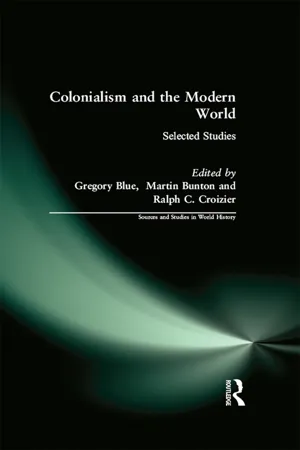
Colonialism and the Modern World
- 344 pages
- English
- ePUB (mobile friendly)
- Available on iOS & Android
eBook - ePub
Colonialism and the Modern World
About this book
This collection fills the need for a resource that adequately conceptualizes the place of non-European histories in the larger narrative of world history. These essays were selected with special emphasis on their comparative outlook. The chapters range from the British Empire (India, Egypt, Palestine) to Indonesia, French colonialism (Brittany and Algeria), South Africa, Fiji, and Japanese imperialism. Within the chapters, key concepts such as gender, land and law, and regimes of knowledge are considered.
1 | INTRODUCTION |
Colonialism has been an abiding concern of Western historiography since the Renaissance. During the colonial era, European authors who addressed the topic did so most frequently to chronicle and justify the exploits of their countrymen and their allies, to demonstrate the backwardness of those they subdued, or to detail the brutalities of their rivals. Anticolonial writers from Las Casas in the sixteenth century to the national liberation leaders of the twentieth tended to stress the greed, arrogance, and blind will to power of the colonizers while documenting the suffering, resistance, and endurance of the colonized. Following the dismantlement of the major colonial empires in the two decades after the Second World War, recent scholarship on the history of colonialism has pushed forward in a variety of new directions. The intention of this volume is to profile some of those initiatives and to illustrate how a diversity of new approaches can reilluminate understanding of a classical subject of historical inquiry.
Colonialism itself is a vast subject, and “the modern world” an even more immense one. It is therefore appropriate to say something at the outset about what can be expected from this volume. The term “modern,” as it occurs in the title, is meant to denote the period of 200 years or so running from the late eighteenth to the late twentieth century. In this sense, following a usage common among historians, the “modern period” is distinguished broadly from the “early modern” era, the latter conventionally defined as spanning the period from the sixteenth century to the eighteenth. From the standpoint of the historian of European colonialism, this convention is particularly useful because it reflects the major transformation that occurred around 1800 in the geographical focus and structural character of the colonial order. More will be said momentarily about the roles of various states and regions in that transformation; for the time being, it may be observed that the changes in the character of European colonialism at this time went hand in hand with two major contemporary economic shifts: on one hand, the weakening of Asian, especially Chinese, economic expansion, which had served as one of the engines of growth in the world economy during the early modern period, particularly by fueling demand for “New World” silver in the seventeenth and eighteenth centuries; and, on the other, industrialization and the growth of factory production in northwestern Europe, developments which determined that the major nineteenth-century colonial powers enjoyed substantially greater technical superiority in the manufacturing sector over countries in Asia, Africa, and Latin America than did their early modern predecessors.1 This industrial superiority coincided, not surprisingly, with increased military prowess as well.2 The knotty, much debated question of what causal relations may have obtained between improvements in technological and scientific proficiency, the expansion of military power, and broader economic trends is not, however, an issue that receives much explicit attention in this particular volume. Likewise, there is no special theoretical discussion of the notion of “modernity,” nor any attempt to define that phenomenon according to broad principles that might differentiate it from earlier or later sociocultural formations. Finally, even within the bounds of the time frame adopted here, it is not the purpose of this book to provide a full or systematic treatment of the colonial order since 1780 or to specify the place of colonialism in general within the global system of international relations as it has evolved over recent centuries, since various studies of that nature are readily available elsewhere.3
What this volume offers is a selection of historical essays, written from a variety of perspectives, devoted to diverse aspects of the colonial order, and aimed at clarifying the nature of particular developments in distinct subordinated societies and at establishing the interplay of those developments with broader international trends. As befits this overall purpose, these contributions do not purport to share or recommend a single theoretical framework; and most of their authors display no great desire for aligning themselves here with one or another broad theory of colonialism. What the chapters do have in common is that all constitute original contributions to scholarship that are based in primary source research, whether the results of that research are presented in detail here or, as in the case of the three opening essays, summarized on the basis of decades of working in the archives. Together the studies presented here are meant to give an impression of some of the concerns and approaches evident in one of the most vibrant fields of world history scholarship. The function of the volume as a whole, then, may perhaps be likened to that of a Chinese ink drawing or a haiku poem, evoking the shape and tone of the field rather than painting it in detail. In terms of national and regional range, the focus is on the colonial order in Asia, Africa, and the Middle East; separate chapters are devoted to British, French, Dutch, Japanese, German, and South African colonial structures.
In order to place into broader context the issues raised in the following chapters, it might be useful to begin with a rough sketch of the broad stages of colonial empire-building since the sixteenth century. Following the voyages of Columbus and da Gama, Spain and Portugal placed themselves at the forefront of European imperial expansion, impelled by a combination of crusading zeal and a lust for gold and glory. Between 1510 and 1533, Spanish forces under Cortés and Pizarro succeeded in overthrowing the powerful Aztec and Inca empires; Habsburg Spain consequently became the predominant power in the Americas, a position it would retain over the next three centuries. The Portuguese constructed a lucrative maritime empire throughout the Indian Ocean basin, with a string of outposts stretching from southern Africa to Japan; they simultaneously promoted seaboard settlement in Brazil and erected commercial bases for slaving and other forms of trade along the east and west coasts of Africa. In the seventeenth century, the Dutch succeeded in making themselves the world’s leading maritime trading power, displacing the Portuguese as the dominant naval power in Asia and taking control of strategic territories in the southeast Asian Spice Islands, in present-day Indonesia. At the same time, as Tsarist Russia was imposing its rule clear across northern Asia to the Pacific, Britain, France, and the Netherlands established small settler colonies in North America, the Caribbean, and northeastern South America, with an eye to becoming players in the lucrative sugar business, the soaring profits from which were based on the harsh exploitation of slaves imported from Africa.4 By the early eighteenth century, however, Britain and France had succeeded in displacing the Dutch maritime supremacy, and London became the center of world trade. Over the following decades, competing British and French commercial and colonial ambitions fed growing rivalries in India, North America, and the Caribbean. Though Spain continued to possess by far the most extensive territorial empire power in the Americas, its mercantilist monopoly of trade was increasingly eroded from mid-century by interlopers from other states, especially Great Britain.
The late eighteenth and early nineteenth centuries then witnessed the dramatic dismantlement of most of the early modern colonial empires and the simultaneous emergence of what is commonly referred to as the “second wave” of European colonialism. France lost its possessions in Canada and the Mississippi basin during the Seven Years’ War (1756–1763), and, despite several vain attempts, failed to regain them during ensuing conflicts with Britain over the following decades. George III was nonetheless compelled to concede the independence of Britain’s original thirteen colonies on the North American mainland, though the Union Jack continued to fly over Canada and in the Caribbean. The Spanish crown was not so fortunate: its once mighty domains were reduced to a sliver of their former glory after republican revolutions brought independence to the vice-royalties from Argentina to Mexico, leaving only a rump empire comprised of Cuba, the Philippines, and a few territories of little interest to other powers. Yet the second wave of European empire-building began to take shape even before the first had passed, the new phase of expansion coinciding, as already mentioned, with industrial and military revolutions in the West and economic slowdown in Asia. The inauguration of this second wave is conventionally dated to the 1760s, when the British East India Company, having just defeated French forces in South Asia, succeeded in making itself the governing power in the wealthy province of Bengal. Over the following eighty years, the Company, aided by the Royal Navy and supervised by Parliament, continued to impose its rule over the entire subcontinent, in some places instituting its own direct rule and in others governing through native princes who had been subjected to its authority. In the same period, partly to compensate for the loss of the thirteen American colonies, Britain also established new colonies of settlement in Australia and New Zealand. After capturing both the Cape Colony and Java from the Netherlands during the Napoleonic era, Britain returned control of Java to the restored Dutch monarchy once peace was restored in 1815, but retained the Cape while establishing a naval and commercial base at Singapore that would cement British naval supremacy in Southeast Asia for the next century.
Paramountcy in India, together with control of the essential sea routes into the Indian Ocean, made Britain the predominant power across South Asia, just as Tsarist Russia was in the north. British victory over China in the first Opium War (1839–1842) forced the declining Qing dynasty to surrender Hong Kong and begin the process of formally opening the famed Chinese market to foreign commerce. Opium raised in India and imposed on the Chinese served conveniently for decades to balance the cost of the British trade in tea, while significantly contributing to British government coffers in Calcutta.5 Meanwhile, the Anglo-Russian struggle for power and influence, which Kipling referred to as “the Great Game,” was becoming the central international rivalry of the nineteenth century, with flashpoints extending from the Balkans and the Black Sea across Central Asia to Manchuria. One result of that rivalry was a new lease on life for French aspirations to great power status and a colonial empire. Though Napoleon’s plans for a reborn French empire beyond Europe were quashed by the success of the Haitian Revolution and the combined forces of the Grand Alliance, the Orléanist regime in 1830 followed up on his plan to subdue Algeria. Over the following decades, successive French governments carried out bloody wars of conquest that pushed their rule further and further south. From the 1850s, impelled by the imperial ambitions of Napoleon III, an expanding French presence was also established in Indochina; and after successfully combining in the Crimean War against Russia, French forces joined again with the British at the end of the decade in an imperial expedition that forced the Manchu regime in China to make major new political and commercial concessions, including the opening of a string of new treaty ports. In the following decade, French- and Belgian-backed expeditions began scouring the Congo basin in search of trading partners, political allies, and promising territories to “civilize” and exploit.
The widely debated issues of what constituted the basic causes behind the so-called New Imperialism that emerged in the last decades of the nineteenth century, and what relation this might have had to the mid-century “Imperialism of Free Trade,” need not occupy us here. Whether sparked by a series of political-economic crises in key subordinate states, or by a general desire for securing new markets and sources of raw materials, or by British anxieties about growing international competition to its manufacturing industries, or again by Bismarckian diplomatic maneuvers meant to sap French revanchism after the Franco-Prussian War, what is clear is that in the four decades after 1871, there occurred sharp acceleration of colonial expansion as Germany, Italy, Japan, the United States, and Belgium entered the imperial fray. In 1860, apart from French-ruled territories in Algeria, the British and Boer holdings in southern Africa and the nearby Portuguese spheres in Angola and Mozambique, there were only a few coastal towns under European rule on the continent. By 1911, all of Africa except for Ethiopia and Liberia had been subjected to European control, following the British occupation of Egypt in 1882 and the infamous Berlin Conference of 1884–1885. The subsequent colonial “scramble,” it must be noted, was not only for Africa, but extended to the Pacific and to Southeast Asia, where the British, French, and Dutch consolidated control over most of the hitherto independent territories except for Siam. France imposed its rule on Tongking in northern Vietnam after winning the Franco-Chinese War in the mid-1880s; and, by the late 1890s, talk was rife of a partition of China, once its defeat in the Sino-Japanese War of 1894–1895 was compounded by an ensuing crisis in imperial finances due to imposition of a crushing foreign debt and mounting Tsarist encroachment into Manchuria. As it happened, Japan’s 1905 victory over Russia, facilitated by the recent Anglo-Japanese alliance, obviated the need, as seen from the perspectives of the other Great Powers, for another carve-up; and China instead retained the status of a “semi-colony”—exploited by all, protected by none, as the revolutionary leader Sun Yat-sen once put it. As a result of these developments, Japan too became a colonial power, annexing Taiwan in 1895, assuming formal control of Korea in 1910, and maintaining a sphere of influence in the Chinese northeast. The United States in the meantime championed “Open Door” equal access for all foreign powers in China proper, while establishing its own colonial regime in the Philippines, a result of victory in the Spanish-American War of 1898.
The general outcome of all these developments was that the colonial order at the beginning of the twentieth century constituted a diversified system involving many different types of states in a complex hierarchy of domination that spanned the globe.6 Within the formal empires, the Great Powers had developed and were developing a variety of mechanisms and strategies for governing the populations and territories under their rule. At the heart of the system was the finely honed, bifurcated framework of direct and indirect rule, in both parts of which the cultivation and manipulation of local allies and collaborators were essential tools of control. Beyond the circle of formal colonial rule, the bands of diplomatic and economic domination tied China, Latin America, the Ottoman Empire, Persia, and Siam to the Great Powers in a system of informal colonialism, in which local allies again played a key role in cementing imperial rule in place. In between the formal and the informal forms of empire lay the fuzzy category of “protectorate,” which provided extra diplomatic flexibility while differing little from official imperial incorporation.7 To the great majority of Westerners and to many who worked with them across the various colonial situations, this was a structure of international relations that appeared perfectly normal. That it did so was due in large part to the conceptual buttressing of the political-economic system by the twin pillars of colonial ideology, namely, biological racism and the conviction that the West was the unique source of modern progress. One of the most significant changes of mentality that occurred during the course of the twentieth century was the unmistakable shift in accepted wisdom, even in the world’s major centers of power, from the conviction that Western colonial dominance was both inevitable and ultimately for the best of everyone involved to the view that it was inherently unjust and reprehensible. In this sense, the views of the masses of people who resisted the colonial order have perhaps triumphed even if the aim of reducing international disparities in levels of wealth and influence has not been achieved. The list of G8 members today is, after all, remarkably similar to that of the leading colonial powers in 1914.8
A new phase of imperial expansion occurred during the First World War when German possessions in Africa and the Pacific were taken over by the Entente powers and their allies, contrary to previous agreements regarding the neutrality of overseas colonies. At the same time, the Arab territories of the Ottoman Empire were occupied by British forces, attacking from India through Mesopotamia and from Egypt through Palestine. To allay President Woodrow Wilson’s concerns about formal colonialism, the Paris Peace Conference devised the mandate system, by which former German and Ottoman territories were officially placed in trusteeship under the jurisdiction of the victorious Allied powers for limited, but vaguely specified periods of time. In practice, the political administrations established in the mandate territories closely resembled systems of colonial and semicolonial governance previously in place elsewhere. Syria and Lebanon were consigned to the French; Iraq, Trans-Jordan, and Palestine, to the British. Germany’s former African colonies were divided among Belgium, Britain, France, and South Africa; its holdings in the Pacific, among Australia, New Zealand, and Japan. Once the Depression struck, Japan’s 1931 invasion of Manchuria launched a new phase of expansion that would culminate in the Axis conquests of the following decade: in Ethiopia in 1935, in China proper in 1937, in Central, Western and eventually Eastern Europe from 1939 onward, and finally in Southeast Asia and the Pacific from December 1941.
Yet the interwar period also witnessed a dramatic upsurge of mass nationalism in major colonial and semicolonial societies, with demands for self-government or independence fired not only by pent-up anger at foreign domination and postwar economic hardship, but also by frustration at the emptiness of wartime rhetoric about democracy and self-determination, by a desire in the British empire to follow the example of the Dominions as they moved toward full autonomy, and, of course, by widespread admiration for Bolshevik revolutionary success in Russia. In Egypt and Iraq, this wave of anticolonial sentiment and organizing led to the establishment of conservative constitutional monarchies still dependent on Britain; in India and Syria, it resulted in the vast popular mobilizations that eventually culminated in independence after the war; in Indochina and the Dutch East Indies, the movement was harshly suppressed by force of arms during uprisings in the late 1920s, but eventually emerged powerfully again over the following decades.
In Part I of this volume, three eminent historians of colonialism suggest distinct historiographical strategies for approaching the subject, each of which offers distinctive new horizons for enriching our understanding of the contours of imperial rule. Thomas Metcalf opens the discussion by showing how a focus on intraregional influences and linkages can bring to light material of interest to world historians and imperial historians alike. While criticizing the world-systems approach as insufficiently sensitive to non-European conditions, Metcalf argues that a regional perspective can fruitfully supplement the standard metropolitan and colony-specific approaches to the history of colonial institutions and colonial social relations and can promote conceptual cross-fertilization between the new world history and the recent wave of imperial historiography. He illustrates this point by showing how Britain’s South Asian empire served as a distinctive subcenter of imperial rule that exercised diverse influences on the character of the colonial order throughout the Indian Ocean basin during the nineteenth century. Tracing the institutional reverberations of several key institutions of the Raj, he examines first how the systems of direct and indirect rule constructed by the British in the subcontinent influenced forms of governance in Malaya (a line of analysis that can be usefully extended to Africa as well),9 then how the legal system elaborated for British India by utilitarian reformers in the mid-nineteenth century became an essential point of reference elsewhere throughout the Indian Ocean region, and finally how migrants from the subcontinent were employed as lower-grade civil servants, police officers, merchants, and laborers in British colonial and semicolonial jurisdictions from East Africa to the Chinese treaty ports.
Fren...
Table of contents
- Cover Page
- Half Title page
- Series Page
- Title Page
- Copyright Page
- Contents
- Foreword by Kevin Reilly
- Acknowledgments
- 1 Introduction
- I Resituating Colonial Histories
- II Land, Law, and Colonial Politics in the British Empire
- III Gendered Identities and the Politics of Colonialism
- IV Regimes of Colonial Knowledge
- V Ordering Space, Building Colonialism
- Bibliography
- Index
- About the Editors and Contributors
Trusted by 375,005 students
Access to over 1.5 million titles for a fair monthly price.
Study more efficiently using our study tools.
Frequently asked questions
Yes, you can cancel anytime from the Subscription tab in your account settings on the Perlego website. Your subscription will stay active until the end of your current billing period. Learn how to cancel your subscription
No, books cannot be downloaded as external files, such as PDFs, for use outside of Perlego. However, you can download books within the Perlego app for offline reading on mobile or tablet. Learn how to download books offline
Perlego offers two plans: Essential and Complete
- Essential is ideal for learners and professionals who enjoy exploring a wide range of subjects. Access the Essential Library with 800,000+ trusted titles and best-sellers across business, personal growth, and the humanities. Includes unlimited reading time and Standard Read Aloud voice.
- Complete: Perfect for advanced learners and researchers needing full, unrestricted access. Unlock 1.5M+ books across hundreds of subjects, including academic and specialized titles. The Complete Plan also includes advanced features like Premium Read Aloud and Research Assistant.
We are an online textbook subscription service, where you can get access to an entire online library for less than the price of a single book per month. With over 1.5 million books across 990+ topics, we’ve got you covered! Learn about our mission
Look out for the read-aloud symbol on your next book to see if you can listen to it. The read-aloud tool reads text aloud for you, highlighting the text as it is being read. You can pause it, speed it up and slow it down. Learn more about Read Aloud
Yes! You can use the Perlego app on both iOS and Android devices to read anytime, anywhere — even offline. Perfect for commutes or when you’re on the go.
Please note we cannot support devices running on iOS 13 and Android 7 or earlier. Learn more about using the app
Please note we cannot support devices running on iOS 13 and Android 7 or earlier. Learn more about using the app
Yes, you can access Colonialism and the Modern World by Gregory Blue,Martin Bunton,Ralph C. Croizier,Criozier, Ralph in PDF and/or ePUB format, as well as other popular books in History & Historiography. We have over 1.5 million books available in our catalogue for you to explore.