- 242 pages
- English
- ePUB (mobile friendly)
- Available on iOS & Android
eBook - ePub
About this book
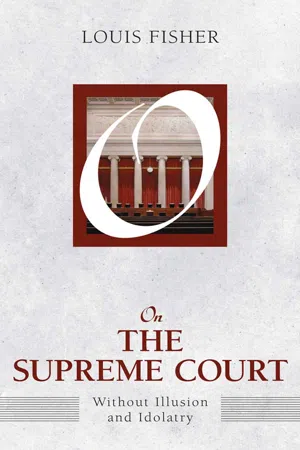
"On the Supreme Court" places the Supreme Court in a rich historical and political context, demonstrating how its interpretations of statutes and the Constitution are necessarily shared with the elected branches, the 50 states, and the general public. It explains why the Court exercises judicial review, not judicial supremacy. It demonstrates that, contrary to popular opinion, the Court does not supply the final or exclusive word on the Constitution. In an era of tectonic changes, "On the Supreme Court" offers a fresh perspective on this mainstay institution from a scholar with unique insights as a Constitutional specialist as well as a Congressional researcher.Key features of the text: "

CHAPTER ONE
EXERCISING JUDICIAL REVIEW
EXERCISING JUDICIAL REVIEW
On what authority does the federal judiciary exercise judicial review: declaring unconstitutional actions by Congress, the president, federal agencies, and the states? The Supreme Court often refers to the U.S. Constitution as one of “enumerated powers,” as though each power granted to the national government were expressly stated in the Constitution. In 1995, while striking down a congressional effort to regulate guns in schoolyards, the Court announced: “We start with first principles. The Constitution creates a Federal Government of enumerated powers.”1 Two years later, while invalidating a religious freedom statute, the Court again stated: “Under our Constitution, the Federal Government is one of enumerated powers.”2
Those statements are highly misleading and erroneous. If the U.S. Constitution were limited to enumerated or express powers, the Court would have no authority to exercise judicial review. Nowhere does the Constitution expressly grant the Court the power of judicial review. It is an implied power. The president and Congress have a number of implied powers as well, including the president’s power to remove department heads and the power of Congress to conduct investigations and hold individuals in contempt. Implied powers must be reasonably drawn from enumerated powers. Article II, Section 3, directs the president to “take Care that the Laws be faithfully executed.” If a department head were unwilling or unable to carry out a statutory duty, the president possesses an implied power to remove that person. Article I, Section 1, vests “all legislative Powers herein granted” in a Congress. On what grounds does the Supreme Court have the implied power of judicial review?
Declaring Independence from England
In the years leading up to America’s rupture with England in 1776, several famous legal challenges were leveled at the British Parliament. In 1761, James Otis in America argued that British customs officials lacked authority to use general search warrants. Even if the British Parliament had authorized what were called writs of assistance to conduct those searches against American colonists, he said the statute would be “against the Constitution,” against “natural equity,” and therefore void (see Box 1.1). Five years later, a Virginia court held invalid the Stamp Act, a British statute that attempted to tax every item in America made of paper, including court documents, college diplomas, liquor licenses, newspapers, and playing cards.3 Colonial resistance to the statute was so fierce that England decided to rescind it. On the eve of the Declaration of Independence, a Massachusetts judge instructed the jury to treat acts of Parliament that violated fundamental law as “void” and “inoperative.”4
The proposition that British courts could void an act of Parliament appeared in an opinion by Chief Justice Edward Coke in 1610. He concluded that when an act of Parliament “is against common right and reason, or repugnant, or impossible to be performed, the common law will controul it, and adjudge such Act to be void.”5 A few British judges in the seventeenth and eighteenth centuries relied on Coke’s decision, but the principle of judicial review never took root on English soil.6 Although Coke’s opinion provided inadequate support for judicial review, it was accepted as good law and precedent for those in America who wanted to break with England. To avoid the appearance of impetuous and impulsive behavior by American colonists, Coke’s opinion helped provide intellectual justification for opposing British rule.
Box 1.1
James Otis and Fundamental Law
This writ [of assistance] is against the fundamental principles of law. The privilege of the House. A man who is quiet, is as secure in his house, as a prince in his castle—notwithstanding all his debts and civil processes of any kind.…
For flagrant crimes and in cases of great public necessity, the privilege may be infringed on. For felonies an officer may break upon process and oath, that is, by a special warrant to search such a house, sworn to be suspected, and good grounds of suspicion appearing
As to Acts of Parliament. An act against the Constitution is void; an act against natural equity is void; and if an act of Parliament should be made, in the very words of this petition, it would be void. The executive Courts must pass such acts into disuse.
Source: 2 The Works of John Adams 521–22, 523–25 (Charles Francis Adams, ed.).
From independence to the drafting of the U.S. Constitution, some state judges in America challenged the statutes of their legislatures. Scholars disagree on the legitimacy of those rulings, but decisions offering support for judicial review were handed down by judges in Virginia, New Jersey, New York, Connecticut, Rhode Island, and North Carolina. It is recognized that the apparently powerful language used by judges in holding state laws invalid was often in excess of the results they achieved.7
By the time of the Philadelphia Convention in 1787, some of the delegates expected judicial review to be part of the new national government. Their statements were not always clear or consistent. There was general agreement that the Articles of Confederation during the War of Independence had to be replaced by giving stronger powers to a central government. Instead of the legislative supremacy that existed under the Articles of Confederation, Congress would be one of three coordinate branches. Both the Virginia Plan presented by Edmund Randolph and the New Jersey Plan submitted by William Paterson called for the creation of an independent judiciary headed by a Supreme Court.
The framers worried that thirteen sets of state courts would issue inconsistent rulings on matters of national concern. Several essays in the Federalist Papers, published in 1788 to promote ratification of the U.S. Constitution, called attention to this problem. In Federalist No. 80, Alexander Hamilton warned that thirteen independent courts of final jurisdiction at the state level “over the same causes, arising upon the same laws, is a hydra in government from which nothing but contradiction and confusion can proceed.” The convention responded to that issue by adopting the Supremacy Clause in Article VI of the Constitution: the Constitution and all national laws, including treaties, “shall be the supreme Law of the Land; and the Judges in every State shall be found thereby, any Thing in the Constitution or Laws of any State to the Contrary notwithstanding.” Judicial review over presidential and congressional actions, however, posed a subject of much greater delicacy. Giving federal courts the final say over actions by the elected branches was an extreme position.
Scholars have spent much time counting the number of framers who favored judicial review. Over the years, constitutional scholar Edward Corwin vacillated on the statistics, ranging from a high of seventeen framers to a low of five or six.8 In testifying before Congress in 1937, Corwin uttered this scholar’s lament: “These people who say the framers intended [judicial review] are talking nonsense; and the people who say they did not intend it are talking nonsense. There is evidence on both sides.”9 Many studies have been infused with a crusading spirit, designed either to prove the historical legitimacy of judicial review or to chop away at its foundations.10 The unsettled nature of judicial review—or at least its scope—adds some constraint to judicial activism.
Judicial review was discussed at the Philadelphia Convention as a means of checking Congress and the states. On May 29, Randolph proposed a Council of Revision consisting of “the Executive and a convenient number of the National Judiciary … with authority to examine every act of the National Legislature before it shall operate, & every act of a particular Legislature before a Negative [presidential veto] thereon shall be fatal; and that the dissent of the said Council shall amount to a rejection, unless the Act of the National Legislature be again passed.”11 The eventual elimination of this council is accepted by some as evidence that the framers rejected judicial review. However, a major argument against the council was the availability of judicial review. One of the framers, Elbridge Gerry, expressed “doubts whether the Judiciary ought to form a part of it, as they will have a sufficient check agst. encroachments on their own department by their exposition of the laws, which involve a power of deciding on their Constitutionality.” In some states, courts had set aside laws “as being agst. the Constitution. This was done too with general approbation.”12
The delegates debated a congressional veto over state legislation. This power was rejected for two reasons. The addition of the Supremacy Clause would presumably handle any conflicts between national law and state legislation. Moreover, state courts could exercise judicial review to control legislative errors. James Madison said that a law “violating a constitution established by the people themselves, would be considered by the Judges as null & void.”13 Those statements were clearly limited to judicial review at the state—not the national—level.
Ratification Debates
At the ratification conventions in 1788, several delegates defended judicial review. James Wilson, soon to be a member of the Supreme Court, told his colleagues at the Pennsylvania ratification convention that the legislature would be “kept within its prescribed bounds” by the judiciary.14 At the Connecticut ratifying convention, Oliver Ellsworth (destined to be the third chief justice of the Supreme Court) expected federal judges to void any legislative act that was contrary to the Constitution.15 At the Virginia ratifying convention, John Marshall anticipated that the federal judiciary would strike down unconstitutional legislative acts.16 Given the context of these remarks, it appears that the availability of judicial review was used to reassure the states that national power would be held in check.
The Federalist Papers include several essays that speak strongly for judicial review. The principal essay, Federalist No. 78, by Hamilton, was designed to allay state fears about national power. He argued that the judiciary was “the least dangerous” of the three branches because it lacked the president’s “sword” and Congress’s “purse.” The judiciary, in his words, “may truly ...
Table of contents
- Cover
- Half Title
- Title Page
- Copyright Page
- Dedication
- Table of Contents
- Preface
- Acknowledgments
- 1 Exercising Judicial Review
- 2 How the Court Decides
- 3 “Self-Inflicted Wounds”
- 4 Judicial Failings after World War II
- 5 Individual and Minority Rights
- Conclusion: A Broad and Continuing Dialogue
- Index of Cases
- Index of Subjects
- About the Author
Trusted by 375,005 students
Access to over 1.5 million titles for a fair monthly price.
Study more efficiently using our study tools.
Frequently asked questions
Yes, you can cancel anytime from the Subscription tab in your account settings on the Perlego website. Your subscription will stay active until the end of your current billing period. Learn how to cancel your subscription
No, books cannot be downloaded as external files, such as PDFs, for use outside of Perlego. However, you can download books within the Perlego app for offline reading on mobile or tablet. Learn how to download books offline
Perlego offers two plans: Essential and Complete
- Essential is ideal for learners and professionals who enjoy exploring a wide range of subjects. Access the Essential Library with 800,000+ trusted titles and best-sellers across business, personal growth, and the humanities. Includes unlimited reading time and Standard Read Aloud voice.
- Complete: Perfect for advanced learners and researchers needing full, unrestricted access. Unlock 1.5M+ books across hundreds of subjects, including academic and specialized titles. The Complete Plan also includes advanced features like Premium Read Aloud and Research Assistant.
We are an online textbook subscription service, where you can get access to an entire online library for less than the price of a single book per month. With over 1.5 million books across 990+ topics, we’ve got you covered! Learn about our mission
Look out for the read-aloud symbol on your next book to see if you can listen to it. The read-aloud tool reads text aloud for you, highlighting the text as it is being read. You can pause it, speed it up and slow it down. Learn more about Read Aloud
Yes! You can use the Perlego app on both iOS and Android devices to read anytime, anywhere — even offline. Perfect for commutes or when you’re on the go.
Please note we cannot support devices running on iOS 13 and Android 7 or earlier. Learn more about using the app
Please note we cannot support devices running on iOS 13 and Android 7 or earlier. Learn more about using the app
Yes, you can access On the Supreme Court by Louis Fisher in PDF and/or ePUB format, as well as other popular books in Law & Public Law. We have over 1.5 million books available in our catalogue for you to explore.