eBook - ePub
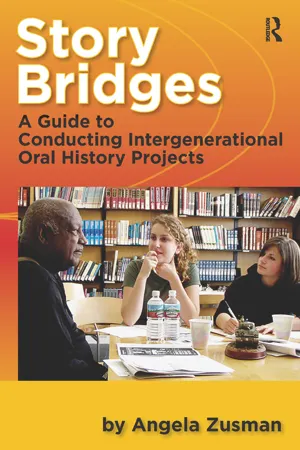
Story Bridges
A Guide for Conducting Intergenerational Oral History Projects
- 165 pages
- English
- ePUB (mobile friendly)
- Available on iOS & Android
eBook - ePub
About this book
Angela Zusman offers an informative guidebook with step-by-step directions for planning and implementing intergenerational oral history projects, using youth to interview elders. An expert on these programs, Zusman uses her experiences and those of other oral historians to show how community projects are organized, youthful historians located and trained, interviews conducted, and the project archived for future community needs. Included are a variety of sample documents and case studies designed to ease the process for the uninitiated.
Information

CHAPTER ONE
History and Benefits of Oral History
One lesson we can learn from pre-industrial peoples is the power of storytelling. I am struck by how important storytelling is among tribal peoples; it forms the basis of their educational systems. The Celtic peoples, for example, insisted that only the poets could be teachers. Why? I think it is because knowledge that is not passed through the heart is dangerous: it may lack wisdom; it may be a power trip; it may squelch life out of the learners. What if our educational systems were to insist that teachers be poets and storytellers and artists? What transformations would follow?
—Matthew Fox
Oral history is both a process and the product this process creates. The process takes verbally transmitted information, generally in the form of structured interviews, and converts it into a product that can be preserved and shared. The product that is preserved and shared, also called an oral history, can take many forms. The primary source created from an oral history project is the recording of the interview itself. This can be an audio or video recording, or both. Secondary sources or products represent the content from the recording and can include transcripts, edited films, websites, books and other documents and mediums.
As expressed in the previous chapter, there are many uses for oral histories. The completed oral history serves as a valuable historical document. By creating an oral history, you are creating a primary historical source—a snapshot of history that comes directly from the participant.
Oral history differs from other story-collecting ventures, such as journalism, because of its emphasis on preservation. Like a journalist, an oral historian may do research, conduct a structured interview, and create a report based on what was learned. While the journalist may be satisfied with the publication of their article, the oral historian goes one step further by preserving the actual recording as well as the product that comes from it. This distinction is important because it highlights the importance of archiving for the oral historian, a facet of oral history that is less familiar to those who may embark upon such a project.
All of this describes what oral history is. What is it not?
Oral history is not an attempt to define an objective “Truth”. Instead, oral history exposes the truth as expressed by each narrator. With oral history, truth is relative. Two people may have two opposite ideas of what is true. One might say, “He was a great man,” while the other deplores him. They may remember events, circumstances and even the weather very differently. In this way, oral history can be compared to quantum physics. As with particles, events are also affected by the act of observation. One cannot observe a quark without affecting it, so no two observations are the same and neither can be considered True. In the same way, no event can be experienced or recollected exactly the same way by two different people, and neither recollection can necessarily be deemed more true that the other. One narrator’s favorite event can be another’s worst nightmare; one man’s success can be another man’s failure. Opposing or contradicting recollections are often both true.
Still, fact checking is important. Many people mix up dates and even locations of important events. Some mistakes need to be corrected; still, the focus of oral history is the narrators’ memories more than any consolidated idea of Truth.
THE HISTORY OF ORAL HISTORY
“The story—from Rumplestiltskin to War and Peace— is one of the basic tools invented by the human mind, for the purpose of gaining understanding. There have been great societies that did not use the wheel, but there have been no societies that did not tell stories.”
—Ursula K. LeGuin
Oral histories have been collected since communication began. For many cultures, verbal transmission was and continues to be the most important method for passing down and therefore preserving ideas, rituals and histories. As early as 1100 BCE, emperors of the Zhou dynasty ordered scribes to record oral histories “for the benefit of court historians.”2 In the fifth century BCE, the Greek historian Herodotus collected first person accounts of the Persian Wars. The African tradition of griot and the Jewish tradition of zahor, which means active remembrance, emphasize not only the telling of stories but the importance of passing them down from generation to generation. Later, in the 19th and into the 20th centuries, historians became more interested in a scientific approach to history, one that focused on things as they “really” were. This methodology presupposed only one truth, however, and disregarded the many personal experiences revolving around a single event. By the middle of the 20th century, interest shifted from historical elites to the lives and experiences of “ordinary” people. Oral histories were conducted to uncover incidents from the battlefield to the workplace.
In addition to historians, activists used oral history to build foundations for their causes, such as the civil rights movement and labor activism. Communities invested in their own local histories and folklorists collected stories and songs. Today, thousands of books and articles teach the methods and share the fruits of oral histories. Several universities offer academic degrees in oral history and some, such as UC Berkeley, house their own oral history collections. The Library of Congress maintains an enormous and growing collection of oral histories, and new projects spring up every year in all corners of the world. Perhaps this is because oral history truly is history for and by the people.
In today’s age of sound bites and the relentless accumulation and distribution of minutiae, the oral history process—with its in-depth focus and appreciation for the whole story—is perhaps even more important. The technological advances that underpin this so-called “Information Age” are creating shifts in our society and culture that portend rapid, ongoing change in everything from how individuals spend their resources to how institutions deal with data and even how countries address the needs of their populations. Oral history allows us to embrace change without losing precious experiences, lessons, details and wisdom of the past.
INTERGENERATIONAL ORAL HISTORIES
An intergenerational oral history goes one step further than a traditional oral history by specifying exactly who participates. This form of oral history brings together people of different generations, generally youth and elders, for the purpose not only of collecting stories but also creating a bridge between generations. In addition to contributing to history, this story bridge opens up new worlds for both parties. As opposed to the passive learning that comes from reading history books and other secondary historical resources, oral history is very engaging and hands-on, making it an excellent learning and teaching medium for people of all ages. Moreover, oral histories provide glimpses into worlds most often neglected by traditional historians. Everyday lives, sentiments, and reactions to historical events bring the past to life in ways that textbooks or even great documentaries cannot. Many of these experiences have never been written about, so the only way to learn about them is to find a primary source.
Nothing compares to sitting with a person as they tell you about their own experience. While secondary sources such as films and history books are extremely valuable, no film or book can replicate the feeling in the air or the connection that is forged between the narrator and interviewer. These stories will be remembered far longer than those studied for the sake of passing a test. These stories inspire curiosity instead of sating the mind with facts that become irrelevant once the book is put down or the test completed. The telling of these stories also allows for contribution from people who have the most experience and the least opportunity to contribute. Preservation of this material is a gift to society that simply cannot be matched by the secondary sources created through traditional research.
Oral history includes the heart and the guts of the stories in addition to dates and other relevant data. Educator Mark Naison, who has developed oral history programs for students in New York, describes his experience:
Oral History Programs are one of the best antidotes to the sense of historical amnesia among the young people we work with. When we tell our students to interview parents, grandparents and neighbors about things that happened in the past, we not only stimulate a dialogue between children and adults that takes place all too rarely in today’s society, we honor community story telling traditions that are in danger of dying out. In our immigrant and working class neighborhoods, there are tens of thousands, if not millions of elderly people who were brought up among great story tellers but who have not had a chance to share their wisdom and experience before an appreciative audience. Having young people sit down and record their stories not only gives the people interviewed an enhanced sense of purpose, it unleashes a creative power that can be a force in its own right. It can give young people doing the interviews a new respect for people they took for granted, and give the entire school community exposure to stories that have the power to uplift, amuse, excite and inspire everyone who hears them.3
FAMILY HISTORY
One of the most common forms of intergenerational oral history is family history. Many families have at least one person who is the “family historian” and feels responsible for collecting and preserving family stories, photos, and other documents, information and memorabilia. The collection of family stories and artifacts often includes an intergenerational aspect, such as an aunt connecting with her parents, siblings, cousins, and nephews. This relatively simple format of getting family members to talk to and about each other can be effectively utilized within an oral history project. As with larger, community-based oral histories, family-based projects can amass valuable anecdotal information and historical documents. When properly collated, such materials can find their way into historical societies and other archiving venues.
The main difference between a family history and an intergenerational oral history is the method of preserving and creating access to the stories and collected items. Generally, family histories are shared only with family members. Even if a product such as a book or DVD is created, this is not considered an archival format unless it is made accessible to the public. Still, family histories are important and enriching for all participants and can be very useful for family members, oral historians, and historians alike. The family—the starting point for each of us—is also a potential starting point for an exceptional intergenerational oral history project.
THE INTERGENERATIONAL APPROACH
“Kids are so busy these days. I’m sure they wouldn’t have time for another activity!” “Young people don’t care about history. All they’re interested in is their iPods and video games.” “I wouldn’t even know where to find teens let alone know how to talk to them about the project.” “Kids aren’t as responsible as adults.” “Young people just don’t have the necessary skills for this kind of project.” “Adding teens to the mix will just make everything more complicated and costly.”
Do any of these quotes sound familiar? Perhaps one or two of them ran through your mind at some point. There is some truth to some of these statements. It will take time to find and train the right volunteers, regardless of their age, which may impact your budget and time line. Yet, consider the goals of your project. If they include building community or connecting people with their past, adding an intergenerational element will certainly help. This format can appeal to teachers and after-school activity leaders looking for more engaging adventures in learning. Museums and other community centers can utilize this kind of project to augment youth participation, now and in the future. The idea that young people are, well, just too young for this kind of thing is simply untrue. Even elementary school children can appreciate and support the gathering of stories.
Another misconception is that young people are not interested in history or even their own family stories. They may roll their eyes at hearing that story again, yet still value it. They may be very busy but still long for a really interesting project to sink their teeth into. They may be bored at school and need a more engaging activity. They may seem to live in a virtual world while still hungering to learn about this one. Implementing oral history into the classroom will almost certainly come as a welcome change from standard curriculum.
Table of contents
- Cover Page
- Half Title
- Title Page
- Copyright Page
- CONTENTS
- Dedication
- ACKNOWLEDGEMENTS
- INTRODUCTION THE VALUE OF STORIES
- CHAPTER ONE HISTORY & BENEFITS OF ORAL HISTORY
- CHAPTER TWO PROJECT OVERVIEW
- CHAPTER THREE PREPARATION
- CHAPTER FOUR BRING ON THE YOUTH
- CHAPTER FIVE INTERVIEWS
- CHAPTER SIX ARCHIVING
- CHAPTER SEVEN ASSIMILATION
- APPENDIXES
- ABOUT THE AUTHOR
Trusted by 375,005 students
Access to over 1.5 million titles for a fair monthly price.
Study more efficiently using our study tools.
Frequently asked questions
Yes, you can cancel anytime from the Subscription tab in your account settings on the Perlego website. Your subscription will stay active until the end of your current billing period. Learn how to cancel your subscription
No, books cannot be downloaded as external files, such as PDFs, for use outside of Perlego. However, you can download books within the Perlego app for offline reading on mobile or tablet. Learn how to download books offline
Perlego offers two plans: Essential and Complete
- Essential is ideal for learners and professionals who enjoy exploring a wide range of subjects. Access the Essential Library with 800,000+ trusted titles and best-sellers across business, personal growth, and the humanities. Includes unlimited reading time and Standard Read Aloud voice.
- Complete: Perfect for advanced learners and researchers needing full, unrestricted access. Unlock 1.5M+ books across hundreds of subjects, including academic and specialized titles. The Complete Plan also includes advanced features like Premium Read Aloud and Research Assistant.
We are an online textbook subscription service, where you can get access to an entire online library for less than the price of a single book per month. With over 1.5 million books across 990+ topics, we’ve got you covered! Learn about our mission
Look out for the read-aloud symbol on your next book to see if you can listen to it. The read-aloud tool reads text aloud for you, highlighting the text as it is being read. You can pause it, speed it up and slow it down. Learn more about Read Aloud
Yes! You can use the Perlego app on both iOS and Android devices to read anytime, anywhere — even offline. Perfect for commutes or when you’re on the go.
Please note we cannot support devices running on iOS 13 and Android 7 or earlier. Learn more about using the app
Please note we cannot support devices running on iOS 13 and Android 7 or earlier. Learn more about using the app
Yes, you can access Story Bridges by Angela Zusman in PDF and/or ePUB format, as well as other popular books in Education & Teaching History. We have over 1.5 million books available in our catalogue for you to explore.