eBook - ePub
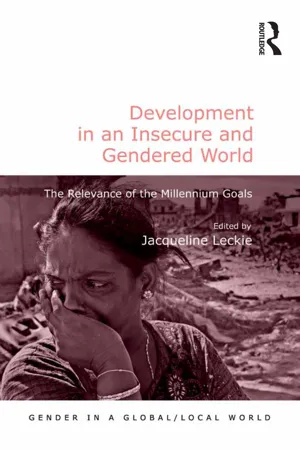
Development in an Insecure and Gendered World
The Relevance of the Millennium Goals
- 266 pages
- English
- ePUB (mobile friendly)
- Available on iOS & Android
eBook - ePub
Development in an Insecure and Gendered World
The Relevance of the Millennium Goals
About this book
The Millennium Declaration was adopted by the United Nations General Assembly in 2000 and explicit targets were set to eradicate key problems in human development by 2015. This collection focuses specifically on the goals relating to gender issues that are problematic for women. The most relevant and contentious is that of promoting gender equality and empowering women. The book provides an overview of this and investigates literature that considers how gender is central to achieving the other goals. The contributors distinctively consider gender in the context of human security (or insecurity); the reduction and elimination of conflict would seem to be central to achieving targets. One of the major themes of this collection is whether gender insecurity has been exacerbated in an increasingly insecure world. The book considers not only military and civilian conflict in the contemporary era but also security in the broader sense of human development, such as environmental, reproductive and economic security.
Information
Introduction
Chapter 1
Development, Gender and Security in a New Millennium
Jacqueline Leckie
Offering
Tied from the roof rafters
The child you rocked in the hammock
To save this precious child
You were thrown high on the roof top
You gave up your life
Your body the Tsunami carried
On its shoulders
As you saved the child you bore
On your shoulders
And you lost your life
To all women
Her life was an offering
To the tsunami
Her life was an offering
My verses all
To this mother an offering.
(Sreedevi 2005)
Sreedevi’s poem ‘Offering’ is both a dedication and a poignant opening to this publication. It evokes the sacrifice people make during catastrophic and unpredictable disasters to secure the survival of their loved ones and the sustainability of their communities. This poem was written by a grieving and traumatized young survivor from the ‘Boxing Day Tsunami’ of 26 December 2004 in South India. Sixteen months later, in the midst of a snowy winter in southern New Zealand, Jubliee Rajiah recited Sreedevi’s poem to delegates at the 40th University of Otago Foreign Policy School.1 This book emanates from this meeting that focused on Human Security and the Millennium Development Goals (MDGs). These once confident goals were contested especially when several speakers brought gender to the fore. Conventional concepts of security were also disrupted with attention to gendered violence, as well as a broader and more inclusive rendering of human development, considering, for example, food, environmental, economic and reproductive security. The Otago Foreign Policy School was a microcosm of divergent perspectives on the MDGs being voiced by 2005. These ranged from official governmental endorsement, outlined here in Phil Goff’s (New Zealand’s former Minister of Foreign Affairs and Trade)2 and María Angélica Arce Mora’s (then Mexico’s Ambassador to New Zealand) chapters, to the critiques and increasing disillusionment of the project by expressed by academics, non governmental workers and others. The later inclusion of other contributors is indicative of the mounting divergence over the rationale and feasibility of the MDGs. The result is this collection that considers development in an insecure and gendered world.
Speakers at the Otago Foreign Policy School also discussed if the MDGs would be attained by 2015. Already by 2005 serious critiques had emerged of not only the MDG blueprint of mainstream development but also whether the goals were ‘on track’. Four years later, writing this introduction during the 2009 global economic recession, earlier scepticism about the discourse, outcomes and possibilities of this global development plan is warranted. However as addressed in several chapters in Part III of this book (‘Localizing Development in an Insecure World’), the MDGs, or a global strategy to broad based development, still matter to many in the ‘lesser developed regions.’3
Sreedevi’s other poems, reproduced in Jenny Bryant–Tokalau’s concluding chapter, also question the politics and practices of well–meaning development aid and the role of Non Governmental Organizations (NGOs). Sreedevi was frustrated by international and national aid agencies to respond and manage disasters such as the 2004 tsunami. This critique extends to the paradoxes of international development and human security in an insecure world. Her village in southeast coastal India, along with millions of others throughout South and Southeast Asia, and communities in the Indian Ocean, were decimated when people elsewhere were recovering and cleaning up after the excesses of Christmas celebrations. If a traumatized young woman can discern such ironies of development why do think–tanks and higher level agencies often fail to do so?
Sreedevi’s poems speak to people’s pain, struggles and survival in a gendered world, a theme that runs through several of the contributions in this book. She also articulates another aim of this collection, to address empowerment and development in an insecure world. Her poems relate to not only the subjectivity of empowerment but also that of development and international relations. Christine Sylvester’s chapter alerts us to how subjectivity, expressed through poems, novels, or memoirs reveals the inconsistencies and ‘madness’ of development, or as Jane Parpart coined at the Otago School, development as ‘fantasyland’. A striking contradiction that emerges from these chapters is how to reconcile an imagined world that can be developed in a world where the realities of war and gendered violence are all too prevalent.
The interrogation of the ‘madness of development’ is critical to issues that weave through this book. We explicitly address the contradictions within mainstream solutions in development. Although the United Nations has, especially through the MDGs, focused on global programmes of development and security, as investigated in Part II of this collection (‘Beyond Bare Life to Reconsidering Empowerment’), these have continued to be denied by many postcolonial regimes. Sylvester (page 46) observes that, ‘for some, it is better to die from the very things the UN seeks to eradicate than die at the hands of one’s own “developmental” government.’ Parpart’s chapter goes on to explore how the literatures of (a) gender, empowerment and development and (b) war and conflict generally do not speak to each other. Such divides are investigated in several case studies in this volume, especially in Part III, ‘Localizing Development in an Insecure World.’ Ronni Alexander’s chapter especially traces the gaps between discourse and practice surrounding gender, empowerment, development and conflict in the Pacific. She alerts us to communities where gendered and environmental security has been threatened by US security within military bases in Okinawa and Guam. Alexander’s chapter speaks to the place of NGOs and social movements in a brutal, insecure and gendered world. The possibilities of these movements are explored in Helen Hintjens’ chapter on gender justice movements as a challenge to insecurity and the quantitative targets of the MDGs.
But first we need to consider the historical context and further critiques of the MDGs, as a contemporary global development paradigm. The contradictions of development in an insecure world dominated by neoliberal economics are then addressed in several of the book’s chapters. This introduction briefly considers violence and development in the ‘new wars’ including the exigencies of ‘bare life.’ We know that gender matters here but can this be reinstated through an emphasis on empowerment and gender mainstreaming? This takes us back to retracing concepts of security where we argue that a gendered perspective broadens conventional parameters to a more inclusive approach, including environmental security. Within both the general chapters and the case studies, gender issues remain crucial to a broader rights approach that does not loose sight of other collective inequalities.
MDGs in the dawn of a new millennium
Sreedevi’s poems were written in the aftermath of the new millennium that had heralded the MDGs. These emerged from the Millennium Declaration adopted by the United Nations General Assembly in 2000 that became the primary global development framework within the United Nations (UN) system.4 The MDGs identified specific targets that should be achieved to surmount and eradicate key problems in human development by 2015. Table 1.1 lists the ambitious aims of the MDGs while a more complete list, including the targets, are in Table 4.1 within A. Haroon Akram–Lodhi’s chapter.
Table 1.1 The Millennium Development Goals

The first seven goals targeted nations of the global ‘South’ while MDG 8 pinpointed issues of trade and aid that were inclusive of the ‘North’ as partners. This collection does not address all of the MDGs but several chapters focus on gender issues especially problematic for women. MDG 3 is most relevant and contentious, as it aims to promote gender equality and empower women. We argue that this should not be isolated from the other MDGs, as these affect women. Gender is central to the discourse and implementation of the MDGs in the context of human security (and insecurity).
When the MDGs were interrogated at the 2005 Otago Foreign Policy School, it was clear that criticism about these goals had set in. By 2005 UN Secretary General Kofi Annan was concerned at the lack of progress towards attaining the MDGs (Annan 2005; UN Millennium Project 2005). So too was his successor Ban Ki–moon who called for an ‘aggressive push’ towards attaining the anti–poverty targets world leaders had pledged to achieve by 2015.5 This was in response to the 2008 United Nations Millennium Development Goals Report that alerted the detrimental impact that high food and fuel prices and the global economic slowdown would have on progress towards the MDGs (United Nations 2008). As detailed in Terence Wood and Vijay Naidu’s chapter, the critiques embraced both the scope and bias of the original MDGs, as well as their monitoring and progress. The goals were ironically considered both too broad and too narrow in scope (e.g., Saith 2006). However Vandemoortele (2008) points out that there does not have to be an all encompassing global strategy for the MDGs because not all nations have been held responsible to the commitments that emanated from various UN conferences during the 1990s (Barton 2005a, 78).
Others have questioned the base line and monitoring of the goals or what Thomas Pogge in his 2005 address to the Otago Foreign Policy School referred to as ‘statistical gimmicks’. He critiqued the narrowness of the ambitious first MDG (see Pogge 2004) by challenging the official statistics that linked this worthy goal to halve extreme poverty by 2015. The World Bank placed US$1.08 per day in purchasing power parity terms as the most basic poverty line, lumping those below to be in ‘extreme poverty’. Pogge argued that this negated that the poorest spend around 80 per cent of their income on food – rendering any universal ‘consumption basket’ – as meaningless. He also presented statistical evidence to question the base lines from which poverty measurements are tabulated and compared. This manipulation has lead to a huge distortion of progress primarily because poverty levels have been set too low. Vandmoortele’s (2008) analysis also begins by locating MDGs from a base of 1990 from which targets are projected over a 25–year period. This contrasts the lack of implementation since 2000 against 1990–2000 achievements. However as Raghuram (2008, 242) cites, Vandmoortele ‘defends global target setting and suggests that though the target is entirely achievable, but rarely met, it is still the raison d’etre for the realization of several important targets.’ This is indicative of official optimism for the framework of the MDGs, as outlined in the chapters by Goff and Arce Mora.
This book addresses some of the most trenchant criticisms of the MDGs – development, security and gender (see also Henry 2007). A growing body of work by academics, practitioners and participants have demonstrated the shortcomings of development, including the MDGs, to address the viability of human security in a gendered world; referred to earlier as the ‘fantasyland’ of idealistic development. A human rights framework has been notably absent in the MDGs despite this being key to the Millennium Declaration. For Carol Barton (2005b), this contradiction is especially striking given the questions about the viability of combining human development goals and a neoliberal agenda (see also Gold 2005). In a recent review of the discourse on the MDGs, Shobha Raghuram (2008, 244) suggests a critique of the MDGs should not be about the ‘…targets but about the bigger silence on democracy, social justice and citizenship, which are vital for providing for the conditions of a social environment in which these goals may be set.’
Akram–Lodhi’s and Hintjens’ chapters echo Saith’s (2006) assessment of the MDGs as highly instrumentalist and limited in the context of the global economy. Akram–Lodhi strongly contests the ‘florid rhetoric’ of the MDGs that lack an intellectual foundation, calling for ‘a humane, democratic, alternative and socially–embedded development paradigm that highlights the agency–led systemic changes necessary to achieve human security’ (see page 76). Referencing Long and Long’s (1992) foundational work, Akram–Lodhi identifies the contradiction between agency and structure as lying at ‘the heart of the conundrum that is the MDGs.’ Likewise, Parpart’s chapter interrogates similar contradictions in gender mainstreaming and empowerment.
Ironically although this collection explicitly critiques the MDGs from a gender perspective, Akram–Lodhi (pages 81–82) reminds us that, ‘gender equality is neither a necessary or sufficient condition for the fulfilment of the MDGs; the fulfilment of the MDGs is quite consistent with increased gender inequality.’ Similarly, Wood and Naidu caution against rejecting the MDGs because of the shortcomings in addressing gender and development.
Despite their optimism, Wood and Naidu echo other concerns that earlier UN global commitments on gender were not reflected in the MDGs; specifically Goal 3 on gender equality and the empowerment of women. Eileen Kelly’s address to the 2005 Otago Foreign Policy School profiled this silence within the MDGs.6 The absence of goals towards achieving universal access to quality sexual and reproductive health by 2015 was a glaring omission in the health and poverty aims of the Goals (see also Antrobus 2003; Wood and Naidu, page 149). Instead Kelly argued, that components of the 1994 Cairo International Conference on Population and Development’s definition of reproductive health were distributed blandly among various other MDGs: particularly Goals 5 and 6 on maternal health and HIV/AIDS. Kelly argued that this circumvented global agendas concerning sexuality. This was considered necessary if nations with different religious, cultural or moral views on reproductive security and development were to accept the MDGs (for example, with programmes addressing women’s control over their fertility). Arce Mora touched on these impediments in her address to the 2005 Otago Foreign Policy School (and here in Chapter 11), noting that although by then Mexico had made considerable progress in meeting the MDGs, both child and maternal mortality remained serious problems.
By 2006, a new target to ‘Achieve, by 2015, universal access to reproductive health’ was added to MDG 5. Nevertheless the continued fundamental issue of achieving any consensus on global reproductive rights and development does not augur well for feminist visions of development. The chapters that address this issue in this volume do not adopt a universal feminist development model but lean towards a more nuanced approach to development and empowerment.
Violence and development: New wars and ‘bare life’
Another glaring weakness of the MDGs was the absence of measures towards reducing human conflict and war, essential t...
Table of contents
- Cover Page
- Title Page
- Copyright Page
- Contents
- List of Figures and Tables
- List of Abbreviations
- List of Contributors
- Series Editors’ Preface
- Acknowledgements
- PART I INTRODUCTION
- PART II BEYOND BARE LIFE TO RECONSIDERING EMPOWERMENT
- PART III LOCALIZING DEVELOPMENT IN AN INSECURE WORLD
- PART IV REFLECTIONS
- Index
Trusted by 375,005 students
Access to over 1.5 million titles for a fair monthly price.
Study more efficiently using our study tools.
Frequently asked questions
Yes, you can cancel anytime from the Subscription tab in your account settings on the Perlego website. Your subscription will stay active until the end of your current billing period. Learn how to cancel your subscription
No, books cannot be downloaded as external files, such as PDFs, for use outside of Perlego. However, you can download books within the Perlego app for offline reading on mobile or tablet. Learn how to download books offline
Perlego offers two plans: Essential and Complete
- Essential is ideal for learners and professionals who enjoy exploring a wide range of subjects. Access the Essential Library with 800,000+ trusted titles and best-sellers across business, personal growth, and the humanities. Includes unlimited reading time and Standard Read Aloud voice.
- Complete: Perfect for advanced learners and researchers needing full, unrestricted access. Unlock 1.5M+ books across hundreds of subjects, including academic and specialized titles. The Complete Plan also includes advanced features like Premium Read Aloud and Research Assistant.
We are an online textbook subscription service, where you can get access to an entire online library for less than the price of a single book per month. With over 1.5 million books across 990+ topics, we’ve got you covered! Learn about our mission
Look out for the read-aloud symbol on your next book to see if you can listen to it. The read-aloud tool reads text aloud for you, highlighting the text as it is being read. You can pause it, speed it up and slow it down. Learn more about Read Aloud
Yes! You can use the Perlego app on both iOS and Android devices to read anytime, anywhere — even offline. Perfect for commutes or when you’re on the go.
Please note we cannot support devices running on iOS 13 and Android 7 or earlier. Learn more about using the app
Please note we cannot support devices running on iOS 13 and Android 7 or earlier. Learn more about using the app
Yes, you can access Development in an Insecure and Gendered World by Jacqueline Leckie in PDF and/or ePUB format, as well as other popular books in Social Sciences & Politics. We have over 1.5 million books available in our catalogue for you to explore.