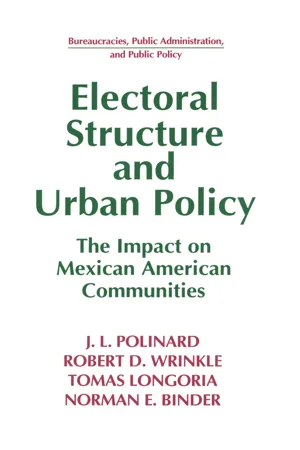
eBook - ePub
Electoral Structure and Urban Policy
Impact on Mexican American Communities
- 216 pages
- English
- ePUB (mobile friendly)
- Available on iOS & Android
eBook - ePub
Electoral Structure and Urban Policy
Impact on Mexican American Communities
About this book
This book examines how electoral structure, representation styles and policy outputs affect the Mexican American community in Texas. In so doing, it makes a major contribution to the larger study of minority politics in the context of urban electoral and political structures.
Information
1
Introduction
It could even develop into a minor revolution of sorts. Those people up there have traditionally had long fuses, but they do have fuses. . . . Still, most of those people are scared stiff of authority. . . . Yet they are also curious right now. . . . I'll tell you frankly, I don't want to misjudge [the] capacity for drawing those people together and causing trouble.. . . Maybe it doesn't seem so now, but that's potentially one hell of a volatile area up there.
John Nichols,
The Milagro Beanfield War
The Milagro Beanfield War
For the past twenty-five years, a "minor revolution of sorts" has occurred throughout the South and Southwest as local governments have altered their electoral structures in response to voting rights litigation or the threat thereof. Implicit in these activities is the belief in a link between electoral structure and the nature of representation. Our research joins the exploration of this relationship. Essentially, we ask whether it makes a difference to the minority population of a community if city council or school board members are elected at-large or by geographically defined districts.
American democracy ultimately is an experiment. Americans take the notion that the people have the right to govern themselves, and we tinker and fuss with the subtle and not-so-subtle complexities of how best to do so. We began as a people, two hundred years ago, with the rather radical idea that "all men are created equal," defining the reference to gender literally and redefining the inclusive "all" to "some" so as to exclude the nonwhite and the nonwealthy. Then, for two centuries, we engaged in an experiment of expanding the idea of self-government to embrace the diverse sectors of our polity.
We Americans assert that, in the political philosophy of our system, there is a certain nobility to this experiment. At the same time, there is also the pragmatism of the distribution of political power, for the issue of who represents whom has direct policy consequences. It is an interesting wedding of philosophy and practice, this tension between democracy (with its majoritarian impulse) and representation (which recognizes numerical strength as just one index of merit).
Initially, attempts to resolve that tension extended the franchise through constitutional amendments and court decisions. The 1960s brought the reapportionment revolution and the application of the one-person, one-vote rule to virtually all levels of American politics. In 1965 the passage of the Voting Rights Act (VRA) heralded an emphasis on voter registration and access to the polls for racial and ethnic minorities. The VRA was designed to ensure equity for minorities in terms of access to the political system.
Subsequent amendments to the VRA have shifted its focus to the structures of local electoral systems. The result has been a revolution with consequences potentially as profound as those produced by the implementation of the one-person, one-vote principle during the 1960s and 1970s. Throughout the South and Southwest, the VRA has been used to change local election systems from at-large to district or mixed structures. In the main, those changes have been initiated, and welcomed, by the minority populations, but in the 1990s voices have been heard suggesting that such changes have brought mixed blessings.1
One of the most enduring of all political axioms is that no one in power relinquishes it voluntarily. This axiom is validated when one examines the historical political relationship between Anglo and Latino communities in the United States. Whether one looks at the national, state, or local community, the same pattern emerges: Anglos historically control the political processes of the community, and any transition of power from the Anglo to the Latino community occurs as a result of aggressive efforts on the part of the Latino community, which are strongly resisted by the Anglo community.
Our inquiry in this work focuses on this transition of power. How does the Latino community organize, mobilize, develop, and execute strategies that result in increased political influence over, and in some cases control of, the political processes of the local community? In other words, we seek to understand the variables that lead to the assumption of power where powerlessness existed before.
Approaches to Minority Politics
Minority politics has long been a staple of political science research. Much of the early work focused on white European ethnics within the scope of national politics (Wolfinger 1965). Restrictive immigration policies and the growth of the existing minority populations have shifted that focus to persons of color in American society (Bass and DeVries 1976; Matthews and Prothro 1966). While much of the focus of minority politics has been on the black community, the emergence of the Latinos as a significant force in American society also has attracted scholarly attention (de la Garza 1984; Grebler, Moore, and Guzman 1970).
One approach to studying minority representation most often addresses the issue in terms of proportionality. That is, minorities are considered underrepresented or overrepresented on the basis of the proportion of offices they hold compared with their proportion of the population (see Cayer and Sigelman 1980; Dye and Renick 1981; Eisinger 1982; Engstrom and McDonald 1981, 1982; Groftnan 1982; Heilig and Mundt 1984; Jones 1976; Karnig 1976; Karnig and Welch 1980; Lineberry 1978; MacManus 1978; Robinson and Dye 1978; Robinson and England 1981).
The focus on proportionality leans heavily on what Pitkin calls "descriptive representation"—that is, representation defined in terms of the characteristics of the representatives—and "passive representation," in which the emphasis is on "being something rather than doing something" (Pitkin 1967,67). This contrasts with active representation, where the representative engages in activity on behalf of the represented. Much research on minority representation has concentrated on descriptive representation (Meier and England 1984; Robinson, England, and Meier 1985).
The literature on electoral systems and passive representation essentially confirms what Davidson and Korbel term the "conventional hypothesis" (1981, 92—93): that at-large election systems dilute minority representation (for summaries, see also Heilig and Mundt 1984; Meier and England 1984; Polinard, Wrinkle, and Longoria 1990, 1991). These examinations of how minority representation evolves traditionally use broad national studies based on samples of cities, generally those with over 50,000 in population (Bullock and MacManus 1990; Engstrom and McDonald 1986; Welch 1990).
The other major approach to studying minority politics has examined the effects of urban structure on the minority population. Much of this research uses case study designs and has developed a wealth of material that has enriched our knowledge concerning urban politics in general and minority politics in particular. One of the major findings from this research is that minority representation within the dominant governing coalition on city councils leads to policies favorable to minority groups (Browning, Marshall, and Tabb 1984).
Despite the contributions of these research efforts to our knowledge of minority representation, descriptive representation studies tell us little about representation as an activity. The link between passive and active representation with respect to minority communities has received little attention. (For exceptions, see Dye and Renick 1981; Eisinger 1982; Fraga, Meier, and England 1986; Heilig and Mundt 1984; and Meier and England 1984.) This is a significant area of inquiry and any complete understanding of the relationship between electoral structure and minority representation cannot ignore this link. We need to know not only if electoral structure facilitates or obstructs the election of minority candidates, but also if the election of minority candidates translates into active representation through policy benefits for the minority community.
This book blends the quantitative cross-sectional approach with the case study approach in order to develop more fully our understanding of the impact of the issues of structure, representation, and outcomes on a minority community. By the combination of these approaches, our analyses should be enhanced.
Election Structures in Urban Politics Research
There are two distinct literatures on the impact of urban institutional structures. Early studies of "reformism" structures, such as councilmanager government, at-large elections, and civil service, examined the changes that occurred at the end of the nineteenth century and during the early years of the twentieth century. Those changes were motivated by the desire of local "good government" civic groups to break up urban political machines, thereby limiting the power of emerging immigrant groups. Despite this intent, empirical research did not find significant fiscal policy differences between reformed and unreformed cities (see, e.g., Liebert 1974; Lineberry and Fowler 1967; Morgan and Pelissero 1980; Wolfinger and Field 1966).
Studies of contemporary urban institutional reform—primarily changing election structures from at-large to single-member districts—examine changes beginning in the early 1970s and continuing today. Such changes result from demands for equal representation by minority groups and are facilitated by the federal government through the VRA. Empirical research, in general, finds that there is greater representational equity under single-member district election systems (Davidson and Korbel 1981; Engstrom and McDonald 1981; MacManus 1978; Polinard, Wrinkle, and Longoria 1991). Others find that city size, not election structure, is related to representational equity (Taebel 1978). In a recent paper, Bullock and MacManus (1993, 295) consider several features of the "totality of circumstances" test and find that "blacks are more likely to be elected in cities that have larger councils and in which there was greater turnover in the most recent election." They also find (1993, 296) that blacks are disadvantaged by certain forms of at-large elections and that the impact of election structures has diminished over time (see also Welch 1990).
Most discussion of representational equity generally has been in terms of descriptive representation. Descriptive representation, while important, usually does not address the issue of what policy consequences for the minority community exist when representation is enhanced. Exceptions to this are studies that have linked district elections structures to more equitable minority employment patterns in cities (Mladenka 1989a) and less discriminatory education policy in schools (Meier and Stewart 1991). These studies are part of a new wave of research focused on institutional structure and policy impact. Findings from the literature that show that institutional structure and representation affect policy challenge research that argues that cities are constrained and have a limited ability to affect local policy and make a difference in the lives of city residents (Peterson 1981).
The finding that structure and representation matter suggests that election structure and minority representation should play a central role in the study of urban governance. However, this is not the case. Before the structure and representation literature can be fully integrated into urban research and theory, research on urban minority representation and policy first must be reconciled with Peterson's assertion that local governments are inherently limited in what they can do to satisfy local demands. One reason for the lack of theoretical stock placed in the issue of election structure is that many urban scholars reject the view of cities as "independent policy-producing units," where local government officials have a considerable amount of substantive policymaking discretion (see Peterson 1981). This view holds that cities lack resources and authority to affect their own well-being. As a consequence, urban politics research is dominated by the study of economic conditions and political economy (Vogel 1992), rather than by study of the impact of municipal structures and representation.
Several urban politics researchers challenge Peterson's model of urban policy making, arguing that cities do, in fact, have policy discretion (see the exchange between Stone and Sanders 1987; see also Browning, Marshall, and Tabb 1984; Peterson 1981; Stone 1989). The relevance of election structure and representation for urban politics research and theory is enhanced if it is linked with the models of urban governance outlined by Stone and by Browning, Marshall, and Tabb. We argue here that election structure and minority representation are directly linked to regime theory (Stone 1989) and incorporation theory (Browning, Marshall, and Tabb 1984).
Stone argues forcefully that urban regimes—informal relationships between the citizens, government, and the business sectors of society —are more important than formal institutions and structure. Urban regimes create and build a governing capacity that enables government to enhance its power and to address its problems more effectively (Stone 1989). Browning, Marshall, and Tabb emphasize political incorporation in which bargaining and coalition building are important determinants of local government policy making. Following Pitkin, researchers Browning, Marshall, and Tabb examine symbolic as well as substantive representation and conclude that unless an elected official is part of the governing coalition, representation can be only symbolic. We believe institutional structures play a larger role in those theories than either Stone or Browning et al. acknowledge.
There is conceptual overlap between Browning, Marshall, and Tabb's political incorporation concept, Stone's regime politics concept, and the role of election structures for minority representation. Browning, Marshall, and Tabb (1984) argue that political incorporation leads to substantive policy consequences. The level of political incorporation increases when minority council members are elected, when minority council members become part of the dominant governing coalition, and when a member of a minority group controls the mayoralty (1984, 272). In two of ten cities they examined, the election of minority council members occurred only after district election structures had been adopted (1984, 202). In five of the ten cities, district elections increased the number of minority council members (Browning, Marshall, and Tabb 1984, 202). Since they do not control for the form of elections because of a "lack of variance" (1984, 84), political incorporation may be spurious with the changes in election structure.
Stone (1989, 81) argues that Atlanta's governing regime went through a restructuring partly as a consequence of the election of Mayor Maynard Jackson in 1973, when there was "a stark reversal of the political past" of an elite-dominated city council. A new city charter, approved in 1973, changed the election structure from at-large to a mixed, or hybrid, system; mobilized Atlanta's neighborhood organizations; increased black political participation; and paved the way for Mayor Jackson's election (1989, 84). Like the congruence between structural change and political incorporation, in the case of Stone's regime framework the linkage between structural change and regime change is clear, but not considered.
Political Resources Model
In addition to the political incorporation model and the regime politics model, which rely primarily on case studies, the political resources model is used to examine urban politics and policy consequences for minority groups. The political resources model is closely linked to resource mobilization theory derived from sociology (see Button 1989; Gamson 1990; McCarthy and Zald 1973), and mobilization theory from political science (Morrison 1987). Button argues that resource mobilization theory offers the best opportunity to analyze such political-social movements as the civil rights movement. Morrison (1987, 3) defines mobilization as the collective activation and application of community or group resources toward the acquisition of social and political goods. Generally it is assumed that it is the level of resources available to minorities and other out-groups that allows the development of strategies and tactics to achieve goals (see Button 1989, 14).
Morrison (1987, 8) suggests that this process occurs through a series of sequential stages:
- a) the existence of values and goals requiring mobilization;
- b) action on the part of leaders, elites or institutions seeking to mobilize individuals and groups;
- c) the institutional and collective means of achieving this mobilization;
- d)the symbols and references by which values, goals and norms are communicated to, and understood as internalized by, the individuals involved in mobilization.
Researchers interested in the acquisition of power by minority groups find that this approach offers an opportunity to study the structural and policy implications of such a transfer of power.
The political resources model used in most aggregate research studies ...
Table of contents
- Cover
- Half Title
- Title
- Copyright
- Dedication
- Contents
- List of Tables and Figures
- Foreword
- Preface and Acknowledgments
- 1. Introduction
- 2. The Jurisprudence of Voting
- 3. Electoral Structure and Minority Representation: A General Description
- 4. Electoral Structure and City Council Member Attitudes
- 5. Electoral Structure and School Board Member Attitudes
- 6. Electoral Change and Policy Impacts in Cities
- 7. Electoral Change and Policy Impacts in Schools
- 8. Summary, Conclusions, and Policy Recommendations
- Appendix A: City/Town Council Members Questionnaire
- Appendix B: School Board Members Questionnaire
- References
- Index
- About the Authors
Trusted by 375,005 students
Access to over 1.5 million titles for a fair monthly price.
Study more efficiently using our study tools.
Frequently asked questions
Yes, you can cancel anytime from the Subscription tab in your account settings on the Perlego website. Your subscription will stay active until the end of your current billing period. Learn how to cancel your subscription
No, books cannot be downloaded as external files, such as PDFs, for use outside of Perlego. However, you can download books within the Perlego app for offline reading on mobile or tablet. Learn how to download books offline
Perlego offers two plans: Essential and Complete
- Essential is ideal for learners and professionals who enjoy exploring a wide range of subjects. Access the Essential Library with 800,000+ trusted titles and best-sellers across business, personal growth, and the humanities. Includes unlimited reading time and Standard Read Aloud voice.
- Complete: Perfect for advanced learners and researchers needing full, unrestricted access. Unlock 1.5M+ books across hundreds of subjects, including academic and specialized titles. The Complete Plan also includes advanced features like Premium Read Aloud and Research Assistant.
We are an online textbook subscription service, where you can get access to an entire online library for less than the price of a single book per month. With over 1.5 million books across 990+ topics, we’ve got you covered! Learn about our mission
Look out for the read-aloud symbol on your next book to see if you can listen to it. The read-aloud tool reads text aloud for you, highlighting the text as it is being read. You can pause it, speed it up and slow it down. Learn more about Read Aloud
Yes! You can use the Perlego app on both iOS and Android devices to read anytime, anywhere — even offline. Perfect for commutes or when you’re on the go.
Please note we cannot support devices running on iOS 13 and Android 7 or earlier. Learn more about using the app
Please note we cannot support devices running on iOS 13 and Android 7 or earlier. Learn more about using the app
Yes, you can access Electoral Structure and Urban Policy by J.L. Polinard,Robert D. Wrinkle,Tomas Longoria,Norman E. Binder in PDF and/or ePUB format, as well as other popular books in Politics & International Relations & American Government. We have over 1.5 million books available in our catalogue for you to explore.