- 192 pages
- English
- ePUB (mobile friendly)
- Available on iOS & Android
eBook - ePub
Explorations in Art, Theology and Imagination
About this book
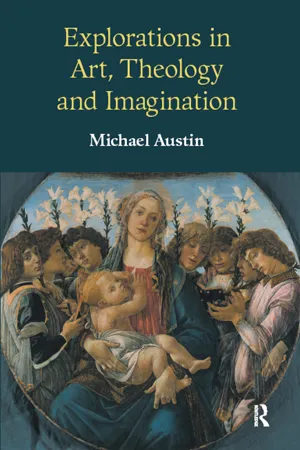
Christianity has repeatedly valued the "Word" over and above the non-verbal arts. Art has been seen through the interpretative lens of theology, rather than being valued for what it can bring to the discipline. 'Explorations in Art, Theology and Imagination' argues that art is crucially important to theology. The book explores the interconnecting themes of embodiment and incarnation, faith and imagination, and the similarities and differences between art and theology. Arguing for a critique that begins with art and moves to theology, 'Explorations in Art, Theology and Imagination' offers a radical re-evaluation of the role of art in Christian discourse.
Information
Chapter 1
Art for Whose Sake?
The Question of Art
We begin with some questions about art, though at the very outset we must heed Paul Cézanne’s caution that ‘all chatter about art is almost useless’. Some chatter is inevitable however, not least about what it is that we mean by the word ‘art’. We cannot hear Cézanne’s warning unless we first plunge into the question: What is art?
This is a question that would hardly have been asked until the eighteenth century. Only then did the notion of ‘the fine arts’ as the separate disciplines of painting, sculpture, music, poetry and architecture united by some kind of common aesthetic become distinct from craft skills on the one hand and the scientific disciplines on the other. The notion of ‘Art’ is therefore of recent invention. This will become important for our discussion later. That art, religion and science are discrete fields of human concern and endeavour having little or nothing in common with each other, and indeed opposed to each other, is therefore a comparatively modern idea, yet we can see its appeal fading rapidly. The use of the words ‘beauty’ and ‘beautiful’ is not confined to art and aesthetics. Questions of meaning and value are no longer regarded as the concern of religion alone. Science is no longer seen as providing the only valid account of the world. Postmodernism is marked by the dissolving of pretentious distinctions and arrogant claims. However, the question of what art is persists, and that is where we will begin.
A Question of Criteria
What has something got to be for it to be called a work of art? Has it got to be the imitation of something, or the expression of some thing’s ‘essence’ for it to be called art? Or is a work of art so defined in terms of factors internal to itself as an object such as symmetry or proportion or the balance of the elements that comprise it, that is its formal qualities? So diverting and difficult has this question become that some have given up the attempt to define art against any set of criteria external to an artist and an artwork. The painter Francis Bacon said once that ‘there is no such thing as art—only artists’. In Bacon’s view artists and no one else determine what it is that they do. It is not for the beholder to say ‘this is art—but that isn’t’.
That point of view has its attractions if only because defining art in an objective way is well-nigh impossible today. As we will see, not only do fashions in art change (and therefore the criteria against which art is judged) but a powerful tendency in contemporary philosophy would have us question whether there is such a thing as objective truth at all. If there is no such thing as objective truth then one opinion about a work of art, and indeed whether it is a work of art is as good as any other. As Rudolf Arnheim points out, ‘one can hardly blame the artist for proclaiming that art is anything he chooses to call art if the very people who are supposed to supply the standards by which to judge what is and what is not art assert that there are no such objective criteria’.1
This is a crucial matter, and not merely for art of course, and we will return to it again. But even assuming that objective criteria do exist by which we can judge what is art and what is not, trying to answer the question ‘What is art?’ would still be very difficult. If we wanted to attempt a definition the process might go somewhat along the lines of this interrogation set out by Richard Wollheim:
‘What is art?’ ‘Art is the sum or totality of works of art’. ‘What is a work of art?’ ‘A work of art is a poem, a painting, a piece of music, a sculpture, a novel…’. ‘What is a poem? a painting? a piece of music? a sculpture? a novel?’… ‘A poem is…, a painting is…, a piece of music is…, a novel is…’
It would be natural to assume that, if only we could fill in the gaps in the last line of this dialogue, we should have an answer to one of the most elusive of the traditional problems of human culture: the nature of art.2
But, as Wollheim points out, matters are nowhere as simple as that. If they were then works of art would be of merely secondary consideration. If there were a set of clear and universally accepted and therefore authoritative criteria which determined not only whether a painting or a sculpture or a novel was in fact a painting or a sculpture or a novel but also whether given examples of each were or were not art then all found objects or created artefacts which people thought might qualify as works or art would be assessed according to those externally imposed canons. And were this the case the criteria would be more important than art itself. Artworks accepted as such by those who determined or interpreted the criteria would then serve no other function than to demonstrate the supposed validity of the criteria. Some works of art would be allowed into the cathedrals of accepted dogma, the great galleries and prestigious exhibitions and collections, and everything else rejected as either poor art or not art.
A Question of Acceptability
And that of course is very much what has happened in the past and still happens now. Each period in art criticism determines the criteria of acceptability. As T.S. Eliot observed: ‘our criticism, from age to age, will reflect the things that the age demands’.3 The process of criticism is circular and self-contained. In each historical period, and in every centre of art, there is a prevailing art establishment with an inner group of distinguished cognoscenti who debate and eventually determine, if not what is and what is not art, then certainly who are and who are not the exemplars of what is acceptable in current art. Writing, in 1965, of the Paris art market John Berger noted that ‘it has become an accepted idea amongst nearly all French intellectuals…that art is the natural blessing of France… In France it is believed that there are no questions about art which have not already been fully answered there/4 So, at one time abstract art prevails and representational art is out of favour. At another so-called ‘realism’ is in the ascendancy while what might be regarded as more imaginative or expressive art is given little attention.
In fact critics and historians of art are much more knowledgeable and sophisticated than to be influenced by mere fashion, even the fashion they themselves create. They, and we, now recognise as great artists men who, like Vincent van Gogh and Paul Cézanne, sold few pictures in their lifetime and who were castigated by most of the influential critics of their day. That underlines a point that I wish to make. Except in the short term the criticism of art follows art, it does not lead it or determine it. In 1911 Wassily Kandinsky said that ‘in real art theory does not precede practice, but follows her’.5 Indeed the very nature of art criticism suggests that there can never be one authoritative and ‘correct’ interpretation and evaluation of any work of art because there can never be a universally accepted set of criteria to which to appeal.6 Thus, as Anne Sheppard points out, the so-called ‘laws’ of single viewpoint linear perspective are not laws at all but conventions which any painter is free to ignore, as Manet and the Impressionists did. So it is too with the established ‘rules’ of musical composition, or the Renaissance requirement that the time covered by the action of a play should be the time taken by the performance—a condition ignored by Shakespeare. There are no canons, codes and criteria in art. Artists, certainly great artists, lead. Theories, canons and criteria follow.
A Question of Authority
Now, to mention here briefly and in passing an important theme for development later, this points to an important distinction between art and religion, certainly between art and the Christian religion. If, as I will argue, religion is at least a kind of art, then the argument seems to fall on this ground alone for Christianity does possess criteria universally accepted by the Church. The three-fold test of catholicity by which truth and falsehood is determined is ‘what has been believed everywhere, always, and by all’.7 These criteria determine credal orthodoxy. Any theological claim or proposition which fails the test of credal orthodoxy is not by definition Christian doctrine. What is and what is not Christian truth is thus capable, so it might be assumed, of being determined by recourse to the defining authority of the universal Church. Yet clearly this is not the case in practice, else why is the Church divided not merely on matters of order but over fundamental questions of faith? And even if the Church was not divided, and all Christians submitted to its authority, what of those outside the Church? Quite properly they would ask (as they do ask) upon what independently verifiable grounds these truth-claims and this authority rests. For them it is not enough to lay claim to special revelation, because that claim is itself formed by, and lies within, the structure of the faith. The fact is that all orthodoxies, be they in art or in religion or even in science, are closed sets of criteria that allow for no development and adaptation beyond the limits they themselves have established, until, that is, they change in the face of overwhelming evidence. As Richard J. Evans has said of history and historians, ‘arguments and theories, however dominant in the intellectual life of their day, have to be assessed on their own merits, not accepted uncritically simply because they are espoused by a majority’.8
Of course, as with thoughtful seekers after truth outside the Church who cannot accept the Church’s truth-claims, those of us moved by art can choose to dissent from the critics. We can trust our own judgment and declare that the kings of the art world have no clothes. Or, much more likely, as with those who while not belonging to the Christian community have an uneasy suspicion that those who do may be right, we can look at a calf cut in half and pickled in formaldehyde and, struggling with our own sense of inadequacy and lack of knowledge, try to work out why the experts consider the poor animal a work of art.
A Question of Common Sense?
There is no easy way out of the dilemmas this discussion raises. A seemingly common sense approach to a work of art, particularly, say, a so-called ‘modern’ painting or sculpture or piece of music that we say that we do not ‘understand’, might be to ask some obvious questions about it: ‘What is it?’, or ‘Has it got a purpose?’, or ‘What does it mean?’, or ‘How can I judge whether it is good art or not?’, or ‘Am I supposed to feel anything?’ Even the critics have asked those questions when faced with art outside their frames of reference, or at least have been driven to some outspoken and commonplace reactions. When Whistler’s painting Nocturne in Black and Gold: The Falling Rocket was exhibited in 1877 the world’s foremost art critic John Ruskin famously wrote that ‘I have seen and heard much of Cockney impudence before now, but never expected to hear a coxcomb ask two hundred guineas for flinging a pot of paint in the public’s face’—a comment that led to a notorious libel action at the end of which Whistler won a ruinous one farthing’s damages. And even great artists can be wrong about art. A few years later Leo Tolstoy in his What is Art? launched a bitter attack on what we now know to be the greatest masterpieces of Impressionist and Symbolist art. He admitted that he did not understand these paintings but went on to argue that as, by his definition, good art is art understood by the masses, and this was not, then Impressionist and Symbolist art was therefore bad art. But, he said,
people may habituate themselves to anything, even to the very worst things. As people may habituate themselves to bad food, to spirits, tobacco, and opium, just in the same way they habituate themselves to bad art—and that is exactly what is being done.9
Thus did Tolstoy dismiss the contemporary painters Manet, Monet, Renoir, Sisley, Redon, Pissarro and Puvis de Chavannes—just as, a page or two later, he was to castigate the ‘composers of the new school’ who employ ‘strange loud sounds’ produced by ‘perspiring and agitated’ performers who ‘just throw hands and fingers wildly at the keyboard in the hope that you fall into the trap and praise [them]’. Tolstoy named these decadent composers. They were ‘Liszt, Wagner, Berlioz, Brahms, and (newest of all) Richard Strauss’!10 To be fair to Tolstoy, in applying his criteria of aesthetic value (that is, that good art is that which is understood by the masses) he rejected, along with Beethoven’s Ninth Symphony, most of his own literary output!
We will return to Tolstoy’s judgment in Chapter 5.
Questions the Artist Asks
The history of art criticism produces ample evidence that asking the so-called common sense questions about an artist or a work of art rarely if ever produces an answer that can stand a second hearing. The reason, certainly so far as great art is concerned, is that it is not merely for us, the viewer or listener, to ask questions of art. The artist, whether consciously or not, asks questions of us. The artist can and does often confront us with truths to which we would prefer to be blind and compels us to pay attention to them. Seen in this way art is for our sake. It has a moral dimension. Art can widen our perceptions of ourselves and of others and of our responsibilities and duties. If we respect art the possibility is ...
Table of contents
- Cover Page
- Half Title Page
- Title Page
- Copyright Page
- Dedication
- Table of Contents
- Preface
- Introduction ‘Art Hidden in the Depths of the Soul’
- Part I
- Part II
- Bibliography
- Index
Trusted by 375,005 students
Access to over 1.5 million titles for a fair monthly price.
Study more efficiently using our study tools.
Frequently asked questions
Yes, you can cancel anytime from the Subscription tab in your account settings on the Perlego website. Your subscription will stay active until the end of your current billing period. Learn how to cancel your subscription
No, books cannot be downloaded as external files, such as PDFs, for use outside of Perlego. However, you can download books within the Perlego app for offline reading on mobile or tablet. Learn how to download books offline
Perlego offers two plans: Essential and Complete
- Essential is ideal for learners and professionals who enjoy exploring a wide range of subjects. Access the Essential Library with 800,000+ trusted titles and best-sellers across business, personal growth, and the humanities. Includes unlimited reading time and Standard Read Aloud voice.
- Complete: Perfect for advanced learners and researchers needing full, unrestricted access. Unlock 1.5M+ books across hundreds of subjects, including academic and specialized titles. The Complete Plan also includes advanced features like Premium Read Aloud and Research Assistant.
We are an online textbook subscription service, where you can get access to an entire online library for less than the price of a single book per month. With over 1.5 million books across 990+ topics, we’ve got you covered! Learn about our mission
Look out for the read-aloud symbol on your next book to see if you can listen to it. The read-aloud tool reads text aloud for you, highlighting the text as it is being read. You can pause it, speed it up and slow it down. Learn more about Read Aloud
Yes! You can use the Perlego app on both iOS and Android devices to read anytime, anywhere — even offline. Perfect for commutes or when you’re on the go.
Please note we cannot support devices running on iOS 13 and Android 7 or earlier. Learn more about using the app
Please note we cannot support devices running on iOS 13 and Android 7 or earlier. Learn more about using the app
Yes, you can access Explorations in Art, Theology and Imagination by Michael Ridgwell Austin in PDF and/or ePUB format, as well as other popular books in Theology & Religion & Religious Art. We have over 1.5 million books available in our catalogue for you to explore.