- 304 pages
- English
- ePUB (mobile friendly)
- Available on iOS & Android
eBook - ePub
About this book
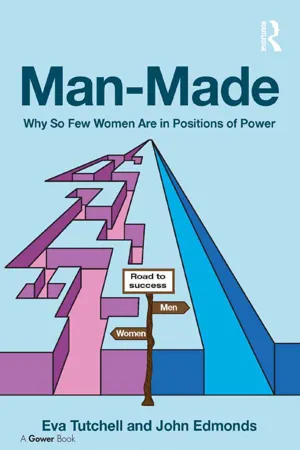
Why are so few women in positions of power? Why are government, business, the institutions and so much of British life dominated by men? Eva Tutchell and John Edmonds find the answers by interviewing over a hundred successful women and discovering what it takes for a woman to get to the top. The statistics are startling. Britain is an 80/20 nation: 80 per cent of the most powerful jobs are occupied by men and only 20 per cent by women. Tutchell and Edmonds uncover the cultural and historical reasons for this extraordinary imbalance of power. Their book is entitled Man-Made because men have made the rules and women must do their best to fit in. In spite of its claim to be a modern nation, Britain is conditioned by a legacy that views men as doers and leaders and expects women to be helpers and supporters. Many men still judge women more by their appearance than by their ability. Most shocking of all, Man-Made reveals that the birth of children pushes the careers of most women into crisis. Mothers are paid less and promoted less. Ambitious women are tempted to make their children 'invisible' to employers. Man-Made provides a rigorous and convincing analysis of the inadequacy of current policy and proposes a more thoroughgoing programme to achieve fairness and equality. Tutchell and Edmonds speculate about whether a new generation of female activists can produce the political pressure to change the culture of Britain.
Chapter 1
The Illusion of Continuous Improvement
This book has its origins in the General Election of 2010. Not in the result but in the nature of the campaign: it was so unmistakably and disconcertingly male. Where were Harriet Harman and Theresa May and Yvette Cooper and Shirley Williams? No doubt they were all out campaigning but they never got into the limelight. All we saw on television were three male Party leaders and a few male acolytes. We bear no ill-will towards Sarah Brown but it cannot be right for the wife of the Prime Minister to be the only female face that appears regularly on our TV screens in the three weeks of a General Election campaign.
A Game for Men
After polling day the impression that national politics is a game played only by men became even stronger. David Cameron and Nick Clegg selected the Coalition Cabinet. It contained 19 men and only four women. Five other Ministers were also entitled to attend Cabinet meetings. They were all men. So the four women around the Cabinet table were outnumbered by six to one.
On the other side of the House of Commons, Gordon Brown resigned and the Labour Party organised an election to replace him as Party Leader. Harriet Harman decided not to stand. Yvette Cooper made the same decision and, in a bizarre twist, allowed her husband to make that announcement on her behalf. Eventually five candidates emerged: four men and only one woman. And the woman candidate, Diane Abbott, only got onto the ballot form after some backroom manoeuvring. When it became clear that she would not secure enough nominations from Labour MPs to reach the minimum constitutional requirement, two of the male candidates asked their supporters to switch their nominations to Abbott. It was only by this device that the Labour Party managed to avoid the embarrassment of an all-male leadership contest.
Thoroughly discouraged by this saga of male supremacy and condescension, we decided to write this book. We started by looking beyond national politics to see exactly what was happening in the rest of society. We knew that the management of private companies was dominated by men but the overwhelming extent of that domination was a shock. We looked at the professions and the professional institutions and found a similar pattern: some exceptional women have broken through but almost all the positions of power are held by men. Local government was not much different. Nowadays there are twice as many male Councillors as women, but, even more significantly, the person who holds the power as the Council Leader is nearly always a man. We hoped to find a different story in education but again we were disappointed. With the exception of Primary schools, men hold a large majority of the powerful positions. Charities and the Arts provided other unpleasant surprises. Women sit on the Committees and Boards but men occupy almost all the real positions of power.
Misconceptions
So what had happened to the comfortable assumption that the ‘glass ceiling’ has been shattered and gender equality is within touching distance? It turns out to be an illusion. And the difference between public perception and reality is much greater than we expected. It should not have been such a surprise. Neither of us is inexperienced in matters of gender and neither of us would normally be described as naïve. The female author of this book spent many years advising public authorities on equality issues and has first-hand experience of the determination that men show when defending their privileges. The male author led a large trade union for nearly 20 years and has seen at close quarters how badly some women are treated at work. Yet, in spite of scepticism born of hard experience, both of us believed that things were better than they proved to be. Like most of Britain, we accepted the optimistic view. And, like most of Britain, we were wrong.
There is a second misconception that reinforces this optimism. Even people who appreciate that there is a large imbalance of power between the sexes tend to believe that we are set on a path that will lead eventually and inexorably to gender equality. It is certainly true that some big battles have been won. Since the middle of the nineteenth century women have gained most of the rights that men previously kept for themselves. Women have won the right to own property, the right to vote and the right to sit in Parliament, equal access to education, the equal right to divorce, the right to control their fertility, the legal right to equal pay and the legal right to be treated equally at work. So perhaps it is understandable that people look back over the last century and see what seems like steady progress. The optimists are also comforted by the knowledge that the discourse about women’s rights has changed. Apart from a few eccentric individuals like that crusty MEP, Godfrey Bloom,1 the refusniks have all but disappeared from public life. Nowadays just about everyone says that of course women should have equal rights and of course women should have equal opportunities. What could be more reasonable than to assume that, although we are not quite there yet, it is only a matter of time before Britain achieves gender equality? We have a national consensus: just wait a little longer and all will be well.
Periods of Reform
Regrettably this warm and seductive prospect is based on a misreading of history. The progress towards gender equality only looks smooth and continuous if we wear rose-tinted glasses and take a cursory glance over our collective shoulder. What might look like a century and more of steady progress is more accurately described as two periods of considerable change followed by long periods of what the optimists will call consolidation but others might call stagnation. In the 1920s the vote was won and a degree of political equality was achieved. In the 1960s and 1970s new rights at work were secured and new standards were set for the way men were expected to describe and treat women. Outside these periods of exciting reform there have been very few important improvements. So has the last century been a period of continuous and inexorable progress? Unfortunately not.
The further disappointment is that the two periods of exciting reform did not, unfortunately, deliver as much as the campaigners expected. The most famous advance for women was of course the winning of the right to vote and the right to sit in Parliament. There were hopes that these stupendous reforms would transform politics but, in the event, change came very slowly. In 1919 Nancy Astor was the first woman to take her seat in Parliament. Twenty years later there were still only seven women MPs. These seven included such formidable women as Ellen Wilkinson and Irene Ward but the House of Commons looked much the same as it did in 1919. Even now, nearly a century after Nancy Astor’s election victory, male MPs outnumber women by more than three to one.
The second period of change was prompted by the campaigns of the Women’s Liberation Movement in the 1960s and 1970s. Two landmark Acts of Parliament were passed: to guarantee equal pay and to outlaw many forms of discrimination, especially at work. This legislation, and the debate that the proposals provoked, did enormous good in changing the discourse about women’s rights and the place of women in society. However the two Acts of Parliament specifically promised to put an end to some of the worst examples of inequality and that has been the greatest disappointment. As we explain in Chapter 2, neither law has been properly enforced and the result has been a very unfortunate discrepancy between what the laws appeared to guarantee and what has actually been delivered. Notwithstanding the Equal Pay Act, there is still a substantial gap between the pay of men and women in Britain. In spite of the Sex Discrimination Act, discrimination on grounds of gender remains a problem in many workplaces.
The Women’s Liberation Movement in the 1960s and 1970s had the wider objective of trying to change the way that women are treated, described and portrayed. Much good was done. Pictures of naked and semi-naked women are no longer displayed in most workplaces and sexual harassment is much less common than it was 30 years ago. But, as we explain in Chapter 5, that particular revolution stalled well before the desired changes were fully embedded in the public consciousness. Here too we are left with an unhappy mixture of good intentions and inadequate delivery. The law declares that rape is a very serious offence carrying heavy penalties but accusations of rape rarely get to court. Allegations of sexual harassment often lead to a demeaning examination of the victim’s dress, behaviour and background. Pictures of scantily-clad women still appear in Britain’s biggest-selling newspaper and the front covers of so-called ‘lads mags’ display photos of nude women in thousands of shops. Even more serious, easy access to hard-core internet porn is beginning to cause deep concern about the way in which boys regard women and the way in which girls regard themselves.
On examination the belief in some inexorable progress towards gender equality turns out to be a myth. Reforms have not come steadily. They have come in fits and starts and, significantly, progress has only been made when the campaign for reform has been backed by a powerful movement: the suffragettes in the early part of the twentieth century and the Women’s Liberation Movement in the 1960s and 1970s. When those campaigns lost their vigour the momentum for reform dissipated. The gains that had been made were not followed by new improvements. Indeed, without the momentum provided by these two powerful campaigns, even the gains that had been secured had less effect than had been hoped and expected. And during those long periods in the last hundred years when there has been no powerful movement campaigning for women’s rights, women have suffered significant reverses. The lesson of history is not that progress towards gender equality is steady and inexorable. The real lesson is that, without a powerful movement maintaining the pressure, improvements come very slowly, tend to be fragile and the position of women is liable to be eroded.
Reverses and Delays
Some of the reverses have been very damaging. New employment opportunities opened up for women during the two World Wars. Particularly during the Second World War, many male jobs were taken over by women. Women learned new skills, earned more money and began to have a clearer vision of independence. But after 1918 and particularly after 1945 all that changed. The men returned from the war and the women were displaced, often without much warning or notice. Indeed it is remarkable how quickly the old order was re-established and how little of a legacy remained after those brief periods of emancipation. In peace-time after 1945 women quickly went back to being housewives and little public recognition was given to the fact that many women wanted more in their lives than an obligation to look after husband, children and home.
A glance at the advertisements of the period shows the extent to which women were identified with the role of housewife. Women radiating contentment were seen at home cooking, cleaning and attending to their family’s needs. Bessie Braddock, the most famous woman in the House of Commons at that time, was known as the MP who spoke up for British housewives. In the same era there were precious few politicians who spoke up for what were then called ‘career women’. And woe betide a woman with children at school who wanted to work full time. The term ‘latch key kids’ was coined by the press to describe the off-spring of such a neglectful mother. Another quarter of a century passed before it became more or less respectable for a woman with children to have anything that looked like a career.
Anyone who believes in the illusion of steady progress should also give some thought to the timescale of improvement. The optimists in Britain will need to be patient. At our current rate of progress it will take until 2070 for gender equality to be reached on the Boards of Britain’s 350 largest companies. And they are the leading group of companies; elsewhere things are moving even more slowly. In politics, the best estimate is that the House of Commons will not contain equal numbers of women and men until about 2080. These are depressing predictions. Unless we find the energy to generate another of those rare periods of rapid reform, we had better prepare our great granddaughters for disappointment: the next three generations of British women will face the dispiriting prospect of continuing inequality.
Women are sometimes startled by the slow pace of change that even apparently enlightened men are prepared to contemplate. Elin Hurvenes, who runs companies in Norway and Britain, had always been against positive discrimination on the grounds that special treatment would be demeaning to women. So she was against the proposal to require Norway’s biggest companies to apply a quota to Board membership to ensure that at least 40 per cent of Board members are women. But the shock of listening to one of Norway’s top entrepreneurs, a self-made billionaire whom she had previously admired, changed her mind. “We should let nature take its course,” he said. “In a hundred years there will be as many women as men on company boards.” Elin Hurvenes was not impressed. “That would be too late for me, my daughter and for any possible granddaughters.”
In the event the more conservative forces were defeated and Norway decided to increase equality by introducing quotas for company Board membership. Other countries have used different policy instruments but most of the so-called advanced western countries and a good number of others have displayed greater urgency than Britain. As a result the UK has dropped down the rankings in the Global Gender Gap2 Report compiled by the World Economic Forum (WEF). The Report measures the position of women in the economy and in respect of education, health and politics. The WEF’s first league table was published in 2006 and at that time the UK was ranked ninth. In 2014 the UK was ranked 26th – behind a host of European countries and also behind the US, South Africa, Nicaragua, Rwanda, Burundi and the Philippines. The unpleasant conclusion is that British women are being left behind.
Men in Britain seem to be content with the slow rate of change. After all, any move towards greater gender equality will have to challenge cultural norms that have existed for hundreds of years and which are very comfortable for men. In Chapter 3 we show how the structure of many institutions and organisations in Britain were formed in the nineteenth century and reflect the way in which women were seen at that time. Men went out into the world and wielded the power while women stayed at home and provided the domestic support. Nowadays these notions seem very old-fashioned but it is surprising how persistent they remain as they flow down through the generations: grandparents teach parents and parents teach us. Our language reveals the strength of this legacy. People who chair meetings are still called Chairmen even if they happen to be women. In many selection meetings someone is likely to talk about, ‘getting the right man for the job’ even if some of the candidates are female.
This legacy from the distant past affects the way so many things are handled, both important and trivial. Recently the man largely responsible for appointing a new Director General of the BBC could not help using phrases that revealed to the world that, even before the appointment process had started, he expected the successful candidate to be a man. At about the same time a famous television presenter was cross about a technical hitch and told the viewers that the search was on for ‘a man with a screwdriver’. One of the authors has suffered a frustrating half-hour trying to teach a male trade union official to break the in-grained habit of referring to all his colleagues as ‘he’ when some of those colleagues were self-evidently female.
If a man who makes such a revealing mistake is challenged, he will usually wave the criticism aside. The remark is only, ‘a slip of the tongue’ or ‘just a figure of speech’. But of course it is nothing of the kind. Stereotypes have a strong hold on our expectations. Doctors are male and nurses are female. That is what history and experience has taught us. And any development that seems to challenge these comfortable assumptions is disconcerting and rather unwelcome. It is not surprising that men, who benefit so obviously from the legacy of centuries of male dominance, are not rushing to make early changes in the way society is organised.
A Focus on Power
The key question that we encountered as we researched gender equality concerned power and its distribution. While some women in Britain have become famous and many more had achieved positions of influence, very few women have managed to reach positions of real power. So we decided that this book should focus on the great imbalance of power that we found in all parts of our society. In the following chapters we seek an answer to the important and straightforward question: Why are so few women in positions of power in Britain?
It is ridiculously easy to identify the obstacles that face women who want to make a successful career. We wanted to go much further. We wanted to learn the secrets of success and the reasons for failure. Does the problem lie with the system or does the explanation lie in the women themselves? Some writers have suggested that women lack the necessary ambition or determination. Is there any truth in that allegation?
We could have examined the statistics and reviewed the existing research and left it at that. Instead we decided on an approach which we thought would produce more insights and a clearer picture. The best people to tell us what it takes to get to the top in modern Britain are those women who have made that journey. Successful women could not only tell us about any obstacles in the path of ambitious women but could also suggest how those obstacles might be bypassed or overcome.
Interviews
We set about the task of interviewing more than 100 successful women. We were given excellent access. Very few of the women we approached refused to be interviewed. We are very grateful for their willingness to help, for their trust and for their frankness. To provide a little balance and a wider perspective, we also interviewed some women who are not yet at the top and a few men.
After a time, a pattern began to emerge. Our first and enduring conclusion is that these successful women are exceptional people. We noticed an absence of any female equivalent of the time-serving, worthy and rather uninspiring man who will often occupy a senior position in many organisations. In current circumstances women have to be extremely able to get to the top in Britain. In Chapter 9 we try to unravel the secrets of their success.
Most of the women accepted as a fact of life that they would have had an easier, and in some cases an even more successful, career if they had been born a man. But there was a notable absence of rancour. They accepted life as they found it without much complaint. When they mentioned any apparent unfairness – which happened less often than we...
Table of contents
- Cover Page
- Title Page
- Copyright Page
- Contents
- The Interviewees
- Preface
- 1 The Illusion of Continuous Improvement
- 2 Outnumbered
- 3 Fashioned by Men
- 4 Fitting In
- 5 Sexism and Discrimination
- 6 How Women are Seen
- 7 How Women are Expected to Behave
- 8 The Maternal Wall
- 9 Secrets of Success
- 10 Slow and Unsteady Progress
- 11 The Glass Ceiling and Beyond
- 12 Reports of the Demise of Feminism Have Been Greatly Exaggerated
- Notes
- Select Bibliography
- Index
Trusted by 375,005 students
Access to over 1.5 million titles for a fair monthly price.
Study more efficiently using our study tools.
Frequently asked questions
Yes, you can cancel anytime from the Subscription tab in your account settings on the Perlego website. Your subscription will stay active until the end of your current billing period. Learn how to cancel your subscription
No, books cannot be downloaded as external files, such as PDFs, for use outside of Perlego. However, you can download books within the Perlego app for offline reading on mobile or tablet. Learn how to download books offline
Perlego offers two plans: Essential and Complete
- Essential is ideal for learners and professionals who enjoy exploring a wide range of subjects. Access the Essential Library with 800,000+ trusted titles and best-sellers across business, personal growth, and the humanities. Includes unlimited reading time and Standard Read Aloud voice.
- Complete: Perfect for advanced learners and researchers needing full, unrestricted access. Unlock 1.5M+ books across hundreds of subjects, including academic and specialized titles. The Complete Plan also includes advanced features like Premium Read Aloud and Research Assistant.
We are an online textbook subscription service, where you can get access to an entire online library for less than the price of a single book per month. With over 1.5 million books across 990+ topics, we’ve got you covered! Learn about our mission
Look out for the read-aloud symbol on your next book to see if you can listen to it. The read-aloud tool reads text aloud for you, highlighting the text as it is being read. You can pause it, speed it up and slow it down. Learn more about Read Aloud
Yes! You can use the Perlego app on both iOS and Android devices to read anytime, anywhere — even offline. Perfect for commutes or when you’re on the go.
Please note we cannot support devices running on iOS 13 and Android 7 or earlier. Learn more about using the app
Please note we cannot support devices running on iOS 13 and Android 7 or earlier. Learn more about using the app
Yes, you can access Man-Made by Eva Tutchell,John Edmonds in PDF and/or ePUB format, as well as other popular books in Business & Business General. We have over 1.5 million books available in our catalogue for you to explore.