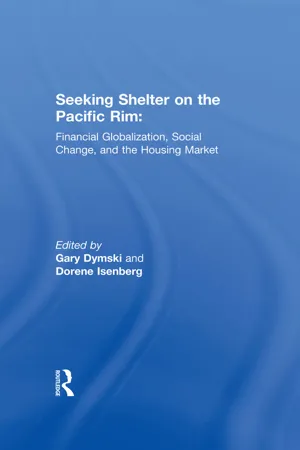
eBook - ePub
Seeking Shelter on the Pacific Rim
Financial Globalization, Social Change, and the Housing Market
- 382 pages
- English
- ePUB (mobile friendly)
- Available on iOS & Android
eBook - ePub
Seeking Shelter on the Pacific Rim
Financial Globalization, Social Change, and the Housing Market
About this book
This innovative book analyzes the changes that financial globalization is bringing about in the housing and home-finance markets of the United States, Japan, and South Korea, with special attention to the circumstances of women in obtaining housing, credit, and personal security. The book's focus on changes in the residential and housing finance markets serves as a window for an integrated examination of how the liberalization of national financial markets has affected the relationship among all players in each of the three economies - government, markets, and individual citizens. Through this examination Housing Finance Futures develops a new critical response to economic globalization based on a groundbreaking concept, the social efficiency of policy and market shifts.
Part 1 United States: From Suburban Tract to Affordability Crisis
2
Trading State-Led Prosperity for Market-Led Stagnation: From the Golden Age to Global Neoliberalism
James Crotty
Introduction
This chapter presents a brief review of the origin and development of neoliberal globalization and evaluates economic performance in the neoliberal era, first in the world economy, then, in more detail, in the U.S. economy. The conclusion is pessimistic: unless a more effective framework for global integration than neoliberalism is designed and put in place, it is highly unlikely that the basic economic needs, including access to housing, of the majority of Koreans, Japanese, and Americans will be adequately met.
Overview of the Transition from the Golden Age to the Global Neoliberal Regime
The qualitative shift in economic structures and policies that took place in the three decades after World War II constituted, to borrow a concept from sociologist Karl Polanyi, a Great Transformation of our economic way of life from a primarily market-guided economy to a state- or socially managed economy. The shift from the Golden Age (GA) to the global neoliberal regime (NLR) in the past two decades might be seen as a Second Great Transformation, this one a counterrevolution that takes us "back to the future," toward a new form of market-led economic system. These two transformations raise the most important and ideologically charged question in economic theory—which kind of system offers ordinary people the best chance of economic security and prosperity? This essay tries at least to outline an answer to this crucial question.
Against conventional wisdom, I argue that the transition to the NLR was not technologically predetermined. Neoliberalism was a deliberate political and economic choice made in the late 1970s and early 1980s by economic elites around the globe in pursuit not of the general welfare, but of their narrow individual and class interests. To date, as I show below, their choice has been a great success for them, but something between a disappointment and a disaster for the majority of the world's people. Fortunately, neoliberalism was not the only possible institutional framework for greater global integration available at the time it was chosen, and it is not the only framework available to us now.
The Golden Age of Modern Capitalism: 1950–1973
The GA was an era of exceptionally fast and widely shared growth, built on the foundation of a qualitative increase in the economic power of society over markets, exercised primarily, though not exclusively, through the state. Markets were, of course, important almost everywhere in the world. This was an era not of central planning, but rather of socially embedded or regulated markets and of state guidance of the broad contours of economic development. This dramatic shift from economic evolution as the unplanned outcome of blind market forces to conscious social choice as the regulator of economic activity took place in response to the catastrophic failures of the previous market-led system—the Great Depression and World War II. After the war, powerful popular movements demanded change, and the elites of the capitalist world lived in fear of the likely political consequences of a return to depression. Wartime economic planning demonstrated that state-guided growth was feasible. And the Keynesian "revolution" in economic thinking not only showed that instability, rising inequality, financial panics, and even depressions were "normal" products of unregulated market systems, but also provided the first widely accepted theoretical framework that government officials could use to guide their efforts to regulate economic development in capitalist economies.
The degree of societal control over economic processes and outcomes varied across countries. In North America and Europe, there was widespread acceptance of the concept of a new "social contract" between state, capital, labor, and citizens as the foundation for a new political economy. In return for public rejection of more radical alternatives to unregulated capitalism, elites agreed to support governments' commitment to high, if not always full, employment, the creation of stronger social safety nets, and the legitimation of unions, giving organized labor more influence over wage setting, working conditions, and political priorities. The U.S. transition, while quite dramatic in light of the pre-Depression commitment to laissez-faire, was the least bold; it featured the regulation of growth and employment through fiscal and monetary policy, modest welfare provisions, mild state regulation of business, reasonable control of financial markets (lest they once again lead the country into depression), and more union-friendly laws and conventions. Latin American countries stressed managed trade based on import substitution, industrial policy, and publicly owned corporations. Europe had more advanced systems of business regulation, stronger support of union power, and deeper social control of economic life. Scandinavia went furthest, adopting elements of the corporatist structures that Keynes himself believed necessary for permanent societal control over market processes.1 Of course, Japan and, later, Taiwan, Korea, and other East Asian countries instituted ambitious and effective modes of state control over domestic and international economic activity and, as a result, achieved the highest growth rates in world history.
International economic relations were also transformed in the GA. Because of the war, economic integration was far looser than had previously been the case. Cross-border financial flows were small and tightly controlled by everyone but the United States, the world's banker. John Maynard Keynes for Britain and Harry Dexter White for the United States, the chief architects of the new Bretton Woods institutions for the regulation of international trade, investment, and finance, built the new system on the core assumption that strict government control over cross-border financial flows was a necessary condition for the achievement of two important objectives. The first was increased trade integration. Keynes and White understood that the more trade dependent countries became, the more vulnerable they would be to exchange rate instability. The Bretton Woods system was therefore based on fixed exchange rates, a policy that required government control of cross-border financial flows to be viable. The second objective was rapid economic growth and consistently low unemployment, to be achieved through expansionary government fiscal and monetary policy when necessary. Tight regulation of capital flows was essential here as well. Keynes was especially adamant about this. He believed that sustained full employment would not be possible if the rich were free to pull their money out of the country—causing rising interest rates, falling stock market prices, and a plummeting exchange rate—whenever economic or political developments were not to their liking.2
Socially embedded markets and government guidance of economic development were not the only reason for the economic achievements of the era, but they were, without doubt, a necessary condition for the success of the GA. These new institutions and policies had their flaws. Not everyone shared in the prosperity. And much of Asia and Latin America was controlled by authoritarian governments, some of which brutally repressed their labor movements. But the transition to state-guided growth did dramatically improve economic performance in almost every country and for most groups within most countries. Harvard economist Dani Rodrik summed up the overall record of state-guided growth in developing countries in the GA: "The postwar period up until 1973 was the golden age for economic growth. Scores of developing countries experienced rates of economic expansion that were virtually unprecedented in the history of the world economy."3
A Time of Transition: 1973–1979
The GA institutions began to break down in the late 1960s and early 1970s. In the United States, rising inflation, fast growth, and increased trade competition, especially from Germany and Japan, created substantial balance of payments deficits that led to pressure on and, finally, the destruction of the Bretton Woods fixed exchange rate system in 1972-1973. Subsequent exchange rate instability triggered vigorous exchange rate speculation, which further increased exchange rate instability in a vicious circle. Ironically, rising exchange rate volatility raised the pressure exerted on governments to weaken or remove their remaining controls over cross-border capital movement so that businesses and individuals could more easily hedge against exchange rate loss. But weaker controls just led to even greater exchange rate instability.
The tripling of oil prices from 1973 to 1974 created a burst of inflation that rocketed around the world, creating two severe strains in the GA system. First, high inflation created a crisis for Keynesian monetary and fiscal policy. In the absence of effective price controls or income policies, governments had to either accept a temporary bout of high inflation that contorted the income distribution and disrupted financial markets, or deliberately create slow growth and high unemployment to lower demand and push prices down again. U.S. and European leaders chose to tighten monetary and fiscal policy, causing the first serious recessions of the era. Unemployment rose significantly in the United States, jumping from 4.9 percent to 8.5 percent between 1973 and 1975. In the advanced Organization for Economic Cooperation and Development (OECD) countries as a whole, unemployment went from an average 3 percent in the period leading up to 1973 to 6 percent by 1979. Second, the oil price hikes created massive international payments imbalances, which led to a qualitative rise in cross-border capital flows and thus to further erosion of capital controls. The ocean of money flowing to OPEC countries ended up being deposited in large U.S. and European banks, which could not find enough domestic borrowers because the United States and Europe were experiencing their worst recession since the 1930s. Instead, in a process that came to be called petrodollar recycling, banks pushed loans all over the Third World. This episode caused a dramatic increase in the economic power and political influence of private financial institutions, further eroded state control over financial flows, and created the preconditions for the subsequent Third World debt crisis.
Creation and Consolidation of the Global NLR: 1979–1999
Here I focus on the United States, because it was the creator, propagator, and enforcer of the neoliberal revolution in both domestic economic institutions, policies, and priorities and in the transformation of relations between domestic economies and global markets.
The second tripling of oil prices between 1979 and 1980 was a decisive moment in the evolution of neoliberalism. The 1970s were a very disappointing decade for economic elites in advanced countries. For example, in the United States, the inflation-adjusted value of the Standard and Poor's (S&P) 500 stock market index declined by 48 percent between 1966 and 1979, real interest rates went from low to negative, and the largest multinational U.S. banks suffered low profits and substantial exposure to Third World loans that were on the verge of default. The Mexican moratorium on debt repayment in 1982 demonstrated just how shaky these banks had become. Meanwhile, in the mid- to late 1970s, U.S. industrial firms had for the first time since the 1930s experienced low profits, excess capacity, and high debt, and were losing ground quickly to Japanese and European corporations. These U.S. firms tried to protect their market share and profit margins by cutting wages and speeding up the labor process, but at decade's end this strategy had not achieved its main goals. Organized labor was weak and demoralized, to be sure, but not yet defeated. It is hardly surprising, then, that the forces of capital demanded their own "New Deal"—a dramatic change in the relation of government to business and the economy.
There were two broad options available to both the citizens and the economic elites of the United States in their struggle to deal with the economic deterioration of the 1970s. The country could have initiated a serious incomes policy to help it ride out the temporary burst of oil price inflation without having to resort to massive unemployment. The oil price rise was a one-time "shock"; inflation would have receded of its own accord in time. And the United States could have followed the lead of many other countries at the time by increasing government control over capital flows to calm financial markets and stabilize its exchange rate. The United States might have taken the lead in creating a more effective international financial system, one based on the model originally proposed by Keynes and rejected by the United States in the negotiations leading up to Bretton Woods. This system could have been designed to penalize exchange rate speculation (perhaps through a Tobin Tax, wherein charges are imposed on financial transactions), su...
Table of contents
- Cover
- Half Title
- Title
- Copyright
- Contents
- Part I United States: From Suburban Tract to Affordability Crisis
- Part II Japan: From Supply Shortage to Social Reproduction Crisis
- Part III South Korea: From Social Housing to Social Polarization
- Part IV Housing Crises and Housing Solutions
Trusted by 375,005 students
Access to over 1.5 million titles for a fair monthly price.
Study more efficiently using our study tools.
Frequently asked questions
Yes, you can cancel anytime from the Subscription tab in your account settings on the Perlego website. Your subscription will stay active until the end of your current billing period. Learn how to cancel your subscription
No, books cannot be downloaded as external files, such as PDFs, for use outside of Perlego. However, you can download books within the Perlego app for offline reading on mobile or tablet. Learn how to download books offline
Perlego offers two plans: Essential and Complete
- Essential is ideal for learners and professionals who enjoy exploring a wide range of subjects. Access the Essential Library with 800,000+ trusted titles and best-sellers across business, personal growth, and the humanities. Includes unlimited reading time and Standard Read Aloud voice.
- Complete: Perfect for advanced learners and researchers needing full, unrestricted access. Unlock 1.5M+ books across hundreds of subjects, including academic and specialized titles. The Complete Plan also includes advanced features like Premium Read Aloud and Research Assistant.
We are an online textbook subscription service, where you can get access to an entire online library for less than the price of a single book per month. With over 1.5 million books across 990+ topics, we’ve got you covered! Learn about our mission
Look out for the read-aloud symbol on your next book to see if you can listen to it. The read-aloud tool reads text aloud for you, highlighting the text as it is being read. You can pause it, speed it up and slow it down. Learn more about Read Aloud
Yes! You can use the Perlego app on both iOS and Android devices to read anytime, anywhere — even offline. Perfect for commutes or when you’re on the go.
Please note we cannot support devices running on iOS 13 and Android 7 or earlier. Learn more about using the app
Please note we cannot support devices running on iOS 13 and Android 7 or earlier. Learn more about using the app
Yes, you can access Seeking Shelter on the Pacific Rim by Gary Dymski,Dorene Isenberg in PDF and/or ePUB format, as well as other popular books in Business & Business General. We have over 1.5 million books available in our catalogue for you to explore.