eBook - ePub
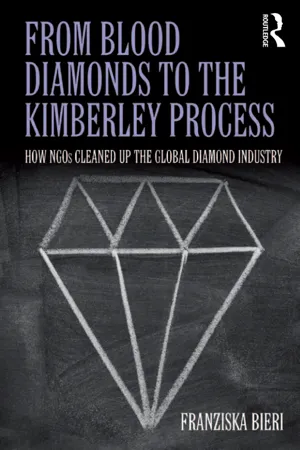
From Blood Diamonds to the Kimberley Process
How NGOs Cleaned Up the Global Diamond Industry
- 226 pages
- English
- ePUB (mobile friendly)
- Available on iOS & Android
eBook - ePub
From Blood Diamonds to the Kimberley Process
How NGOs Cleaned Up the Global Diamond Industry
About this book
In the late 1990s, several non-governmental organizations (NGOs) focused world attention on the issue of conflict diamonds which funded wars, massive death, and refugee crises across Central and West Africa. Several governments, NGOs, and key industry players engaged in negotiations under the so-called Kimberley Process (KP). A voluntary global agreement came into effect leading to a substantial decline in illicit diamond trade. Despite its importance in international affairs, the KP remains understudied in academia. Franziska Bieri's book provides the first comprehensive account of the KP and is the first to reveal how NGOs have become critical actors in their own right, possessing the ability to directly influence policies and to participate in the decision making and the implementation of global agreements. In developing this argument, Bieri explains: why the NGO campaign to raise awareness was successful; why a rapid and comprehensive resolution on such a complex global problem was possible; how the tripartite negotiations between states, NGOs, and industry developed during the implementation of the agreement, which is an on-going process. Based on extensive personal interviews with prominent campaigners, leading bureaucrats, and industry officials, hundreds of KP publications, official UN documents, industry news, and NGO reports, this timely book allows for a much needed engagement in contemporary debates about the campaign against conflict diamonds, the Kimberley Process, and the themes defining today's global governance arena.
Information
Chapter 1
A Diamond is Forever. Or is It?
Introduction
Diamonds are judged by the “four-Cs”: carat, clarity, color, and cut. In the late 1990s, however, consumers have been asked to inquire about a fifth C: conflict. Conflict or so-called blood diamonds are rough diamonds traded by rebels to finance their armed conflicts against legitimate governments. Blood diamonds have fueled and funded wars, massive death, and refugee crises in Angola, Sierra Leone, Liberia, the Democratic Republic of Congo (DRC), and Côte d’Ivoire.1 It is estimated that four million people have died in wars involving conflict diamonds over the past few decades. Between 3.7 percent and 20 percent of the total diamonds traded were estimated to be conflict diamond during the 1990s. Even the lower-end estimate suggests a significant source of war funding, given that the annual diamond trade is worth around $7 billion.
Parallel efforts by the United Nations (UN) and several non-governmental organizations (NGOs) catapulted the issue of blood diamonds onto the global agenda in 1998/1999, creating greater awareness amongst policy makers, business representatives, the media, and the public at large. What emerged was the Kimberley Process (KP), a negotiation forum involving states, NGOs, and industry. These unique tripartite negotiations rapidly led to the Kimberley Process Certification Scheme (KPCS), a voluntary international agreement regulating the diamond trade through the certification of legitimate diamonds. Today, 75 countries have joined the KP and adhere to its extensive requirements.
Only very few studies have investigated the conflict diamond campaign, describing how the various stakeholders initially engaged the problem and put conflict diamonds on the global agenda (Mokhawa and Taylor 2003; Sanders 2001; Smillie and Gberie 2001; Tamm 2004). A bit larger is the scholarly interest in the more recent regulation efforts. Studies have analyzed various aspects of the KP and its workings (Bone 2003; Grant and Taylor 2004; Scheiber 2006; Smillie 2005; Tamm 2002; Wright 2004). This book builds on these studies in answering the following questions: What factors account for the rapid spread of concern about this previously ignored issue? Why did the KP move so quickly to a consensual solution and so rapidly implement this unique global certification scheme? Beyond explanations to these case specific questions, this book explores the campaign against blood diamonds and the KP as illuminating cases for two phenomena that have emerged in this era of globalization and that have reshaped global governance: transnational campaigning and global tripartite relations, between states, NGOs, and corporations. Let me briefly introduce both features here and offer a more in depth review of these processes at the end of this chapter.
A significant scholarly literature has developed investigating global campaigns and the influential role of NGOs in global politics (e.g., Price 1998; Smith 1999; della Porta et al. 1999; Khagram et al. 2002; Willetts 1996; Clark et al. 1998). Some evidence points to global campaigns as grassroots movements, creating bottom-up pressure to the political and economic establishment. Others point out that, rather than bottom up public pressures, global campaigns emerge in a top down fashion, lacking involvement of significant segments of the global public. Also, scholars have explored what strategies and frames are effective in for global campaigns (Keck and Sikkink 1998; della Porta and Tarrow 2005). Moreover, political opportunities are important to global campaigns, which often rely on dense networks and coalitions of NGOs across continents and issue areas. The blood diamond campaign and the KP offer further insights into these areas of scholarly examination. Specifically, the campaign exhibits top down organizing by networked NGOs. The case also specifies enabling conditions for campaigns to move forward, such as the threat of a boycott. Most importantly though, while much of the literature focuses on campaigns or the role of NGOs in the agenda setting phase of the movement, I explore how this campaign transitioned from initial awareness raising efforts to more formalized settings of decision-making and implementation in the KP. Here, we learn more about the role of NGOs as watchdogs. NGOs engaged in monitoring from within the KP and continued to do so from the outside, as independent actors, publishing highly critical reports where needed. In fact, I show that NGOs are not easily co-opted in these formalized governance settings. Also, their activities far exceed the usually ascribed watchdog functions but extend to implementation practices and policy making. I argue that these wide ranging input opportunities for civil society arose in the KP because of the decentralized nature of the KP and its formal tripartite structure.
This brings me to the second transformation in global governance I seek to illuminate with this case study. Tripartite solution building increasingly serves as model in global engagement (e.g., Kofi Annan’s Global Compact, various forest conservation initiatives), yet academics, activists, industry leaders, and policy makers lack understanding of what multi-stakeholder coalitions entail, why they emerge and how effective they are. Some activists refuse participating in such settings assuming them to be a definite sell-out. Some in the industry believe that such arrangements legitimize business practices, without requiring changes in actual business practices. And many policy makers do not know how to engage the various stakeholders and are uncertain in what political venues such multi-actor negotiations should be held. In other words, tripartite structures, while very much en-vogue, are still very much ambiguous. This study provides important insights and lessons on the intricate workings of such a tripartite process unfolding from earliest events of the blood diamond campaign that clashed the parties together until present undertakings in the KP.
Before further delving into these explorations, it is important to introduce in more detail the workings of the diamond trade and industry, to elaborate on the problem of blood diamonds, and to briefly outline the changes that have occurred in the diamond trade as a result of the campaign, which will be the focus of more detail in the remainder of the book. Let me first begin, by introducing the protagonists of the diamond industry.
De Beers and the Creation of Diamonds as We Know Them
There is nothing intrinsically beautiful or highly valuable about diamonds. In fact, diamonds are fairly common. The greatest price determinant is limited supply not rarity in nature. Moreover, most people would hardly recognize a diamond in its rough form. Rough diamonds to the untrained eye do not look particularly precious. The manner of cutting a diamond is crucial for hiding the flaws found in most natural stones, maximizing their brilliance and light while maintaining as much of the carat weight as possible. The largest cutting centers for diamonds are found in India and China. Lower value diamonds are cut mainly in Asia where labor costs are substantially lower. Higher value diamonds are most frequently cut in established diamond districts in Western Europe, New York, and Tel Aviv, where orthodox Jews have traditionally led the cutting and polishing sector. Thus, while 90 percent of all cut diamonds are processed in India, by value they account for only 50 percent of production. Once diamonds are cut and polished they are sold at one of 26 worldwide diamond bourses. By that stage, the value of the diamonds has already increased by one hundred percent (from $8 billion as rough diamonds at mine production to $16 billion when cut and polished in 2009) (Royal Bank of Canada 2009). The market value further increases by over 400 percent at the point of retail sales, totaling $65 billion.
A handful of companies control the rough diamond market. De Beers controls a little over 40 percent of the global extraction market, while ALROSA, the Russian state-owned diamond company, has the second largest market share with over 20 percent. UK-based Rio Tinto, BHP Billiton, an Australian based company, and Aber, a Canadian firm, each have about 10 percent of the market. The diamond trade too is highly concentrated, with major trading centers in Antwerp (Belgium), London, Tel Aviv, and New York. Eighty percent of all rough diamonds and 50 percent of all cut diamonds are traded through Antwerp. De Beers and its subsidiaries control slightly under 50 percent of rough diamond distribution. At its monopolistic height, the Diamond Trading Company in London, De Beers’ distribution arm formerly known as the Central Selling Organization, traded over 80 percent of all rough diamonds.
De Beers’ successful history started in Kimberley, South Africa, in 1871, where its first mines were opened. This town would later give its name to the Kimberley Process. Cecil Rhodes, a British-born South African, founded the company. In 1888, De Beers started to form a consolidated cartel by buying up mines, restricting supply, and raising prices. Ernest Oppenheimer discovered a large diamond field in 1914. Oppenheimer’s company, Anglo American, was asked by De Beers to join its cartel in 1920. Under a threat from Anglo American to flood the market with diamonds at low prices, De Beers agreed to make Oppenheimer chairman of De Beers in 1929. Since that day, De Beers’ chairman has been an Oppenheimer (Ernest, Henry, and now Nicky) and Anglo American and De Beers have been intimately connected. In 1998, De Beers was divided into two main companies: De Beers Consolidated Mines Ltd. in Kimberley, South Africa, and De Beers Centenary AG in Lucerne, Switzerland. While the former dealt with matters relating to South Africa, the latter firm was in charge of all business dealings outside South Africa. In early 2002, DB Investments, itself controlled by the Oppenheimer family and Anglo American, acquired De Beers. De Beers was transformed into a private company, which then stopped releasing specific information on its stockpiles.
While the specifics of De Beers’ corporate structure are rather complex, the market control it exerts as a monopoly is hardly mysterious. With its large market share De Beers is able to manipulate prices by adjusting diamond extraction and sales to market conditions. The large stockpile it has accumulated serves the purpose of reacting to market shifts and potentially flooding the market for a short period of time, hurting emerging competition. Under US antitrust laws, De Beers was prohibited from operating in the United States, its biggest retail market. De Beers was convicted under the Sherman Antitrust Act for fixing the price of industrial diamonds in 1994. However in July 2004, De Beers pleaded guilty and paid a $10 million dollar fine. In 2005, the company also settled several outstanding civil class action suits in the United States, paving the way to operate legally in the country.
Historically diamonds have enjoyed special status in many civilizations. Ancient Indian history provides some of the earliest accounts of the status and use of diamonds in religious ceremonies. But since the mid-twentieth century, clever advertising and promotion of diamonds have dramatically increased demand. De Beers can be credited with what perhaps has been the most effective long-term marketing campaign ever. The company successfully boosted demand through innovative marketing strategies. De Beers arranged for product placements of diamonds in movies and promotion through close association with celebrities, perhaps most notably Marilyn Monroe. It created the tradition of engagement rings and more recently invented products like the three-stone anniversary ring. The slogan, “A Diamond Is Forever”, ensures that a secondary market for diamonds is essentially non-existent. It’s perhaps most famous ad campaign are the 1990s shadow commercials, featuring black and white images and the classical tune now more commonly associated as the diamond jingle rather than by its original title “Palladio” composed by Karl Jenkins.
De Beers’ shadow ads would become a direct target in the campaign, when Amnesty International launched its remake, which features the shadows of the brutal Revolutionary United Front (RUF) tactic, chopping off arms with machete. It quickly became clear that the image that De Beers so carefully constructed was about to be shattered with powerful associations of diamonds with blood, destruction and death. Unquestionably, the campaign benefited from the fact that diamonds are a non vital product of largely symbolic values and a problem that lent itself to sensationalized media coverage. Moreover, the high degree of market concentration also benefited the success of the campaign and the KP. As the dominant industry player, De Beers’ links to blood diamonds quickly became the focus in the emerging campaign. Especially its links to Angolan diamonds were the subject of early investigations and accusations by one UN panel and by Global Witness, a British NGO.
Diamonds: A Curse or a Blessing?
The commodity chain from ground to retailer is all but glamorous and that is true for blood and so-called clean diamonds. Diamonds are found in many places around the world; approximately 26 countries mine for diamonds worldwide. Botswana, Australia, Russia, the DRC, South Africa, Angola, and Canada are the top producers of diamonds. Globally, approximately 160 million carats, or 32,000 kg, of diamonds are mined every year (Royal Bank of Canada 2009). Of those, 30 million carats are gem diamonds. This amounts to an annual $9 billion in industry revenues. Diamonds are found in either alluvial or kimberlite deposits. Alluvial diamonds are the result of millions of years of erosion which brought diamonds to the surface across vast areas, usually along riverbeds. Artisanal miners dig for these diamonds with basic tools such as shovels and sieves. African countries with large alluvial diamond reserves are Angola, the Central African Republic, Côte d’Ivoire, DRC, Guinea, Ghana, Liberia, Sierra Leone, and others. Kimberlite diamonds, on the other hand, are mined with capital-intensive machinery that extracts the diamonds directly from volcanic pipes. Kimberlite deposits are the source for most of the diamonds mined in the top producing countries, except for the DRC and Angola. Much of the diamond deposits, particularly kimberlite mines, are owned by states that frequently hold licensing agreements with companies like De Beers for diamond extraction. For example, DEBSWANA, the company in control of Botswana’s diamond extraction, is co-owned by the government of Botswana and De Beers. In Russia, on the other hand, ALROSA, a state-owned company, is in charge of all of Russia’s diamond extraction.
Diamonds have largely been a blessing for kimberlite diamond countries like Botswana and a curse for alluvial diamond nations like the DRC or Sierra Leone. Nations who suffered from the negative effects of blood diamonds all have alluvial diamond deposits. Rebels frequently control alluvial diamond fields and poor artisanal diamond workers are easily recruited for rebel armies or to sell the diamonds they find to regional warlords. Kimberlite mines on the other hand are more easily regulated with stable ownership by states and private enterprises, contained and controllable sites, salaried employees, and anti smuggling infrastructure, like x-ray machines. The type of industry and extraction goes to the root of the conflict diamond problem and without adequately regulating artisanal diamond mining, the volatility for conflict remains (PAC and Global Witness 2004). Chapter 5 in this book revisits the most recent efforts by civil society, states and industry to address these underlying causes.
Angola’s civil war plagued the country since it gained independence from Portugal in 1975 (see Collier and Dietrich 2000). During the cold war, the Soviet Union funded the Marxist MPLA government of Angola, while the United States supported the UNITA rebels and their leader, Jonas Savimbi. After the cold war ended and alternative sources of funding dried up, UNITA increasingly funded its war effort through the trade of diamonds. It is estimated that UNITA controlled 60 to70 percent of Angola’s diamond trade between 1992 and 1999, which translated into $3.7 billion in income (Global Witness 1998). The war came to an end when a ceasefire was brokered in 2002.
In Sierra Leone, the RUF waged a brutal civil war from 1991 to 2002. The RUF’s tactics included amputating limbs and the use of child soldiers. The trade in diamonds funded the ongoing war, which killed an estimated 75,000 people. Liberia’s Charles Taylor, who took power amidst Liberia’s civil war (1989–2003), sponsored the RUF in an attempt to destabilize his neighbor. Taylor provided the RUF with weapons and training in return for diamonds. Taylor is currently standing trial in The Hague for crimes against humanity. Liberia is now led by the first female president in Africa, Ellen Johnson Sirleaf, who was democratically elected in 2005.
The DRC (former Zaire) experienced multiple civil wars in the 1990s and has suffered the greatest death toll, approximately 4 million lives. Diamonds were among the resources (including coltan and cassiterite) that fueled various factions in the fighting. Most recently, conflict has flared in the Goma district in eastern DRC, where Tutsi rebel leader General Nkunda led its force against the government and Rwandan Hutu army members who fled to that area of the DRC after the genocide in Rwanda in 1994. The various factions in this conflict too have been funded in part by diamonds.
Thus while some of the extensive civil war fighting funded through the diamond trade has come to an end, new conflicts involving diamonds have emerged more recently. Côte d’Ivoire’s civil war started with a coup in 1999. Ivorian diamonds are currently under UN sanctions because the Forces Nouvelles, a rebel group, is under control of the diamond-rich northern area.
The Global Diamond Trade: Now and Then
The horrific impacts of blood diamonds throughout the 1990s seem quite clear now, yet the problem of conflict diamonds remained largely ignored for many years. Then, in 1998/1999, efforts in the UN and by two relatively unknown NGOs, Global Witness and Partnership Africa Canada, unveiled the issue and catapulted it onto the radar screen of numerous states, NGOs, and diamond companies. The symbol of love, purity, and eternity became increasingly linked to war, destruction, and gruesome images of children with chopped-off limbs. By mid-2000, conflict diamonds had been established on the global agenda as a social problem. The issue regularly made front-page news.
What resulted from this campaign, was an unprecedented move toward regulating an entire industry. This is not only astounding for an industry that has been renowned for its secrecy and lack of oversight but it also a significant anomaly in a decade squarely rooted in trade liberalization.
In May of 2000, South Africa, Namibia, and Botswana (three of the largest diamond exporters) initiated informal talks with Britain, the United States, and Belgium (three of the largest diamond traders and consumers) in Kimberley, South Africa, to deal with the blood diamond controversy. NGOs and industry were also invited to what has become known as the first Kimberley Process (KP) meeting. The tripartite talks expanded to include many more states. In less than three years, negotiations resulted in the adoption of the KPCS (January 2003). Today the agreement regulates about 99 percent of the global rough diamond trade. The agreement is far reaching, imposing rules on a previously unregulated industry and allowing only signatory countries to import or export diamonds.
The KP is unique in several ways. First, KP negotiations led to an agreement in record speed compared to other global accords. Second, the KPCS is a voluntary certification process established outside of traditional international legal avenues, i.e., through treaties or the United Nations. Third, the KP participation of states, industry, and NGOs is unique and unprecedented. What led these actors to pursue solutions on conflict diamonds in a tripartite setting? The willingness of states to participate in a decision-making process which included NGOs and industry is puzzling. I explore these unique characteristics of the KP. Specifically, I explain the extent and process of NGOs’ influence over states, the industry, and the KP.
The KPCS h...
Table of contents
- Cover Page
- Title Page
- Copyright Page
- Contents
- List of Figures
- Acknowledgements
- List of Acronyms and Abbreviations
- 1 A Diamond is Forever. Or is It?
- 2 Agenda Setting – “A Rebel is a Girl’s Best Friend”: Creating Global Concern for Blood Diamonds
- 3 Decision-Making: The Creation of an Independent Tripartite Forum, the Kimberley Process
- 4 The Kimberley Process Certification Scheme: A Voluntary Agreement, Not a Treaty
- 5 Implementation: Translating Words into Action
- 6 Revitalization: Resetting Agendas and Reinvigorating the Campaign
- 7 Conclusions: Beyond Blood Diamonds
- Bibliography
- Index
Trusted by 375,005 students
Access to over 1.5 million titles for a fair monthly price.
Study more efficiently using our study tools.
Frequently asked questions
Yes, you can cancel anytime from the Subscription tab in your account settings on the Perlego website. Your subscription will stay active until the end of your current billing period. Learn how to cancel your subscription
No, books cannot be downloaded as external files, such as PDFs, for use outside of Perlego. However, you can download books within the Perlego app for offline reading on mobile or tablet. Learn how to download books offline
Perlego offers two plans: Essential and Complete
- Essential is ideal for learners and professionals who enjoy exploring a wide range of subjects. Access the Essential Library with 800,000+ trusted titles and best-sellers across business, personal growth, and the humanities. Includes unlimited reading time and Standard Read Aloud voice.
- Complete: Perfect for advanced learners and researchers needing full, unrestricted access. Unlock 1.5M+ books across hundreds of subjects, including academic and specialized titles. The Complete Plan also includes advanced features like Premium Read Aloud and Research Assistant.
We are an online textbook subscription service, where you can get access to an entire online library for less than the price of a single book per month. With over 1.5 million books across 990+ topics, we’ve got you covered! Learn about our mission
Look out for the read-aloud symbol on your next book to see if you can listen to it. The read-aloud tool reads text aloud for you, highlighting the text as it is being read. You can pause it, speed it up and slow it down. Learn more about Read Aloud
Yes! You can use the Perlego app on both iOS and Android devices to read anytime, anywhere — even offline. Perfect for commutes or when you’re on the go.
Please note we cannot support devices running on iOS 13 and Android 7 or earlier. Learn more about using the app
Please note we cannot support devices running on iOS 13 and Android 7 or earlier. Learn more about using the app
Yes, you can access From Blood Diamonds to the Kimberley Process by Franziska Bieri in PDF and/or ePUB format, as well as other popular books in Politics & International Relations & Diplomacy & Treaties. We have over 1.5 million books available in our catalogue for you to explore.