eBook - ePub
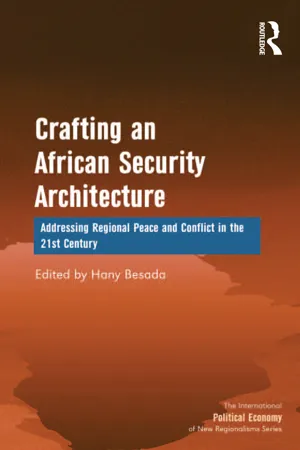
Crafting an African Security Architecture
Addressing Regional Peace and Conflict in the 21st Century
- 250 pages
- English
- ePUB (mobile friendly)
- Available on iOS & Android
eBook - ePub
Crafting an African Security Architecture
Addressing Regional Peace and Conflict in the 21st Century
About this book
The humanitarian crises caused by civil conflicts and wars in Africa are too great in scope for an adequate and effective continental response. The founding of the African Union and the drafting of the Responsibility to Protect doctrine, the basis for collective action against genocide, ethnic cleansing and crimes against humanity makes this a critical time to reflect on how best to address regional conflicts. This book responds to new regional conflicts over health, water, land and food security in the world's poorest, most socially fragmented continent. The work assesses African regional security arrangements and provides new policy recommendations for the future.
Information
Chapter 1
African Solutions for African Problems and Shared R2P
Hany Besada, Ariane Goetz, and Karolina Werner
Background
Since the early 1990s, the world has witnessed profound and new challenges in the realm of peace and security. On the one hand, the dramatic rise of intra-state conflicts, particularly on the African continent, reflected an acute security vacuum that many less developed countries were facing due to the end of the Cold War and the ‘sudden’ withdrawal of military, political, and financial support by great powers, largely a result of superpower competition by the United States and the Soviet Union. On the other hand, and in response to this debasing security situation in many countries around the world, unprecedented national, regional, and global efforts were undertaken to address these severe imploding security conditions.1 In fact, the often-weak political, socio-economic, and military capacities and capabilities of states or international organizations2 in dealing with these security concerns yielded a push by national and international actors for adequate institutionalized solutions at the regional or international level. Consequently, a reconfiguration of existing institutions has taken place together with the creation of new elements and norms within the regional and international security architecture.
It is against this background of events that the authors in this book, assess the security architecture emerging under the new overarching international security and human rights norm ‘Responsibility to Protect’. The chapters focus on a broad range of phenomena, covering not only the emerging African security architecture but also, more broadly, forms of international cooperation in the realm of peace and security. Additionally, case studies on Sudan, Burundi, and Liberia evaluate regional (EU, AU, or ECOMOG) and global (UN) actors and the particular modes of cooperation involved in African Peacekeeping. Central to our discussion about the emerging (African) Security Architecture on the regional and global level is the new concept and norm of a (shared) ‘Responsibility to Protect’(R2P).
Global and Regional Developments in View of R2P
At the global level, the concept and norm ‘R2P’ was first introduced and promoted in 2001 by a correspondent report of the International Commission on Intervention and State Sovereignty (ICISS). The Commission had been initiated by the Canadian government as a direct reaction to the long and disreputable history of retroactively mandated ‘humanitarian’ interventions3 by individual nations or so-called ‘coalitions of the willing’,4 and the widely rejected ‘right to intervene’5-principle underpinning them. Faced with the rise in intra-state wars and the related ‘moral dilemma of non-intervention’ (Thakur 20066), the overall goal was to reconsider and further ‘standardize’ procedures, contents, and channels of intervention and global security cooperation. In doing so, the ‘right to intervene’-principle was superseded by the ‘responsibility to protect’ of states towards its own citizens and of the international community to protect civilians in case a state fails to fulfil this responsibility.
The concept of R2P built on and complemented the notion of ‘human security’ that had been introduced into the international relations discourse as early as 1994, when a Human Development Report by the UNDP had tried to re-conceptualize the notion of security in an attempt to provide for an analytical lens for intra-state conflict. Traditional IR discourses had focused primarily on inter-state conflict and security threats, mainly the nuclear threat, and had thus proven unable to analytically capture the phenomenon of intra-state conflict adequately enough for policy makers and politicians to act upon in cases of severe crisis.7 Accordingly, the concept ‘human security’ comprised a wider range of issues, such as economic security, food security, health security, environmental security, personal security, community security, and political security, thereby merging the development and the security discourse. Both aspects seemed relevant for the achievement of peace.8
Similarly, the concept R2P expanded beyond military protection, and included a three-dimensional notion of responsibility to prevent, react, and rebuild. The promoters of the concept argued that the world needed a multilateral and principled security response in the face of mass atrocities, genocide and crimes against humanity. The response should reflect an obligation of all nations to provide for civilian protection in severe crises, and at the same time put more effort into non-military means of prevention. Thus, at the international level, the doctrine of the responsibility to protect, together with the establishment of an International Criminal Court (ICC),9 were meant to provide for a widely accepted security approach in the face of gross internal human rights violation, thereby also acknowledging for the first time that the state itself could become a security threat for its population.
In 2005, still under the impression of the history of UN failures in form of intervention or non-intervention in situations of severe humanitarian crisis, massacre, or genocide (e.g. Somalia, Cambodia, Rwanda, and Srebrenica), the United Nations General Assembly unanimously endorsed the concept R2P at a summit meeting on its 60th anniversary, in September 2005.
At the same time, institutional and normative changes took place on the regional level. The African continent – the focus of this book – began restructuring its security architecture, with the failures and lack of reliability of the international security architecture (e.g. Rwanda in 1994) serving as contributing stimulus for change. In fact, normative and institutional changes took place. In 2002, the Organization of African Unity (OAU) was succeeded by the African Union (AU). The focus of the newly founded AU yielded a shift from non-intervention to non-indifference in the face of massive human rights violations within a member state. Its founding doctrine incorporated the R2P concept in form of a reinterpretation of the sovereignty principle. Moving beyond the legal restrictions of the OAU, the AU today has the potential to become an influential regional actor in view of civil strife and mass atrocities across the continent, and with regard to the R2P implementation In fact, new sub-institutions and agencies were created, such as the Peace and Security Council (PSC) to provide for institutional means to recommend and implement interventions in cases of severe crisis. At the same time, the responsibility to prevent has been strengthened through the creation of new structures such as the consultative Panel of the Wise and the Continental Early Warning System (CEWS). In addition, an African Standby Force (ASF) is being built up to ensure various missions, from observation to intervention.10 While most of these innovative institutions are still in the build-up phase, in the medium term the higher degree of ‘institutional preparedness’11 of the continental organization could enhance its role as an important building block in the international peace and security architecture, as well as satisfy the widespread desire for greater continental self-reliance. However, similar to sub-regional groups and integration initiatives, such as the Economic Community of West African State (ECOWAS) and Common Market for Eastern and Southern Africa (COMESA), the AU still faces many hurdles in form of shortage of financial resources, very diverse members, as well as great challenges in view of the overall improvement of human security within the member states (particularly in view of security, economic development, environmental and health challenges).
Dilemmas and Prospects
In defence of the new concept, the proponents of R2P argue that the real choice has never been between intervention or non-intervention, but rather between a regularized, multilateral, and principled approach to intervention, conducted by the global security community in the face of mass atrocities, or an arbitrary, unilateral approach by world powers or a ‘coalition of the willing’.
In fact, R2P is perceived as the best possible solution in the myriad of contradicting principles and norms such as an expanded notion of sovereignty, humanitarian intervention with military means, and responsibility in providing for an almost subsidiary understanding of responsibility, or the understanding of responsibility. Accordingly, the ‘old’ Westphalian notions of sovereignty as territorial ‘control’ by the state and the related principle of ‘non-intervention’ in state matters was re-phrased into sovereignty as a primary responsibility by the state to provide for the protection of its citizens. Only in cases where this primary responsibility was not met, the secondary responsibility by the international community to provide for the safety and protection of the respective population comes into being.12
Thus, R2P – according to proponents – does not undermine the state’s sovereignty, but instead strengthens its role in the international community. Contrary to the ‘right to intervene’ with military means, R2P’s focus on prevention and reconstruction are seen as valuable contributions to international peace and security.
At the same time, and quite to the contrary, opponents of the concept argue that the consequences of R2P and ‘human security’ do undermine sovereignty, the potential costs of which are hardly ever taken into closer consideration. Moreover, the asymmetric power distribution in the UN Security Council, and the UN more generally seemingly adds to the difficulty of potential host countries to trust in the concept. While there are regional differences concerning the perception of R2P, a fundamental – and valid – point of skepticism is sparked by the fact, that thus far R2P remains a rather top-down endeavour, one that puts particular emphasis on the second responsibility to react, while neither prevention, nor the comprehensive analysis of systemic causes or roots of a conflict are being given the attention they would deserve.13 This is often less the result of a traditional understanding of sovereignty, but in fact a lack of political will of all parties involved.
Besides, scholars such as McFarlane and Khong (2006) have pointed out that the R2P’s complementary notion of human security might suffer from conceptual overstretch – while this not only raises false hopes and promises, it also creates a preference of military solutions to problems due to their a priori securitization.14
Discussions among academics have made it clear, that so far, there seems to be no common perception or agreement on the notion of a shared responsibility to protect. While it was argued by some participants that the most important normative shift took place from non-intervention to non-indifference, this shift was many times looked at very critically. Repeatedly, it was questioned, by whom and why the responsibility to protect should be shared. From a similar perspective, the question was raised regarding the role regional organizations, such as the AU and ECOWAS, have played and should play in the near future in the continent’s security architecture. In a time of globalization, how realistic was the demand by some for ‘African solutions to African problems’? And how adequate could global solutions be in providing for regional, national or local peace? Here, for instance, the UN-induced preference for negotiating comprehensive peace agreements was mentioned as an impediment rather than a stepping stone to sustainable peace, due to its unrealistic presumption that all parties would be interested in participating in a peaceful interaction or be interested in a peaceful resolution to a conflict(s).15 This is particularly evident in situations characterized by a privatization of authority and polypoly of force.
In addition the ‘shared R2P’ concept was seen critically in the light of self-determination of the host country, given that the third component of R2P, the reconstruction process, implied the implementation of particular economic, social and political models on the ground.16
Scholars such as Thakur (2006) have rightly pointed out that these unresolved discussions often take the form of a ‘North–South blame game’, where the South blames the North over its dominant position in the international system, while the North refers to the South’s failure to fulfil its international responsibilities.17 Yet, at the same time, scepticism about and criticism of R2P point to important problems of the concept as a proxy of international norm creation. While, for instance, from the viewpoint of R2P, external (international) concepts and actors (implicitly) are considered to be effective in reconstruction, prevention, and reaction efforts, from the host country’s perspective they might be seen as troubled by their weak accountability, or their potential unreliability in the face of acute crises or long-term commitment.18 Moreover, the current normative inconsistency and incoherence in the global security realm, and the pervasive case and norm selectivity undermine the trust by less developed countries further.
Thus, it seems that as long as these states are denied more active roles in the global norm creation processes, it is unlikely they would project a strong political will in support of international measures and concepts; yet, aside from leadership and mandate, political will has proven to be the most important factor for the success of any security cooperation.
One might conclude that difficult security problems, be they practical or normative in kind, require complex solutions. In order to find widespread approval and improvement of top-down security means, more emphasis should be given to prevention, actual analysis of roots of conflicts on the ground, as well as incorporation of systemic causes in the overall assessment and solution-finding process. This would imply not only scrutinizing the problems and actors of actual host countries, but also the programmes and actions of international organizations and actors. Also, normative implications or realities of the current society of states would need more open discussions and assessments. In this regard, R2P not only reflected a redefinition of the principle of state sovereignty; it also cemented the fact that in the current institutional architecture and economic practice of the system of (modern) states, ‘self-determination’ is at best ‘limited self-determination’.
This has several implications for African peace and security as well as the role of the international community in the further build up of a peace and security architecture. First, with regard to the international level, it seems important to reconceptualize the regional and international peace and security architecture and ambitions by taking into consideration that the ‘playing field was never level’.19 As Mayall (in Sharp and Wiseman 2007) has pointed out, ‘[e]ven before the end of the Cold War, the Western powers had begun to shape the ‘developing’ world to their own design by attaching economic conditions to their bilateral loans and debt relief and imposing structural adjustment programmes’20 through the IMF and WB. After the end of the Cold War, good governance, democratization, and human rights were added to the eco...
Table of contents
- Cover Page
- Title Page
- Copyright Page
- Contents
- List of Figures and Tables
- Notes on Contributors
- List of Abbreviations
- Foreword Meeting the Demand for Intervention: The Promise of African Security Architecture
- 1 African Solutions for African Problems and Shared R2P
- 2 Through the Lens of European Integration Theory: African Peace and Security Architecture as a Framework in Transition
- 3 Hopes and Challenges for the Peace and Security Architecture of the African Union
- 4 From the Multilateralism of States to the Multilateralism of Peoples: The Roles of the African Union and the United Nations in Supporting Security Sector Reform
- 5 The European Union (EU) and the Emerging African Peace and Security Architecture
- 6 R2P and the IGAD Sub-region: IGAD’s Contribution to Africa’s Emerging R2P-oriented Security Culture
- 7 Complementary Approaches to Peacekeeping? The African Union and United Nations in Burundi
- 8 Partnerships for Peacebuilding in Burundi: Some Lessons Learned
- 9 The DDRR and SSR Process in Liberia: Prospects and Challenges
- 10 The Darfur Conflict and the Responsibility to Protect: Towards a Sustainable Peace
- 11 Steady but Uneven Progress: The Operationalization of the African Standby Force
- 12 A ‘Public’ Duty? Building Citizen Focused Accountability and Oversight Mechanisms in Global Peace and Security Governance
- Index
Trusted by 375,005 students
Access to over 1.5 million titles for a fair monthly price.
Study more efficiently using our study tools.
Frequently asked questions
Yes, you can cancel anytime from the Subscription tab in your account settings on the Perlego website. Your subscription will stay active until the end of your current billing period. Learn how to cancel your subscription
No, books cannot be downloaded as external files, such as PDFs, for use outside of Perlego. However, you can download books within the Perlego app for offline reading on mobile or tablet. Learn how to download books offline
Perlego offers two plans: Essential and Complete
- Essential is ideal for learners and professionals who enjoy exploring a wide range of subjects. Access the Essential Library with 800,000+ trusted titles and best-sellers across business, personal growth, and the humanities. Includes unlimited reading time and Standard Read Aloud voice.
- Complete: Perfect for advanced learners and researchers needing full, unrestricted access. Unlock 1.5M+ books across hundreds of subjects, including academic and specialized titles. The Complete Plan also includes advanced features like Premium Read Aloud and Research Assistant.
We are an online textbook subscription service, where you can get access to an entire online library for less than the price of a single book per month. With over 1.5 million books across 990+ topics, we’ve got you covered! Learn about our mission
Look out for the read-aloud symbol on your next book to see if you can listen to it. The read-aloud tool reads text aloud for you, highlighting the text as it is being read. You can pause it, speed it up and slow it down. Learn more about Read Aloud
Yes! You can use the Perlego app on both iOS and Android devices to read anytime, anywhere — even offline. Perfect for commutes or when you’re on the go.
Please note we cannot support devices running on iOS 13 and Android 7 or earlier. Learn more about using the app
Please note we cannot support devices running on iOS 13 and Android 7 or earlier. Learn more about using the app
Yes, you can access Crafting an African Security Architecture by Hany Besada in PDF and/or ePUB format, as well as other popular books in Politics & International Relations & African Politics. We have over 1.5 million books available in our catalogue for you to explore.