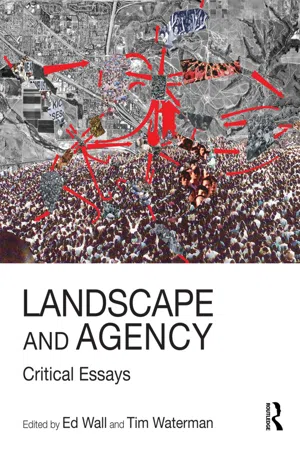
Landscape and Agency explores how landscape, as an idea, a visual medium and a design practice, is organized, appropriated and framed in the transformation of places, from the local to the global. It highlights how the development of the idea of agency in landscape theory and practice can fundamentally change our engagement with future landscapes. Including a wide range of international contributions, each illustrated chapter investigates the many ways in which the relationship between the ideas and practices of landscape, and social and subjective formations and material processes, are invested with agency. They critically examine the role of landscape in processes of contemporary urban development, environmental debate and political agendas and explore how these relations can be analysed and rethought through a dialogue between theory and practice.
- 198 pages
- English
- ePUB (mobile friendly)
- Available on iOS & Android
eBook - ePub
About this book
Information
p.7
1
LANDSCAPES OF POST-HISTORY
Ross Exo Adams
Supernatural
There is a certain magic we invest in the term ‘landscape’ today. Like ‘nature’, ‘democracy’ or ‘communication’, no one doubts landscape. As much as we are destroying landscapes each day (and perhaps precisely because of this), it has become a signifier around which undeniable truths orbit closely. The fact that landscape as a discursive category intersects with fields from architecture, urbanism and art to geography, political theory, anthropology and philosophy is surely in part a response to a shifting set of concerns that have taken hold under the shadow of climate change and the multitude of phenomena this has brought into public consciousness. Landscape, in turn, is one of the key sites in which a fledgling collective aesthetic is taking shape. Today, it finds itself as a category central to the ways in which discourses are being reshaped, opening up questions of land, geological strata, ecological processes, economies of extraction and production, social and legal divisions, infrastructural connectivity and processes of urbanization. Landscape today appears at once as a consistent background against which contemporary problems obtain visibility and, increasingly, the object occupying the foreground itself.
Landscape is often associated with ‘agency’. If there is agency in landscape practices, it is likely grounded in the ontological status of landscape itself. In discussing landscape urbanism in his seminal essay, ‘Terra Fluxus’, James Corner expounded this capacity of landscape perhaps most succinctly, ascribing four fundamental themes to the then nascent practice of landscape urbanism: landscape urbanism would be a temporally based process, it would work through a medium of surfaces, as a practice, it would be grounded in realism, and it would aim to construct a collective imaginary.1 While tied to a specific type of landscape practice (landscape urbanism), we can nonetheless see how these principles begin to open up a more general ideological understanding of landscape practices consistent with much of today’s ongoing work. Perhaps most fundamentally, unlike architecture, art, literature, music or any other artistic medium, landscape pre-exists its creative becoming: to create landscape, is always to transform it. Kate Orff reminds us that landscape is “both a frame and a solution”.2 More than in any other creative practice, the ontological status of landscape lends itself to the ways in which practices of modifying it come to be. In other words, to define what landscape is, is also to define the means by which to transform it in practice. So, if we want to question the agency of landscape, we might first consider assessing how landscape is ontologically constructed.
p.8
From Corner’s essay, we can begin to see how landscape builds itself around a dual agenda: it is, on the one hand, the site of dynamic, horizontal connectivities – the space of forces, flows and processes. As such, designing landscape is an affirmatively non-object-driven practice, but rather a relational ‘staging’ of systems. Its status, unlike architecture’s, is a catalyst of multiple processes – an instigator for an ‘ecology of events’ to emerge. And indeed, across the discourses of landscape, terms like ‘engagement’, ‘plurality’, ‘non-hierarchical’, ‘indeterminate’, ‘ephemeral’ and so on seem to constitute landscape’s inherent properties as much as they also designate the basic outlines for practices of transforming it. On the other hand, the contemporary role of landscape in the city makes it a primary site in which to reimagine the contemporary public realm. Thus, all of its inherently non-hierarchical, relational and dynamic capacities are put to work toward constructing a practice equally invested in landscape as a representational medium – the surface on which an emergent symbolism can take root. The two sides of contemporary landscape reveal it to be at once biological and pedagogical; productive and narrative; functionally indeterminate and culturally over-determined.
Archive
We can imagine that contemporary landscape discourses and practices draw a certain influence from discussions around New Materialism and from renewed interest in material cultures. On the one hand, given the trajectory that landscape has inherited from the likes of Corner et al., landscape is endowed with a kind of ontological predisposition toward agency. This sentiment has benefitted in part thanks to thinkers like Jane Bennett and her political ecology of matter,3 which suggests an agency that dwells in the more-than-human ecology of actors. Landscape, in this sense, much like Corner’s version of it, may be seen as a kind of thickened substrate of ‘quasi-agents’ – “forces with trajectories, propensities, or tendencies of their own”.4 Not only is landscape the medium of naturally existing forces, flows and processes, but the very matter that constitutes landscape itself – the rocks, the soils, the fossils it produces – all add temporal, ecological and geological dimensionality to its ‘vitality’ – its non-human agency. On the other hand, this agency, if well documented in its materiality, can play a more interpretive role in constituting a kind of historical narrative of human culture – a means to probe the recent and deep past of the human condition in relation to objects extracted from or placed within the landscape. Taken together, these various discursive tendencies instigate a practice in which the rigorous documentation of materials, plants and their unique ecologies can be curated to reveal a kind of social and cultural agency that passes through the material fragments of landscape, entangling the human and non-human worlds in a complex, more-than-human ecology. Landscape, we could say, appears today as a kind of as-found archive of social and cultural history.
p.9
If landscape is an archive, then our interventions into it can become the making visible of the richness of its historical evidence; like a well-cut ice core, it must draw us into the past, narrating the unfolding of the human and non-human relations layered into the ways in which landscape now speaks in the present. And if landscape is to be seen as a spatial and material record of the past, it is inevitable that this record will speak of past errors and inherited social systems, recounting – often indirectly – the exploits of capitalism, modernity, imperialism and episodes of human and ecological violence.
Yet here, a surprising thing happens: as much as such material histories may open up questions of politics, by constituting this politics through the various ‘ecologies of matter’, it often has a counter-political effect: the complexity, violence and injustice that such material cultures of landscape may illuminate often appear ungraspable in the present, either speaking of histories long since past or inviting us to encounter ongoing atrocities such as climate change as comprehendible only through the sublime awe of total, inevitable catastrophe. Either way, when engaging landscape-as-archive, our perception of it seems trapped in one form of contemplation or another. If agency exists in the way the materiality of landscape reveals these histories to us, it all too often comes at the cost of displacing agency from the political realm, suturing it instead to an exclusively material-cultural entanglement curated in a present which, itself, is drained of the political. This sentiment is captured acutely in the announcement of a recent exhibition at the University of Wisconsin, Milwaukee, Placing the Golden Spike: Landscapes of the Anthropocene:
Through photography, sculpture, video animation, film, performance, and participatory events, the exhibition invites us to contemplate how the manipulation of local ecologies and the global exploitation of natural resources will require new ways of living in the 21st century. The exhibition and accompanying programs challenge visitors to recognize the omnipresence of human impact on contemporary landscapes – suggesting that the closer and more carefully we look, the more places we may find to place a golden spike of the Anthropocene.5
Why is this? What is it about landscape as a category that forces what is overtly political in content to become passive in its reception? What effect does this have on framing the ways in which we intervene in landscape?
Divide
According to philosopher and geographer Augustin Berque, the modern understanding of landscape – as a theoretical form of knowledge – appeared in Europe in the fourteenth century when Petrarch ascended Mont Ventoux and was moved to reflect on the beauty its vistas presented to him. This, he says, is the moment when landscape “begins to exist for the Europeans”.6 Landscape, here, denotes a subject of thought for which the object (landscape) must exist as something representable. Notwithstanding its tautological definition, Berque’s is one that places landscape in the realm of the philosophical and the aesthetic. With this in mind, he marks a distinction between landscape theory and landscape thought, a divide that emerged with the modern construction of the former to the detriment of the latter’s more ancient status. This divide allows a rather moralized symmetry to cut through the entire text: landscape thinking is the more primordial, non-Western, non-urban, ‘spontaneous’ way in which humans have for millennia taken landscape (again, tautologies aside) as an indispensable part of what it means to dwell in time and space. Landscape thinking requires an intimate and immediate sensitivity of land, its authentic processes, natural transformations and the social entanglements it constructs across generations. Landscape theory, on the other hand, emerges as a reduction of landscape to ‘false’ representations of itself, seen from an otherwise ‘disinterested’ gaze looking from the city outward. It is landscape thinking in reverse, where landscape is constructed through a cold logic and becomes the space onto which projections of class structures appear; it is the formation of a rationality born of the artificial, elitist distance in between subject (the ‘leisure class’) and object (the landscape). He attributes this degraded view of landscape, and its subsequent invention of landscape as theory, to what he broadly calls the ‘CMWP’, or the ‘Classical Modern Western Paradigm’, that formed somewhere in the seventeenth century. The source of our contemporary, ‘corrupt’ fascination with landscape – coinciding with our incessant destruction of it – is, Berque asserts, rooted in the CMWP.
p.10
What is curious about this rather moralized hypothesis is how the concept of landscape, which is decidedly modern in origin,7 dating from the seventeenth century, accords for Berque to a predominantly pre-modern spatial ontology. While certainly not incorrect, since such an ontology is not replaced outright by the modern one (and that the modern/pre-modern ‘divide’ is itself problematic), Berque’s approach has the effect of portraying landscape as a timeless object that, at one point in history, becomes the hapless victim of the violence that the ‘CMWP’ imposes. In other words, landscape, for Berque, remains a constant; what changes is the way we humans understand it (either as an authentic way of thinking or as an object of a disinterested, elitist and immoral gaze). Such a reading not only plays to an essentialist depiction of landscape, ignoring the political histories that helped give birth to the concept as we’ve inherited it, but, more crucially, it overlooks how landscape itself has also come to serve as a fundamental...
Table of contents
- Cover Page
- Landscape and Agency
- Title
- Copyright
- Contents
- List of Figures
- Notes on Contributors
- Acknowledgements
- Foreword
- Introduction: Critical Concerns of Landscape
- 1 Landscapes of Post-History
- 2 Reciprocal Landscapes: Material Portraits in New York City and Elsewhere
- 3 Agency, Advocacy, Vocabulary: Three Landscape Projects
- 4 The Law is at Fault? Landscape Rights and ‘Agency’ in International Law
- 5 How to Live in A Jungle: The (Bio)Politics of The Park As Urban Model
- 6 Planetary Aesthetics
- 7 The Closed Landscapes of Sverdlovsk-44 and Krasnoyarsk-26
- 8 Rhythm, Agency, Scoring and the City
- 9 Publicity and Propriety: Democracy and Manners in Britain’s Public Landscape
- 10 The Power of the Incremental: Agronomic Investment in Lisbon’s Chelas Valley
- 11 Post-Landscape Or the Potential of Other Relations With the Land
- 12 Activating Equitable Landscapes and Critical Design Assemblages in Bangkok
- 13 Agency and Artifice in the Environment of Neoliberalism
- Afterword: Landscape’s Agency
- Index
Trusted by 375,005 students
Access to over 1.5 million titles for a fair monthly price.
Study more efficiently using our study tools.
Frequently asked questions
Yes, you can cancel anytime from the Subscription tab in your account settings on the Perlego website. Your subscription will stay active until the end of your current billing period. Learn how to cancel your subscription
No, books cannot be downloaded as external files, such as PDFs, for use outside of Perlego. However, you can download books within the Perlego app for offline reading on mobile or tablet. Learn how to download books offline
Perlego offers two plans: Essential and Complete
- Essential is ideal for learners and professionals who enjoy exploring a wide range of subjects. Access the Essential Library with 800,000+ trusted titles and best-sellers across business, personal growth, and the humanities. Includes unlimited reading time and Standard Read Aloud voice.
- Complete: Perfect for advanced learners and researchers needing full, unrestricted access. Unlock 1.5M+ books across hundreds of subjects, including academic and specialized titles. The Complete Plan also includes advanced features like Premium Read Aloud and Research Assistant.
We are an online textbook subscription service, where you can get access to an entire online library for less than the price of a single book per month. With over 1.5 million books across 990+ topics, we’ve got you covered! Learn about our mission
Look out for the read-aloud symbol on your next book to see if you can listen to it. The read-aloud tool reads text aloud for you, highlighting the text as it is being read. You can pause it, speed it up and slow it down. Learn more about Read Aloud
Yes! You can use the Perlego app on both iOS and Android devices to read anytime, anywhere — even offline. Perfect for commutes or when you’re on the go.
Please note we cannot support devices running on iOS 13 and Android 7 or earlier. Learn more about using the app
Please note we cannot support devices running on iOS 13 and Android 7 or earlier. Learn more about using the app
Yes, you can access Landscape and Agency by Ed Wall, Tim Waterman, Ed Wall,Tim Waterman in PDF and/or ePUB format, as well as other popular books in Architecture & Sustainability in Architecture. We have over 1.5 million books available in our catalogue for you to explore.