- 252 pages
- English
- ePUB (mobile friendly)
- Available on iOS & Android
eBook - ePub
About this book
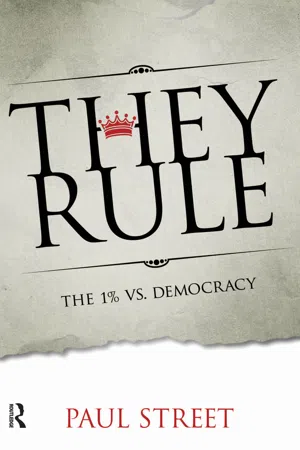
They Rule reflects on key political questions raised by the Occupy movement, showing how similar questions have been raised by previous generations of radical activists: who really owns and rules the US? Does it matter that the nation is divided by stark class disparities and a concentration of wealth in the hands of a few? Along the way, this book sharpens readers' sense of who the US oligarchy are, including how their fortunes have changed over the course of US history, how they live and think and how to detect and de-cloak them. They Rule is a masterful historical and political analysis, revealing what lies beneath the surface of US society and what ordinary people can do to bring about social change.
Chapter 1
"They Own the Place"
Scenes from America's Unelected Dictatorship, 2009–2013
I witnessed the raid on the Occupation Oakland camp . . . and it was terrifying to see. It harkened back to old footage I had seen of Nazi Germany.... It had that tenor.
—Witness to the police raid on Occupy Oakland, October 26, 20111
You’re going to have to do something to lower peoples’ expectations of what they’re going to get, the entitlements and all people think they’re going to get, because you’re not going to get it.
—Lloyd Blankfein, CEO of Goldman Sachs, November 19, 20122
Fall and Early Winter 2011: Repressing Dissent
"To Fight for the America We Believe In" (Bay Area, October 2011)
Two and a half days in the American West in the fall of 2011 speak volumes about money and power in the United States, the self-declared homeland and headquarters of democracy. For US president Barack Obama, Tuesday, October 25, 2011, started in Los Angeles with an interview with television talk show host Jay Leno, broadcast later that night on The Tonight Show. After taping at NBC’s studios, Obama and his entourage flew on Air Force One to San Francisco for a $1 million luncheon fundraiser with a gathering of millionaires at the posh W Hotel. Singer Jack Johnson performed at the event, in keeping with the Obama reelection campaign’s tactic of “turning on star power for top donors.” The president had spoken at two fundraisers in Los Angeles on Monday evening, including a Latino-oriented event at the Hollywood mansion of actors Antonio Banderas and Melanie Griffith.
At the W, Obama made a poignant appeal to 200 contributors who paid a minimum of $5,000 to attend. “Whether you are an old grizzled veteran or new to the scene, I need your help,” he said. The coming election, Obama said, was “more consequential, more important” than the last one. He said that a jobs bill he was advancing would “give the economy the jolt it needs right now” and likened the nation’s current difficulties to prior challenges: the Great Depression, the Civil Rights Movement, and landing on the moon. “If we don’t work even harder than we did in 2008, then we’re going to have a government that tells the American people, ‘You’re on your own,’” he said. “That’s not the America I believe in; it’s not the America you believe in. We’re going to have to fight for the America that we believe in.”3
It was Obama’s “third visit to the Bay Area—always a lucrative fundraising location for him—in a little more than six months and his seventh since taking office,” the San Jose Mercury News reported. The previous month he had collected nearly $6 million at lucrative fundraisers in the affluent Bay Area communities of Woodside and Atherton. After two and a half hours on the ground in the Bay Area, Obama left for Denver, Colorado, where he had two more fundraisers scheduled as part of a three-state western fundraising sweep.4 It was all part of a major push focused largely on wealthy donors, an epic quest for campaign cash that helped Obama gather $90 million by the end of November 2011. He was averaging one big fundraiser every five days in 2011.5 In early March of the following year, USA Today found that the president had already attended 191 elite fundraisers—a new first-term presidential record with ten months still to go. The previous standard of 173 had been set by the notoriously plutocratic George W. Bush,6 who once referred (at a black tie New York campaign event in 2000) to the nation’s super-rich as “my base.”7
Early the following morning, long after The Tonight Show had been broadcast and the president had settled into a comfortable suite in Denver, something unpleasant happened across the San Francisco Bay. Dozens of activists were camped out in Oakland to “fight for the America that we believe in” in ways that had little to do with electoral politics. “Occupy Oakland” had staked out a park in the depressed city’s downtown earlier in the month. It was one of hundreds of local Occupy movements that had sprung up under the inspiration of and in solidarity with Occupy Wall Street, the remarkable New York City protest that began on September 17, 2011, against economic inequality and the control of US society and politics by “the 1%”—against the very wealthy few whose money Obama was soliciting in person once every five days.
The Oakland Occupation had never sat well with the city’s “progressive” Democratic mayor Jean Quam. She had decided to move against it in a predawn raid. In the still-dark hours of the very early morning, heavily armored and visor-wearing riot police from no less than ten Bay Area jurisdictions assaulted the protestors with a barrage of rubber bullets, chemical agents, and concussion grenades. They fired a “sonic canon” designed to attack protestors’ ear drums.8 The attack was described by a downtown security guard who beheld a massive, Nazi-like police rush on one hundred or so peaceful occupiers:
I witnessed the raid on the Occupation Oakland camp, at a little bit after 4:30 in the morning, and it was terrifying to see.... There were just so many policemen ... the numbers were incredible.... They lined up almost like in a phalanx, on the street, and then they moved in.... There were helicopters flying about and with high beams on the camps ... the beams were moving across every which way.... There were young people in these camps and children, infants in a lot of the tents.... They shot ... tear gas into the middle of the camp ... and then they moved to the next stage of taking the barricades and kicking them down. And then they moved in and the first thing they hit was the information tent, and they just started just tearing everything down.... This was a military type operation, the way they moved in. It harkened back to old footage I had seen of Nazi Germany.... It had that tenor. . . . The helicopters, and the lights, and the loudspeaker, all those were all intended to create panic and terror for the people inside.... It was something like out of a Star Wars movie except instead of being in white they were all in black ... they were all in riot gear ... with the visors, they looked like automatons, they just moved in, in a line.... They had these vehicles that looked like armored boxes, black, special riot vehicles.... The thing that stays in my mind’s eye is in the middle ground with the lights from the helicopters, the police moving in and just stomping on these tents, and moving in one layer, after another, moving in deeper and deeper.9
This chilling militarized police action put a US military veteran (Scott Olson) in intensive care with a fractured skull and inflicted numerous other injuries.
The White House had nothing to say about the repression unleashed on homeless Americans and populist protestors by a big city mayor from the president’s own party—sixteen and a half hours after he had just raised a million dollars from the rich and powerful in the same metropolitan area. The silence was telling. When the Occupy Movement broke into the national and global spotlight from its original base in New York City’s financial district earlier that month, top Democrats had smelled opportunity—popular anger they could yoke to their electoral strategy against the Republicans. “For a Democratic Party dispirited by its president’s sliding approval ratings,” the Wall Street Journal explained, “the new energy has been greeted as a tonic comparable to what Republican congressional leaders tapped in the Tea Party movement—and are now finding it difficult to harness.... Democrats see an avenue to bring the anger back to their side.”10 Still, Obama offered no words of encouragement or recognition of the movement—no praise for its determination to act in accord with a notion that he had invoked more than once on the campaign trail in 2007 and 2008: that progressive “change doesn’t happen from the top down. Change happens from the bottom up.” There were no words of White House concern over the violation of peaceful protestors’ human and civil rights.
"Measures More Reminiscent of a Dictatorship" (New York City and Other US Cities, November 2011)
The president was silent weeks later when a slew of mostly Democratic big city mayors across the country cracked down on the Occupy Movement in mid- and late November. Especially chilling was the eviction conducted against the original Occupy Wall Street site in New York City’s Zuccotti Park in the early morning of November 15 on the orders of Wall Street titan turned New York mayor Michael Bloomberg—himself a true 1%-er (the twelfth richest person in the United States, in fact). By one eyewitness account,
The area around Zuccotti Park was subject last night to a 9/11-level lockdown over peaceful, lawful protests by a small number of people.... Martial law level restrictions were in place. Subways were shut down. Local residents were not allowed to leave their buildings. People were allowed into the area only if they showed ID with an address in the ’hood. Media access was limited to those with official press credentials, which is almost certainly a small minority of those who wanted to cover the crackdown.... They were kept well away from the actual confrontation (for instance, the tear gassing of the Occupiers in what had been the [OWS] kitchen, as well as the use of pepper spray and batons). News helicopters were forced to land. As of 10 a.m.... police helicopters were out in force buzzing lower Manhattan.11
A former New York Supreme Court justice served as an independent legal observer of the police action. When she witnessed a New York Police Department (NYPD) officer force a protestor to the ground and beat her on the head, the observer asked the officer why he had done it. The officer, Harper’s Magazine columnist Jeff Madrick notes, “pushed her up against the wall and asked if she wanted to be arrested. A New York City councilman,” Madrick adds, “was pushed to the ground and arrested. The use of batons and pepper spray and the dragging of protestors was well-documented.... Examples of violence against reporters were also plentiful.” Such abuses received scant attention thanks in part to Bloomberg’s imposition of a “media blackout” (as the New York Times “Decoder blog” accurately reported) on the eviction raid—a technical violation of international human rights law. The local CBS television affiliate (WCBS) reported that the NYPD blocked its news helicopter from filming the police, though only the Federal Aviation Administration has the legal authority to restrict airspace access. It all followed weeks of police abuse against Occupy Wall Street. A report published in the summer of 2012 documented 130 incidents of excessive force by the NYPD—actions that violated protestors’ civil and human rights—during the occupation and over subsequent months.12
The human rights advocate Dr. Marsha Coleman-Adebayo was reminded of past visits to South Africa, where she heard anti-apartheid activists recall “the dark days of repression and how police would conduct raids during the early morning hours knowing that their victims would be groggy and fearful in the dark.” “It seems,” a friend of Coleman-Adebayo’s wrote her from England after the NYPD raid, “like US police are resorting to measures more reminiscent of a dictatorship.” As president, Coleman-Adebayo argued, Obama “should be the primary defender of the Constitution, yet he remains silent, apart from hypocritically pontificating on global platforms while at home the economy crashes and violent police actions against peaceful protestors take place.”13
Over the previous ten days, violent police raids and clearances of the Occupy Movement had been carried out in the name of “public health and safety” against protestors in a number of other cities, including St. Louis (Friday, November 12), Denver (Saturday, November 13), Portland, Oregon (Sunday, November 14), Salt Lake City (Saturday, November 12), Albany (Saturday, November 13), and Dallas (Thursday, November 17). A police action against Occupy Seattle included the pepper-spraying of an eighty-four-year-old woman. Student Occupiers were beaten by Alameda County sheriffs in the full light of day on the campus of the great liberal bastion the University of California at Berkeley. None of this repression elicited the slightest bit of commentary from Obama. He was touring Asia and Australia to promote “free trade” and an expanded US military presence in the Far East while much of the repression unfolded in the “homeland.”
Eight days after the martial law action in lower Manhattan, the president flew up to New York City to speak at three big donor fundraising events there. On November 30, Wall Street protestors tried to greet Obama outside a $10,000-a-plate fundraiser at the Sheraton New York. Police officers there kept demonstrators penned in what the NYPD called “frozen zones.” At 9 p.m., police barricaded fifty protestors into a small space at Seventh Avenue and 53rd Street. At first blush, this seemed to be nothing new. Officially designated “free speech zones” had long been routine outside high-level political events in the United States. “But here’s the twist,” Mother Jones reporter Josh Harkinson noted, “Protestors in the NYPD’s free speech zone were trapped.... Not only could nobody enter after a certain point, but for about an hour and a half, nobody could leave.... When I arrived outside the event, I found that the police had cordoned off the sidewalk a block in all directions and were not admitting the press. Deeper inside this ‘frozen zone,’ as the police called it, were the kettled protestors, who occupied a sort of Faberge egg of dissent that was completely inaccessible to anyone not already there.... I couldn’t even read their signs.”14
Two months later, the NYPD was on hand in large numbers along with the US Secret Service and other federal officers to safeguard another big money presidential fundraiser in Manhattan. Obama raised $1.6 million at the Upper East Side home of filmmaker Spike Lee, where sixty guests paid $71,600 per couple. Stars such as Mariah Carey and Nick Cannon attended the event, which started at 6:00 p.m., right after another chic gathering in which wealthy Jewish New Yorkers paid $25,000 to meet and get a picture taken with Obama.15 The evening contradicted Obama campaign manager Jim Messina’s claim at the time that rumors of a $1 b...
Table of contents
- Cover
- Half Title
- Title
- Copyright
- Contents
- Acknowledgments
- Introduction John Carpenter's Magic Sunglasses and the Real Choice
- Chapter 1 "They Own the Place" Scenes from America's Unelected Dictatorship, 2009–2013
- Chapter 2 Richistan and the Rest of Us The Second Gilded Age and Why It Matters
- Chapter 3 Political Economy How They Got So Rich
- Chapter 4 Dismantling Domestic Development The Global Age of Finance
- Chapter 5 How They Rule The Many Modes of Moneyed Class Power
- Chapter 6 No Crystal Ball On What Might and Must Be Done
- Epilogue
- Notes
- Index
- About the Author
Trusted by 375,005 students
Access to over 1.5 million titles for a fair monthly price.
Study more efficiently using our study tools.
Frequently asked questions
Yes, you can cancel anytime from the Subscription tab in your account settings on the Perlego website. Your subscription will stay active until the end of your current billing period. Learn how to cancel your subscription
No, books cannot be downloaded as external files, such as PDFs, for use outside of Perlego. However, you can download books within the Perlego app for offline reading on mobile or tablet. Learn how to download books offline
Perlego offers two plans: Essential and Complete
- Essential is ideal for learners and professionals who enjoy exploring a wide range of subjects. Access the Essential Library with 800,000+ trusted titles and best-sellers across business, personal growth, and the humanities. Includes unlimited reading time and Standard Read Aloud voice.
- Complete: Perfect for advanced learners and researchers needing full, unrestricted access. Unlock 1.5M+ books across hundreds of subjects, including academic and specialized titles. The Complete Plan also includes advanced features like Premium Read Aloud and Research Assistant.
We are an online textbook subscription service, where you can get access to an entire online library for less than the price of a single book per month. With over 1.5 million books across 990+ topics, we’ve got you covered! Learn about our mission
Look out for the read-aloud symbol on your next book to see if you can listen to it. The read-aloud tool reads text aloud for you, highlighting the text as it is being read. You can pause it, speed it up and slow it down. Learn more about Read Aloud
Yes! You can use the Perlego app on both iOS and Android devices to read anytime, anywhere — even offline. Perfect for commutes or when you’re on the go.
Please note we cannot support devices running on iOS 13 and Android 7 or earlier. Learn more about using the app
Please note we cannot support devices running on iOS 13 and Android 7 or earlier. Learn more about using the app
Yes, you can access They Rule by Paul Street in PDF and/or ePUB format, as well as other popular books in Economics & North American History. We have over 1.5 million books available in our catalogue for you to explore.