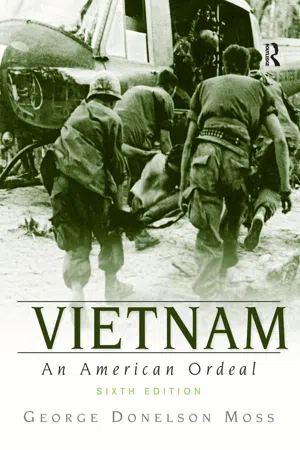
This book provides a comprehensive narrative history of U.S. involvement in Southeast Asia, from 1942 to 1975--with a concluding section that traces U.S.-Vietnam relations from the end of the war in 1975 to the present. Unlike most general histories of U.S. involvement in Vietnam--which are either conventional diplomatic or military histories--this volume synthesizes the perspectives to explore both dimensions of the struggle in greater depth, elucidating more of the complexities of the U.S.-Vietnam entanglement. It explains why Americans tried so hard for so long to stop the spread of Communism into Indochina, and why they failed. Key topics: The Fall of Saigon: The End as Prelude. Vietnam: A Place and A People. The Elephant and the Tiger. An Experiment in Nation Building. Raising the Stakes. Going to War. The Chain of Thunders. The Year of the Monkey. A War to End a War. The End of the Tunnel. Market: For anyone curious to know about the long American involvement in Southeast Asia, 1942-1975.
- 456 pages
- English
- ePUB (mobile friendly)
- Available on iOS & Android
eBook - ePub
About this book
CHAPTER 1
Origins of American Interventions in Southeast Asia
THE JAPANESE OCCUPY INDOCHINA
World War II marked a rapid expansion of the power and influence of the United States everywhere in the world, including Southeast Asia. Long before the 1940s, the United States had acquired major economic, political, and strategic interests in Southeast Asia. The United States became an imperial power with important colonial possessions in that region when it wrested the Philippine archipelago and the island of Guam from the Spanish following the Spanish-American War. During the first few decades of the twentieth century, the United States developed a thriving trade with the Southeast Asian colonies of Great Britain, France, and the Netherlands. From Malaya came tin and rubber, from the Dutch East Indies came rubber and oil, and from Vietnam came rubber. During the early 1940s, the exigencies of world war thrust America into more prominent roles in the political affairs of this vital region. These wartime experiences confirmed the American sense of Vietnam’s significance as a source of foodstuffs and raw materials and as a strategic location astride major shipping lanes linking India, China, Japan, and the islands of Southeast Asia.
The fall of France in June 1940 created serious diplomatic problems for the United States. President Franklin Roosevelt despised the collaborationist government the Germans allowed the French to establish at Vichy. However, he granted it diplomatic recognition to forestall German occupation of the French colonies in North Africa and—unsuccessfully—the Japanese occupation of Indochina. U.S. officials were angered by French acquiescence in the Japanese penetration of Vietnam. From their perspective, it appeared that French officials made little effort to resist Japanese demands and settled rather comfortably into a joint occupation with them. U.S. officials also perceived that possession of Indochina gave the Japanese strategic leverage in Southeast Asia for its continuing war with China. They later attributed many of the Japanese successes in conquering Southeast Asian territories, including the Philippines during 1941 to 1942, to their use of Indochina as a base of operations.
It was the Japanese move into all of Indochina in the summer of 1941 that probably made war between the United States and Japan inevitable. Roosevelt viewed Japanese entry into that strategic region as a clear sign that the Japanese planned further imperialistic moves into the southeast Pacific region. The U.S. response to Japan’s takeover of all of Indochina was to cut off Japan’s supply of oil. The oil cutoff created a crisis for the Japanese leaders. With only six weeks of oil reserves on hand, the Japanese would have to get the oil embargo rescinded quickly or find a new source of supply to prevent their war machine and industrial economy from grinding to a halt. U.S. and Japanese negotiators met through the summer and fall of 1941 to try to resolve their conflicts. As the price for restoring Japan’s oil supplies and other trade goods that had been embargoed, Washington demanded that the Japanese get out of China and Indochina. These terms proved unacceptable to Japan, who would not consider abandoning their expansionist ambitions. They opted for war with the United States rather than surrender their dreams of empire. The Japanese response came on December 7, 1941, at Pearl Harbor, which brought the United States into the Asian war. Soon afterward, the Japanese, using Vietnam as a staging area, occupied the East Indies and began extracting oil from this former Dutch colony. The Japanese also made use of Vietnamese ports as depots for the resources they were getting from their newly conquered empire in Southeast Asia.
The Japanese move into Indochina brought the first U.S. military intervention into Vietnam in early 1942, about a month after America had entered the war. Cutting the Japanese lifeline from Southeast Asia and denying the Japanese use of air bases in Vietnam for continuing attacks on China became major objectives of the American Volunteer Group, famed as the “Flying Tigers,” under the command of General Claire L. Chennault. The Flying Tigers operated under the control of the Chinese Nationalist Army. Flying out of bases in southern China, the Flying Tigers, in early 1942, began attacking Japanese airfields in northern Vietnam.1
As the war progressed, the future political status of Indochina became a diplomatic problem among the wartime allies. It was tied to a larger issue, the postwar fate of the European Asian empires. On the one hand, U.S. officials, faithful to Atlantic Charter war aims, firmly opposed the restoration of colonial imperialism in Asia. Liberation from Japanese occupation was to be followed by independence. The end of colonialism in Asia would liberate subject peoples, open markets to U.S. exports, and bring stability to turbulent regions. On the other hand, President Roosevelt had an understanding with British Prime Minister Winston Churchill that the Atlantic Charter did not apply to British colonial possessions, particularly India. But in a private conversation with Secretary of State Cordell Hull, Roosevelt made clear early in 1944 the kind of future he envisioned for Indochina:
France has had the country—30 million inhabitants—for nearly one hundred years, and the people are worse off than they were at the beginning. . . . France has milked it for one hundred years. The people of Indochina are entitled to something better than that.2
Charles De Gaulle, the leader of the Free French government-in-exile, whom Roosevelt disliked intensely, joined with Churchill in an effort to thwart Roosevelt and forestall the loss of Indochina after the war. Churchill, linking De Gaulle’s attempts to retain France’s Asian colonies with his own efforts to cling to empire, supported De Gaulle. The colonial issue created fissures in the wartime alliance’s conduct of the war in Southeast Asia. The British tried to claim wartime jurisdiction of Indochina, which the Americans had assigned to the China theater. Roosevelt, perceiving Churchill’s strategy, blocked the British efforts by ordering that no U.S. aid would go to French forces in Indochina and forbade the British to conduct military operations in the region without clearance from the U.S.-China command.3
Pursuing efforts to prevent a return of French colonialism in Vietnam, Roosevelt asked Jiang Jieshi, the nationalist leader of China, if he wanted to govern Indochina. The answer he received was an emphatic, “No!” Jiang, aware of Vietnam’s long history of resistance to Chinese colonialism, told Roosevelt that the Vietnamese were not Chinese. They would not assimilate into the Chinese people.4 Following Jiang’s rejection, Roosevelt proposed the creation of an international trusteeship for Indochina until the people were ready for independence.5
Roosevelt understood that the collapse of European colonial authority in Southeast Asia had created a power vacuum, and he was openly hostile to British, Dutch, and French colonialism in those regions. He was an anti-imperialist ideologue to the core. He especially wanted to see Vietnam freed of the burden of French colonialism. He was motivated in part by the desire to punish the French for their wartime capitulation to the Axis, and he wished to shear off one of their prized imperial possessions. He also sensed that the days of Western imperialism in Asia were ending and that colonialism promoted imperial rivalries that led to war. He wanted to make use of a historic opportunity to liquidate French imperialism in Southeast Asia and align U.S. foreign policy with the forces of Asian nationalism. At various international conferences among the Allied leaders during World War II, Roosevelt pursued his idea of an international trusteeship for Vietnam that would prevent the return of French colonialism and provide for the eventual restoration of sovereignty to the Vietnamese.
THE VIETMINH REVOLUTION, AUGUST 1945
While world leaders quarreled over the political future of Indochina, Vietminh guerrillas carried out espionage missions and raids on Japanese forces occupying northern Vietnam. The Vietminh also used their wartime guerrilla activities and the prestige gained from their American connections to strengthen their leadership of the Vietnamese nationalist movement. In December 1944, in the Cao Bang province, Ho Chi Minh ordered the creation of a military division of the Vietminh, the Vietnamese Liberation Army. During the winter of 1944 to 1945, under the leadership of Vo Nguyen Giap, Vietminh guerrillas gained control of three northern provinces and engaged Japanese forces in sporadic combat.6
Beginning in the spring of 1945, the Vietminh received support from an Office of Strategic Services (OSS) contingent operating out of the U.S. China Mission at Kunming. The Vietminh and OSS units collaborated to hasten the defeat of the Japanese. The Vietminh helped OSS commandos rescue downed U.S. pilots and escaped prisoners, accompanied them on sabotage missions, and provided them with information on Japanese troop movements in Vietnam. The OSS in return provided the Vietminh with radios, small arms, and ammunition.
The OSS officers served with the Vietminh at Ho Chi Minh’s headquarters at Pac Bo. The Americans came to know many of the Vietminh leaders and assisted them in their struggle for national independence. Ho energetically cultivated the American OSS officers. Like other Asian nationalists, Ho and the guerilla commander Vo Nguyen Giap assumed that the United States would support the Vietminh drive for independence. The OSS officers who knew Ho Chi Minh viewed him as a Vietnamese patriot who would subordinate his Leninist revolutionary principles to the larger cause of national liberation. For their part, the Vietminh leaders viewed this small group of American OSS officers working with them to defeat the Japanese as a symbol of liberation, not only from the Japanese occupation but also from 80 years of French colonial rule.7
By early 1945, U.S. and British forces had reclaimed many of Japan’s wartime Southeast Asian conquests. They had liberated important territories, including the Dutch East Indies, Malaya, and the Philippine archipelago. Confronted with their rapidly shrinking assets in Southeast Asia, Japan made a determined effort to hold its vital Indochina positions. Aircraft operating from carriers of the U.S. Third Fleet in the Gulf of Tonkin began attacking Japanese shipping. Army Air Corps bombers from Clark Field in the Philippines carried out raids on Saigon and Danang, destroying Japanese warships and freighters. Within a few months, American planes had closed Japanese supply lines from Vietnam to China and their home islands. U.S. bombers knocked out all railway linkages between Vietnam and China. Indochina was cut off from the remaining Japanese theaters of war.
These U.S. air raids signaled that the end of the Japanese presence in Indochina was fast approaching. Many of the French in Vietnam, who had collaborated with the Axis for years, prepared to join the fight for Vietnam’s liberation from Japan. Sensing the changed French attitudes, the Japanese moved to prevent French action against them. On March 9, 1945, the Japanese abruptly brought the 80-year-old French rule over the Indochinese people to an end. In a series of lightning raids that took the French by surprise, Admiral Decoux and many officials were arrested, and most French soldiers were disarmed and interned. Thousands of French nationals were also interned. Only a few hundred managed to escape to the hills. Some joined the Vietminh guerrillas; others fled to China. Japanese officials seized control of the Indochina government.8
In their efforts to retain control of Vietnam, the Japanese also installed a Vietnamese government headed by Emperor Bao Dai, who for 10 years prior to the war had been the French-controlled ruler of Annam from his palace in Hue.9 Japanese officials informed Bao Dai that he was the ruler of an “independent” nation that had been “liberated” from the French imperialists. In reality, the Japanese were going through a desperate charade. The new government had neither the resources nor the power to command. Japanese Army officers remained in control of Vietnamese affairs. Bao Dai also understood that Japa...
Table of contents
- Cover
- Half Title
- Title
- Copyright
- Contents
- PREFACE
- ACKNOWLEDGMENTS
- 1 ORIGINS OF AMERICAN INTERVENTION IN SOUTHEAST ASIA
- 2 THE FRENCH INDOCHINA WAR, 1946-54
- 3 AMERICA'S DIEM EXPERIMENT
- 4 AMERICA RAISES THE STAKES IN VIETNAM, 1961-63
- 5 AMERICA GOES TO WAR, 1964-65
- 6 WAGING LIMITED WAR IN VIETNAM, 1965-68
- 7 THE POLITICS AND DIPLOMACY OF WAR, 1965-68
- 8 THE TET OFFENSIVE, JANUARY 30 TO MARCH 31, 1968
- 9 AFTERMATH OF THE TET OFFENSIVE, APRIL-DECEMBER 1968
- 10 NIXON'S VIETNAM WAR, 1969-71
- 11 NIXON'S VIETNAM WAR, 1971-73
- 12 ENDING THE WAR: DECLINE AND FALL OF SOUTH VIETNAM, 1973-75
- 13 LEGACIES OF A WAR
- TABLES
- GLOSSARY
- CHRONOLOGY OF AMERICAN INTERVENTION IN VIETNAM, 1954-75
- BIBLIOGRAPHY
- INDEX
Trusted by 375,005 students
Access to over 1.5 million titles for a fair monthly price.
Study more efficiently using our study tools.
Frequently asked questions
Yes, you can cancel anytime from the Subscription tab in your account settings on the Perlego website. Your subscription will stay active until the end of your current billing period. Learn how to cancel your subscription
No, books cannot be downloaded as external files, such as PDFs, for use outside of Perlego. However, you can download books within the Perlego app for offline reading on mobile or tablet. Learn how to download books offline
Perlego offers two plans: Essential and Complete
- Essential is ideal for learners and professionals who enjoy exploring a wide range of subjects. Access the Essential Library with 800,000+ trusted titles and best-sellers across business, personal growth, and the humanities. Includes unlimited reading time and Standard Read Aloud voice.
- Complete: Perfect for advanced learners and researchers needing full, unrestricted access. Unlock 1.5M+ books across hundreds of subjects, including academic and specialized titles. The Complete Plan also includes advanced features like Premium Read Aloud and Research Assistant.
We are an online textbook subscription service, where you can get access to an entire online library for less than the price of a single book per month. With over 1.5 million books across 990+ topics, we’ve got you covered! Learn about our mission
Look out for the read-aloud symbol on your next book to see if you can listen to it. The read-aloud tool reads text aloud for you, highlighting the text as it is being read. You can pause it, speed it up and slow it down. Learn more about Read Aloud
Yes! You can use the Perlego app on both iOS and Android devices to read anytime, anywhere — even offline. Perfect for commutes or when you’re on the go.
Please note we cannot support devices running on iOS 13 and Android 7 or earlier. Learn more about using the app
Please note we cannot support devices running on iOS 13 and Android 7 or earlier. Learn more about using the app
Yes, you can access Vietnam by George Donelson Moss in PDF and/or ePUB format, as well as other popular books in History & Asian History. We have over 1.5 million books available in our catalogue for you to explore.