- 235 pages
- English
- ePUB (mobile friendly)
- Available on iOS & Android
eBook - ePub
About this book
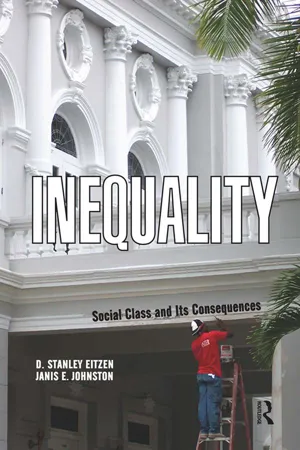
This book offers an up-to-date portrait of the realities of social class and its consequences in the United States today, focusing on the increasing inequality gap; the shrinking middle class; the myth and realities of social mobility; the consequences of class for work, health care, education, the justice system, war, and the environment; and progressive solutions for reducing inequality and improving human life.
Information
Part I
Dimensions of Social Stratification
CHAPTER 1
SOCIAL CLASS IN AMERICA
One’s position in the American class system defines the opportunities that she or he has within that system. People live in neighborhoods with others of their social class, they go to schools with people who share their social class, and they marry within their social class. The lines between the social classes act as barriers that most people never cross. In general, if you begin life in the lower class, you end life in the lower class. If you begin life in the upper class, you end life in the upper class. As Scott and Leonhardt point out in the first reading, however, the line that divides the social classes is no longer as apparent as the line that existed when our grandparents, or their grandparents, were young.
The blurring of the lines between the classes has led some to believe that the United States is moving toward a society in which class is no longer the factor that it once was. The evidence, however, points to the contrary. Membership in the upper class really does provide people with opportunities that are not available to the lower classes. Students from the upper class have access to the best schools, the best teachers, and the best technology. The affluent have access to the highest-quality health care, and can afford to follow doctors’ recommendations and pay for prescription medications. People in the upper class have access to better legal advice, are better equipped to survive a natural disaster, and live in safer neighborhoods than people in the lower classes.
Social class even affects how people travel; for example, the well-to-do can better afford to fly. A more pressing difference between the social classes, however, concerns automobile travel—specifically, access to safe vehicles and highways. Members of the upper class are not only likelier to drive automobiles that are equipped with the latest in safety technology (anti-lock braking systems, computer adjustment to the wheels in bad weather, air bags, and access to immediate help through satellite systems), but they also enjoy greater access to safe roads. Toll roads are the latest in safe roads, but they require travelers to pay a fee. The number of toll roads is increasing, as is the cost. Consider E-470, for example. This is a toll road that skirts the east side of Denver, Colorado. A driver who traverses the entire 46.10 miles of E-470 in a standard passenger car now pays $9.75 one-way. Moreover, the building of toll roads often means that public roads in adjacent areas receive only minor attention and may not be improved as conditions warrant, so as to encourage drivers to take the toll road instead. This problem has recently come to public attention in the form of a debate over toll roads. Consider the proposed improvements to C-470, another toll road in Colorado. As noted in the Denver Post (Leib, 2006, p. 1A), the proposed improvements are “an expensive approach to congestion that favors a minority of motorists who can afford high tolls, leaving most drivers mired in clogged, adjacent, free lanes at peak travel times.” Additionally, Denver has just opened its “high-occupancy vehicle” lanes to solo drivers who agree to pay a toll. Yes, social classes still exist, and one’s membership in a social class does matter.
Children born in the baby-boom generation grew up with the idea that they would have a better life than their parents—that they would be upwardly mobile. They also believed that their own children would be better off than they themselves, a dream that is rapidly becoming more difficult to obtain. Upward mobility is elusive, whereas its counterpart, downward mobility, is a reality for many Americans. With company downsizing, the movement of technical jobs out of the United States, bankruptcies and scandals resulting in the elimination of jobs and retirement accounts, and the crash of the “dot-commer” industry, many people in this country have learned, firsthand, what downward mobility really means.
Social class is not a choice, it is not an option, and it is not disappearing. Social class colors every aspect of a person’s life. Part I of this book introduces the issues related to social class with three readings that discuss class in U.S. society. The first of these describes the class system in the United States; the second one describes the working class; and the final selection portrays the lower class.
REFERENCES
- Leib, Jeffrey. 2006. “A Fork in C-470 May Sway How State Adds Lanes,” Denver Post, May 30, pp. 1A, 12A.
1. SHADOWY LINES THAT STILL DIVIDE
Janny Scott and David Leonhardt
There was a time when Americans thought they understood class. The upper crust vacationed in Europe and worshiped an Episcopal God. The middle class drove Ford Fairlanes, settled the San Fernando Valley and enlisted as company men. The working class belonged to the A.F.L.-C.I.O., voted Democratic and did not take cruises to the Caribbean.
Today, the country has gone a long way toward an appearance of classlessness. Americans of all sorts are awash in luxuries that would have dazzled their grandparents. Social diversity has erased many of the old markers. It has become harder to read people’s status in the clothes they wear, the cars they drive, the votes they cast, the god they worship, the color of their skin. The contours of class have blurred; some say they have disappeared.
But class is still a powerful force in American life. Over the past three decades, it has come to play a greater, not lesser, role in important ways. At a time when education matters more than ever, success in school remains linked tightly to class. At a time when the country is increasingly integrated racially, the rich are isolating themselves more and more. At a time of extraordinary advances in medicine, class differences in health and lifespan are wide and appear to be widening.
And new research on mobility, the movement of families up and down the economic ladder, shows there is far less of it than economists once thought and less than most people believe. In fact, mobility, which once buoyed the working lives of Americans as it rose in the decades after World War II, has lately flattened out or possibly even declined, many researchers say.
Mobility is the promise that lies at the heart of the American dream. It is supposed to take the sting out of the widening gulf between the have-mores and the have-nots. There are poor and rich in the United States, of course, the argument goes; but as long as one can become the other, as long as there is something close to equality of opportunity, the differences between them do not add up to class barriers.
Over the next three weeks [May and June 2005], The [New York] Times will publish a series of articles on class in America, a dimension of the national experience that tends to go unexamined, if acknowledged at all. With class now seeming more elusive than ever, the articles take stock of its influence in the lives of individuals: a lawyer who rose out of an impoverished Kentucky hollow; an unemployed metal worker in Spokane, Wash., regretting his decision to skip college; a multimillionaire in Nantucket, Mass., musing over the cachet of his 200-foot yacht.
The series does not purport to be all-inclusive or the last word on class. It offers no nifty formulas for pigeonholing people or decoding folkways and manners. Instead, it represents an inquiry into class as Americans encounter it: indistinct, ambiguous, the half-seen hand that upon closer examination holds some Americans down while giving others a boost.
The trends are broad and seemingly contradictory: the blurring of the landscape of class and the simultaneous hardening of certain class lines; the rise in standards of living while most people remain moored in their relative places.
Even as mobility seems to have stagnated, the ranks of the elite are opening. Today, anyone may have a shot at becoming a United States Supreme Court justice or a C.E.O., and there are more and more self-made billionaires. Only 37 members of last year’s Forbes 400, a list of the richest Americans, inherited their wealth, down from almost 200 in the mid-1980’s.
So it appears that while it is easier for a few high achievers to scale the summits of wealth, for many others it has become harder to move up from one economic class to another. Americans are arguably more likely than they were 30 years ago to end up in the class into which they were born.
A paradox lies at the heart of this new American meritocracy. Merit has replaced the old system of inherited privilege, in which parents to the manner born handed down the manor to their children. But merit, it turns out, is at least partly class-based. Parents with money, education and connections cultivate in their children the habits that the meritocracy rewards. When their children then succeed, their success is seen as earned.
The scramble to scoop up a house in the best school district, channel a child into the right preschool program or land the best medical specialist are all part of a quiet contest among social groups that the affluent and educated are winning in a rout.
“The old system of hereditary barriers and clubby barriers has pretty much vanished,” said Eric Wanner, president of the Russell Sage Foundation, a social science research group in New York City that recently published a series of studies on the social effects of economic inequality.
In place of the old system, Dr. Wanner said, have arisen “new ways of transmitting advantage that are beginning to assert themselves.”
FAITH IN THE SYSTEM
Most Americans remain upbeat about their prospects for getting ahead. A recent New York Times poll on class found that 40 percent of Americans believed that the chance of moving up from one class to another had risen over the last 30 years, a period in which the new research shows that it has not. Thirty-five percent said it had not changed, and only 23 percent said it had dropped.
More Americans than 20 years ago believe it possible to start out poor, work hard and become rich. They say hard work and a good education are more important to getting ahead than connections or a wealthy background.
“I think the system is as fair as you can make it,” Ernie Frazier, a 65-year-old real estate investor in Houston, said in an interview after participating in the poll. “I don’t think life is necessarily fair. But if you persevere, you can overcome adversity. It has to do with a person’s willingness to work hard, and I think it’s always been that way.”
Most say their standard of living is better than their parents’ and imagine that their children will do better still. Even families making less than $30,000 a year subscribe to the American dream; more than half say they have achieved it or will do so.
But most do not see a level playing field. They say the very rich have too much power, and they favor the idea of class-based affirmative action to help those at the bottom. Even so, most say they oppose the government’s taxing the assets a person leaves at death.
“They call it the land of opportunity, and I don’t think that’s changed much,” said Diana Lackey, a 60-year-old homemaker and wife of a retired contractor in Fulton, N.Y., near Syracuse. ...
Table of contents
- Cover
- Half Title
- Title Page
- Copyright Page
- Table of Contents
- Preface
- Introduction
- Part I: Dimensions of Social Stratification
- Part II: The Consequences of Class
- Part III: Reducing Inequality
- Websites
- Credits
- Index
- About the Editors
Trusted by 375,005 students
Access to over 1.5 million titles for a fair monthly price.
Study more efficiently using our study tools.
Frequently asked questions
Yes, you can cancel anytime from the Subscription tab in your account settings on the Perlego website. Your subscription will stay active until the end of your current billing period. Learn how to cancel your subscription
No, books cannot be downloaded as external files, such as PDFs, for use outside of Perlego. However, you can download books within the Perlego app for offline reading on mobile or tablet. Learn how to download books offline
Perlego offers two plans: Essential and Complete
- Essential is ideal for learners and professionals who enjoy exploring a wide range of subjects. Access the Essential Library with 800,000+ trusted titles and best-sellers across business, personal growth, and the humanities. Includes unlimited reading time and Standard Read Aloud voice.
- Complete: Perfect for advanced learners and researchers needing full, unrestricted access. Unlock 1.5M+ books across hundreds of subjects, including academic and specialized titles. The Complete Plan also includes advanced features like Premium Read Aloud and Research Assistant.
We are an online textbook subscription service, where you can get access to an entire online library for less than the price of a single book per month. With over 1.5 million books across 990+ topics, we’ve got you covered! Learn about our mission
Look out for the read-aloud symbol on your next book to see if you can listen to it. The read-aloud tool reads text aloud for you, highlighting the text as it is being read. You can pause it, speed it up and slow it down. Learn more about Read Aloud
Yes! You can use the Perlego app on both iOS and Android devices to read anytime, anywhere — even offline. Perfect for commutes or when you’re on the go.
Please note we cannot support devices running on iOS 13 and Android 7 or earlier. Learn more about using the app
Please note we cannot support devices running on iOS 13 and Android 7 or earlier. Learn more about using the app
Yes, you can access Inequality by D. Stanley Eitzen,Janis E Johnston in PDF and/or ePUB format, as well as other popular books in Social Sciences & Politics. We have over 1.5 million books available in our catalogue for you to explore.