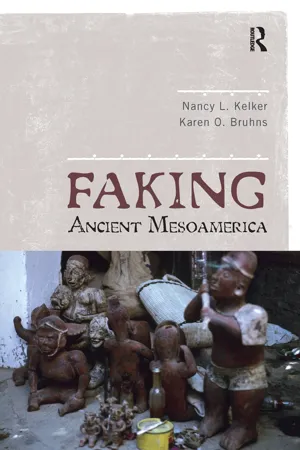
The history of antiquities forgery in Mesoamerica presents a much shorter timeline than in Europe, where the first fakes are thought to have been produced by the Phoenicians (Arnan 1961, 295–296). Most scholars believe that Precolumbian fakes were being produced at least by the seventeenth century. Indeed, it is possible that a pre-Conquest cottage industry of forgers may have sprung up around the ruins of Teotihuacán to meet the demands of pot-hunting Aztecs, who regularly went out to the “City of the Gods” to search for artifacts. The arrival of mendicant friars also may have occasioned the production of fakes as a means of satisfying the missionaries’ penchant for burning idolatrous works. However, it was not until the 1820s—post-Independence—when the borders of the formerly closed Spanish viceroyalties were opened to foreigners—that native forgers began to do serious business. The published travel accounts of such explorers as Count Alexander von Humboldt, John Stephens, and Frederick Catherwood, as well as Enlightenment notions about “noble savages,” and “lost” or “primitive” cultures, fed European interest in the exotic, unknown lands of the Americas.
The nineteenth century was the age of European colonialism, cultural imperialism, and collection building. European museums soon began acquiring antiquities, ethnographic materials, and “primitive” curiosities of all kinds, sometimes through donations of collections acquired by gentlemen-travelers, missionaries, and colonial administrators, and sometimes by sending out their own “roving curators” to obtain pieces directly. These activities created a demand that was greater than the readily available supply of antiquities, and local artisans quickly stepped in to fill the void. By the 1820s, black pottery forgeries were being produced in workshops on Tlatelolco Street in Mexico City and sold at Teotihuacán (Ekholm 1964, 22). The appeal of such “primitive” materials in industrial Europe was as a foil to their own progress and as justification for their colonization of lands belonging to these “less civilized” cultures. As Shelly Errington (1998, 5) notes, “Progressivist meta-stories of the nineteenth century sort invent, indeed depend upon, the notion of the ‘primitive,’ because the universal line of time needs a starting point from which to measure change and progress.”
Such concepts played an important role in shaping the directions fakery took in the Americas because forgeries reflect contemporary market biases. Thus, in the nineteenth century some rather hideous fakes were accepted as genuine because their crudeness reflected the dominant culture’s concepts about the savage nature of the presumed ancient makers. Even today, some novice collectors equate crudeness with authenticity. Still other collectors sought a “primitive” art that was more congruent with Western concepts of aesthetics and refinement. Savvy forgers were quick to accommodate, incorporating classical ratios of proportion and contrapposto movement into their designs. Today many of these Westernized fakes still hold their appeal (and their places in museums) because they seem more familiar, more understandable, than true antiquities. Even the condition of fakes is determined by the market. The Victorians, for example, were rather fussy about their knickknacks, preferring them to be perfect, whole, and overly ornamented, thus giving a market advantage to dandified forgeries over genuine but damaged artifacts. Conversely, some collectors assume that genuine artifacts show signs of wear and tear, and forgers will play to their assumptions by skillfully chipping away parts to give their fakes the look of great age.
Much of our current thinking about fakes and forgeries continues to be shaped by this legacy of nineteenth-century primitivism. Because conventional wisdom holds that fakes and forgeries are made by horrid, nasty fellows, lacking in imagination, it is erroneously assumed that fakes are always copies: “forgeries require authentic objects to emulate, as well as skilled makers” (Coe and Miller 2005, 18). Using this sort of rationale, it would be an easy task to identify a forgery: one would simply compare it to the masterwork that spawned it and dismiss the copy. Of course, one could also run the risk of occasionally tossing out a few authentic antiquities that were created as multiples, but a little breakage is to be expected in any endeavor.
More dangerous is that this sort of Western-biased thinking leads to authentications ad ignorantiam: if originality equals truth, then eccentric works without known precedent are deemed to be genuine because they imitate no known models. This is simply not the case. Forgeries of Precolumbian art reflect a wide range of skill levels, ranging from the mere copy to the pastiche to the original forgery or “replivention.” In addition, there are the shadowy categories of “near fakes,” including “false restorations”—antiquities that have been so overly restored that there isn’t much “real” work left—and “faked-on originals”—genuine but plain (undecorated) artifacts acquired by forgers as “blanks” and then painted to significantly increase their market value. A frequently encountered category of “faked-on originals” are plain (or sandpapered) Maya cylinder vases that have been repainted in ancient Maya styles. The prolific “Don Honorato”1 of El Salvador explained to Bruhns in detail how he made these “restorations” (which were, of course, actually forgeries intended for the art market). Don Honorato always worked in acrylic. Now, you would think that a buyer would have his Q-tip™ and a bottle of alcohol or fingernail polish remover at the ready to test the pigment, since the ancient Maya did not paint in acrylic—but maybe buyers just don’t want to know, anyway. Honorato says that if the vessel was broken, he would rejoin the pieces with white glue, painting the traces of the breaks with a little gesso mixed with ground clay. An old break or one that did not fit would be ground down and the lacunae filled with gesso, which was then painted to match the background. These are legitimate restoration techniques, although this is not what was intended here. Don Honorato says that sometime after he began his “restoration” business, Sherwin-Williams began to manufacture Kemvar™, a sealant not affected by the common organic solvents. Both he and dealers immediately began to use it to finish off the repainted vessels. Kemvar reportedly makes the vessel a bit yellower if applied too thickly, but mainly it makes a vessel look like it was originally polished. Don Honorato claimed that the dealers he knew would carefully brush it on over the newly painted pots, making them look beautifully burnished and resistant to any attempts to find out if something more modern than slip had been used in their fabrication.
THE COPY: IMITATION IS THE SIMPLEST FORM OF FAKERY
The crudest form of fakery is the copy, which replicates an existing work without alteration; this is the bottom rung of the forgery trade. These are the more common forgeries that are sold to tourists at archaeological sites and in curio shops, that show up regularly on Internet auctions, and that appear occasionally in American sales galleries. Often these faux works find their way into museums as part of donated collections or as the result of curatorial inexperience or naiveté. Some of these pieces may have actually started out as legally sanctioned, but impermanently marked, reproductions that were sold by unscrupulous dealers as the genuine article. This particular form of chicanery is far more common than any dealer wishes to admit.
The models used by copyists may be authentic antiquities or, in some cases, earlier forgeries. There are instances of the multi-generation production of fakes based on earlier fakes made by grandparents or great-grandparents. In the nineteenth and early twentieth centuries, the common means of reproduction involved making a mold of the target work. Today, modern media have made three-dimensional models unnecessary; the plethora of well-illustrated auction and exhibition catalogs—many with stunning, full-color roll-out views—provide the copyist with a wide variety of working patterns. Hard-copy sources have been further augmented by Internet databases, such as the Kerr Archive, which are consulted by forgers working in a wide range of media.
THE PASTICHE: A LITTLE BIT FROM HERE, A LITTLE BIT FROM THERE
The second, somewhat more sophisticated category of forgery is that of the pastiche, or pasticcio. The pastiche-maker borrows motifs from various sources and then assembles them hodgepodge into a new piece, which, while generally imitative, does not exactly copy any particular known work. Because the common misconception is that forgeries are always copies, the more skillful forger tries to avoid producing the sort of obvious copy-work that will mark his creations as frauds. As Claude Baudez (2002b, 11) notes:
Forgers are not foolish enough to simply copy, because they are well aware that the demonstration of plagiarism is also proof of forgery…. The forger must be able to create, combine and invent…. In a broader context, where thousands of copies exist, a certain inventiveness is required to produce the sort of spectacular work desired by collectors. The forger’s art lies in the ability to create an exception, providing it remains within certain probable limits. The closer the forger’s work comes to these limits, the more it will be sought after and the higher prices it will command.
Since the motifs borrowed by the pastiche-maker are derived from various genuine artifacts or from illustrations in archaeological reports and museum catalogs, the resulting works have the look of authenticity. The Rickards Zapotec urn forgeries are good examples of the pastiche technique. Adam Sellen (2004, 35) found that some of the false urns were created using multiple molds, which replicated parts of several different authentic urns; the resulting sections were then combined to create an assortment of highly believable faux urns.
Another variant on the pastiche incorporates elements of “false restoration.” Instead of assembling a new work from mold-made elements, the forger combines fragments from several incomplete artifacts to create a new vessel, which is then resurfaced with plaster, overpainted and lacquered (Sawyer 1982, 21–22). Since lacquer is impervious to most solvents, traditional swab-tests are ineffective, and because fragments of genuine vessels are used in the construction, thermoluminescence testing might fail to identify the work as a forgery. Sawyer describes this technique as practiced in the Andes, but it is also incredibly common in Mesoamerica and Central America. Given the lack of consensus as to where restoration ends and forgery begins, as well as a general avoidance of the ethical consideration of assembling ancient fragments into a new whole, we suspect that pastiches of various degrees are as common in Precolumbian art as they are in that of Africa and Asia (Brent 2001; Rasmussen 2008)
GILDING THE LILY
Embellishment of plain objects is a frequent means of adding value and is unfortunately a very common practice in the art world. No one seems to worry that there is a line, somewhere, between reconstruction and outright fraud. The only time this has been publically discussed was in a 1978 paper by Dicey Taylor, who brought up the inconvenient fact that a very large number of painted Maya pots should not be used for “scholarly” study because the painted scenes were over-restored. Yet even Taylor did not consider that over-restoration—painting fancy new images over the faded ancient ones—constituted outright forgery. The real problem here, aside from legal or moral issues, is that these over-restored pieces, or outright fabrications on an ancient base, are altogether too often included in photographic databases and then used to reconstruct ancient life and, especially, mythology and rituals. It is a sad commentary on Americanist scholarship that so many studies are done using such artifacts as a supposedly reliable data source.
THE ORIGINAL FORGERY: THE MASTERWORK OF THE ARTIST-FORGER
The third category is that of the “original forgery” or “replivention” created by a master artist-forger who is able to manipulate style and technique to create “original interpretations” of ancient works. History has shown that the greatest art forgers, such as the young Michelangelo, are often great artists who possess the imagination and ability necessary to exceed what scholars consider to be stylistic norms. Such “original forgeries” are neither copies of particular works nor pastiches of several works; they are independent creations. In recent times, as the career of Brígido Lara has more than amply demonstrated, these are the forgeries most likely to be the subject of authentication ad ignorantiam (originality = authenticity), as well as the most difficult to unmask. Ironically, the works of the artist-forger are of such quality that even when presented with irrefutable proof, there are those who will still refuse to believe that the false works are not genuine antiquities. Luckily for all the red-faced art historians, the Michelangelos and Brígido Laras of the world appear on the scene infrequently (we hope).
FAKING IT: COMMON MEDIA AND TECHNIQUES OF THE FORGER’S ART
The media selection for forgeries is limited only by the skill, inclination, and ambition of the forger. The ancient cultures of the New World created in clay; they carved wood, bone, shell, jade, jadeite, serpentine, basalt and a number of other stones; painted manuscripts on hides and native paper; made objects of gold, silver, and copper; worked images in feathers; decorated palace and temple walls with frescoes; and wove fine textiles of natural materials. Fakes have been created in all of these media, but in Mexico, Guatemala, and the adjoining modern states occupying the region of ancient Mesoamerica, the most common forgeries are of ceramics, stone carvings, painted manuscripts, frescoes, and, less frequently, works in wood and metal.
Ceramics
Clay is the most convenient and common medium for forgers of artifacts; it is readily available and doesn’t require much to age convincingly. Even better for the forger, ceramic material, according to Julie Jones, “is apparently among the most difficult in the world to test” (Kutner 1987). Part of this is due to the paucity of chemical and petrographic characterization of ancient clay sources. However, in many cases forgers are using the original clay sources, so testing would no...