eBook - ePub
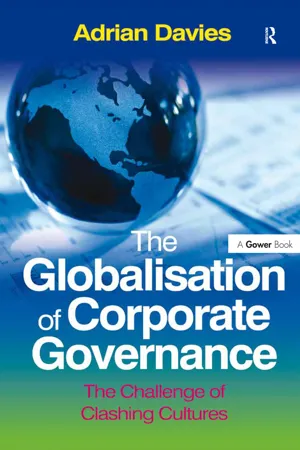
The Globalisation of Corporate Governance
The Challenge of Clashing Cultures
- 256 pages
- English
- ePUB (mobile friendly)
- Available on iOS & Android
eBook - ePub
About this book
The structure of corporate governance has made significant progress in OECD countries but it remains imperfectly linked to the activities of many businesses. Its advance on the global stage will be hesitant and slow until its practice in OECD countries is more consistent and convincing. Weaknesses in corporate governance and law enforcement are impeding the investment needed to build the global economy to its full potential. The Globalisation of Corporate Governance: The Challenge of Clashing Cultures, explores the challenges of making corporate governance effective for all participants in a global economy. The tasks of: o
CHAPTER 1
How Much Has Corporate Governance Achieved So Far? What Benefits Can Be Demonstrated?
Given that corporate governance often works against the grain of human nature, it has made considerable progress in some areas since it emerged as a public concern in the 1980s. At the heart of corporate governance is the tension between individual ambitions and the aspirations of society. This tension is inherent in any communal activity, and balancing individual and group interests is as challenging as riding a bicycle on a bumpy road. This book is a bicycle ride through the landscape of corporate governance and an attempt to see over the next hill to assess the way ahead.
The Purpose of Corporate Governance
Corporate governance has many definitions, depending on the scope it is granted. The Cadbury Committee Report in 1992 had a clear but narrow definition:
Corporate governance is the system by which companies are directed and controlled. Boards of directors are responsible for the governance of their companies. The shareholders’ role in governance is to appoint the directors and auditors and to satisfy themselves that the appropriate governance structure is in place.
This definition focuses on directors and shareholders, with shareholders devolving authority to directors and employing auditors to underpin control.
In recent years the scope of corporate governance has widened, not least because of growing recognition of the key role of companies as the wealth creators of society and of the wide range of stakeholders who are affected by their performance. The UK Companies Act 2006 now recognises stakeholders and their relationship with companies. Stakeholders are recognised in the World Bank definition of 1999, which has both a corporate perspective and a public policy perspective:
From the standpoint of the corporation, the emphasis is put on the relations between the owners, management board and other stakeholders (the employees, customers, suppliers, investors and communities). Major significance in corporate governance is given to the board of directors and its ability to attain long term sustained value by balancing these interests. From a public policy perspective, corporate governance refers to providing for the survival, growth and development of the company and at the same time its accountability in the exercise of power and control over companies. The role of public policy is to discipline companies and, at the same time, to stimulate them to minimise differences between private and social interests.
Such a definition sets corporate governance in a much wider context, particularly as companies are increasingly involved in global issues such as climate change, human rights and resources sustainability. Many large companies have developed corporate social responsibility programmes to involve themselves in such issues, with limited evidence of success to date.
The purpose of corporate governance has also evolved over time. The OECD saw the purpose in 1999 to be:
• to protect shareholders’ rights;
• to ensure the equitable treatment of all shareholders;
• to recognise the rights of stakeholders as established by law and promote the concept of good corporate citizenship;
• to ensure that timely and accurate disclosure is made of all material matters regarding the corporation, including the financial situation, performance, ownership and governance of the company;
• to ensure the strategic guidance of the company, the effective monitoring of management by the board, and the board’s accountability to the company and the shareholders.
This framework remains valid, despite some potential internal conflicts, but, like the evolving definition of corporate governance, a wider framework is now needed. Corporate governance should not be used as a vehicle for advancing social justice or any purposes which conflict with its key purpose of wealth creation. Nevertheless companies need to promote the concept of good corporate citizenship in support of their mission of creating wealth, not just obeying the law but by building a reputation for trustworthiness. Dealing with corruption is one of the core tests of effective corporate governance; fair and equal treatment for people involved with the company is another talisman of good governance. The ultimate purpose of corporate governance is to ensure the long-term survival of the company and this can only be achieved by making it indispensable to all who deal with it, rather like the ‘really useful’ storage boxes which are at the core of civilised living and enable us to survive a crowded and busy lifestyle. It is the complexity and pace of modern business life which makes effective corporate governance increasingly essential for survival. Without it we face the fate of Enron, Barings Bank or Bear Stearns.
The Drivers of Corporate Governance
Unless and until it becomes self-sustaining, corporate governance needs to be impelled and shaped by a number of ‘drivers’. These may vary between companies at the margin but the core drivers include the following:
• reaction to scandals or misbehaviour;
• reaction to excessive remuneration for the staff at the top of companies;
• reaction to competition;
• reaction to the media.
REACTION TO SCANDALS/MISBEHAVIOUR
It was the frequency of scandals in City quoted companies which led to the Cadbury Enquiry Report at the end of the 1980s. In the USA it was the activity of corporate raiders such as KKR and T Boone Pickens which stimulated interest in corporate governance. Scandals have also impelled corporate governance in the Netherlands (Ahold), Switzerland (Swissair), Italy (Parmalat), Japan (Nissan) and elsewhere. Most countries deal with their crises behind closed doors so that they do not erupt as scandals. Crédit Lyonnais was brought to the brink of bankruptcy by uncontrolled expansion; similar hubris led to the restructuring of Lyonnaise des Eaux, but both were dealt with ‘out of sight’.
It had been hoped that scandals would be less frequent and severe in the twenty-first century as corporate governance inhibited their gestation. The emergence of Enron, WorldCom, Tyco and other scandals in the USA, with Ahold and Parmalat in Europe, has demonstrated that scandals and misbehaviour are abiding risks in the corporate world. The growth in criminality globally is a key driver of corporate misdemeanour. The impact of criminality on corporate governance will be examined in detail in Chapter 4. In general, it acts as a brake on economic progress in countries where criminals can exercise political power, but can be a spur to improve governance where power is more diffuse and its exercise is subject to scrutiny.
REACTION TO EXCESSIVE REMUNERATION OF STAFF AT THE TOP OF COMPANIES
With the retreat of socialism, there has been a growing acceptance that rewards may be unequal and that outstanding contributors deserve outstanding rewards. Actors in blockbuster films and outstanding athletes have long enjoyed pay that reflects their personal contribution to the wealth created. On the other hand, opportunists throughout history have enriched themselves excessively and some have been able to pass their plunder to later generations. India, for example, has been pillaged by a succession of opportunists of whom Lord Clive was only one of the most successful and most envied. As the world has become better informed and cooperation more essential for wealth creation, self-enrichment has become more subject to scrutiny. The trusts set up by J P Morgan and others in nineteenth-century USA created polarities of power which had to be broken up to protect society. Ever since, entrepreneurs and putative cartels have been watched to detect incipient abuse and action has been taken, as with Microsoft, where market dominance is unreasonably exploited. The public is suspicious of ‘tall poppies’ and is usually pleased to see them cut down to size.
This sense of fairness is reflected in public attitudes to executive pay. Until around twenty years ago directors’ pay was typically some twenty times that of shop floor workers. This differential was tolerated where company performance was strong and society reflected the views of J P Morgan a century ago on the balance of risk and reward. A survey by The Guardian newspaper in 2007 showed an average boss:worker differential of 66:1 (based on salary alone) and 98:1 with other incentives. In South Africa a 2006 survey by COSATU complained of a 53:1 ratio, whereas in the USA the IPS/UFE 2007 CEO compensation survey showed large company CEOs enjoying a 364:1 ratio – earning in one day the annual pay of the average American worker, before pensions and other perquisites.
This egregious excess is justified by recipients and rewards consultants as the price of ‘leadership’. Few attempt to define this concept; despite a plethora of literature on the subject, there is no generally accepted definition of ‘leadership’ and little attempt to measure it. The power of CEOs is based on the Napoleonic model of leadership – the single galvanising force who drives his/her organisation to exemplary success. This model is increasingly challenged, both because of the leader’s total dependence on effective and loyal followers and because hubristic leadership has invariably ridden before a fall. The interplay of leadership and power is explored further in Chapter 3.
The issue of remuneration is present throughout this book, rather like the image which runs the length of a stick of candy rock. It is a key factor in our examination of sustainability since effective governance depends crucially on the support of all stakeholders and remuneration which do not reflect the real contribution of their recipients undermines the foundations of good governance.
REACTION TO COMPETITION
Monopolies are rarely models for corporate governance. External challenge is healthy for all organisations, forcing them to reappraise their performance and adopt better practices. Lack of external challenge makes organisations inward-looking and tends to encourage internal politicking. This phenomenon can be seen in some of the major utilities and in airlines like Alitalia. Even a world champion like Coca Cola is kept alert by the presence of Pepsi, and the epic struggle between Boeing and Airbus leaves neither with any respite from meeting new challenges.
Companies facing intense competition are forced to maximise productivity and to innovate to maintain profitability. Competition is the visible working of Adam Smith’s ‘invisible hand’ and creates the pressures which can only be sustained by effective corporate governance. Companies like Rolls-Royce survive by constantly renewing themselves, which demands value systems and operating processes to which all employees and other stakeholders are totally committed.
Competition itself is driven by change and needs constantly to adapt to new realities. Competition is the manifestation of a Darwinian struggle for survival of companies in a specific marketplace. It can be ‘destructive competition’ which seeks to eliminate all rivals and monopolise the market, or it can be ‘cooperative competition’ which seeks to expand the market for the benefit of all participants. Most companies would like to succeed in ‘destructive competition’ but are restrained by costs and the fear of regulatory intervention if they become too dominant. This may be seen in the continuous attempts by Intel to marginalise competition from AMD in the computer chip market. ‘Cooperative competition’ can also be hazardous when it involves the creation of cartels or agreements in restraint of trade. Keeping competition honest or substituting for a lack of competition where utilities exercise a ‘natural monopoly’, is a key role of regulators. The influence of regulation on corporate governance is examined in detail in Chapter 6.
REACTION TO THE MEDIA
Referring to the media as the ‘fourth estate of the realm’ recognises their pervasive power in society. The media are also a stakeholder in most organisations, rarely at the wish of management but as ineluctable as HMRC. The media are rarely passive and pursue an agenda largely of self-interest. The media are drivers of corporate governance, not primarily to improve society but to embarrass the targets which their audience distrusts and maintain their audience’s custom. The media frenzy over Northern Rock had little to do with protecting savers but everything to do with embarrassing Gordon Brown and his government.
In the context of corporate governance, therefore, the media seek stories of scandal, of greed and of incompetence which will resonate with their audience. The media are drivers of corporate governance through revealing hidden misfeasance, not by stimulating best practice. The media are adept and persistent in revealing complex plots, notable in the case of Watergate and of BCCI in a business context. Many cartels and price-fixing arrangements have been uncovered by the media, which earlier drove the movement to break up major trusts in US business such as Standard Oil.
The media do not always have a free hand in dealing with companies. A key part of the revenue of most media is advertising, much of it paid for by businesses; where the media have critical stories to tell about such businesses, they face an immediate conflict of interest. ‘Publish and be damned’ may be a dramatic and principled reaction to such a dilemma but is unlikely to be typical. Few other than the Duke of Wellington could take such an un-nuanced stand.
Perversely it may be the media which are the most effective driver of corporate governance, not by intent but through their unceasing fascination with wealth and the flow of stories which it generates. The other unrelenting driver of good governance is competition, fed by the ‘invisible hand’ of Adam Smith and the interplay of human nature.
Development of Corporate Governance To Date
The original Code of Best Practice of December 1992 was derived from the Cadbury Report, issued as a draft earlier that year. The focus of the Code is primarily on the financial aspects of corporate governance, highlighted by the scandals which had prompted the commissioning of the Cadbury Report.
Early experience of using the Code showed weakness in dealing with directors’ remuneration, which the Cadbury Code had entrusted to a Remuneration Committee of the board, following guidelines from PRoNED (the promoter of best practice in recruiting non-executive directors). In order to address this issue in greater detail, a study group was established under the chairmanship of Sir Richard Greenbury, then Chairman of Marks and Spencer plc, which reported in July 1995. ‘Directors’ Remuneration’ was the second corporate governance report in the UK and it too had a Code of Best Practice, focusing on the Remuneration Committee of the board, Disclosure and Approval Provisions, Remuneration Policy, and Service Contracts and Compensation. The Code seeks to take directors’ remuneration out of the hands of prospective beneficiaries and empower non-executive directors to use auditors and outside experts to guide policy and provision.
The Cadbury and Greenbury Codes were reviewed and consolidated into the Combined Code following an assessment of progress to date by a committee led by Sir Ronald Hampel, then Chairman of ICI plc. This committee reported in January 1998 and the Combined Code was issued in June 1998. The thrust of the report is clear from its opening paragraph: ‘The importance of corporate governance lies in its contribution both to business prosperity and to accountability. In the UK the latter has preoccupied much public debate over the past few years. We would wish to see the balance corrected.’ A decade later corporate governance remains over-focused on process and is underachieving in building strong and sustainable business performance.
Part of this failure to redress the balance may be attributed to the work of the Internal Control Working Party, set up by the Institute of Chartered Accountants in England and Wales, to provide detailed guidance on implementing the provisions of the Combined Code relating to internal control. The so-called Turnbull Report focused on different aspects of business risk and required an annual statement of risks identified and of the actions taken to manage them. This requirement led to the establishment of Risk Management Departments in major companies and to compliance procedures within the business to avoid risks. Many companies developed elaborate models of risk to guide business decisions; it is unfortunate that most of these models used only historical evidence and failed to identify new risks or changing patterns of risk. Lack of understanding of derivatives and other new trading techniques contributed to the debacle over sub-prime mortgages, which created the banking crisis of 2007. Risk management is now more crucial than ever and its role in corporate governance is considered in detail in Chapter 6.
The Combined Code was revised in 2003 in the light of two other reports – the Higgs Report on the use of non-executive directors and the Smith Report on auditing. Both were issued earlier in the same year as the new Combined Code. The Higgs Report confirms the work of earlier reports and develops the role of non-executive directors in the working of the board and its committees. Higgs expands this role both by prescribing that boards should have a majority of non-executive directors and by detailing arrangements for their appointment and activities. He also re-emphasises the need to split the roles of chairman and chief executive, and creates the role of senior independent director, who meets a new test of the independence required of a majority of board directors.
The Smith Report of January 2003 focuses on accounting and audit arrangements. It strengthens the role of the Audit Committee of the board by requiring, for larger companies, at least three independent directors to be members, with at least one member having ‘significant, recent and relevant financial experience’. The Audit Committee is to have free access to information it requires on individuals and its activities are to be detailed in the company’s Annual Report. The Audit Committee oversees internal controls, internal audit and statutory audit arrangements. The use of auditors for non-audit work is subject to stringent control. No specific provision is made for the rotation of auditors (as in the Sarbanes-Oxley Act in the USA) and this remains an unresolved issue in the UK.
In 2006 a new Companies Act was passed by Parliament after many years of gestation. The new Act replaces ...
Table of contents
- Cover Page
- Title Page
- Copyright Page
- Contents
- List of Figures
- List of Tables
- Foreword
- Introduction
- Chapter 1 How Much Has Corporate Governance Achieved So Far? What Benefits Can Be Demonstrated?
- Chapter 2 The Global Pattern of Corporate Governance. Different Approaches and Cultures; Winners and Losers
- Chapter 3 What Drives Corporate Governance? What Resists it, and Why?
- Chapter 4 How Can Human Nature and Corporate Governance Be Reconciled?
- Chapter 5 How Does Corporate Governance Relate to Globalisation?
- Chapter 6 How Can Corporate Governance Further Sustainability?
- Chapter 7 Corporate Governance Defines the Way a Company ‘Does Business’
- Chapter 8 Selected Case Studies
- Chapter 9 Scenarios for Corporate Governance in 2030
- Appendix 1: The Social Ecosystem of CSR: Mediating Among Businesses, Government and Civil Society
- Appendix 2: Seven Point Reform Plan to Restore Trust in Business and in the Global Financial System
- Appendix 3: Interview with David Paterson, Head of Corporate Governance, National Association of Pension Funds
- Bibliography
- Index
Trusted by 375,005 students
Access to over 1.5 million titles for a fair monthly price.
Study more efficiently using our study tools.
Frequently asked questions
Yes, you can cancel anytime from the Subscription tab in your account settings on the Perlego website. Your subscription will stay active until the end of your current billing period. Learn how to cancel your subscription
No, books cannot be downloaded as external files, such as PDFs, for use outside of Perlego. However, you can download books within the Perlego app for offline reading on mobile or tablet. Learn how to download books offline
Perlego offers two plans: Essential and Complete
- Essential is ideal for learners and professionals who enjoy exploring a wide range of subjects. Access the Essential Library with 800,000+ trusted titles and best-sellers across business, personal growth, and the humanities. Includes unlimited reading time and Standard Read Aloud voice.
- Complete: Perfect for advanced learners and researchers needing full, unrestricted access. Unlock 1.5M+ books across hundreds of subjects, including academic and specialized titles. The Complete Plan also includes advanced features like Premium Read Aloud and Research Assistant.
We are an online textbook subscription service, where you can get access to an entire online library for less than the price of a single book per month. With over 1.5 million books across 990+ topics, we’ve got you covered! Learn about our mission
Look out for the read-aloud symbol on your next book to see if you can listen to it. The read-aloud tool reads text aloud for you, highlighting the text as it is being read. You can pause it, speed it up and slow it down. Learn more about Read Aloud
Yes! You can use the Perlego app on both iOS and Android devices to read anytime, anywhere — even offline. Perfect for commutes or when you’re on the go.
Please note we cannot support devices running on iOS 13 and Android 7 or earlier. Learn more about using the app
Please note we cannot support devices running on iOS 13 and Android 7 or earlier. Learn more about using the app
Yes, you can access The Globalisation of Corporate Governance by Adrian Davies in PDF and/or ePUB format, as well as other popular books in Business & Business General. We have over 1.5 million books available in our catalogue for you to explore.