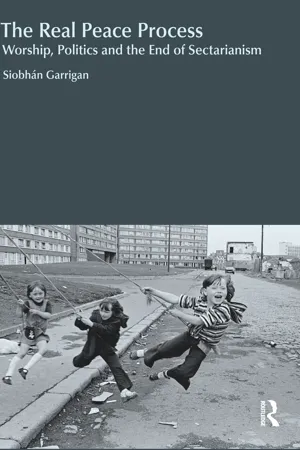
The Good Friday Agreement resulted in the cessation of paramilitary violence in Northern Ireland. However, prejudice and animosity between Protestants and Catholics remains. The Real Peace Process draws on extensive fieldwork in Protestant and Catholic churches across Ireland to analyse how Christian worship can become caught up in sectarianism. The book examines the need for a peace process that changes hearts and minds and not merely civic structures of their inhabitants. Aspects of everyday worship – ranging from the spatial and symbolic to the verbal, musical and interpersonal – are explored as the means by which sectarianism can be challenged and transformed.
- 192 pages
- English
- ePUB (mobile friendly)
- Available on iOS & Android
eBook - ePub
About this book
Information
Chapter One
Worship and Sectarianism
'One's own sectarianism is the only kind one can necessarily do anything about.'1
It would be naïve to think that everyone who goes to church does so with the sole intention of praying for their enemies. However, most people walking through a church door in Ireland think that they are doing a good thing, and they are certainly not doing so out of a conscious desire to do anyone else harm. My argument in this book is not that people going to church or leading worship are consciously engaging in sectarian activities by doing so. On the contrary, people from a wide range of religious backgrounds pray for peace in their worship and go to church as a community-building activity with positive effects beyond their own small community.
My argument is, rather, that the worship practices of many communities, contrary to the conscious peace-commitments of their members, allow congregations to engage in a series of verbal and non-verbal interactions which play out (and thereby reinforce) division and express biases and stereotypes, which produce prejudice. A striking example of this gap between what congregants understand faith to be about and what worship is actually accomplishing in the world arose in several of the churches I visited: the sermon preached peace but no peace gesture was made when the conventional time for peace-passing came. This book will present many more examples; it will demonstrate how they are in fact related to the perpetuation of sectarian devices in social life; it will suggest what might be done instead (e.g., pass the peace!); and it will imagine what the effects of such actions might be.
This chapter will introduce the foundational aspects of the study, explaining why it examines the whole island of Ireland and not just Northern Ireland; how sectarianism and its effects should be understood in this context; the extent to which religion is a factor in the Irish-British conflict; and the methodological and theoretical underpinnings of the research that forms the basis of this book. By the end of this chapter I hope it will be apparent why it is vital at this time to take full account of the role of religious practices, especially worship, in addressing sectarianism in Ireland. It should also be apparent why sectarianism is here treated as an all-island problem (and not one confined to 'the North'2), as well as why the study of religious habits can both shed light upon and offer a route beyond sectarian attitudes and practices.
The Geography of Irish Theology
I set as the scope of this book all of Ireland-Northern Ireland and the Republic of Ireland–because the four major churches on the island (Roman Catholic, Presbyterian Church in Ireland, Church of Ireland, and Methodist Church) are all-Ireland in their structures of governance, theological education and self-description. To delineate the study in this way is not to affirm implicitly a nationalist or Republican view of Irish identity, but rather to promote a view that can otherwise be denied in the Republic: that religion in the South has a direct relationship to the situation in the North and, furthermore, that its lines of responsibility and implication stretch to, and beyond, those borders. There is a tendency among residents of the Republic to perceive 'the Troubles' as having belonged to Northern Ireland alone, and for but a short period in the twentieth century, ignoring the view that they were the product of whole-country conflicts spanning several decades.3 Confounding this perception is the psychological and attitudinal legacy of these conflicts (animosity, tribalism, segregation, sectarianism, ethnic and religious hatred, etc.), which continue to be evident not just in Northern Ireland, but in the Republic too, albeit in sometimes subtle forms. One example would be how English-sounding accents are treated on the public service broadcaster Radio Telefís Éireann (RTÉ)–they are frequently ridiculed or stereotyped, and it is not usually seen as discriminatory.4
This study also takes an all-Ireland stance because although residents of the Republic have generally grown used to thinking of the violence as confined to Ulster, and to thinking of sectarianism as a Northern problem, the media has recently begun to confront the inaccuracy of such a worldview.5 Several key studies have brought to light the ways in which Irish people in the Republic as well as in Northern Ireland habitually harbour sectarian thoughts as a fundamental part of their world-view, and have challenged the country to develop awareness of these attitudes, exploring both their histories and their consequences. For example, Geraldine Smyth (the long-serving and pioneering former Director of the Irish School of Ecumenics) insists that all of Ireland is implicated in both the problem and the task of recovery that lies ahead. Speaking about the novel The God of Small Things, she says that Arundhati Roy's description of post-colonial India,
speaks to our condition in Ireland, North and South, as we experience the conflicting reactions to the dismantling of our own "History House" with all its embattled history, its mythic fascination and its restless train of never-satisfied ghosts. For those with a neurotic craving for order and security, resting inside the "History House", warmed by the influence of totalitarian politics, "communalist" culture, or fundamentalist religious constructions can feel normal.6
Sectarian hatred is very much alive in the South, and it is the sibling, not the distant cousin, of that which is so much more apparent in the North. At the height of the hunger strike crisis (August 1981), the then Toaiseach,7 Dr. Garret Fitzgerald, received substantial criticism for saying that the Irish state at that time, 'was not the non-sectarian state that the national movement for independence had sought to establish, one in which Catholic, Protestant and Dissenter would feel equally at home; it had rather become a state imbued with the ethos of the majority in our part of the island' (by which he meant the religious ethos of Roman Catholics). Considering the possibility of an all-Ireland republic of the sort for which successive historical figures in those movements for independence had fought, he lamented its unlikelihood under present circumstances, commenting that, 'If I were a Northern Protestant today, I cannot see how I could be attracted to getting involved with a state that is itself sectarian ... [in] our laws and our constitution, our practices, our attitudes'.8
Some might think that the generation since the hunger strikes has seen an end to all that Fitzgerald was talking about, what with the changes to the constitution brought about by the removal of the bans on the availability of contraception and divorce in the 1990s, the crises of faith caused by the many scandals within the church, and the changing shape of religious identity in the Republic due to the demographics of new immigration.9 For example, Roy Foster's satirical synopsis of Ireland's embrace of modernity between 1970 arid 2000 begins with this assessment: 'as Irish people turned away from the Church, they looked to another kind of miraculous intercession: the economy.'10 However, even after many people have turned away from the church and toward other gods, the preamble to the constitution retains its Catholic-nationalist rhetoric,11 the language of the constitution is still imbued with a Catholic 'ethos',12 and, of direct relevance to this present study, the other things that Fitzgerald flagged–'our practices, our attitudes'–remain even less reformed than the constitution. Many Catholics in the Republic continue to see Catholicism as the normative religion of the State, Protestants as merely tolerated guests, and 'the North' as someone else's problem altogether.
This set of altitudes arose in the aftermath of the creation of the State, and has been remarkably resistant to change, despite the challenges to it presented by the recent arrival of immigrants and returning emigrants with their different faith traditions (or different understandings of the same faith tradition). In their acclaimed study, Ruane and Todd track the attitudes of Southern Catholics over the past 100 years and comment that: 'The South rejected partition but was required to accommodate itself to it. ... The solution the South chose was to distance itself from the North and to resist attempts by Northern nationalists to involve it. The two societies went their separate ways and Southerners recognised less and less of their own experience in that of Northern Catholics.'13 Political and economic factors played a large part in creating this divorce, what with the feeling of impotence in the face of achieving independence for all 32 counties, the impossibility of continuing Michael Collins's strategy of destabilization while running an effective government, and the sense that Ireland's pocket of viable industrial activity had been taken away. However, religious factors were combined with politics and economics in such a way that religion became polarized through these after-effects of partition. Prior to partition, the nationalist cause was and had long been something for which Protestants as well as Catholics fought. After it, with the Southern Catholics 'going their separate ways', the landscape of 'nationalism' subtly changed and was presented increasingly as a Catholic (and an anti-Protestant) concern.14
Within this polarized landscape, the things that marked a person as 'Catholic' became the things that legitimated them as 'Irish'. As one of my relations in the west of Ireland remarked in 2006 of the recent influx of immigrants: 'At least these Poles and Darkies go to Mass'; meaning, the new immigrants' participation in the core practice of Roman Catholicism (Mass) indicates they have a minimal qualification for citizenship in Irish society. Or, roughly translated: these newcomers are not fully welcome here, but they're better than Protestants, Catholicism being the constituent marker of Irishness. His assessment is shot through with ethnic and racial prejudice, but its fundamental prejudice (the one against which the others are tested and found to be relative) is an anti-Protestant one, and he is far from alone in measuring the world by this standard.
Another example is the discussion around the creation of a gaelscoil15 in Westport, Co. Mayo in the mid-1990s. A group of local residents (the majority of them 'blow ins'16) who had campaigned for the establishment of a gaelscoil argued that the school should be multi-denominational. At a series of public meetings, with local TDs17 present, a larger group (the majority of whom had been born in the town) resisted vehemently, with individuals arguing that if the school were multi-denominational and not purely Catholic, 'it would make us secular', 'they would be teaching homosexuality' and their children 'would not get a proper education'. But the premise that underpinned the argument that eventually won was that: the Irish language is the symbol of Irish identity, and Irish identity is necessarily Roman Catholic: how can you have an Irish-language school, therefore, which is not normatively Roman Catholic? The fact that the gaelscoil was so recently founded on this premise, and that a new generation is now being taught there, is further evidence that sectarian thinking is an all-Ireland problem.18
Furthermore, as post-colonial commentators increasingly note, the problem of sectarianism, which one finds played out in one form or another in former imperial territories all over the world and not just in the Irish Republic, far from being generated by indigenous mismanagement or latent tribalism (as classic imperial analyses would have it),19 is directly related to, and possibly even manufactured by, the original colonial power and the aftermath of its withdrawal. 'Lest we forget,' remark Peter Shirlow and Brendan Murtagh, 'the sectarianism of society in the UK is encouraged by a government intent upon the promotion of faith schools and legislation centred upon religious hatred. The same government that subjects the British labour market to the unfettered forces of globalisation but fails to acknowledge the causal link between that process of economic change and the ghettoisation of life along racial lines.'20 Ireland's status is (as the next chapter will suggest), far from straightforwardly 'post-colonial', and the UK's habilitation of religion in civic policies is far from straightforwardly divisive; but it cannot be denied that the 'racialization of religion'21 has been a notable feature of the historically complicated relations between British and Irish management of Ireland. Increasing awareness of the place of religion (in the form of attitudes and practices) is therefore vital to the task of first noticing and then dismantling sectarianism in this yet-young State.
Now, while I am arguing that there are grounds for taking seriously what Fitzgerald identified as the problem in the Republic (the sectarianism of our attitudes and practices), I am not suggesting for an instant that there is pari...
Table of contents
- Cover Page
- Half-Title Page
- Title Page
- Copyright Page
- Dedication
- Table of Contents
- Acknowledgements
- Preface
- Chapter One: Worship and Sectarianism
- Chapter Two: Worship and Reconciliation
- Chapter Three: Space, Gestures, Bodies and Visuals
- Chapter Four: Words
- Chapter Five: Meals
- Chapter Six: Music
- Chapter Seven: Conclusion
- Bibliography
- Index of Subjects
- Index of Names
Trusted by 375,005 students
Access to over 1.5 million titles for a fair monthly price.
Study more efficiently using our study tools.
Frequently asked questions
Yes, you can cancel anytime from the Subscription tab in your account settings on the Perlego website. Your subscription will stay active until the end of your current billing period. Learn how to cancel your subscription
No, books cannot be downloaded as external files, such as PDFs, for use outside of Perlego. However, you can download books within the Perlego app for offline reading on mobile or tablet. Learn how to download books offline
Perlego offers two plans: Essential and Complete
- Essential is ideal for learners and professionals who enjoy exploring a wide range of subjects. Access the Essential Library with 800,000+ trusted titles and best-sellers across business, personal growth, and the humanities. Includes unlimited reading time and Standard Read Aloud voice.
- Complete: Perfect for advanced learners and researchers needing full, unrestricted access. Unlock 1.5M+ books across hundreds of subjects, including academic and specialized titles. The Complete Plan also includes advanced features like Premium Read Aloud and Research Assistant.
We are an online textbook subscription service, where you can get access to an entire online library for less than the price of a single book per month. With over 1.5 million books across 990+ topics, we’ve got you covered! Learn about our mission
Look out for the read-aloud symbol on your next book to see if you can listen to it. The read-aloud tool reads text aloud for you, highlighting the text as it is being read. You can pause it, speed it up and slow it down. Learn more about Read Aloud
Yes! You can use the Perlego app on both iOS and Android devices to read anytime, anywhere — even offline. Perfect for commutes or when you’re on the go.
Please note we cannot support devices running on iOS 13 and Android 7 or earlier. Learn more about using the app
Please note we cannot support devices running on iOS 13 and Android 7 or earlier. Learn more about using the app
Yes, you can access The Real Peace Process by Siobhan Garrigan in PDF and/or ePUB format, as well as other popular books in Theology & Religion & Christian Rituals & Practice. We have over 1.5 million books available in our catalogue for you to explore.