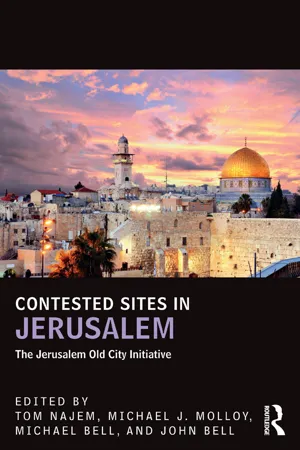
Contested Sites in Jerusalem
eBook - ePub

Contested Sites in Jerusalem

The Jerusalem Old City Initiative

  1. 230 pages
  2. English
  3. ePUB (mobile friendly)
  4. Available on iOS & Android
eBook - ePub

Contested Sites in Jerusalem

The Jerusalem Old City Initiative

About this book

Contested Sites in Jerusalem is the third and final volume in a series of books which collectively present in detail the work of the Jerusalem Old City Initiative, or JOCI, a major Canadian-led Track Two diplomatic effort, undertaken between 2003 and 2014. The aim of the Initiative was to find sustainable governance solutions for the Old City of Jerusalem, arguably the most sensitive and intractable of the final status issues dividing Palestinians and Israelis.

This book examines the complex and often contentious issues that arise from the overlapping claims to the Temple Mount/Haram al-Sharif, the role of UNESCO, and the major implications of the JOCI Special Regime for such issues as archaeology, property, and the economy. Part I is dedicated to holy sites – ground zero of the Israeli–Palestinian conflict, a point reinforced by the autumn 2014 disturbances which threatened to spiral out of control and engulf Palestinians and Israelis in yet another wave of violence. Parts II–IV of the volume contain studies on archaeology, property, and economics that were written after the completion of the Special Regime model, specifically to address in depth how a Special Regime would deal with each of these three important areas.

Contested Sites in Jerusalem offers an insightful explanation of the enormous challenges facing any attempt to find sustainable governance and security arrangements for the Old City in the context of a peace agreement between the Israelis and the Palestinians. It will therefore be of immense value to the policy-making community, as well as anyone in academia with a focus on Middle East politics, the Israeli–Palestinian conflict, and the Middle East peace process.

Trusted byĀ 375,005 students

Access to over 1.5 million titles for a fair monthly price.

Study more efficiently using our study tools.

Information

Publisher
Routledge
Year
2017
Print ISBN
9781138666566
eBook ISBN
9781317213444

PART I
Holy sites

1
OPTIONS FOR THE ADMINISTRATION OF THE HOLY PLACES IN THE OLD CITY OF JERUSALEM

Yitzhak Reiter

Introduction: the complex and multi-faceted issue of the holy places in the Old City

The issue of the holy places of Jerusalem is one of the most complicated aspects of the Israeli–Palestinian conflict. Everything connected to the Old City of Jerusalem and the holy places is not just a dispute over land but a disagreement over spaces and sites charged with religious sentiments, passionate beliefs and the symbols of national identity.
In contrast with other issues debated between the Palestinians and Israel – such as borders and refugees, which are bilateral disputes – the matter of the holy places is a multilateral issue. Israel and the Palestinian Authority have a central role in finding a solution to the problem, but there are many others whose needs have to be taken into consideration by those directly involved in the conflict. Since some of the sites deemed holiest by Judaism, Christianity and Islam are found in the Old City and its environs, any future solution to the national conflict between the Palestinians and Israel must consider the values and interests of these three religions. Furthermore, it is not likely that a settlement of the issue is possible without the participation of these additional interests, especially from Arab countries.
Since June 1967 the issue of the Old City of Jerusalem has become the problem of greatest concern in the Muslim communities outside the Holy Land. The Organization of the Islamic Conference (OIC), which brings together 57 countries, runs a special committee on the matter of al-Quds (Jerusalem). An illustration of the importance the wider Arab community ascribes to Jerusalem is Yasser Arafat’s response to the July 2000 proposal by US President Bill Clinton to re-divide Jerusalem and the Temple Mount/Haram al-Sharif (hereafter: TM/Haram or Haram/TM according to context). Arafat replied that he was not authorized to respond on his own to such an initiative and must consult with the leaders of other Muslim countries. Any arrangement for the future of Jerusalem (especially for the Old City and surroundings) and the holy sites will require the approval of the important Arab and Muslim states such as Saudi Arabia, Egypt, Jordan and Morocco. Jordan has a double role to play regarding sites holy to Islam based on clause 9b of its peace treaty with Israel and as the employer of the Waqf personnel of the Jerusalem district.
A similar claim can be made on behalf of the Jewish people living outside Israel. The Jewish Diaspora has displayed great interest in the question of Jerusalem as a whole and Israel will have to take into account the position of the Jewish world abroad (although there is no Jewish body as influential as the OIC).
The holy places of Jerusalem also hold great importance to the Christian world. In the Holy Land, and beyond, Christian communities have authority, legal status and rights regarding certain sites as well as assorted benefits for church property and clergy. Israel and the Palestinians, separately and together, respect the existing rights of the Christian churches and the Ottoman–Mandatory status quo (see following) in the places holy to Christianity and have declared their obligations both orally and in writing. However, international Christian organizations do not have great confidence in the two conflicting parties and therefore are interested in guaranteeing that no future agreement will impinge in any way on their rights in the Old City. It should be noted that, although Christianity does have ties and historical links to the Temple Mount, no Christian body today makes claims on it.

A description of the current situation and the problems it generates

The Christian status quo: historic and current

The Ottoman status quo that was anchored in edicts by the Sultan in 1852 and 1853 relates to seven Christian holy sites in Jerusalem and Bethlehem. Only two are in the Old City: the Church of the Holy Sepulcher and its parts and Deir el-Sultan, on the roof of the Chapel of St. Helena above the Church of the Holy Sepulcher. The Sultan’s edict (ā€œfirmanā€ in Turkish) of 1852 detailed the rights of the different Christian denominations in the various parts of each of the sites noted and declared that the existing rights of possession, access and worship would remain as they were at the time. The Paris negotiations following the Crimean War (1856) and the Berlin Treaty (1878) recognized these rights and ensured they would thereafter be unchangeable.1
Article 13 of the British Mandate in Palestine entrusted Great Britain with the responsibility (to the League of Nations) of guaranteeing existing rights to the holy places, their buildings and other holy sites in general and free access within the limitations necessary for maintaining public order. Article 14 declared that Britain would form a special commission with the approval of the Council of the League of Nations that would ā€œinvestigate, define, and determineā€ the different rights and claims of the religious communities over the holy places. The demand for the creation of such a commission came from the Vatican which wanted to change the conditions of the 1852 status quo for the benefit of the Catholic Church. The commission was never created owing to disagreements over its composition (the Vatican wanted a majority of Catholic members) and Britain managed the holy places on its own, largely based on the principle of preserving the Ottoman status quo at the Christian sites and maintaining the existing situation at other sites. The 1924 Palestine Order-in-Council (holy places), which is still in force in Israel, removed ā€œholy places, religious buildings or sitesā€ from the jurisdiction of courts.2 The British government prepared a detailed guide of rights written by the British district officer Lionel Cust according to the status quo; its influence remains great to this day.3
The rule of the Hashemite Kingdom of Jordan over Jerusalem, 1948–1967, also saw to the maintenance of the status quo regarding the Christian holy places (the fate of some Jewish holy places, such as the Churva and other synagogues in the Old City and the Mount of Olives cemetery, was different). After 1967 Israel, in turn, continued the status quo regarding the Christian holy places and generally pursued a policy of preserving existing arrangements (in contrast to Israel’s activities at the Western Wall and on the TM/Haram, where significant changes were made). As to the Coptic–Ethiopian dispute over the Monastery of Deir el-Sultan, great pressure was brought to bear on the Israeli government to take a stand in the matter. The government refrained from doing so, though its officials were involved in informal negotiations between the sides. Israeli courts also see themselves as unauthorized to intervene in conflicts over substantive rights in the holy places and lay the authority to do so with the government.4 Moreover, the Christian churches, their real estate assets, their educational and communal institutions, as well as the heads of the church institutions, enjoy a special status in terms of entry permits and residence in Israel for clergy and tax exemptions on cars and other property.
The historic status quo was reconfirmed in the Fundamental Agreement signed between the Holy See and Israel in 19935 and in the agreement between the Holy See and the PLO in 2000.6 Any future agreement between Israel and the Palestinians will have to be acceptable to the local churches, international Christian organizations and, most notably, the Vatican. They are concerned not only with such matters as the status of the places holy to Christians but also with the status and the rights of their religious figures, freedom of movement within Jerusalem and access to holy sites under the control of the Palestinians and of Israel, as well as passage between the two sides. The Vatican is interested in obtaining some sort of international guarantee of these rights, since it has little confidence in either side.

The Muslim–Jewish status quo in the area of TM/Haram and the Western Wall

The situation since 1967 on TM/Haram crystallized as part of the complicated reality of Israeli rule which focused on three concerns: possible violent outbreaks by the local Muslim population, criticism by Arab and Muslim nations friendly to Israel, plus international criticism. The new modus vivendi emerged from informal contacts and unwritten agreements between Israeli authorities (municipality, police) and the Waqf administration (which was subordinate to Jordan).7 These arrangements were formulated in the context of overriding Israeli strength. The Palestinian–Muslim side lived with this, the lesser of possible evils, despite the fact that it was not an optimal situation from their point of view. The Palestinians do not recognize Israeli sovereignty on the Haram/TM but are willing to uphold the informal agreements they have made as part of an interim, temporary situation.
According to the arrangement formulated in June 1967, the Muslim Waqf – a local, Muslim, Palestinian institution tied to Jordan and, unofficially, since 1994, to th...

Table of contents

  1. Cover
  2. Half Title
  3. Title Page
  4. Copyright Page
  5. Dedication
  6. Table of Contents
  7. Notes on contributors
  8. Acknowledgements
  9. Introduction
  10. Part I Holy sites
  11. Part II Archaeology
  12. Part III Property
  13. Part IV Economics
  14. Index

Frequently asked questions

Yes, you can cancel anytime from the Subscription tab in your account settings on the Perlego website. Your subscription will stay active until the end of your current billing period. Learn how to cancel your subscription
No, books cannot be downloaded as external files, such as PDFs, for use outside of Perlego. However, you can download books within the Perlego app for offline reading on mobile or tablet. Learn how to download books offline
Perlego offers two plans: Essential and Complete
  • Essential is ideal for learners and professionals who enjoy exploring a wide range of subjects. Access the Essential Library with 800,000+ trusted titles and best-sellers across business, personal growth, and the humanities. Includes unlimited reading time and Standard Read Aloud voice.
  • Complete: Perfect for advanced learners and researchers needing full, unrestricted access. Unlock 1.5M+ books across hundreds of subjects, including academic and specialized titles. The Complete Plan also includes advanced features like Premium Read Aloud and Research Assistant.
Both plans are available with monthly, semester, or annual billing cycles.
We are an online textbook subscription service, where you can get access to an entire online library for less than the price of a single book per month. With over 1.5 million books across 990+ topics, we’ve got you covered! Learn about our mission
Look out for the read-aloud symbol on your next book to see if you can listen to it. The read-aloud tool reads text aloud for you, highlighting the text as it is being read. You can pause it, speed it up and slow it down. Learn more about Read Aloud
Yes! You can use the Perlego app on both iOS and Android devices to read anytime, anywhere — even offline. Perfect for commutes or when you’re on the go.
Please note we cannot support devices running on iOS 13 and Android 7 or earlier. Learn more about using the app
Yes, you can access Contested Sites in Jerusalem by Tom Najem,Michael Molloy,Michael Bell,John Bell,Michael J. Molloy in PDF and/or ePUB format, as well as other popular books in Politics & International Relations & Political Economy. We have over 1.5 million books available in our catalogue for you to explore.