eBook - ePub
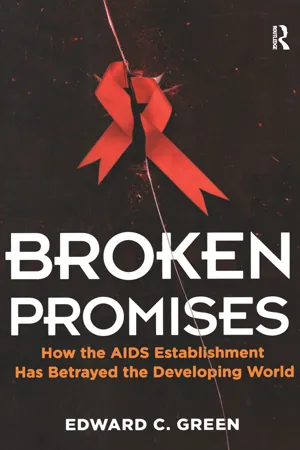
Broken Promises
How the AIDS Establishment has Betrayed the Developing World
- 267 pages
- English
- ePUB (mobile friendly)
- Available on iOS & Android
eBook - ePub
About this book
Ideological blinders have led to millions of preventable AIDS deaths in Africa. Dr. Edward C. Green, former director of the Harvard AIDS Prevention Project, describes how Western AIDS "experts" stubbornly pursued ineffective remedies and sabotaged the most successful AIDS prevention program on that ravaged continent. Drawing on 30 years of conducting research in Africa, Southeast Asia, and other parts of the world in international health, Green offers a set of evidence-based and experience-rich solutions to the AIDS crisis. He calls for new emphasis on promoting sexual fidelity, the only strategy shown by research to work. Controversial but important findings for health researchers, international development specialists, and policy makers.
Information
PART I
THE ROAD TO FIDELITY
Dissent is the native activity of the scientist.
JACOB BRONOWSKI
Science and Human Values
Science and Human Values
CHAPTER 1
Gangs, Maroons, and the Egg Taboo
Before Africa, there was an illegal trip upriver in Suriname. Before Harvard, there were the Sewer Rats. Before congressional subcommittees, there were long talks with African spirit mediums. These activities may seem irrelevant to spotting the fidelity solution and promoting it as the means to combating the spread of AIDS, but some of these activities were crucial and partly explain why others took longer.
I was born at the start of the Boomer generation that came of age in the 1960s. I grew up in a liberal family, and I still have photos of my mother with Robert Kennedy and Hubert Humphrey. My father, Marshall Green, was a career foreign service officer who rose to become a much respected ambassador, assistant secretary of state, and then a leading family-planning advocate and authority. When he died, my brother and I got a condolence cable from Henry Kissinger, who was forever grateful that my father had omitted from his memoir certain stories about Nixon’s trip to China and a world-class blunder Kissinger almost caused.
Because of my father’s career, my family often moved. I have fine childhood memories of New Zealand and Sweden. Later, in Washington D.C., I distinguished the family escutcheon by cofounding the Sewer Rats gang. We had black leather jackets with our names on the back, Elvis haircuts—the works. I began smoking (only tobacco in those days) at age twelve, got a police record for a switchblade incident of which I was most proud, and experienced the sweet taste of rebellion. Why I was the black sheep of the family I cannot say.
Starting at age ten, I attended two boarding schools for almost five years: Fay School, where actor Peter Fonda was as miserable as I was, and super-elite Groton, where my father and Franklin Roosevelt had thrived, and which I hated. The feeling was reciprocal. After I had been expelled for a “chronic negative attitude” toward authority, my mother informed me that my life was over. One bitterly cold day in January 1960, we moved to Seoul, Korea, and I enrolled at the American high school for military brats. There I disproved my mother’s dictum by cofounding the Aborigines gang and losing my virginity amid heavy drinking and wild times. I resumed my hoodlum life and started a rock-and-roll band. We played at local nightclubs and got paid partly in booze.
One day my history teacher, Mr. Hervey, caught me looking at someone else’s paper during a quiz. He confronted me and asked me if I’d like to be handed over to the principal. In a mock-indignant voice I asked him if he were man enough to step outside with me. He backed down and I felt lousy almost at once. Yet a few months later, I was surprised and rather touched when he shyly asked me if he could play his tenor sax with us at a school dance on the ‘50s hit “Tequila.” A photo of this strange rapprochement recently surfaced on the Internet.
I became the first kid in my 11th grade to get a “social” disease. I soon discovered that girls in my school were not quite as thrilled as guys about my accumulating triumphs. Still, promiscuity was the name of the game and I was clearly an all-star. In my high school yearbook for the Class of ‘62, the prophecy for me was: “Shot by a jealous husband.” Friends from this earlier life (including my ex-wife, who left me because of my infidelity) can hardly believe Ted Green promotes faithfulness these days.
I surprised my parents by entirely skipping my sophomore year. They might have been even more surprised if they’d known how I’d managed it. I happened to be in a taxi with our Korean band manager, who also worked at the high school. He had gotten a call asking him to drop everything and pick up our school principal, who was in a brothel, robbed of his money and clothes. I waited a discreet week and then went to see the principal about moving ahead one year. He decided that some courses I had taken at Groton could be considered high-school level, therefore I had earned enough credits to leap ahead a year. No mention of the previous encounter.
In other words, you won’t find my picture if you look up “prude” in the dictionary. And—as perhaps you have surmised—I have a problem with authority. I dislike it, probably more than most people, as shown by my expulsions from Groton, from summer camp, and eventually from Harvard’s Center for Population Studies (even as I write this book). I like to stick up for the weak and stick it to the rich and powerful, especially if they are arrogant. Whether my joy in puncturing these floating, self-important bags of professionalism is a bias to overcome, a form of masochism, or a useful analytic tool, I wish at least to be forthright about it.
Two powerful forces shaped my life. The first was rebellion. My parents had laid out a Life Plan for Son #2 and it differed little from that for Son #1, my well-behaved elder brother: Groton, Yale, then one or more graduate degrees, whereupon noblesse oblige nudged us away from Wall Street (“Making money is so vulgar,” my mother used to say) and toward the foreign service, an Ivy League professorship, or an Episcopal bishophood. We descend directly from the first Episcopal bishop of the United States, Samuel Seabury, who gazed down on us from the often-invoked family pantheon, along with five colonial governors. So to become my own person, I had to spurn all of the above and become a juvenile delinquent, as every logician and psychologist would agree.
The second force that shaped my life was yearning toward achievement. For all was not right with my alternative life. My mother had drummed into my head that I was a failure and would always be a failure. Not like my peerless older brother. Part of me needed to prove my mother wrong. I could be as good as my older brother—if I cared to. I just didn’t. But what if I changed my mind later on? 1 realized I shouldn’t cut off my options entirely. So the whole time I was a hoodlum, and later a hippie and druggie, I was also quietly working on a degree or a postdoc or writing an article or a book. Most of my friends didn’t know about that secret life.
The Vietnam War fed into this dualism. As tens of thousands of people in my generation died overseas and the question “Why are we in Vietnam?” stumped the officials who had started the war (including my father, then assistant secretary of state for East Asian affairs), I spent my time doing antiwar activism and, to tell the truth, getting high a lot. When LBJ tried to draft me in 1966,1 trotted out my juvie police record in the preinduction exam. They asked if I was rehabilitated, and I said, “Hell no.” They informed me I had to be, because it said right there on paper that I had a master’s degree. In the end I became a conscientious objector and performed alternative service in an all-black psychiatric ward at a D.C. mental hospital. I also served as draft counselor and wrote a column for war objectors. With my press pass I got front-row seats—once right next to peace activists Jane Fonda and Shirley MacLaine—at major antiwar events.
Meanwhile, in college at George Washington University, I was leaning toward clinical psychology, through which I hoped to gain insights into why I felt generally alienated from the human race. But before long I discovered an entire academic field of study—a profession—peopled by the alienated: anthropology. The literary theorist Susan Sontag had recently published an enticing essay called “The Anthropologist as Hero” about the heroic journey into the unknown that anthropologists take.1 Professors in this field wore dusty cowboy boots, offered courses in arcane subjects like “Magic, Witchcraft, and Religion,” opposed the Vietnam War, and smoked pot with their followers. It was hard to resist.
I remained in anthropology through a master’s degree and a Ph.D. because it seemed intrinsically interesting. I looked forward to total-immersion fieldwork in an exotic culture, billed by the likes of American anthropologist A. L. Kroeber as an experience far more transformative than long-term psychoanalysis. But I still had no real career goals. As a grad student in anthropology, at the age of twentysix, I set off for the South American rain forest.
Among the Maroons
I arrived in 1971 with my young wife, a one-year-old son, and our trusty mixed German shepherd Karl (he preferred the Marxist spelling) in the capital of Suriname, Paramaribo, which sprawled along the piranha-filled Suriname River. It was still a Dutch colony and would remain so until 1975.1 intended to voyage deep into the jungle to examine the impact of Dutch colonial culture on the fragile matrilineal kinship system of the Matawai. I felt privileged to be about to investigate a never-before studied tribe in the tropics, just like Margaret Mead (about whom more anon). It was an opportunity from a bygone era.
The Matawai fascinated me. They were Maroons—that is, people descended from the three hundred thousand African slaves the Dutch had shipped over to work, sweat, and die in the sugar, coffee, and cocoa plantations. Their lives had been dreadful even by slave standards. However forbidding the rain forest, it had sucked them in by the thousands. (Hence the name “Maroons,” which originally referred to domesticated animals that ran off and became wild.) When owners recaptured these slaves, they had them drawn and quartered, and hung the dismembered carcasses up on trees to discourage other slaves from flight.
The Maroons did not ignore this message. They attacked the plantations at night, freeing more slaves—including women. Soon they established “rebel societies” in the Amazon forest and developed a Creole language based on Portuguese, English, and various African tongues, sprinkled with Yiddish words (some plantation owners were Jews who had originally come from Brazil). After years of war with the Dutch, the Maroons signed a treaty that secured their independence in 1760. Thus, twenty-three years before the U.S. Revolutionary War ended, they became the first people in the Americas to win freedom from Europe. When I was in Suriname, the colonial government still paid tribute to the Maroons in the form of rum, machetes, pots, and pans in return for their remaining peaceful and not incinerating plantations.
All in all, this was just the right place for a nonconformist like me with serious authority issues. It sure beat fighting a misbegotten war half a world away. I was eager to go upriver and start fieldwork. But I had a problem. I needed to obtain formal permission from the host country to do research in tribal areas. In Paramaribo I made contact with the Matawai at a little slum building where Amerindians and Maroons from the interior could hang their hammocks, sleep, and cook during their short trips to town. On my first visit there, I met an American woman, a Ph.D. linguist, whose goal was to learn the language of the Saramakas, the tribe one river over from the Matawai. She had been waiting for formal government approval for two years. The closest she ever came to her tribe was this part of town.
Yikes! I had only two years for my entire project.
So I went up the river with my wife, son, and dog. I simply showed up among the Matawai and began doing fieldwork. And there, day by day, I waited for someone in the government to kick me out.
I hardly expected air-conditioning and featherbeds in the jungle, but life there proved far more challenging than I’d imagined, what with killer parasites, poisonous snakes, flesh-stripping piranhas, clouds of predatory mosquitoes, vampire bats, culture shock, and broken communication in an unwritten language. My wife got a bad case of typhoid fever, and overall I realized that I’d had a laughably shallow understanding of the word “inconvenience.”
At first the Matawai thought I was a missionary who was pretending for some reason to not be one. Who else but a man of the Bible would come to live with strangers under these harsh conditions, especially with a wife and child? After I learned enough Matawai to converse, they tried a few scatological, missionary-busting songs in my presence. When I laughed in the right places, they figured, “This guy must be OK. We don’t need to worry about what we say in his presence.” In fact, they eventually became proud to have their own white family in their midst. Soon people were bringing me things to fix, like wristwatches and outboard motors. I tried to explain what a klutz was, but they insisted: “Aren’t these things made by white people? Are you not white? Please repair!”
My wife and I came to greatly admire the Maroons, the first non-Western people I came to know really well. I have a little Dutch ancestry in my blueblood lineage, so it’s possible my ancestors enslaved, tortured, and killed the ancestors of these Matawai. Yet they adopted us and treated us with the utmost hospitality. Although I proved a letdown with Paleface gadgetry, I came to see how we provided comic relief from the tedium of the tristes tropiques. Picture me in a loincloth and toga, seated with the elders at an all-night festival. The village chief would challenge other men in their twenties to name all the villages in Matawai territory, whether existing or abandoned, over the past two centuries. Men my age were learning about the outside world, via radio and trips to town, and some found the Motown sound much more worthy of attention than vanished villages. If someone failed the history test, an elder would say, “Ha! Now listen to the Curious One. He can name them all!”
In fact, I came to see that as someone intrigued by the Old Ways, I was a conservative in my adopted society yet a radical revolutionary in my own. After that epiphany I could never take political classifications as seriously as most people do. I learned something even more important. When anthropologists study an exotic culture, we practice something called cultural relativism, meaning we don’t superimpose our own moral or other judgments on the culture. For example, we do not say, “The tribe I lived with practiced a primitive, anti-Christian practice that demeans and disempowers women.” Instead, we suspend our values and simply describe what we see. That is what I learned to do with the Matawai, and that is what I have done ever since in my professional life.
This approach is scientific—we describe what is rather than what should be in our own highly important opinion—but it has a second virtue too: clarity. It forces our eyes open. When we dismiss a practice as immoral, we often see its details less precisely and its function not at all. This blurring happens automatically, and most of us are scarcely aware of it. Frankly, I didn’t think too much about it at the time eith...
Table of contents
- Cover
- Half Title
- Title Page
- Copyright Page
- Dedication
- Table of Contents
- Prologue
- Part I The Road to Fidelity
- Part II Uganda
- Part III Calamity’s Cradle
- Part IV Shifting The Riverbed
- Abbreviations and Acronyms
- Notes
- Index
- About the Author
Trusted by 375,005 students
Access to over 1.5 million titles for a fair monthly price.
Study more efficiently using our study tools.
Frequently asked questions
Yes, you can cancel anytime from the Subscription tab in your account settings on the Perlego website. Your subscription will stay active until the end of your current billing period. Learn how to cancel your subscription
No, books cannot be downloaded as external files, such as PDFs, for use outside of Perlego. However, you can download books within the Perlego app for offline reading on mobile or tablet. Learn how to download books offline
Perlego offers two plans: Essential and Complete
- Essential is ideal for learners and professionals who enjoy exploring a wide range of subjects. Access the Essential Library with 800,000+ trusted titles and best-sellers across business, personal growth, and the humanities. Includes unlimited reading time and Standard Read Aloud voice.
- Complete: Perfect for advanced learners and researchers needing full, unrestricted access. Unlock 1.5M+ books across hundreds of subjects, including academic and specialized titles. The Complete Plan also includes advanced features like Premium Read Aloud and Research Assistant.
We are an online textbook subscription service, where you can get access to an entire online library for less than the price of a single book per month. With over 1.5 million books across 990+ topics, we’ve got you covered! Learn about our mission
Look out for the read-aloud symbol on your next book to see if you can listen to it. The read-aloud tool reads text aloud for you, highlighting the text as it is being read. You can pause it, speed it up and slow it down. Learn more about Read Aloud
Yes! You can use the Perlego app on both iOS and Android devices to read anytime, anywhere — even offline. Perfect for commutes or when you’re on the go.
Please note we cannot support devices running on iOS 13 and Android 7 or earlier. Learn more about using the app
Please note we cannot support devices running on iOS 13 and Android 7 or earlier. Learn more about using the app
Yes, you can access Broken Promises by Edward C Green in PDF and/or ePUB format, as well as other popular books in Medicine & Health Policy. We have over 1.5 million books available in our catalogue for you to explore.