eBook - ePub
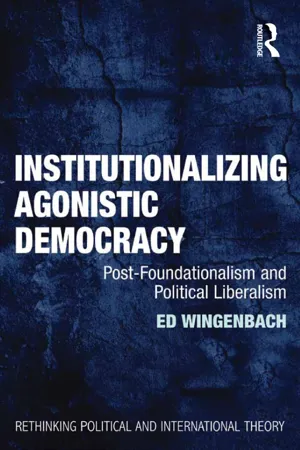
Institutionalizing Agonistic Democracy
Post-Foundationalism and Political Liberalism
- 238 pages
- English
- ePUB (mobile friendly)
- Available on iOS & Android
eBook - ePub
About this book
The first book length study of agonism as a mature account of democratic politics, Institutionalizing Agonistic Democracy provides a lucid overview of agonistic democratic theories and demonstrates the viability of this approach for institutional politics. Situating agonistic democracy within and against debates about radical democracy, foundationalism, liberal democracy, and pluralism, Institutionalizing Agonistic Democracy engages the texts of Mouffe, Connolly, Ranciere, Tully, Honig, Owen, and others to fully map the contours of agonistic democratic theories. Organizing this diverse literature into a coherent typology enables sophisticated analysis of the assumptions, distinctions, and aspirations of the often conflicting theoretical positions gathered within the constellation of agonistic democratic theory. Using this framework to explore the concrete institutional possibilities appropriate to agonistic democracy, Wingenbach argues that a modified version of Rawlsian political liberalism describes the institutional conditions most likely to sustain agonistic political practices. Once shorn of metaphysical commitments and detached from aspirations to consensus, political liberalism offers a contingent and historically viable framework within which agonistic contestation can occur. Such a reinterpretation of Rawls produces not the sublimation of agonism but a transformation of liberalism, so that it more adequately accommodates the deep pluralism of the post-foundational condition.
Information
Part IPost-Foundationalism and Agonistic Democratic Theory
Chapter 1 Post-Foundational Politics and Democracy
DOI: 10.4324/9781315588872-2
The kilogram is losing mass. Or perhaps gaining mass. It is hard to tell. Le Grand K, a platinum-iridium cylinder housed in a suburb of Paris, has defined the standard measure of weight in the metric system since 1883. The precision with which contemporary scientists describe the mass of tiny particles, the confidence with which engineers calculate the load capacity of a bridge, or the care with which a child's growth is recorded all depend upon this one small piece of metal forged by human beings over a century ago. The International Prototype Kilogram (IPK) is the foundation for the measurement of mass everywhere the metric system is used. And nobody knows how much it weighs.
Copies of Le Grand K housed around the world norm national systems of weights and measures. The copies appear to have gained mass relative to the IPK. Or the copies remain constant and the IPK has lost mass relative to them. The direction of change cannot be resolved since a comparison of the relative weights of the kilogram and its copies is impossible; without an external reference against which to measure them all, the comparison has no meaning. If anyone knew how much “a kilogram” weighed, we could use that standard to assess the kilogram, and resolve the problem. But nobody knows this, and nobody can, since the weight of Le Grand K is, by definition, the weight of a kilogram, even if that mass has shifted.
The arbitrary mass of the kilogram reflects human practices. A system of measurement was defined and anchored to this artifact, and the artifact guarantees the system's stability. It does so even if its own status fluctuates, since the system fluctuates with it. These fluctuations cause problems, however. If the mass of the standard shifts, even slightly, then the descriptions of reality anchored to this standard shift as well, introducing error where accuracy is assumed. At a fundamental level our measurement of the mass of the natural world is indeterminate. It is indeterminate because the foundation of the system used to generate meaning is indeterminate; literally so, as no standard exists to norm the IPK apart from the IPK itself.
The indeterminacy of the mass of the kilogram could be resolved by naturalizing the standard. If the mass of the IPK were translated into a quantified, independently verifiable description, then the IPK could be abandoned and the new determinate definition used to anchor the metric system. Scientists eager to purge ambiguity from the measurement of mass are pursuing a variety of options. Some have proposed defining the gram using a multiple of Avogadro's constant. The problem with this solution is that Avogadro's constant is itself indeterminate. For this reference to work, two levels of consensus would have to be forged: first the scientific community must agree to define the constant to a specified value and then agree to ratify the relationship between the newly defined constant and the newly defined gram. A second proposal involves constructing the kilogram from a stipulated number of atoms placed in a particular configuration. The mass of these atoms in this arrangement would provide a replicable standard. Unfortunately, moving from the theoretical to physical world introduces problems of measurement similar to those posed by the IPK, as small differences between isotopes of the same atoms introduce variance of a magnitude similar to that found between the IPK and its copies. A third attempt to naturalize the kilogram involves weighing Le Grand K itself in order to generate a specific energy equivalence for the kilogram, called the watt balance. An accurate determination of the watt balance of the IPK would provide an unambiguous anchor for the measurement of mass. Problematically, to weigh Le Grand K to the degree of precision required demands an instrument so sensitive that it can be disrupted by even the tiniest vibrations. It also demands a fixed measure for the earth's gravity, and the earth's gravity is itself subject to variation based on location and season. At least two groups have measured the watt balance of the kilogram using these techniques, the National Institute of Standards and Technology in the United States and the National Physical Laboratory in the United Kingdom; their measurements are not the same (Fildes 2007).
This contingency does not render the standard capricious: a kilogram is a kilogram everywhere, even given the minor indeterminacy of the current standard, and one cannot simply assert one's own definition and expect to be understood. Recognition of the historically conditioned emergence of the particular definition of the mass of the kilogram removes none of its power, importance, or centrality to the way contemporary humans make sense of reality. The kilogram is necessary, whether in its current form as a human artifact or a future form as a numeric standard anchored in natural constants. It is, to use Butler's (1992) term, a “contingent foundation.” That the kilogram is arbitrary does not make it false. Without the kilogram the metric system would be inexplicable. A standardized kilogram permits us to understand the natural world and communicate that understanding to one another. The habits and practices of billions of people testify to its reality. The foundational character of the kilogram dominates its contingent status, to the point that its contingency seems irrelevant to anyone not engaged in the problem of its measurement. To ask if its value is “true” is to ask a nonsensical question. To argue that the absence of a transcendent anchor for the kilogram would produce a chaos of relativism in global measurement is to assert an absurdity.
Post-foundationalism and Politics
Much debate in contemporary political theory engages arguments analogous to the attempt to measure the kilogram, absent the awareness of the necessary contingency of the principles debated. Political theories in the dominant mode postulate, stipulate, investigate, and deduce first principles upon which to erect justifications for political institutions and practices. Or they articulate the telos toward which human beings tend, toward which societies are directed, and under which human flourishing might be increased. Political theorists argue about whether or not these principles or claims are true, where true does not merely reference wide-spread social agreement but access to normative reality. Often these arguments recognize explicitly the pragmatic character of political behavior and institutions while implicitly introducing a quasi-transcendent standard to buttress the conclusions reached; variously, these implicit foundations include concepts like reason, human nature, the popular will, the categorical imperative, the market, human capacities, religious scripture, neurological discoveries, and so on. The post-foundational approach to political theory asserts that any normative justification for a set of coherent political claims will have at its core a kilogram. At some point a theory of politics must assert the centrality of a claim that cannot be further defended, a claim that when queried from outside the system in which it makes sense and to which it provides coherence is exposed as a contingent assertion of social will. From the post-foundational perspective all political systems are similarly dependent upon contingent foundations, whether theorized or not.
To understand the development of agonistic democratic theory it is important to distinguish post-foundationalism from anti-foundationalism. Both share a range of philosophical assumptions and draw from overlapping intellectual lineages reaching back at least to Rorty (1979), who identified “anti-foundationalism as a slogan for a complex cluster of ideas previously lacking resonant expression” (Simpson 1987: 1–2, quoted in Seery 1999: 467). These shared presumptions are described by Fish:
Anti-foundationalism teaches that questions of fact, truth, correctness, validity, and clarity can neither be posed nor answered in reference to some extracontextual, ahistorical, nonsituational reality, or rule, or law, or value; rather, anti-foundationalism asserts, all of these matters are intelligible and debatable only within the precincts of the contexts or situations or paradigms or communities that give them their local and changeable shape (1989, 344).
As anti-foundational work in political theory became more sophisticated, a divergence emerged between thinkers focused on exposing the limits of foundationalism as the key step in making emancipation possible and those emphasizing that recognition of the inevitability of founding narratives is a condition of further work to reform them (For a detailed discussion, see Marchart 2007). The two dispositions differ significantly in how they understand the status of contingent foundations and their political implications. With the caveat that all such classifications are overbroad and reductive for specific thinkers, I suggest the central distinctions between post- and anti- foundationalism lie in their disparate analyses of the necessity of foundations and their different aspirations for human emancipation. These two distinctions are rooted in a third: their understanding of the status of “truth.” Both positions recognize that the contingent foundations upon which political systems depend produce and sustain relations of power. The “givens” that ground any social order delineate the terms of social identity, determine the characteristics that will be systematically rewarded or define the terms of universality against which deviance will emerge, provide the range of acceptable values against which action will be conceptualized, and establish the appropriate domain of political questions. All of these outcomes, which shift across cultures and time as social foundations differ, shape the allocation of resources, privilege, and cultural advantages that translate into political power. Both post- and anti-foundational theorists recognize that the distribution of power emerging from a particular set of foundations also tends to render these foundations invisible, as the anchor to any system of meaning will, from within, appear inevitable.
Anti-foundationalism describes a constellation of approaches found in philosophy, literary theory, anthropology, sociology, legal theory, cultural studies, and political theory.1 Anti-foundationalist political theories suggest the narratives that impose and sustain social relations are inherently oppressive because of the necessary exclusions of difference required to maintain the illusion of totality and coherence. Foundational narratives are, on this account, always a threat to otherness, always a danger to particularity and individuality, and always reflect hegemonic power. They further assert that all such narratives must be resisted in order to open up the possibility of human emancipation. Otherness and difference can only emerge in the space created by critical resistance to hegemony and meta-narrative. Bevir describes this tendency quite well:
Anti-foundationalists stress the ineluctability of differences and hence the failings of any notion of totality or unity. Differences generate meaning in language; it prevents any meta-theory from covering the diversity of what we know; and it disrupts the romantic dream of harmony in nature and society. A related concern to defend the otherness of the individual against an invidious social power dominates post-modern political theories (2007: 48).
While the diagnosis of the danger varies amongst different thinkers, all assert some version of the claim that emancipation can only occur in resistance to foundational claims, even if such claims will always reassert themselves in some way. Identifying the failings of narratives creates space for freedom and individual creativity to emerge. By contrast, foundational claims are always hostile to difference and thus always incompatible with emancipation. The anti-foundationalist “hostility to all unities or totalities – what I would call a sort of positive aesthetic dandyism – leads them to denounce community as inimical to difference” (Bevir 2007: 48). For the anti-foundationalist, then, the role of political theory is to expose the artifice of narratives in order to permit the emergence of resistance and creativity. All foundations are problematic, because all foundations produce relations of power and meaning that undermine the emancipatory potential of human creativity, while simultaneously producing excluded and oppressed subjectivities. This description would be true even for radically democratic foundations. Little (2008: 176), drawing upon Žižek and others, argues that the “issue, then, is partly about the extent to which democracy is inclusive or exclusive but, more fundamentally, it is also about the way in which all democracies are exclusive and antagonistic to their Others, to some extent, in order to regulate the behaviour of and conduct between those who are included.” For an anti-foundationalist emancipation demands neither the improvement of narratives nor the creation of more inclusive, still imperfect, foundations, as all foundations are oppressive.
The post-foundational position shares the diagnosis of the exclusive and oppressive character of foundational narratives but rejects the conclusion that emancipation primarily demands resistance. This rejection arises not from an embrace of totality or dismissal of the emancipatory ideal but the recognition that social foundations are unavoidable. While it is accurate to assert that meaning, identity, power, and other core aspects of political life emerge contingently within the play of language and the developments of history, it is not accurate to assert that these foundations can be escaped or weakened so dramatically as to lose their hold on subjects. As social creatures without access to transcendent truths or unmediated ontological knowledge, meaning will always depend upon some constellation of assumptions shared by the community within which politics takes place. In practice, human beings rely upon foundations, regardless of their ultimate status. It is simply not possible to escape them completely, or even to relativize them so utterly that their impact is of minor consequence. We require some sort of ontology, even if only shallowly held, to render social order possible.
White's (2000) concept of weak ontology provides a useful framework to understand post-foundational claims. We experience our own histories as both contingent and fundamental. We find ourselves inhabiting a set of “ontological figures” that emerge from our situatedness in a particular history, culture, and language. We can recognize that these figures shape our subjectivity in ways that are both not optional to our identity and not fully accessible to choice or reason, while also understanding that these fundamental elements of our personal and communal identities are not “true” in any sense that exceeds our own practices and history. White's summary of weak ontology expresses the commitment of post-foundationalism (though he uses the term non-foundationalism) succinctly: “first, it holds that one's most basic commitments regarding self, other, and the beyond human are taken to be both fundamental and contestable; and, second, it holds that this contestability extends as well to one's assessments of the strong ontologies of others” (2009: 815). The necessary condition of social life is some sort of shared horizon of meaning, some sort of ground upon which politics takes place. It is important to post-foundational politics that the contingent status of this ground be made visible. It is important that pretension to universality be exposed. But it is not desirable to liberate subjects from the foundational narratives within which they unavoidably live.
Moreover, the post-foundationalist assertion of the necessity of contingently held ground allows it to evaluate the normative status of various foundational claims. For anti-foundationalism all foundations are obstacles to emancipatory politics, and all should be resisted. Post-foundationalism, by contrast, can offer judgments about the relative virtues and dangers of various ontologies and work to move any particular ontology closer to a more contingent understanding. Marchart articulates this difference when he asserts:
what came to be called post-foundationalism should not be confused with anti-foundationalism. What distinguishes the former from the latter is that it does not assume the absence of any ground; what it assumes is the absence of an ultimate ground, since it is only on the basis of such absence that grounds, in the plural, are possible. The problem is therefore posed not in terms of no foundations (the logic of all-or-nothing), but in terms of contingent foundations. Hence post-foundationalism does not stop after having assumed the absence of final ground and so it does not turn into anti-foundationalist nihilism, existentialism or pluralism, all of which would assume the absence of any ground and would result in complete meaninglessness, absolute freedom or total autonomy. Nor does it turn into a sort of post-modern pluralism for which all meta-narratives have equally melted into air, for what is still accepted by post-foundationalism in the necessity for some ground (2007: 14).
Marchart's passage articulates the distinction between the aspiration to escape or destroy foundations, which he rightfully asserts would lead to incoherent politics and individualist anomie, and the aspiration to actively embrace the contingent necessity of already existing foundations in order to foster in those grounds a greater opportunity for democratic politics. Some foundations are better, some are worse, and all are necessary; the task of post-foundational political thought is to highlight the weakness of our social grounds, the costs they impose on otherness, and the resources available within them to develop an emancipatory politics.
Why, if they generally agree about the deleterious impact of universalized or insufficiently decentered foundations, do the two approaches differ so dramatically in their prescriptions for political action? I assert that anti-foundationalism presumes a liberatory narrative of resistance to certainty and rule. An implicit assumption of an anti-foundational politics is that once the non-universal status of foundations becomes apparent and foundations are deprived of universal pretensions, subjects will be able to free themselves of violence, oppression, inequality, etc. The most common version of this supposition is found in post...
Table of contents
- Cover
- Half Title Page
- Series Page
- Title Page
- Copyright Page
- Table of Contents
- Dedication
- Preface
- Introduction
- Part I Post-Foundationalism and Agonistic Democratic Theory
- Part II Evaluating the Institutional Possibilities for Agonistic Democracy
- Bibliography
- Index
Trusted by 375,005 students
Access to over 1.5 million titles for a fair monthly price.
Study more efficiently using our study tools.
Frequently asked questions
Yes, you can cancel anytime from the Subscription tab in your account settings on the Perlego website. Your subscription will stay active until the end of your current billing period. Learn how to cancel your subscription
No, books cannot be downloaded as external files, such as PDFs, for use outside of Perlego. However, you can download books within the Perlego app for offline reading on mobile or tablet. Learn how to download books offline
Perlego offers two plans: Essential and Complete
- Essential is ideal for learners and professionals who enjoy exploring a wide range of subjects. Access the Essential Library with 800,000+ trusted titles and best-sellers across business, personal growth, and the humanities. Includes unlimited reading time and Standard Read Aloud voice.
- Complete: Perfect for advanced learners and researchers needing full, unrestricted access. Unlock 1.5M+ books across hundreds of subjects, including academic and specialized titles. The Complete Plan also includes advanced features like Premium Read Aloud and Research Assistant.
We are an online textbook subscription service, where you can get access to an entire online library for less than the price of a single book per month. With over 1.5 million books across 990+ topics, we’ve got you covered! Learn about our mission
Look out for the read-aloud symbol on your next book to see if you can listen to it. The read-aloud tool reads text aloud for you, highlighting the text as it is being read. You can pause it, speed it up and slow it down. Learn more about Read Aloud
Yes! You can use the Perlego app on both iOS and Android devices to read anytime, anywhere — even offline. Perfect for commutes or when you’re on the go.
Please note we cannot support devices running on iOS 13 and Android 7 or earlier. Learn more about using the app
Please note we cannot support devices running on iOS 13 and Android 7 or earlier. Learn more about using the app
Yes, you can access Institutionalizing Agonistic Democracy by Ed Wingenbach in PDF and/or ePUB format, as well as other popular books in Política y relaciones internacionales & Ensayos en política y relaciones internacionales. We have over 1.5 million books available in our catalogue for you to explore.