eBook - ePub
Fundamental Issues in Defense Training and Simulation
- 330 pages
- English
- ePUB (mobile friendly)
- Available on iOS & Android
eBook - ePub
Fundamental Issues in Defense Training and Simulation
About this book
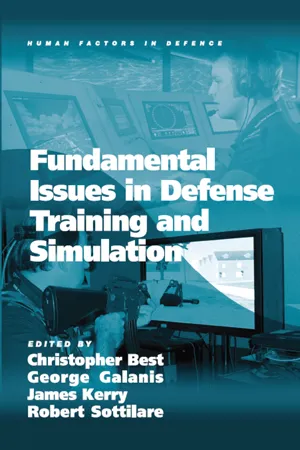
Defense forces have always invested a great deal of their resources in training. In recent times, changes in the complexity and intensity of operations have reaffirmed the importance of ensuring that warfighters are adequately prepared for the environments in which they are required to work. The emergence of new operational drivers such as asymmetric threats, urban operations, joint and coalition operations and the widespread use of military communications and information technology networks has highlighted the importance of providing warfighters with the competencies required to act in a coordinated, adaptable fashion, and to make effective decisions in environments characterized by large amounts of sometimes ambiguous information. While investment in new technologies can make available new opportunities for action, it is only through effective training that personnel can be made ready to apply their tools in the most decisive and discriminating fashion. There are many factors which can have an impact on the efficacy of training and many issues to consider when designing and implementing training strategies. These issues are often complex and nuanced, and in order to grasp them fully a significant investment of time and energy is required. However, the requirement to respond quickly to ever-changing technology, a high operational tempo and minimal staffing may preclude many in today's defense forces from seeking out all such resources on their own. This edited collection provides brief, easy-to-understand summaries of the key issues in defense training and simulation, as well as guidance for further reading. It consists of a collection of short essays, each of which addresses a fundamental issue in defense training and simulation, and features an up-to-date reference list to enable the reader to undertake further investigation of the issues addressed. In essence, this book provides the optimum starting point, or first resource, for readers to come to terms with the important issues associated with defense training and simulation. The contributions are written by leading scholars from military research institutions in the US, UK, Canada, Australia and New Zealand, as well as selected researchers from academic and private sector research institutions.
Information
Chapter 1
Introduction
Defence Research and Development Canada
The Technical Cooperation Program (TTCP) was founded shortly after the Second World War to share military information and to collaborate on research and development of a non-atomic nature. TTCP includes Australia, Canada, New Zealand, the United Kingdom, and the United States of America as members. TTCP is organized as a set of groups, and within each group there are technical panels and action groups that address topics of common concern. One of the oldest technical panels within the Human Performance (HUM) Group is Technical Panel 2 (TP2), which focuses on military training. The vision for this panel is to provide “a future in which training technologies provide the military of all member nations with timely, superior, affordable training that fully supports coalition operations.” The goal of the panel is to improve military operational effectiveness through collaborative research and development and information exchange in training systems, methods, and assessment techniques. This book contributes to this goal in keeping with the spirit of collaboration and information exchange among the members of TTCP. It also now distributes knowledge about military training to others outside TTCP.
The escalating costs and the resource constraints faced by the militaries of the TTCP countries have led to greater reliance on innovative training technologies, new training methods, and evidence-based assessments as means to maintain and enhance military preparedness. Although the science and technology of military training have advanced greatly since the formation of TP2, there are persistent questions and recurring issues that need to be addressed. Often these questions or issues are raised by new project managers who are largely unfamiliar with the areas of human learning and memory, instructional system design, training effectiveness evaluation, and human factors. In the past, the questions mostly concerned the design, use, or evaluation of military training simulators, since they were very costly to buy and to operate. A typical example would be a young army captain involved in the acquisition of an armored vehicle and its training equipment who asks whether a motion base is necessary or beneficial for a driving simulator. The panel recognized the need to provide understandable answers to questions about simulator design, training concepts, training development, simulator training practices, and training evaluation to project managers, staff officers, and others who might lack a background in simulation and training.
In order to provide ready answers to recurring questions about military training technologies, the US and Canadian members of TP2 funded the development of a web-based repository of answers to frequently asked questions (FAQ) on behalf of the panel. All members of the panel provided questions based on their experience as defense scientists and engineers in the field of military training technology. Subsequently, the Human Systems Information Analysis Center (HSIAC) was engaged to provide answers to frequently asked questions and to consolidate, web-enable, and link the answers to relevant reference materials, including abstracts of the scientific literature. The HSIAC was ideally suited to this task because it was one of many centers created specifically by the US Department of Defense to provide analysis, synthesis, and dissemination of timely knowledge and information.
When the repository was completed, Dr. Stephen Goldberg, then chair of TP2, entered into an agreement with the National Training Systems Association (NTSA) to place it on their website so that it could be accessed by the training and modeling and simulation (M&S) communities (available online at <http://www.trainingsystems.org/TTCP/index.html>; accessed 27 July 2012). At the time, this initiative meshed well with the emerging efforts of the NTSC to provide certification for M&S practitioners.
In the following years, TP2 sought to expand the FAQ beyond its simulator-based focus. Australia took the lead for this effort and organized workshops with its military to identify topics of particular interest, which were later discussed and vetted within the panel. The idea of a book emerged during this time and a publisher was sought. The result is this compendium of articles that provides a knowledge base for the application of the science and technology of military training. Although researchers have written and edited this book, they hope that it will be useful for a wide range of practitioners and stakeholders involved in the challenging and exciting business of military training. This book is written by authors from all countries within TTCP, it has adhered to the principles of collaboration and information exchange during its development, and it aims to help realize the grand vision of TP2.
Lochlan E. Magee, Ph.D.
Canadian National Leader (1988–2011)
Chair (1998–2000 & 2006)
TTCP Human Performance Technical Panel 2 (Training)
PART I
Analysis
Chapter 2
Before We Start, Let’s Do Some Homework
New Zealand Defence Force – Defence Technology Agency, Human Systems Group
Many, many years ago, long before the personal computer, when transistors were the thing and pocket calculators that utilised reverse Polish notation (e.g., Burks, Warren, & Wright, 1954) were beginning to supplant the slide rule, I heard for the first time a phrase that was to dominate my career: “Poor preparation leads to poor performance.” This part of the book aims to inform and provide guidance to those who are involved in the business of delivering training. It refers specifically to the very start of the preparatory phase of training and provides some foundational knowledge. So, before you rush off and implement a solution, silence the smartphone, close your email and social network apps, shut the door (or put your earbuds in), take the phone off the hook, and take an hour to read the next few chapters. They may reinforce or challenge your views, provide a sensible way ahead or just make you think. Either way you will be better informed and aware of further reading you might like to pursue, and you will have been exposed to the collective wisdom of a number of practitioners in this field. Rather than attempting to be comprehensive, we have chosen to highlight four specific areas that are important to consider during the early stages of preparing a training strategy or system.
Some years ago I was told that it was vital that my organization “become a competency-based organization.” At the time, this was considered so important that it was defined as “Strategic Goal 1.1.” I researched the problem, adopted a framework, put a project team in place, and drove forward with enthusiasm and vigour. Three years later the project was about 60 percent complete (and on track) when I moved on to a new job. Within six months of my departure the project had faded away due to lack of support from the new board of directors, and the project team members were reassigned to other, more pressing work. Now that I have a little more time to reflect and research the issue, I understand why this happened. In Chapter 3 – “Competency in the Military” – I explore the origins of competencies, the theory behind them and how they should work. Various types and definitions of competency are discussed and a two-dimensional competency model is put forward. The first dimension takes an individual through a career; the second dimension provides an organization with a framework that will build a team of individuals, mould each team into a unit, and bring units together to become an effective force. The potential benefits of a competency model are discussed, and finally I examine why it is that so many competency models fail. I wish this information had been available to me when I was first charged with addressing “Strategic Goal 1.1.”
The soldiers, sailors, and airmen joining our defence forces today have been immersed in information technology for their entire lives. Sometimes referred to as “new millennium learners” or “digital natives,” they were born in the late twentieth century and have grown up and been educated in an environment very different from that of their predecessors. The chapter by Tremblay and Christensen (Chapter 4) investigates whether or not our defence force training and education systems need to adapt to the different expectations and requirements of this generation. Just how different are these people entering the workforce? What impact does continuous access to vast networks of information and people have on the way this generation learns? What are the implications for our military training and educational systems? These questions are addressed, and the conclusions may surprise you.
Now that we have a competency framework and a young, enthusiastic workforce, they need an effective and efficient training system to bring out their full potential and deliver military capability. The establishment of a training system involves the analysis of the need for training, investigation of options for satisfying this need, and development of an effective and efficient solution. A simulation device could be the product of training development and a strategy of simulation-based training could precede development, but should simulation be considered during the very early stage of analyzing the training need? In Chapter 5, Wallace presents the case for this and provides a general framework and some detailed approaches to training analysis for simulation-based training in relation to major capability projects.
Historically, combat aircrews have trained under an event-based system, maintaining combat mission-ready status by accomplishing specified numbers of sortie types and events during the annual training cycle. However, developments in high fidelity simulation technology that allow distributed and live, virtual, and constructive (LVC) training provide opportunities to deliver developmental experiences that are close to the operational environment and without the constraints of peacetime flying training. Competency-based training places emphasis on the required proficiency rather than the number of times the mission has been performed. The transition requires answers to two basic but vital questions: “What do we measure and how do we measure it?” In Chapter 6, Bennett et al. put forward the concept of Mission Essential Competencies (MECs). They explain that most training development efforts begin with a task analysis, but MECs start with the mission as performed within the combat environment. Knowledge elicitation workshops with subject matter experts (SMEs), data gathering from the broader operational community, and in-depth analysis of the results provide training needs that are then ranked. From this, specific prioritized training recommendations are made to the operational customer. These authors go on to describe how a more efficient and effective training program can be developed to target the areas identified as most important and provide the necessary developmental experiences. MEC-based training offers the ability to optimize training resource allocation while maintaining war-fighter readiness and operational capability. A challenge for the future is to take this framework and adapt it to the maritime and land environments.
References
Burks, A.W., Warren, D.W., and Wright, J.B. 1954. An Analysis of a Logical Machine Using Parenthesis-Free Notation. Mathematical Tables and Other Aids to Computation, 8 (46), 53–7.
Chapter 3
Competency in the Military
New Zealand Defence Force, Defence Technology Agency
Introduction
The military takes the majority of its recruits directly from school, college or university and provides a career package that will enable the most able to become the head of the organization. However, unlike the police or fire service, the military trains an extraordinary range of diverse skills: cooks, tank drivers, electricians, submariners. In many countries the military is one of the largest training organizations; the UK Armed Forces need about 25,000 new recruits every year and discharge some 17,000–18,000 trained personnel annually (Ministry of Defence UK, 2003).
As defence budgets come under scrutiny, defence force leaders are pressured to cut back or “optimize” training. Individual training is often perceived as too long and too detailed. Training time is increasingly constrained by limited training areas and assets; deployment, fuel and ammunition costs; and security and safety concerns.
Competencies are seen as a methodology by which rigor can be brought to the training and human resources processes. An audit trail is required that follows the new recruit to the delivery of military effects so that each element of the training process can be justified. Some governments’ policy statements consider that civilians often provide specialist skills at a lower cost (New Zealand Government, 2010; Australian Government, 2009). Assuming this is correct, a methodology needs to be implemented that can accurately match personnel to these new roles.
This chapter looks at the origins of “competency,” defines the terminology and p...
Table of contents
- Cover
- Half Title
- Title Page
- Copyright Page
- Table of Contents
- List of Figures
- List of Tables
- List of Contributors
- Acknowledgments
- 1 Introduction
- PART I ANALYSIS
- PART II DESIGN
- PART III TECHNOLOGIES
- PART IV MEASUREMENT
- Index
Trusted by 375,005 students
Access to over 1.5 million titles for a fair monthly price.
Study more efficiently using our study tools.
Frequently asked questions
Yes, you can cancel anytime from the Subscription tab in your account settings on the Perlego website. Your subscription will stay active until the end of your current billing period. Learn how to cancel your subscription
No, books cannot be downloaded as external files, such as PDFs, for use outside of Perlego. However, you can download books within the Perlego app for offline reading on mobile or tablet. Learn how to download books offline
Perlego offers two plans: Essential and Complete
- Essential is ideal for learners and professionals who enjoy exploring a wide range of subjects. Access the Essential Library with 800,000+ trusted titles and best-sellers across business, personal growth, and the humanities. Includes unlimited reading time and Standard Read Aloud voice.
- Complete: Perfect for advanced learners and researchers needing full, unrestricted access. Unlock 1.5M+ books across hundreds of subjects, including academic and specialized titles. The Complete Plan also includes advanced features like Premium Read Aloud and Research Assistant.
We are an online textbook subscription service, where you can get access to an entire online library for less than the price of a single book per month. With over 1.5 million books across 990+ topics, we’ve got you covered! Learn about our mission
Look out for the read-aloud symbol on your next book to see if you can listen to it. The read-aloud tool reads text aloud for you, highlighting the text as it is being read. You can pause it, speed it up and slow it down. Learn more about Read Aloud
Yes! You can use the Perlego app on both iOS and Android devices to read anytime, anywhere — even offline. Perfect for commutes or when you’re on the go.
Please note we cannot support devices running on iOS 13 and Android 7 or earlier. Learn more about using the app
Please note we cannot support devices running on iOS 13 and Android 7 or earlier. Learn more about using the app
Yes, you can access Fundamental Issues in Defense Training and Simulation by George Galanis,Robert Sottilare, Christopher Best in PDF and/or ePUB format, as well as other popular books in Technology & Engineering & Human-Computer Interaction. We have over 1.5 million books available in our catalogue for you to explore.