- 200 pages
- English
- ePUB (mobile friendly)
- Available on iOS & Android
eBook - ePub
About this book
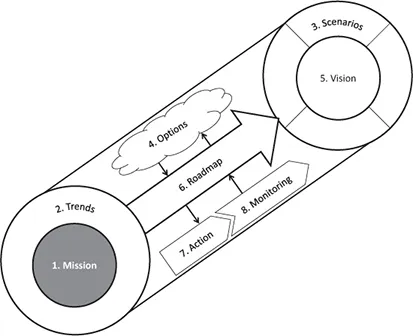
We need strategy. The world is changing, the future uncertain. What is required is vision: What might the future bring? Where is our business going? What are our fundamental business values? This book is a manual for all those who want to apply strategy in organisations. It is intended for everyone who wants to put the future on the agenda, to look beyond the short term and beyond mere profit. It describes in practical terms the eight questions we must continually discuss in order to pursue a future-proof strategy in a dynamic and uncertain world: mission, trends, scenarios, options, vision, roadmap, action and monitoring. If you are dissatisfied with an approach to strategy based on simple backward looking analysis, management controls and problems solving after the fact, but would like to make a positive contribution to thinking about the future, Scenario-based Strategy offers the instruments to turn your intention into practice. The text provides examples from commercial to government and trade organizations; showing how others have undertaken future explorations and how they used these explorations to create a dynamic strategy. Paul de Ruijter has a deep insight into the theory, alongside practical experience working with some of the most highly regarded and resilient organizations. The result is a rich combination of methodology and practical, engaging examples that shows you how to go about creating an agenda for the future.
CHAPTER 1
Mission: What is the reason for the organization’s existence and what is the key to its success?
Self-insight and self-analysis are indispensable in every strategy. Because if you want to determine where you are heading, you ought to know your point of departure. After all, strategic decisions are about the future but they carry a past as well. The luggage aboard is equally important as the harbour and the course. A navigation system is useless if you do not know where you are and when it comes to navigation, it does make a difference whether you travel in a small speedboat, a cruise ship, a large tanker or even maybe a fleet of ships.
The sign at the gateway to the Oracle of Delphi said: ‘Know thyself’: an assignment from the god Apollo to visitors coming by to consult the Oracle. This was useful advice to the ancient Greeks but it still is very relevant to the modern strategist seeking to determine the route. I remember an ongoing discussion at Shell in 1992 about the question of whether Shell was an oil and gas company or an energy company. This discussion was crucial to Shell, because self-image determines direction. When the calls from society for wind and solar energy became ever louder, Shell had to decide how to react. When you consider yourself an oil and gas company, you do not want to be involved in wind and solar energy. But when you consider yourself an energy company, it makes perfect sense to invest in these new, sustainable technologies.1 And self-image can change; something Shell knew first hand. In 1907 Royal Dutch Shell started as a collaboration between N.V. Koninklijke Nederlandse Petroleum Maatschappij (Royal Dutch) and Shell Transport and Trading, a company the founder started in 1833 trading shells – hence the name – but subsequently decided oil transport would be an interesting business. If Shell had stuck to their self-definition of being a transporter of shells, the company would have ceased to exist, but because it placed its identity in a broader perspective and changed its self-definition, it could become involved in oil transport and, together with Royal Dutch, grow into a multinational which is still here, almost two centuries later.
When you want people in your organization to think about the identity of the organization, two elements are essential: the mission and the formula for success. Both elements (‘who are we and where are we now?’) will be elaborated in this chapter, because they are fundamental as a starting point in the other strategic conversations.
1.1 What is our Mission?
WHAT IS THE ADDED VALUE OF OUR ORGANIZATION?
The use of the word ‘goal’ often creates confusion, because it is more indicative of what you want to achieve – long-term or short-term, in broad sense or narrow sense – than of what you do or who you are. Also ‘mission’ (derived from the Latin mittere, which means to send) is used in different contexts: from the military mission in Afganistan to the missonary work in Africa, and from Mission Impossible to the diplomatic missions of governments abroad.
However, in this chapter the word ‘mission’ is used in the sense of a ‘greater cause’, the reason for the existence of the organization. This greater cause can seldom be achieved within a set time, and is the starting point of all of the more concrete goals which an organization sets itself. In fact, the mission shows why the organization was established in the first place and the reason for its existence. The mission not only expresses the field of expertise of the organization, but also who or what the organization is by describing the core values or principles of the organization. While the field of expertise is still variable, the core values have deeper roots: in the case of Rabobank the core values are described as ‘nearby, involved and leading’, and in the mission statement of the Dutch police: ‘to be vigilant and to serve’. Thus the mission is threefold and consists of its statutory goal, what the organization does, and why it does this (its higher purpose or core value). The mission forms the ethical foundation for the organization and exists as the value system underpinning each contract the organization enters into. In this way the mission gives meaning to relationships: with employees, with customers, with suppliers and with shareholders.
The mission has a major influence on the organization at a fundamental basis. The formulation of the mission can also have a major influence on its way of working. Take for example the mission of social housing corporations: to provide affordable housing to people who can’t provide this themselves. However, there is a huge difference between ‘affordable housing’ defined in terms of just the rent or the total housing expenses. I experienced this in a strategy project involving a social housing corporation. With energy prices increasing, the total household expenses, including for those in social housing, increase even though the rent stays almost unchanged. The question as to whether social housing corporations should help their tenants, e.g. by insulating houses and apartments (for example, with double glazing), depends entirely on the formulation and the interpretation of their mission. Do they just provide housing with affordable rents? Or is it their mission to keep the total household expenses on an affordable level for the less fortunate?
THE MISSION OF SEVERAL SOCIAL HOUSING CORPORATIONS2
• Wonen Zuidwest Friesland ‘Being dedicated to the customer Wonen Zuidwest Friesland provides housing services to everyone, in a pleasant and healthy living environment in South-west Friesland. The core of the mission is: housing services, dedicated to the customer, pleasant and healthy living environments for all.’
• Rhenense Woningstichting (RWs) ‘As a social entrepreneur RWs is a professional supplier of good, affordable and appropriate housing in a pleasant living environment. RWs provides housing to everyone in the region and primarily to those who have difficulties in providing this for themselves. In addition, RWs aims to organize and/or facilitate good and appropriate service levels, with special attention on wellbeing and care. To realise this RWs works actively together with its stakeholders.’
• Woningbouwvereniging Stadgenoot ‘Working with passion on quality for everyone, in a city to be cherished.’
• Woningbouwcorporatie Vestia ‘Vestia is an entrepreneurial organization which implements good living for everyone and for vulnerable groups in particular, in a socially involved and creative way.’
• Woningbouwvereniging Helpt Elkander ‘The motivation of Helpt Elkander is to offer affordable and attractive housing in a viable and sustainable living environment.’
• Woningbouwvereniging Beter Wonen ‘Beter Wonen simply sees its name as its mission: improved living. Our organization is continuously working to contribute to an improved housing situation and living environment of its customers. We do this starting with involvement; in the broadest sense of the word. Only involvement in the whole spectrum of living eventually leads to real, intrinsically improved living!’
• Woningcorporatie WoCom ‘Customized housing in a livable environment.’
‘Mission’ and ‘motto’ are often confused. To distinguish one from another, consider the following definitions: a mission articulates why the organization exists, while a motto (derived from the Latin movere which means ‘to move’) summarizes the mission, e.g. by only mentioning the core values. The motto can be used to position the organization as a brand. Philips uses as its motto ‘Innovation and You’ (which replaced ‘Sense and simplicity’ in 2013 which replaced ‘Let’s make things better’ in 2004) and the Foundation Children’s Stamps has ‘For children by children’.
WHY: THE IMPORTANCE OF SELF-KNOWLEDGE
Why is it important to have a conversation about the reason for an organization’s existence? The answer is simple: who you are, determines what you do. This applies to both individuals and organizations: when you define yourself and place yourself in a certain group, this may lead you to overlook, consciously or unconsciously, competitors from outside this group. You only have an eye to what is inside your world. These are cases in which the mission and the formula for success are a dangerous obstacle; the unwritten law of the Hare and the Tortoise is a reminder that successful organizations become lazy. These companies are aware of changes in their environment, but prove unable to respond adequately because they are blinded by their mission and their adherence to an efficient process. This leads to ‘active inertia’ and to decline of the organization: the new, fresh thinking which created the success in the first place is now replaced with rigid defence of the status quo and with acting on autopilot. When changes in the outside world become apparent, the mission and the strategy which were successful at first now make the organization unable to meet these changes. The moment organizations which are apparently blooming find themselves victims to their own way of thinking and working, four things happen: the strategic framework becomes a blinder, processes become routine, relationships (with employees, customers, suppliers, distributor and shareholders) become ties and values become dogmas.3
But there is hope! History shows that a number of leading organizations, such as Shell and Rabobank, proved themselves able to react to changes in the outside world without giving up their mission. To avoid inflexibility you must first ask yourself what could possibly obstruct the organization, and focus attention on the existing strategic framework, processes, relationships and values, before you take any action to instigate change. It is often not necessary (and undesirable) to break completely with the past. In many cases the strategic framework, processes, relationships and values can be rearranged to face up to new challenges whilst showing respect for the heritage of the organization. So it is important that you make the organization know itself and at the same time understand how its mission and formula for success can work as a disadvantage.
All of this underlines the need to engage in a conversation about the mission of the organization and the explanation of that mission. The aim of such a conversation is not necessarily to change the mission, but to sense, check and internalize it. Does everyone know the mission? Is the mission still valid? Is it necessary to rephrase the underlying purpose? The mission needs to be alive in the heads and hearts of the people, otherwise it will not work: it will become an empty shell and the organization will be adrift and soulless.
Through conversations about the mission of the organization all stakeholders will understand fully what the mission means and be able to act accordingly. They are bound by common values. Arie de Geus describes the value of involvement of the whole organization in The Living Company. A common characteristic of long-living organizations was that the employees showed a strong sense of ‘feeling at home in the organization’ and identified themselves with its goals and successes. The fact that the employees saw themselves as a part of the bigger endeavour, working with others with a common loyalty to the mission, turned out to be essential for the survival of the organization in times of change.4 Shared ideas and values give the organization a strong identity and a certain continuity which can keep it together in times of change.5
At the same time it is important to conserve the diversity of an organization. After all, different people will have different perspectives on the mission of the organization. Sometimes you need to pay attention to this diversity: you might open a conversation about the mission. At other times it can be more useful to have everyone rowing in the same direction, effectively to ‘impose’ the mission on the organization. When the organization is fighting to remain competitive, leadership and an unambiguous mission are needed. It is up to you to determine which moments require divergence and which convergence.
The mission can also play a role in the leadership of the organization. An executive can manage the company by focusing on milestones and targets, but also on the mission. In the case of the latter, a missionary organization, the values are guiding.6 In a missionary organization we see common norms and values and a strong company culture. A simple example is the Disney Corporation which went as far as to create its own language: employees are cast members, customers are guests and jobs are parts in a performance.7
It is also valuable to connect the conversation about the mission with other strategic conversations, e.g. about the external environment, scenarios, options or vision – about which, more in the next chapters. Don’t forget, the image of the organization can be as important as its identity, but how you are seen is sometimes much more influential than how you really are.
HOW DO YOU FIND OUT ABOUT THE MISSION?
I often ask people I meet if they know the mission of the organization they work for. Even top managers often confess that they don’t have a clue, and have to look it up on their company’s website. Each organization should have a greater cause. How the organization defines its mission determines what the organization does, and sometimes, a single word can make the difference, as seen in the example of the social housing corporations. The mission represents the reason for your existence and the core values of the organization; and it often appears in the communication to the most important stakeholders: e.g. employees (vacancies), customers (proposition) and financiers (annual reports). Any external party who decides to engage in the organization (as a provider, a client or an employee), effectively endorses the mission of the organization.
When the organization does not have a written mission statement, the mission, or at least the basics thereof, can be found in the articles of association. As with contracts these are the formal, written account of relationships, the reason for the organization’s existence and the mission of the organization. In that context, the mission is called the ‘statutory objective’. Everyone who has ever founded a Limited co...
Table of contents
- Cover Page
- Dedication
- Title Page
- Copyright Page
- Contents
- List of Figures
- Preface
- Introduction
- Chapter 1 Mission: What is the reason for the organization’s existence and what is the key to its success?
- Chapter 2 Trends: What is happening around us?
- Chapter 3 Scenarios: In which situations could we end up?
- Chapter 4 Options: Is our current course future-proof and, if not, what can we do to make it so?
- Chapter 5 Vision: Where do we want to go, who do we want to be?
- Chapter 6 Roadmap: How do we get there?
- Chapter 7 Action: From talking to acting
- Chapter 8 Monitoring: To stay on course
- Epilogue: Welcome
- Glossary
- Bibliography
- Acknowledgements
- About the Author
- Index
Trusted by 375,005 students
Access to over 1.5 million titles for a fair monthly price.
Study more efficiently using our study tools.
Frequently asked questions
Yes, you can cancel anytime from the Subscription tab in your account settings on the Perlego website. Your subscription will stay active until the end of your current billing period. Learn how to cancel your subscription
No, books cannot be downloaded as external files, such as PDFs, for use outside of Perlego. However, you can download books within the Perlego app for offline reading on mobile or tablet. Learn how to download books offline
Perlego offers two plans: Essential and Complete
- Essential is ideal for learners and professionals who enjoy exploring a wide range of subjects. Access the Essential Library with 800,000+ trusted titles and best-sellers across business, personal growth, and the humanities. Includes unlimited reading time and Standard Read Aloud voice.
- Complete: Perfect for advanced learners and researchers needing full, unrestricted access. Unlock 1.5M+ books across hundreds of subjects, including academic and specialized titles. The Complete Plan also includes advanced features like Premium Read Aloud and Research Assistant.
We are an online textbook subscription service, where you can get access to an entire online library for less than the price of a single book per month. With over 1.5 million books across 990+ topics, we’ve got you covered! Learn about our mission
Look out for the read-aloud symbol on your next book to see if you can listen to it. The read-aloud tool reads text aloud for you, highlighting the text as it is being read. You can pause it, speed it up and slow it down. Learn more about Read Aloud
Yes! You can use the Perlego app on both iOS and Android devices to read anytime, anywhere — even offline. Perfect for commutes or when you’re on the go.
Please note we cannot support devices running on iOS 13 and Android 7 or earlier. Learn more about using the app
Please note we cannot support devices running on iOS 13 and Android 7 or earlier. Learn more about using the app
Yes, you can access Scenario Based Strategy by Paul de Ruijter in PDF and/or ePUB format, as well as other popular books in Business & Business General. We have over 1.5 million books available in our catalogue for you to explore.