- 200 pages
- English
- ePUB (mobile friendly)
- Available on iOS & Android
eBook - ePub
Messy Self
About this book
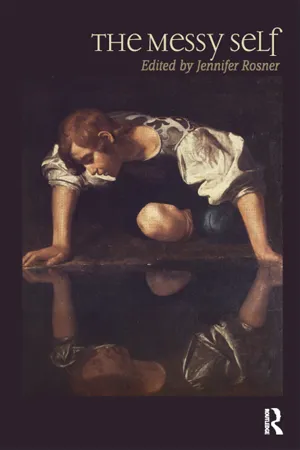
The Messy Self challenges the idea -- and the ideal -- of a coherent, harmonious self. Taken together, the essays illustrate how a flourishing self is inevitably divided, ambivalent, fractured, messy -- and how the self triumphs through disorder. Written in accessible language by award-winning writers and scholars, the book offers a diversity of perspectives on the complexities of the self. With chapters on creativity, love, self-understanding, self-deception, identity, responsibility, and well-being, The Messy Self gives a range of voices to the ordinary and extraordinary divisions, fragmentations, and uncertainties that mark our everyday experience.
Information
I
Love and the Messy Self


A Strange Disorder
A strange disorder rules the house
where lately slender method scared
papers into files neat as hedgerows
and caution laid its dropcloth everywhere.
Now books lie slaughtered on the rug,
the telephone rings, old letters dune
among bills and maps and coffee spoons
in a room spontaneous as a compost heap
where you work the oracle of my thoughts
and haunt the prison of my sleep.
My Tourette’s
I AM A SUCKER FOR WALTZES, although I have never danced one. Not only am I clumsy, but the slightest spin of my body makes me very dizzy. I have not been to an amusement park in nearly half a century, and were I to go, my movement would consist of going from one popcorn stand to another. It is not the waltz as dance that moves me, but rather its rhythm, which, more than any other time signature, is so expressive about love. Nothing beats a love song in waltz time.
My two favorites are “Lotus Blossom,” a wordless beauty composed by Billy Strayhorn, and “They Were You” from The Fantasticks, written by Tom Jones and Harvey Schmidt. Strayhorn, who was the writing genius behind so many Duke Ellington classics, knew about love, I’m sure, and “Lotus Blossom” is a serene, yet thrilling waltz. “They Were You” represents all that the creators of The Fantasticks in its 42-year run hoped to achieve: simplicity, clarity, beauty—leaving us longing for the illusion that young love triumphs. The other great waltz from the show, “Try to Remember,” has disappeared from the repertoires of many singers because it is nostalgic for September, and after 9/11, one does not easily sing of that month.
I suppose many people think of waltzes as old-fashioned, even though savvy songwriters still write love songs in three-four. I think of myself as old-fashioned and trendy, sometimes at the same moment. It can be messy and confusing, too, like love.
My parents were born before World War I. I did not factor the full significance of this until I became an adult, when I realized how great an impact it had on my childhood and adolescence. I feel it still. What was most obvious to me growing up was that my parents were at least ten years older than those of most of my friends. My older sister and I were late children. My mother was well into her thirties before she became pregnant with my sister, and she was thirty-eight, my father forty, when I was born. In fact, my parents were closer in age to some of my friends’ grandparents. While there have always been forty-something parents pushing prams—especially fathers—it seemed rare in the middle of the 20th century to see forty-ish mothers doing it. What I knew as a child was that my parents, without articulating to me their hesitation or boredom, participated reluctantly in various parent-child activities at school, if they bothered at all. Neither was a candidate for lining up the cherubs at a Christmas pageant, chaperoning dances, helping the pep squad hang banners, or sitting in a PTA meeting devoted to lunchroom etiquette. I felt the consequences of their age every day as I grew up in the 1950s and 60s, in what they deemed appropriate clothing, recreation, and comportment. They were delightful, wonderful, loving people, and I adored them, but the answer to my entreaties of “may I” frequently was “no” unless they knew the parents sponsoring an event. And they didn’t know the parents or the grandparents.
It was only when I began to place my parents’ lives in a context wider than the walls of our home that I reached a sound understanding of their values and mores. All of my grandparents had been born in the 1880s in the Midwest, and all of them were intent on maintaining or gaining a place in the growing black middle class. The physical, psychological, political and social fallout from slavery was not just in the South; it was everywhere. My grandparents and parents became part of the racial “uplift” movement that sought to shake it off with every step forward. What this meant, in part, was the desire to live a life in defiance and contrast to degrading and painful racial stereotyping. It meant, in part, being black Victorians, believing that hard work and a secure family life were beneficial to both the public and the private good. My father was fond of saying, “everything in moderation,” and he believed it, despite his own immoderate eating and cigarette smoking. And it meant, in part, making sure that they bore no resemblance to the caricature of black people as the quintessence of sexual aggression and licentiousness. I am sure that my parents never saw each other in the nude, and I recall the shock my sister and I experienced when our mother told us, years after the fact, that she had miscarried ten years after I was born. We had been sure that our conceptions were a result of the two times they had engaged in intercourse. We simpering teenagers were wrong, of course, but all of this indicated that in our home, sex was not a topic for discussion and that I had no idea what it was, even after I had been told the “facts of life.” My sister and I have repeated the story many times of how serious my mother was when she proclaimed to my sister, “I’d rather see you dead than pregnant.” Sarah Bernhardt could not have done it better.
Like any good Victorian, my father had a couple of pulp fiction novels in his room, with cover art promising hot times inside. I remember thumbing through one whose cover had a matador and a woman in a pose, I suppose, of ecstasy. If there were hot times inside, I never found them, the juicy parts making no sense to me. But my father knew that I had read the book, and he asked my mother to tell me that I was not to read such things. That was how communication on the topic of sex occurred in our home. My father would have considered it the height of impropriety to speak to his daughters about anything sexual.
I have inherited from my maternal grandfather a habit of making up silly songs. The first one I can recall I composed when I was ten. I decided that singing “I’ve got the cutest little bottom in the house” was a satisfying way to spend an afternoon. My father, shocked to hear me, directed my mother to tell me to stop. And I will never forget my mother’s face when I ran downstairs after going to bed with a biology book from the library and asked her, “What is masturbation?” She paled and blurted out, fidgeting, “itmeansplayingwithyourself.” Thanks, I said, thinking that I had been masturbating for many years with my games of solitaire, jacks, and riding all over hell and gone on my bicycle.
In adulthood, my sister discovered that one reason she had no dates in high school was because my father, who, in his work at the Urban League, helped black people find work, scared off any interested young men with his fierce countenance. Watching Preston Sturges’ brilliant 1944 comedy, Miracle at Morgan’s Creek, together one afternoon quite a few years ago, my sister and I howled at the surname, Kockenlocker, with William Demarest doing anything to ensure the virtue of daughter Trudy, played by Betty Hutton. “It would have been a good surname for us,” my sister said. Or, to be even more precise, we both said out loud, Kockenblocken.
I do not mean to suggest that my parents were formal or humorless. On the contrary, we had a lively home, filled with laughter, spiced with silliness and sarcasm. My parents were thoroughly modern people with sophisticated, wry senses of humor. My father was a terrific dancer, light on his feet; he could foxtrot and Lindy Hop with the best of them. My mother, in a silly mood, would wave her index finger in the air and do a little trucking to a jazz record. They both loved music and bridge. My mother loved the movies. Their views of life, however, were informed by the 19th century. They only married when my father had finished college and some graduate school and had a secure job. Th...
Table of contents
- Cover
- Half Title
- Title Page
- Copyright Page
- Dedication
- Table of Contents
- Foreword
- Introduction
- Acknowledgments
- Part I. Love and the Messy Self
- Part II. Self-Understanding and the Messy Self
- Part III. Self-Deception and the Messy Self
- Part IV. Identification and the Messy Self
- Part V. Well-Being and the Messy Self
- Part VI. Creativity and the Messy Self
- About the Contributors
- About the Editor
Trusted by 375,005 students
Access to over 1.5 million titles for a fair monthly price.
Study more efficiently using our study tools.
Frequently asked questions
Yes, you can cancel anytime from the Subscription tab in your account settings on the Perlego website. Your subscription will stay active until the end of your current billing period. Learn how to cancel your subscription
No, books cannot be downloaded as external files, such as PDFs, for use outside of Perlego. However, you can download books within the Perlego app for offline reading on mobile or tablet. Learn how to download books offline
Perlego offers two plans: Essential and Complete
- Essential is ideal for learners and professionals who enjoy exploring a wide range of subjects. Access the Essential Library with 800,000+ trusted titles and best-sellers across business, personal growth, and the humanities. Includes unlimited reading time and Standard Read Aloud voice.
- Complete: Perfect for advanced learners and researchers needing full, unrestricted access. Unlock 1.5M+ books across hundreds of subjects, including academic and specialized titles. The Complete Plan also includes advanced features like Premium Read Aloud and Research Assistant.
We are an online textbook subscription service, where you can get access to an entire online library for less than the price of a single book per month. With over 1.5 million books across 990+ topics, we’ve got you covered! Learn about our mission
Look out for the read-aloud symbol on your next book to see if you can listen to it. The read-aloud tool reads text aloud for you, highlighting the text as it is being read. You can pause it, speed it up and slow it down. Learn more about Read Aloud
Yes! You can use the Perlego app on both iOS and Android devices to read anytime, anywhere — even offline. Perfect for commutes or when you’re on the go.
Please note we cannot support devices running on iOS 13 and Android 7 or earlier. Learn more about using the app
Please note we cannot support devices running on iOS 13 and Android 7 or earlier. Learn more about using the app
Yes, you can access Messy Self by Jennifer Rosner in PDF and/or ePUB format, as well as other popular books in Psychology & Literary Essays. We have over 1.5 million books available in our catalogue for you to explore.