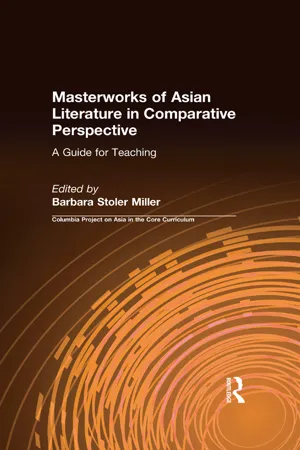
eBook - ePub
Masterworks of Asian Literature in Comparative Perspective: A Guide for Teaching
A Guide for Teaching
- 576 pages
- English
- ePUB (mobile friendly)
- Available on iOS & Android
eBook - ePub
Masterworks of Asian Literature in Comparative Perspective: A Guide for Teaching
A Guide for Teaching
About this book
This is a collection of 46 essays by specialists in Asian literature, who offer a wide range of possibilities for introducing Asian literature to English-speaking students. It is intended to help in promoting multicultural education.
Information
IV
Japanese Texts
Japanese Texts: Lyric
THE MAN’YŌSHŪ AND KOKINSHŪ COLLECTIONS
THE MAN’YŌSHŪ
The Man’yōshū is the first, and in the opinion of most scholars of Japanese literature, the greatest collection of Japanese poetry. The exact period of the compilation is unknown, but the last dated poem was composed in 759, and the final selection of poems probably took place soon afterwards. The name of the compiler is not given, but there is strong reason to believe that Ōtomo no Yakamochi (718?-85), an important poet and sometime governor, edited the bulk of the Man’yōshū and possibly the entire work. The last four of the twenty books of the collection are given over so largely to his poetry that they have even been called his “poem diary.”
The three characters used to write the name of the collection, man, yō, and shū, mean literally “Ten Thousand Leaves Collection,” and it has been generally supposed that this was a figurative way of referring to the large number of poems contained in the collection, 4,516 in all; “ten thousand” (man), like the English word “myriad,” was often used to express any large number. According to the theory first advanced by scholars of Chinese literature, however, “ten thousand leaves” was a poetic way of saying “ten thousand ages,” and was so used in numerous Chinese texts. Even if we accept this emendation, it does not entirely clear up the ambiguity: should “ten thousand ages” be interpreted as an exaggerated description of the perhaps 400 years of poetry included in the Man’yōshū, or should it be interpreted as signifying that the collection was destined to last for ten thousand years? The meaning of the title remains to be determined.
The vast majority of the poems in the Man’yōshū are in the form of the tanka—a poem in five lines consisting respectively of 5, 7, 5, 7, and 7 syllables. (The lack of a stress accent in Japanese and the excessive ease of rhyming caused poets to depend on syllabics as a means of distinguishing poetry from prose.) The masterpieces of the collection, however, are the chōka (long poems), of which there are 265 examples. A chōka was written in alternating lines of 5 and 7 syllables with an additional line of 7 syllables at the end. The longest examples run to over 150 lines. There are also sixty-two poems in non-traditional forms, including four in Chinese. The oldest poem of the collection, if we can accept the traditional attribution, is the first, said to have been composed by the Emperor Yūryaku (reigned 457–79). Many poems bear prefaces composed in classical Chinese giving the circumstances of composition, which are usually not otherwise apparent because of the brevity of the tanka.
The poems were recorded in an extraordinarily complicated script. Chinese characters were used sometimes for their meaning, sometimes merely to transcribe Japanese sounds. The problems encountered when reading texts that combine two entirely different systems of writing, neither suited to the Japanese language, are enormous, and some poems have not yet been given definitive pronunciations. When a new system of writing, the kana, was invented in the ninth century it was so much more suited to writing Japanese than the earlier systems that people forgot how to read the Man’yōshū, and the collection as a whole was not rediscovered until the seventeenth century, though poems known as songs had survived.
The absorption of Chinese learning, originally undertaken mainly in the hopes of strengthening the country politically in face of the vastly more evolved continental culture, greatly enriched Japanese poetiy, as we can tell by comparing the poems in the Man’yōshū with those in the even earlier Kojiki (Record of Ancient Matters), an account of Japan from the creation until the sixth century, which is virtually free of Chinese influence. New themes and new modes of expression were quickly adopted by the Japanese poets almost as soon as they came into contact with books of poetry from the continent. This influence is most readily apparent in the poems composed in Chinese by members of the court. In contrast, the Man’yōshū on first reading may seem almost untouched by this influence, but it is nonetheless present, and helps to account for the superiority of Man’yōshū poems to those in the Kojiki.
Although the Japanese were eager to improve their poetiy by incorporating Chinese poetic techniques, they remained reluctant to use borrowed Chinese words in their poetry. This reluctance was maintained by tanka poets until the late nineteenth century. It is as if English poets after the Noiman conquest had absorbed the techniques and subject matter of French poetry but had refused until the twentieth century to use any words not of pure Anglo-Saxon origin. Of the 6,343 different words in the Man’yōshū, all those of Chinese origin (with two exceptions only) are found in the heavily Buddhist Book XVI. Such words as hōshi (priest) and dan’ochi (parishioner) were probably used because no “pure” Japanese equivalents existed. A few words such as ume (plum; Chinese met) and yanagi (willow; Chinese yang) were earlier borrowings that by this time had been assimilated into the Japanese language.
The Man’yōshū is unique among anthologies of Japanese poetry in the variety of its poetic forms, its subject matter, and its authors. Although the great majority of the poems are the short tanka, there are also dialogues and various other unusual poetic forms. However, the chōka are the glory of the collection. The chōka survived vestigially in some later collections, but the masters of this form were all Man’yōshū poets.
The content of the poetry is also exceptional. In most later anthologies the tanka are generally about the seasons or about love, but in the Man’yōshū many tanka describe travel, and there are also tanka of both humorous and deeply religious meaning. The chōka include elegies for deceased princes and princesses, poems commemorating events of national significance, and expressions of grief over the departure of soldiers for the frontier. Some poems reveal specific Chinese or Buddhist influence, such as those that praise liquor in the manner of the Taoists or those that insist in Buddhist fashion on the transitoriness of life.
The authorship of the poems is also exceptional in that poems by persons of humble status, in no way associated with the court, were included. It may be that some poems attributed to soldiers on the frontier or to rustics were in fact composed by courtiers assuming these roles, but many were surely by plebeian authors. In the Kokinshū and later imperial collections such poems were usually said to be “anonymous.”
Perhaps the quality of the Man’yōshū that most clearly distinguishes it from later Japanese poetry, however, is the directness of the expression of the poets’ emotions. Later poets, largely because the tanka form was so short, tended to rely on suggestion to fill out what was actually stated, but the Man’yōshū poets, free to extend their poems beyond the five lines of a tanka, could give full vent to their feelings in a chōka. Eighteenth-century scholars of national learning referred to the “masculinity” (maswaoburi) of such expression and contrasted it with the “femininity” (tawayameburi) found in the later imperial collections. This is an oversimplification, but it accounts for the popularity of the Man’yōshū during the war years of 1941–45, when the “feminine” indirectness of the Kokinshū fell into disfavor, and innumerable studies of the “spirit” (seishin) of the Man’yōshū appeared.
The particular strength of the Man’yōshū poets was their ability to treat truly tragic, as opposed to merely sad emotions, and to confront harshly dramatic, as opposed to merely touching human experiences. For example, a fair number of poems describe the poet’s reflections on seeing a dead body by the side of the road or on the shore. Dead bodies do not appear in the Kokinshū: the rules of good taste had come to dominate poetic composition, and the poets believed that the falling of the cherry blossoms, no less than the sight of a corpse, could stir in the beholder an awareness of the impermanence of this world. Some poems on cherry blossoms do indeed convey so poignant a sense of the passing of time as to bring tears to the reader’s eyes, but the dramatic impact of falling cherry blossoms is obviously not as strong as that of the sight of a corpse washed by the waves.
The poems in the Man’yōshū fall into three main groups: love poems (sōmon), elegies (banka) and miscellaneous poems (zōka). Over half the poems in the collection are about love, most often described in terms of unhappy or frustrated love affairs; this is true also of the love poetry in later anthologies. The elegies are usually public poems that treat the deaths of members of the court and were probably written by court poets in response to commands of emperors or high officials, but some elegies are private, mourning the death of the wife or child of the poet. The public elegies were apparently composed in keeping with funerary practices observed during the seventh century. It was customary to place the body of...
Table of contents
- Cover
- Half Title
- Title Page
- Copyright Page
- Dedication
- Table of Contents
- Contents by Genre
- Preface
- Guide to the Reader
- Principles of Transliteration and Pronunciation Guide
- Introduction Masterworks of Asian Literature in Comparative Perspective
- I. The Worlds of Asian Literature
- II. Indian Texts
- III. Chinese Texts
- IV. Japanese Texts
- Postscript
- Summaries of the Masterworks
- History Timelines
- Index
- Contributors
Trusted by 375,005 students
Access to over 1.5 million titles for a fair monthly price.
Study more efficiently using our study tools.
Frequently asked questions
Yes, you can cancel anytime from the Subscription tab in your account settings on the Perlego website. Your subscription will stay active until the end of your current billing period. Learn how to cancel your subscription
No, books cannot be downloaded as external files, such as PDFs, for use outside of Perlego. However, you can download books within the Perlego app for offline reading on mobile or tablet. Learn how to download books offline
Perlego offers two plans: Essential and Complete
- Essential is ideal for learners and professionals who enjoy exploring a wide range of subjects. Access the Essential Library with 800,000+ trusted titles and best-sellers across business, personal growth, and the humanities. Includes unlimited reading time and Standard Read Aloud voice.
- Complete: Perfect for advanced learners and researchers needing full, unrestricted access. Unlock 1.5M+ books across hundreds of subjects, including academic and specialized titles. The Complete Plan also includes advanced features like Premium Read Aloud and Research Assistant.
We are an online textbook subscription service, where you can get access to an entire online library for less than the price of a single book per month. With over 1.5 million books across 990+ topics, we’ve got you covered! Learn about our mission
Look out for the read-aloud symbol on your next book to see if you can listen to it. The read-aloud tool reads text aloud for you, highlighting the text as it is being read. You can pause it, speed it up and slow it down. Learn more about Read Aloud
Yes! You can use the Perlego app on both iOS and Android devices to read anytime, anywhere — even offline. Perfect for commutes or when you’re on the go.
Please note we cannot support devices running on iOS 13 and Android 7 or earlier. Learn more about using the app
Please note we cannot support devices running on iOS 13 and Android 7 or earlier. Learn more about using the app
Yes, you can access Masterworks of Asian Literature in Comparative Perspective: A Guide for Teaching by Barbara Stoler Miller in PDF and/or ePUB format, as well as other popular books in Education & Teaching Arts & Humanities. We have over 1.5 million books available in our catalogue for you to explore.