- 242 pages
- English
- ePUB (mobile friendly)
- Available on iOS & Android
eBook - ePub
Change Management in Information Services
About this book
Information services are currently going through what is probably the most significant period of change in their history. At the same time, thinking about organisational change in general management has continued to develop, and many of the emerging ideas, strategies and processes are increasingly relevant to information services. Since the first edition of this highly regarded book was published in 2000 the pace of change has accelerated because of the influence of digitisation and technological developments in general, the emergence of what might be called a business culture, changes in skills and knowledge requirements, and changes in user and personnel attitudes. Despite these rapid developments the current literature tends to reflect a preoccupation with technological developments at the expense of consideration for the broader managerial base. This second edition fills the gap in the literature and is fully updated with the inclusion of a number of new chapters and new case studies.
Chapter 1
The Nature of Change
In the last six or seven years, change in information services has begun to assume a character which has in many ways been totally unforeseen. This may well be a facile statement of the obvious, but while most of the texts written in the late 1990s and the first few years of the 21st century – including the first edition of this one – tend to show there was little difficulty in identifying and analysing the major characteristics of change, there were few which were able to anticipate accurately the way in which the landscape changed as the technological revolution in information services gathered force. This chapter looks at the characteristics of these changes, and begins to consider ways in which managers and organizations can respond to the features described (see Figure 1.1).
Characteristics of Change
One of the most striking things about change in information services is that it has become the norm. There might even be a grain of truth in snappy but meaningless sound-bites like ‘change is the only constant’. In the wider economy, change is often seen as one of the focal points of life in institutions making a whole-organization response to global developments. While these developments are often outside the control of the players, it nevertheless seems to be important to adopt a proactive and dynamic attitude to the question of change. If there is an appropriate aphorism it could be Cage’s comment (2005): ‘If it ain’t broke, break it.’
The first edition of this book opened with some strictures on the limited impact of technological change on library services, arguing that our application of technology was too narrow, therefore sapping its strength as a force for change. It is no longer possible to scorn the power of technology as a change instrument in libraries, for the evidence of the impact of technological change is all around us. But the assertion of narrowness is even more pertinent today than it was a few years ago. To embrace Cage’s exhortation is to confront and challenge the power of the technological revolution in an imaginative and creative way: yet the charge against technology in the information sector today is that it has paradoxically become a powerful support for the status quo in libraries; that is, until now.
But it is now the technologists who are beginning to change this. There are signs, particularly in the growth of the Web 2.0 and Library 2.0 initiatives, of an emerging strand of broad thinking amongst the technologists, and this is taking information services into what can be considered to be the second stage of technologically-based change. This is when the massive emphasis on the nature of the technology itself, still the norm in wide swathes of information services, begins to be replaced by what is sometimes described as a cultural view of technological change (Tebbutt, 2006). This is seen in the way in which Web 2.0 and Library 2.0 both drive the move to realise the concept of the personalised library service, and take libraries to the user in a major reworking of the idea of libraries without walls.
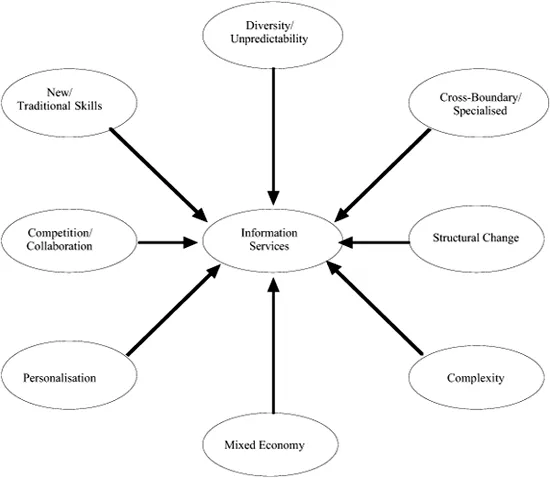
Figure 1.1 The Nature of Change in Information Services
Most of the characteristics of change identified in that first edition referred to earlier are nevertheless still relevant in practice today. While this is correct, it is also true to say that technology, and the way it is approached and handled, is at last beginning to show its true power to enhance the change forces, rather than mitigate them or paradoxically act as a brake to change. This retarding effect occurred mainly because of the specialist nature of the early technology and the way it was handled.
It is now technology which can release the transformational power dormant in most organizations. The impact of technological change therefore runs throughout this chapter.
Diversity and Unpredictability
It may well be that some libraries are now amongst the most highly diversified organizations in the world. In terms of the spread of resources they make available, and the extensive development and variation in services which has been accompanied by significant role change, they are in many ways models of diversification in a managerial sense. This characterisation draws added piquancy from the increasingly diverse nature – again in a managerial sense – of the personnel employed in contemporary information services.
Because of new configurations which have brought libraries into relationships with other services, and encouraged in their wake an influx of staff from different disciplines, with different traditions of training and education and different perspectives, most libraries now exhibit considerable variety in their services and their staffing. These conditions have been created, at least in part, by the development of technology. It is because of technology that libraries can now be staffed by combinations of:

They can also be managed by non-librarians, and by imports from business and industry. Technology has increased the physical reach of information services, and facilitated the entry of information workers into organizations, and areas within organizations, where they would not traditionally have been found.
Technology has contributed much to the broadening of the scope of library operations. It is technology which has created a requirement for library staff who have matured in different environments and bring different viewpoints, skills and experience to the task of managing and operating in organizations. This multiplicity of perspectives is an important factor in change management, provided that it is used in the right way.
Diversity also stems from the mix of technological and political influences which have been at work on libraries since before the early days of electronic collections and digitisation. Political and economic factors led to mergers in academic institutions, and one of the prime but sometimes best-concealed motives for convergence in university libraries was the need for financial savings in the organization of information services (Pugh, 1997a). The mergers, and the demergers, are still continuing in some areas, and the ongoing financial impetus for change cannot be better illustrated than it is in Case Study 1, which is a contemporary example of the use of technology in support of ostensibly more effective information provision at a lower cost.
On the other hand, the history of the eLib programme in the UK offers good examples not only of cooperation between institutions, but also of the kind of cross-sectoral collaboration which in many cases can bring together different traditions and work cultures (Pinfield, 2001, 2004). These situations also demand a different emphasis in the overall skill of managing change, and they may well become more prevalent as time passes.
The essence of the environment in which the hybrid libraries of today will increasingly operate is unpredictability. This unpredictability comes from a number of sources. The web, an important feature of the information map, is still an unpredictable landscape. That the information on it is unstable, and not always susceptible to evaluation in the conventional way, has been well documented.
Access rights to some information sources are increasingly complicated. This complication has reached such a pitch that it has given birth to yet another professional specialisation – that of digital rights. The way in which we handle specialisation is not only another barrier in the way of exploiting diversity, but it also increases unpredictability and complexity – of which more later – through its effect on communication and other organizational features.
It is also of course true that user behaviour, and in particular the emergence of technologically-competent users capable of self-organization and with the potential to manage their own information needs, represents an even more acute source of unpredictability. This development holds out the singular, if not eccentric, prospect of the user possessed of a high degree of self-sufficiency in the search for in formation, along with the will to use it. If anything this development, the apotheosis of true librarianship, is in some respects the main reason for seeking to understand the nature of contemporary change forces in libraries. To fail in this is to leave libraries, and librarians, susceptible to the dangers described in Case Study 1, and out of work.
All this is related to the sheer pace of technological change. For how long have we actually been able to conceive of the user who can navigate the information map himor herself, then evaluate, store, retrieve and use the resulting information without the aid of the librarian? Users can now, if they are so minded, single-handedly create and manipulate their own digital libraries. Providing and organising services for these prodigious characters represents real uncertainty and the ultimate diversity. One of the issues raised by those who evangelise on behalf of Web 2.0 and Library 2.0 is the need for a far more imaginative involvement of users in library services. This will create the opportunity for far-reaching change.
To sum up, Figure 1.2 shows the way in which technology has actually helped to create the potential for dynamic change in information services, basically through the way in which it is introducing diversity into library services, but also through its ability to break down barriers in both a physical and metaphorical sense.
We are therefore setting out to plan for further unpredictability, if that is not an oxymoron. This will impinge on the skills base, the appropriateness or otherwise of present organizational forms, the hybrid nature of information itself, and the collapse of the old professional boundaries. It will do this by allowing greater penetration by, and of, other professions. The situation will also demand partnerships and collaboration of a kind and degree we are not used to.
The uncertainty of the environment is obvious. The difficulty becomes more apparent when the attempts to deal with uncertainty in the things which surround us are based on applying some of the old certainties which stood libraries in good stead in more stable operating conditions. ‘If it isn’t broke, don’t fix it’ has not yet been replaced by ‘If it ain’t broke, break it’ (Cage, op cit).
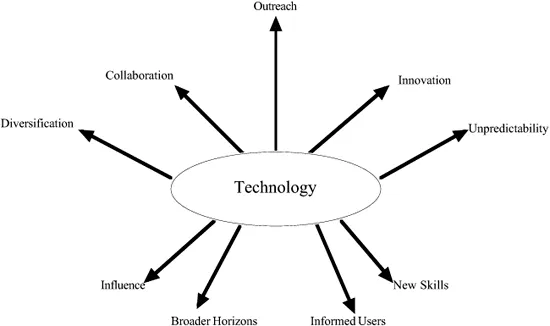
Figure 1.2 The Influence of Technology on the Characteristics of Change
The Misnomer of Discontinuous Change
It is often said that libraries are in the grip of discontinuous change. This is correct in the sense that the combination of change forces we now see is unlike anything we have seen before. It is clearly evident in the impact of technology in general. It is obvious in the more specific changes in skills requirements. It is manifest in the growth of collaboration and cooperation across organizational boundaries and between libraries inhabiting different sectors. In some senses the boundaries between the sectors are becoming refreshingly blurred.
Discontinuous change demands a distinguishable break with past practice, and requires the recognition that the former ways of doing things will not create and sustain successful organizations. This, it could be argued, is particularly so in the information sector, which now embraces a vast and diffuse area of activity. It is therefore a form of change for which there is no template in previous experience, no model of the process and consequently no new consensus about how change should be handled. The stress in the last sentence is on ‘new’. One of the most comprehensive examples of discontinuous change which the traditional purist might recognise in contemporary libraries is that of converged support services in universities and colleges, and here resides another cautionary note.
When considering the impact of technology, some commentators (for example Edmondson, 2003) point to the disruptive impact of technology. They are concerned about the capacity of technology to disrupt well-established relationships. This is undoubtedly an issue to be confronted when considering the psychology of change (see Chapter 9), but it has a ...
Table of contents
- Cover Page
- Title Page
- Copyright Page
- Contents
- List of Figures
- Preface
- Acknowledgements
- 1 The Nature of Change
- 2 Change Theories
- 3 Strategies
- 4 Process and Models
- 5 Metaphors for Organizations
- 6 Structures
- 7 Teams in Change Management
- 8 Leadership for Change
- 9 The Psychology of Change
- 10 The Skills of Change Management
- Bibliography
- Index
Trusted by 375,005 students
Access to over 1.5 million titles for a fair monthly price.
Study more efficiently using our study tools.
Frequently asked questions
Yes, you can cancel anytime from the Subscription tab in your account settings on the Perlego website. Your subscription will stay active until the end of your current billing period. Learn how to cancel your subscription
No, books cannot be downloaded as external files, such as PDFs, for use outside of Perlego. However, you can download books within the Perlego app for offline reading on mobile or tablet. Learn how to download books offline
Perlego offers two plans: Essential and Complete
- Essential is ideal for learners and professionals who enjoy exploring a wide range of subjects. Access the Essential Library with 800,000+ trusted titles and best-sellers across business, personal growth, and the humanities. Includes unlimited reading time and Standard Read Aloud voice.
- Complete: Perfect for advanced learners and researchers needing full, unrestricted access. Unlock 1.5M+ books across hundreds of subjects, including academic and specialized titles. The Complete Plan also includes advanced features like Premium Read Aloud and Research Assistant.
We are an online textbook subscription service, where you can get access to an entire online library for less than the price of a single book per month. With over 1.5 million books across 990+ topics, we’ve got you covered! Learn about our mission
Look out for the read-aloud symbol on your next book to see if you can listen to it. The read-aloud tool reads text aloud for you, highlighting the text as it is being read. You can pause it, speed it up and slow it down. Learn more about Read Aloud
Yes! You can use the Perlego app on both iOS and Android devices to read anytime, anywhere — even offline. Perfect for commutes or when you’re on the go.
Please note we cannot support devices running on iOS 13 and Android 7 or earlier. Learn more about using the app
Please note we cannot support devices running on iOS 13 and Android 7 or earlier. Learn more about using the app
Yes, you can access Change Management in Information Services by Lyndon Pugh in PDF and/or ePUB format, as well as other popular books in Business & Media & Communications Industry. We have over 1.5 million books available in our catalogue for you to explore.