- 215 pages
- English
- ePUB (mobile friendly)
- Available on iOS & Android
eBook - ePub
About this book
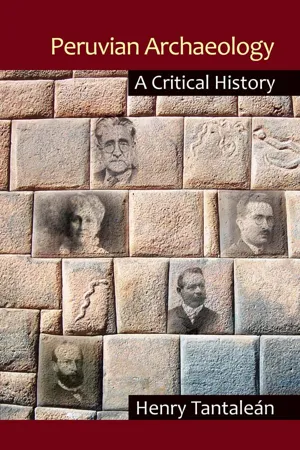
This book offers a unique, critical perspective on the history of Peruvian archaeology by a native scholar. Leading Peruvian archaeologist Henry Tantaleán illuminates the cultural legacy of colonialism beginning with "founding father" Max Uhle and traces key developments to the present. These include the growth of Peruvian institutions; major figures from Tello and Valcárcel to Larco, Rowe, and Murra; war, political upheaval, and Peruvian regimes; developments in archaeological and social science theory as they impacted Andean archaeology; and modern concerns such as heritage, neoliberalism, and privatization. This post-colonial perspective on research and its sociopolitical context is an essential contribution to Andean archaeology and the growing international dialogue on the history of archaeology.
Information
Chapter 1
The Beginnings of Archaeology in Peru
Introduction
INTEREST IN THE central Andean past, in the area that would later become Peru, goes back to the prehispanic period, when societies such as the Tiwanaku and the Inca used sites and special places, known as huacas, as a means to create historical narratives for themselves.1 This common historical phenomenon served to justify and legitimize the political structure of dominant social elite of these societies. Thus, this interest in the past is based, as in other areas of the world (Egypt, Rome, China, India, etc.), on the need to give depth to time and to create cultural “roots” through iconic archaeological cultures, sites, and archaeological objects.
However, since we have no written sources in the precolumbian Andean world, it is only since 1532 that we can actually understand the intentions of the individuals and institutions responsible for linking the past with their contemporary social and political world. Thus, the first Spanish chroniclers were also responsible for generating some of the first intellectual linkages of their contemporary world with that of the ancient past as they saw it. For example, Miguel de Estete’s ([1534] 1891) account of the journey of Hernando Pizarro from Cajamarca to Pachacamac in early 1533 is a significant case in point. It relates the social and political dynamics that occurred at this key oracle center, an important Inca and pre-Inca site located a few miles south of Lima, which would become the capital of the Viceroyalty of Peru. He observes, for example, “the village seems to be ancient, due to the fallen buildings that are in it” (Estete [1534] 1891:133). This is one of the first instances in the early historical documents in which a writer differentiates between buildings in use and those that had been abandoned and therefore were older. In a similar manner, the chronicles of Pedro Cieza de León ([1553] 2005) are important documents precisely because he takes the time to distinguish between and Inca and pre-Inca buildings and settlements. While this may strike the modern observer as somewhat self-evident, it was a major observation in the sixteenth and seventeenth centuries. In a world that the West considered only about 6,000 years old, the discovery of societies that did not have historical records was quite significant.
One document that has unique cultural meaning and that has been compared with other sacred books such as the Old Testament, the Popol Vuh, or the epic of Gilgamesh (Millones and Mayer 2012:11) is the anonymous text attributed to Francisco de Ávila (1598?) known as the “Huarochirí Manuscript” (Arguedas [1966] 2007). This text relates a myth describing huacas and their form of existence in the world alongside humans. These “extirpators of idolatries” such as Ávila provide valuable information about archaeological sites and objects in their effort to erase indigenous beliefs and practices. In spite of the huge damage that this extirpation campaign by the Catholic Church wrought on the customs and life of the indigenous peoples, it also constitutes the first source of ethnographic information of Andean societies.
Later, during the Spanish colonial period and viceroyalty, the looting of archaeological sites became one of the many exploitative practices in Peru similar to mining and guano exploitation. Looting of huacas was widespread, as described by Jorge Zevallos Quiñones (1994) for the north coast. However, beyond bureaucratic and tax documents, there are no additional records of such activities.
As Lisa Trever (2012; also see Schaedel 1949) has shown, the Bishop of Trujillo, Baltasar Martínez Compañón, established one of the first idioms of archaeological representation in Peru using the sites and archaeological objects of the north coast in Trujillo del Perú, published between 1781 and 1789. The watercolor images in the book link this work directly with contemporary European traditions that also dealt with archaeological remains, such as those about Pompeii or Herculaneum in Naples (Pillsbury and Trever 2008).
Despite these early attempts at archaeological descriptions and representations, it is only with the advent of the Republic from 1821 that we see systematic efforts by individuals and institutions to create a deeper historical sense in the Peruvian nation. These efforts were realized under the influence of foreign investigators, or within largely European theoretical constructs. North American scholars at this time effectively borrowed from European models, which were indirectly imposed in Peru. Peruvian scholars at this time likewise sought to establish a postcolonial history freed from the influence of Spain; however, they could not escape the larger European intellectual climate. In the absence of precolumbian documents, Peruvianists would have to look at the remains of the past before the arrival of Pizarro’s army.
Peru in the Nineteenth Century
Like many of the Latin American countries that overcame colonial domination, Peru began its republican history inspired by the ideals of the European republics like France, especially the liberal values embodied in their political constitutions. Therefore, in the case of Peru, from the beginning of the Republic in 1821, but more specifically from the final expulsion of the Spanish Royalist troops after the Battle of Ayacucho in 1824, the country embarked on a path to create an autonomous and independent postcolonial political reality. Its political life was marked by the emergence of warlords, a time Alberto Flores Galindo (1999) referred to as the “authoritarian tradition.” The national economy in the nineteenth century also was still heavily dependent upon foreign capital, especially from Britain. The process of postcolonial state-building in Peru was at times painfully slow, in fits and starts, as the new Republic sought to create its own reality.
In fact, the history of Peru after 1824 until the middle of the nineteenth century is marked by the unsuccessful search for a viable form of government and a national economic policy that labored under the colonial legacy. The failure to clearly establish a political structure and the lack of a true republican democracy led to a number of political experiments, such as the Peruvian-Bolivian Confederation, which lasted a few short years from 1836 to 1839.
Warlord interests drove the bulk of political activity in this period, creating a volatile climate that shaped the structure of the state and impeded the development of the national economy. In this context, the various governments of the time did little more than support and protect the warlords and safeguard the interests of foreign capital enterprises, especially that of the British, through the mineral, guano, and salitre (sodium nitrate) concessions. In fact, the principal commercial houses in Lima were British, and as a consequence the social elite of Lima adopted European values much more than Andean ones.
As Julio Cotler (1978) reminds us, the change from the Viceroyalty to the Republic left a “colonial legacy” that burdened Peru through its struggles for independence and created economic and political contradictions throughout its history. Therefore, while there was a political agenda that promoted the incorporation of republican ideals in Peru, inspired by liberal European developments and notions of progress grounded in technology, economic, political, and ideological practices (particularly the Catholic religion), the culture continued to reflect an internalized colonial mentality that did not permit national integration of the many social classes. The cultural climate was intensely racialized,2 a means by which the elite and their government marginalized most citizens. The debate between conservatives and liberals (effectively two points of view shared by the elite that excluded most people) represents this situation during the nineteenth century.
Later, there was a relative period of calm aided by an ephemeral economic boom in the middle of the nineteenth century fueled by the exploitation of guano. This was particularly clear during the government of Ramón Castilla (1855–1862). This important moment of national consolidation intensified with the first democratically elected president, the civilian Manuel Pardo (1872–1876). With Pardo, we see a series of reforms of the Peruvian state; because of this, the intellectual climate in Lima surged again.
It was in this context that Antonio Raimondi, Italian by birth, came to Peru on July 28, 1850. He helped generate a new intellectual life in Lima, especially from his position as Chair of Historia Natural en la Facultad de Medicina de San Fernando. This position gave him a new relationship with the Limeña intellectual elite. At the same time, he became acquainted with the provincial intellectuals while he explored the country. Raimondi focused on the rich Peruvian flora and fauna, an activity that had commercial implications for both the Peruvian state and foreign concerns. His subsequent relationship with President Pardo (Villacorta 2008) was also vital for his enhanced intellectual and political prestige in Peru; his prominent participation in national development projects is a good example of this. Along with the early Atlas Geográfico del Perú (1865) by Mariano Paz Soldán,3 the news, reports, and images published by Raimondi (1874) from his natural and historical explorations of the country generated the first significant images that impressed the urban elite of Peru in the second half of the nineteenth century. Raimondi conducted classical natural history research, cataloging botanical and animal species, and also documented the rich mineral resources of the country.4
A turning point in the national economy was fueled by salitre and guano, especially in the far south of Tarapa...
Table of contents
- Cover
- Half Title
- Title Page
- Copyright Page
- Table of Contents
- List of Illustrations
- Dedication
- Acknowledgements
- Foreword
- Introduction: The Crisscrossed Past
- Chapter 1. The Beginnings of Archaeology in Peru
- Chapter 2. The Foundation (Western) of Peruvian Archaeology: Max Uhle and Cultural Evolutionism
- Chapter 3. Archaeology and Nationalism in the 1920s: Julio C. Tello and Peruvian Culture
- Chapter 4. Indigenismo in the Ancient Capital of the Incas: The Cusqueño Period of Luis Valcárcel
- Chapter 5. North American Influence in the 1940s: Rafael Larco Hoyle and the Virú Project
- Chapter 6. New Horizons in Peruvian Archaeology: John H. Rowe and the Berkeley School
- Chapter 7. Ethnohistory and Archaeology in the 1960s: John Murra's Influence in Peru
- Chapter 8. Archaeology as Social Science: From Gordon Childe to Luis Lumbreras
- Chapter 9. Processualist Archaeology in Peru: Emergence and Development
- Chapter 10. Archaeology in 1990s Peru: A View from Lima
- Chapter 11. Peruvian Archaeology at the Beginning of the Twenty-First Century: Boom and Bust
- Conclusion: New Horizons for Peruvian Archaeology in a Globalized World
- Notes
- References
- Index
- About the Author and Translator
Trusted by 375,005 students
Access to over 1.5 million titles for a fair monthly price.
Study more efficiently using our study tools.
Frequently asked questions
Yes, you can cancel anytime from the Subscription tab in your account settings on the Perlego website. Your subscription will stay active until the end of your current billing period. Learn how to cancel your subscription
No, books cannot be downloaded as external files, such as PDFs, for use outside of Perlego. However, you can download books within the Perlego app for offline reading on mobile or tablet. Learn how to download books offline
Perlego offers two plans: Essential and Complete
- Essential is ideal for learners and professionals who enjoy exploring a wide range of subjects. Access the Essential Library with 800,000+ trusted titles and best-sellers across business, personal growth, and the humanities. Includes unlimited reading time and Standard Read Aloud voice.
- Complete: Perfect for advanced learners and researchers needing full, unrestricted access. Unlock 1.5M+ books across hundreds of subjects, including academic and specialized titles. The Complete Plan also includes advanced features like Premium Read Aloud and Research Assistant.
We are an online textbook subscription service, where you can get access to an entire online library for less than the price of a single book per month. With over 1.5 million books across 990+ topics, we’ve got you covered! Learn about our mission
Look out for the read-aloud symbol on your next book to see if you can listen to it. The read-aloud tool reads text aloud for you, highlighting the text as it is being read. You can pause it, speed it up and slow it down. Learn more about Read Aloud
Yes! You can use the Perlego app on both iOS and Android devices to read anytime, anywhere — even offline. Perfect for commutes or when you’re on the go.
Please note we cannot support devices running on iOS 13 and Android 7 or earlier. Learn more about using the app
Please note we cannot support devices running on iOS 13 and Android 7 or earlier. Learn more about using the app
Yes, you can access Peruvian Archaeology by Henry Tantaleán in PDF and/or ePUB format, as well as other popular books in Social Sciences & Archaeology. We have over 1.5 million books available in our catalogue for you to explore.