- 350 pages
- English
- ePUB (mobile friendly)
- Available on iOS & Android
eBook - ePub
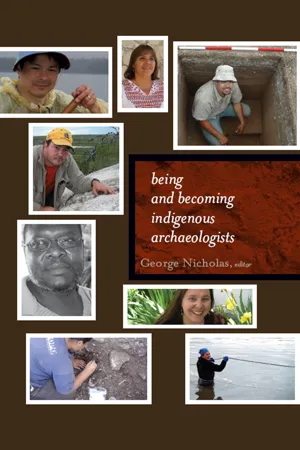
Being and Becoming Indigenous Archaeologists
About this book
What does being an archaeologist mean to Indigenous persons? How and why do some become archaeologists? What has led them down a path to what some in their communities have labeled a colonialist venture? What were are the challenges they have faced, and the motivations that have allowed them to succeed? How have they managed to balance traditional values and worldview with Western modes of inquiry? And how are their contributions broadening the scope of archaeology? Indigenous archaeologists have the often awkward role of trying to serves as spokespeople both for their home community and for the scientific community of archaeologists. This volume tells the stories—in their own words-- of 37 indigenous archaeologists from six continents, how they became archaeologists, and how their dual role affects their relationships with their community and their professional colleagues. Sponsored by the World Archaeological Congress
Information
CHAPTER ONE
BEING AND BECOMING A SOUTH AMERICAN ARCHAEOLOGIST

Photo by Manuel Perales
It has been ten years since my first archaeological class. In the beginning, I had many questions: What were the real goals of archaeology? Was it just the study of ancient artifacts, or was there something more? Why did I pick archaeology in the first place? Today, as a practicing archaeologist, I still consider these questions important but also have a much deeper understanding of the contributions that archaeology makes, and the challenges that we face, especially as Indigenous archaeologists.
As a child I had enjoyed reading history books. When I was fifteen, the novels of Jules Verne captured my imagination and led my mind to wander as I thought about new and different cultures. But I couldn’t fantasize too much; the reality was that I lived in one of the poorest countries in the world, with its large populations of marginalized and oppressed Indigenous peoples.
My grandmother belonged to a peasant community. She was taken from Tarma, near Junin in the Central Highlands of Peru, when she was just eight and raised in Lima. That is where she established my family. However, no one acknowledged their Indigenous past. Family members grew up in the city and decided to assume a more Western way of life. They became doctors and engineers; my mom became a social worker. It was not until after her death that family members decided to learn more about the family history and visit their roots.
I was raised by my grandmother, who taught me many traditional Andean ways. It wasn’t until some years later, when I first took that archaeological class, that I realized that all of the people who had migrated to Lima, just like my grandmother’s family, were part of the ancient cultures that my teacher told us about. And what a discovery that was—that the past wasn’t the past of a different people, it was my past. I also learned that the various and unique cultures of ancient times continued into the present, occupying the Andean landscapes of a past that I hadn’t known about before then.
Until that point I had been educated as most middle-class Peruvians from Lima had been, learning that the Andean people were great in the past. But we never heard anything about them in the present. It was ironic that we had been taught to bestow such prestige and honor on these ancient people, and yet their descendants had been living in some of the poorest conditions for the last 500 years. There was something very wrong with this. I therefore started to adopt the identity of my past. I soon came to believe that the discipline of archaeology provided the means to challenge this imbalance and to make contributions to Andean people beyond simply reconstructing the past.
RECONNECTING TO THE PAST
What does it mean to be an Andean archaeologist who is disconnected from his origins, from his past? This question was in my mind for ten more years, until I developed an answer for myself. Generally, the study and practice of archaeology in Peru and other Latin America countries is a major undertaking. Often doing archaeology here feels like a kind of fight, because archaeologists have to constantly confront the government and its policies, in addition to fighting against local and regional authorities who think that the past is nothing more than ruins to be exploited—a product to be sold. In addition, Indigenous and peasant communities sometimes see archaeologists as enemies who want to steal their lands and disrupt their livelihood. This is due to the idea (sometimes accurate, even today) that archaeologists view the past primarily in terms of objects that can be taken straight to the lab, or as exotic works of art that can be exhibited without benefit to the communities who are the real owners of that heritage.
Indeed, the international archaeological community has often been guilty of overlooking Indigenous peoples and their rights. Intentionally or not, the connections that living peoples have to the past may go unrecognized, yet it is their heritage and history that is at stake. Ignoring both human and historical property rights, Western archaeologists have sometimes been responsible for taking artifacts or for interpreting the past in ways that challenge local knowledge. In doing so, they have “kidnapped” a part of Indigenous social life, beliefs, and belongings.
One example of this is a case I have been involved in—the artifacts and other materials taken from Machu Picchu by the North American explorer Hiram Bingham in 1911 and 1916. The Peruvian government had authorized him to take the remains out of the country for scientific study at Yale University in the United States, but only for a limited number of years. However, after more then 90 years, the university has returned just a small sample of artifacts and some human bones. As a result, part of the history of the people from Cusco, the former Inca capital, and the descendants of the Quechua’s Inca communities, has been lost to them. Thousands of people have been denied their heritage rights. To me, the lack of access to my material past is very much like my grandmother being denied the right to know her roots.
Machu Picchu is perhaps the best-known site not only in Peru but possibly in all of South America. There is a lot at stake here. As archaeologists Colin Renfrew and Paul Bahn (1991) note, the past is a big business, for both tourism and the auction houses. In important museums around the world, the past is a kind of rentable space. This big-business approach to cultural heritage not only affects the integrity of material culture, but destroys the identities of entire nations and limits access to their origins. I strongly believe that a people without a past and an identity are an easy target for oppression and conquest. My hope is to see, within my lifetime, the material aspects of my identity, represented by the Machu Picchu artifacts, placed inside an Andean museum as a celebration of our history.
There is another “other” history to consider: the Indigenous one that is included in what the government calls the “national identity of Peru.” This is what academics and museum curators call “prehistory,” which to me means the forgetting of history, of traditional and local beliefs, as a result of the Spanish conquerors’ imposition of 300 years of colonialism, exploitation, and racism. Now we know that we have a history, one not separated from us in time—our history is not “pre” anything! When the Spanish arrived in America, they did not start civilization or history. This process began in South America when the first complex societies were developing, which in the Andes was 5,000 years ago.1 The use of the term “prehistoric” is, in my view, just a colonial reminiscence and a term I encourage archaeologists and the public to avoid using. In fact, Peruvian archaeologists generally don’t like to use it, but it is common to read the term in the North American and European archaeological literature.
THE PROBLEM, THE SUFFERING, THE REALITY
In addition to exploring the past, I believe that archaeologists need to develop an activist position, possibly in the sense of the early 20th-century Italian philosopher Antonio Gramsci, whom I consider an engaged intellectual. To illustrate this, I will tell some true stories of what Indigenous or peasant communities in Peru have had to live with.
In the year 2000, a mining company wanted to exploit a gold quarry that was directly under the town of Tambogrande in the Piura region of northern Peru. The people of Tambogrande were opposed to this project and rejected it in a popular referendum by 98%. They knew they would be ill affected by mining activities on their land: the drinking water supply would be polluted, as would be a number of cultivable fields; it would even be necessary to move the town. In situations like this, the first casualties are cultural heritage and archaeological remains, followed by health threats affecting the lives of children and then of the whole community.

Author mapping a shell scatter at Playa Chica, Huaura Valley, Peru. Photo by Manuel Perales.
While the peasants were battling this proposed project, in 2001 the mining company presented to the Peruvian government their environmental impact statement on the potential effects of the project in the Tambogrande region. The document was thousands of pages long and was almost impossible for community members to acquire. Robert Moran, a Canadian environmental engineer, provided the Tambogrande community with his evaluation of the environmental impact report, and concluded that there would be water contamination if the operations of the mine continued. The company’s report could have been written to be much clearer, but obviously there was no intention of communicating the results to the people. This fact created an uprising, supported by many human rights organizations, university scholars, and social organizations. Community members called strikes throughout the area. The risks of the mining operation to agriculture—an ancient traditional activity—were the principal reasons the people succeeded in removing the threat of the mining operation from their land.
However, the residents of Choropampa, near Cajamarca, Peru, were not so lucky. On June 2, 2000, large quantities of mercury were spilled by the Minera Yanacocha. Yana-cocha is a gold-mining company, and a very powerful one in Peru. Many believe that Yanacocha is a corrupt transnational that paid local authorities, members of the Peruvian Congress, regional clubs, reporters, and religious congregations to help cover the crime—a crime that to this day is costing the lives of children, in addition to causing chronic illness, abortions, kidney failure, and other health problems for the rest of the inhabitants.2 Ironically, the people who protested against the mining company were ordered to pay a fine to the government for disturbing the peace.
Peruvian archaeologists are generally not only disconnected from Indigenous issues, but sometimes work for these corrupt companies, making big money doing rescue archaeology and permitting the destruction of sites and the identity of small communities. Being unaware or ignorant of the reality of traditional lifeways results in poor scholarship by archaeologists, making it impossible to understand the past and even the archaeological record.
DOING SOCIAL ARCHAEOLOGY: A PROPOSAL
With the Tambogrande and Choropampa cases in mind, I propose a different way of doing archaeology in South America, especially in the Andes. This is a proposal that involves practicing archaeology within the traditional communities—living with them, sharing the culture, and viewing the world from their perspective. This can be considered as a new perception of archaeology, a social archaeology based on ethnoarchaeology, and with a theoretical independence from more conservative general theories (Aguilar Diaz 2004). This is the way that I’ve conducted my archaeological practice for the last few years.
Social archaeology is also a political practice and a way of doing the discipline outside of academia. It shares the same formal objectives with the rest of the social sciences, but it does have a distinct methodology and praxis. I’ve found many inspired ideas from Luis G. Lumbreras, one of the creators of Latin American Social Archaeology, particularly for promoting the idea of an archaeology that is relevant to descendant communities.3 I have found another methodology that is similar in some respects to Lumbreras’s, and that is Jerimy Cunningham’s ethnoarchaeological study (2005) of pottery production in Mali. I find that his desire to understand the past by means of working with community members is very similar to mine. He writes:
The central topic in this dissertation is that ethnoarchaeology has much to gain from engaging with the economic, social and political realities that created material systems in the present. Ties between individuals and their things— whether things they have bought or things they have made—are complex, sensual, emotive, economic and utilitarian. Things are banal and they are esoteric. Ethnoarchaeology can only meet its goals within the broader discipline of archaeology by seeking to identify as accurately as possible exactly these sorts of ties. (Cunningham 2005: 9)
This approach can be contrasted with processual archaeology’s emphasis on groups, not individuals, and also with the position that material correlates of human behavior (via Binford’s middle range theory, for example) are relatively unambiguous. My idea is to go beyond the typical field of study and range of traditional archaeology beca...
Table of contents
- Cover
- Half Title
- Title Page
- Copyright Page
- Dedication
- Table of Contents
- Introduction
- 1. Being and Becoming a South American Archaeologist
- 2. The Challenges of a Ghanaian Archaeologist
- 3. Understanding Archaeology from a Samoan Perspective
- 4. Raise Your Head and Be Proud Ojibwekwe
- 5. Searching for Identity through Archaeology
- 6. Indigenous Journeys—Splinterville, Drenthe, Amherst
- 7. Being a Yorta Yorta Heritage Man: An Interview by Claire Smith
- 8. The Experience of a Mayan Student
- 9. My Life as a Kaqchikel Mayan Tour Leader and Maya Researcher in Guatemala
- 10. Who Am I and How Did I Get Here?
- 11. Indigenous Archaeology and Being Indian in New England
- 12. Written Voices Become History
- 13. Archaeology in My Soul
- 14. The Flying Alien—An Outsider Archaeologist
- 15. Archaeological Reflections of a 68-Year-Old Bushman
- 16. Take Only What You Need, and Leave the Rest
- 17. Archaeology and Perceptions of the Past in Papua New Guinea
- 18. Being an African Archaeologist in the United States
- 19. The Journey of a L’nu Archaeologist in a Mi’kmaw Place
- 20. Echoes from the Bones: Maintaining a Voice to Speak for the Ancestors
- 21. “An Encounter”: A Personal Account of Being-Becoming an Indigenous Archaeologist in South Africa
- 22. The “Other” Accidental Archaeologist
- 23. (Re)Searching for Ancestors through Archaeology
- 24. Archaeological Battles and Triumphs: A Personal Reflection
- 25. Working for My Own
- 26. Living Archaeology for the Ainu in Hokkaido: An Interview by Hirofumi Kato
- 27. Being an Inuvialuk Archaeologist and Educator from Tuktoyaktuk
- 28. Nach’en or Transforming into a Squamish Nation Indigenous Archaeologist
- 29. Haere Tika Tonu Atu—Keep Going Forward
- 30. Indigenous Archaeology in Mexico: Recognizing Distinctive Histories
- 31. Munk-txwáp íliɂi khapa nayka anqati shawash tillixam ikta—Digging for My Ancestors’Things
- 32. What Better Way to Give Back to Your People
- 33. Being an Indigenous African Archaeologist
- 34. Becoming One of “Them”…
- 35. Becoming a Ngarrindjeri Archaeologist: The Journey to and from Suburbia
- 36. My Eclectic Career in Archaeology
- About the Contributors
Trusted by 375,005 students
Access to over 1.5 million titles for a fair monthly price.
Study more efficiently using our study tools.
Frequently asked questions
Yes, you can cancel anytime from the Subscription tab in your account settings on the Perlego website. Your subscription will stay active until the end of your current billing period. Learn how to cancel your subscription
No, books cannot be downloaded as external files, such as PDFs, for use outside of Perlego. However, you can download books within the Perlego app for offline reading on mobile or tablet. Learn how to download books offline
Perlego offers two plans: Essential and Complete
- Essential is ideal for learners and professionals who enjoy exploring a wide range of subjects. Access the Essential Library with 800,000+ trusted titles and best-sellers across business, personal growth, and the humanities. Includes unlimited reading time and Standard Read Aloud voice.
- Complete: Perfect for advanced learners and researchers needing full, unrestricted access. Unlock 1.5M+ books across hundreds of subjects, including academic and specialized titles. The Complete Plan also includes advanced features like Premium Read Aloud and Research Assistant.
We are an online textbook subscription service, where you can get access to an entire online library for less than the price of a single book per month. With over 1.5 million books across 990+ topics, we’ve got you covered! Learn about our mission
Look out for the read-aloud symbol on your next book to see if you can listen to it. The read-aloud tool reads text aloud for you, highlighting the text as it is being read. You can pause it, speed it up and slow it down. Learn more about Read Aloud
Yes! You can use the Perlego app on both iOS and Android devices to read anytime, anywhere — even offline. Perfect for commutes or when you’re on the go.
Please note we cannot support devices running on iOS 13 and Android 7 or earlier. Learn more about using the app
Please note we cannot support devices running on iOS 13 and Android 7 or earlier. Learn more about using the app
Yes, you can access Being and Becoming Indigenous Archaeologists by George Nicholas in PDF and/or ePUB format, as well as other popular books in Social Sciences & Archaeology. We have over 1.5 million books available in our catalogue for you to explore.