- 288 pages
- English
- ePUB (mobile friendly)
- Available on iOS & Android
eBook - ePub
About this book
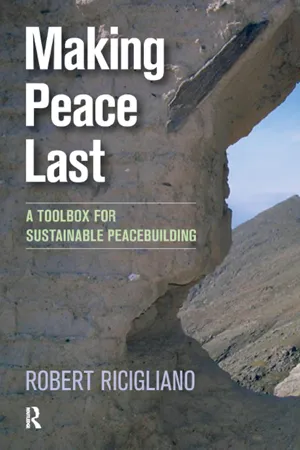
The international community invests billions annually in thousands of projects designed to overcome poverty, stop violence, spread human rights, fight terrorism and combat global warming. The hope is that these separate projects will 'add up' to lasting societal change in places like Afghanistan. In reality, these initiatives are not adding up to sustainable peace. Making Peace Last offers ways of improving the productivity of peacebuilding. This book defines the theory, analysis and practice needed to create peacebuilding approaches that are as dynamic and adaptive as the societies they are trying to affect. The book is based on a combination of field experience and research into peacebuilding and conflict resolution. This book can also be used as a textbook in courses on peace-building, security and development. Making Peace Last is a comprehensive approach to finding sustainable solutions to the world's most pressing social problems.
Information
PART I
UNLOCKING THE POWER OF PEACEBUILDING
CHAPTER 1
WE NEED TO DO BETTER, AND WE CAN

The fault, dear Brutus, is not in our stars,
But in ourselves, that we are underlings.
But in ourselves, that we are underlings.
—Cassius, Julius Caesar (I, ii, 140–141)
This book is an attempt to apply insights from systems thinking to spark a revolution in the sustainability and cost-effectiveness of efforts to build a more peaceful, just, and secure world. It represents a personal journey as much as an intellectual one. I will try to limit the personal stories to those that make the intellectual argument more comprehensible and to discuss the technical side in ways that are accessible to those outside these specific fields. I am sure I will at times fail at both, but bear with me as I pick up the journey …
In the summer of 1995, in the middle of a crowded airplane traveling toward a destination halfway around the world, I spotted a young woman nuzzling her infant son. Most people would smile at this. I cried. Two months earlier, my wife and I had had our first child. When I saw the woman and her son on the plane, I realized that I was speeding away from the two people I loved the most.
Why was I doing this? Traveling abroad was a regular feature of my job doing conflict resolution work, or what some might call peace work, but now it seemed too great a sacrifice. Then I thought about others I have worked with in places like Colombia or the former Soviet Union and what they had sacrificed to improve their lives and their societies. I thought about the activist in South Africa in 1993 who was assassinated simply for attending a workshop on negotiation that I helped conduct. What motivates people to make these sacrifices? I thought about the fact that what kept me going was a belief that the great problems of the world—war, poverty, and injustice—were formidable, but they were within our grasp as humans to affect. Cassius’s lament in Julius Caesar is both a criticism and an opportunity—because the current situation is our fault and not our fate; we have the power to change it. This was what I needed to be able to say to my family. We can make the world a better, more peaceful place.
Unfortunately, events of the late twentieth and early twenty-first centuries have provided ample evidence to prove my optimism unfounded. In July 2004, the US government took the unprecedented step of labeling the violence in Darfur, Sudan, as a genocide. Still, the suffering there continued. The Democratic Republic of Congo witnessed what has been labeled the world’s worst humanitarian tragedy (5.4 million dead between 1998 and 2007). Wars raged in Iraq (over 2 million displaced people, perhaps 1 million dead) and Afghanistan against the backdrop of an increasing global terrorist threat. These followed on the heels of 800,000 killed in the Rwandan genocide (1994) and ethnic cleansing in Bosnia (early 1990s) and Kosovo (1999). Suffering continues in Somalia, Haiti, Israel-Palestine, Colombia, Zimbabwe, and elsewhere. This history provides ample support for the view that the prospect of “peace in our time” is as bleak as ever.
In stark contrast, however, there are credible claims that the decades after 1989 have witnessed a level of success in ending violent conflicts that is unprecedented in human history:
• After peaking in 1991, the number of civil wars had dropped 40 percent by 2003.1
• The number of wars ended through a negotiated settlement has increased dramatically. During the Cold War, “the number of civil wars ending in military victory (by the government or the rebels) was twice as large as the number that were concluded by negotiated settlements.”2 In the 1990s this trend was reversed, and almost twice as many wars ended in negotiated settlements versus military victories.3
• In the fifteen years between 1988 and 2003, more wars ended through negotiated settlement than had in the previous two centuries.4
These trends are a cause for celebration and have led many to tout the impact of organizations like the United Nations and its member governments along with the growing number and diversity of nongovernmental organizations (NGOs).
So, which is it: inexorable slide toward doom or accelerating trend toward peace? Asked another way, if the patient is planet Earth and the malady is violent conflict, is the patient terminal or on the road to recovery? As unsatisfying as it sounds, the answer lies somewhere in between. While it may be very difficult to ascribe specific causation to any one group, the positive trends cited above indicate that the international community, practitioners, and academics have learned important lessons about ending wars and building peace. The wealth of reports, books, and papers on postconflict reconstruction, war-to-peace transitions, and conflict resolution testify to this fact.5
The impressive statistics cited above are tempered, however, by the reality that almost 25 percent of wars that end in a negotiated settlement relapse into violence within five years.6 And much of this improved peacebuilding batting average must be ascribed to factors other than increased skill or organizational effectiveness. For example, many of the Cold War conflicts were sustained in large part by military subsidies from one or both superpowers. In some cases, the end of those subsidies after 1989 may have had as big an influence on achieving negotiated settlements as the actions of interveners like the United Nations or the efforts of NGOs.
Although we have no statistic from the Cold War period for how many of the wars that ended through means other than negotiation relapsed into war, the five-year relapse rate of negotiated settlements means that the international community’s batting average for settling wars through negotiation is only marginally better than it was during the Cold War. Further, the rate of negotiated peace relapsing into violence shows that the international community is better at stopping violence than building or consolidating peace. This statistic exemplifies the heart of the problem: The challenge is not making peace, at least in some partial sense; rather, the difficulty is making peace last. Several studies have concluded that the track record of peacebuilding is “quite mixed.”7 Nicolas Sambanis and Michael Doyle looked at 124 peacebuilding initiatives from 1945 to 1997.8 Their study concluded that peacebuilding initiatives were successful in 43 percent of the cases, using a lenient definition of peace, and in only 35 percent of cases, using a “stricter” definition of peace. More troubling are cases where peace processes may have contributed to even greater violence. For example, in Rwanda (1994) and Angola (1993) more people died after peace agreements failed than died in the previous civil wars.9
In addition to the difficulty of consolidating peace, the international community has not necessarily shown a markedly increased ability to prevent the outbreak of wars. The post–Cold War period has not seen a reduction in the rate at which new civil wars begin.10 Prevention is a critical challenge because states that have had one civil war are “far more likely” to experience additional violent conflict.11
The difficulty that the international community faces in preventing the outbreak of wars and consolidating peace has gained importance with the changing nature of war from predominately interstate to predominately intrastate wars. Civil wars are proving more destructive than interstate wars.12 And the longer a war continues, the more likely it is to exacerbate the structural factors that supported the outbreak of the war in the first place, lead to additional grievances, and make peace more difficult to consolidate.13 Studies show that a main determinant of whether there will be a recurrence of a civil war is the duration and destructiveness of the preceding violence.14
The challenge is much larger than just stopping violent conflict. It also entails creating the conditions for a sustainable peace or redressing the conditions that may lead to future conflict. Definitions of peace vary, but most would agree that it means more than just the absence of violence. Inextricably interconnected with peace are issues of chronic poverty, state weakness or failure, environmental degradation, health crises, food shortages and other resource conflicts, and recurring human rights violations. For example, while poverty alone may not necessarily spark violence, it is hard to imagine that there could be sustainable peace when about 1 billion people are living in extreme poverty with another 1.5 billion living just above the subsistence level.15
In addition, a 2001 report by the Council on Foreign Relations finds a correlation between a country’s poor health status and “a decline in state capacity, leading to instability and unrest.”16 Dr. Michael Ryan, global alert and response coordinator for the World Health Organization (WHO), estimates that 50 to 75 percent of WHO responses to epidemics are in conflict-affected countries, considered “zones of emergence” for diseases that spread to non-conflict areas. Many of the last cases of diseases eradicated in other parts of the world remain in violence-affected areas.17
There is also a strong link between violence and state failure, either as a driver or consequence of state collapse.18 Violent conflict has many well-established impacts on the environment.19 In addition, there is a growing link between climate change, instability, and conflict. A report on the connection between climate change and national security found that “climate change acts as a threat multiplier for instability in some of the most volatile regions of the world.”20
There are two critical implications of this link between peace and the many social problems identified above. First, whatever the particular cause—reversing global warming, ending poverty, protecting human rights—building peace is certainly going to be part of the solution. Second, and perhaps most profoundly, the interconnectedness of the issues peacebuilding affects raises the fundamental question of how the world is going to finance efforts to deal with all these problems. When one aggregates the costs—not just of peacekeeping or peacemaking operations but of dealing with poverty, humanitarian crises, weak states, and the like—it is clear that the demand for resources to address these problems will easily and permanently outstrip the resources dedicated to alleviating them. Aaron Salzberg, special coordinator for water resources at the US State Department, said that “even if we took all the world’s official development assistance together and applied it to water [issues], it would not be enough.”21
This changes the problem from one of absolute resources to one of efficiency in using them. The international community has to get much more productive, by several orders of magnitude, in how it spends funds dedicated to peace, justice, development, and the environment. Unfortunately, the international community is not using its resources wisely. The inefficiency in how the international community spends its money on peacebuilding in conflict zones is a good case in point. It is not hard to find examples of peacebuilding funds being wasted. An audit by the special inspector general for Iraq reconstruction found $9 billion in unaccounted-for funds.22 In Afghanistan, $300 million was spent on a presidential election in 2009 in order to strengthen governance as part of rebuilding that country. However, many observers felt the massive fraud in the election further delegitimized the government of Hamid Karzai.23
The problem extends beyond these notable examples. William Easterly, a former World Bank economist, argues that the problem is not that the donor countries are stingy but that they are ineffective because their programs are poorly designed and executed.24 In order to test whether there was a relationship between a country’s rate of economic growth and the level of foreign aid it received, Easterly divided the countries in the poorest quintile into two groups: half with highest level of aid and half with the lowest level. The result of his analysis is sobering for those who tout the effectiveness of foreign aid: “There is no significant difference in growth rates between the two groups, despite average aid as a percentage of GDP being two to five times larger in the top group.”25
WHY AREN’T WE DOING BETTER? THE MICRO-MACRO PARADOX
Lasting peace will not likely be attained unless peacebuilding undergoes a productivity revolution. The central reason why peacebuilding programs are not more productive, or cost-effective, is that we are not working “smart.” This is not to say that we lack smart, hardworking people in the field who are designing and carrying out a myriad of peacebuilding programs. The thousands of peacebuilding practitioners across the world are among the best and the brightest. Rather, the problem is that peacebuilders need the tools to create synergy among their programs in order to make their collective impact much greater than the sum of their individual projects. Michael Lund, a leading evaluator of the effectiveness of peacebuilding programs, explains this phenomenon well: “Energies are dispersed in hundreds of different directions but the myriad of activities is not guided by an underlying grounded theory, or overall strategy, only vague assumptions.”26
Developing this underlying theory and a practical approach for its implementation is the most urgent task of the peacebuilding community. The starting point is to squarely confront the “micro-macro paradox”: Why do we see many programs across conflict zones, diverse in their nature and particulars, that are successful as measured by their ability to achieve immediate program objectives at the local (micro) level in the midst of conflicts that resist systemic (macro-level) change? This dynamic was captured best by Mary Anderson and Lara Olson (2003), who conclude, “From the vantage point of a broad overview of many activities over many locations over a long period of time one overwhelming conclusion emerges: All the good peace work being done should be adding up to more than it is. The potential of all these efforts is not being realized.”27 In terms of cost-effectiveness, one could paraphrase Anderson and Olson to say that the billions of dollars spent on peacebuilding projects should be buying more peace. Resolving the micro-macro paradox holds the key to improving our peacebuilding productivity.
What should we learn from both our successes and our shortcomings in reducing violent conflic...
Table of contents
- Cover Page
- Half Title Page
- Title Page
- Copyright Page
- Contents
- List of Illustrations
- Acknowledgments
- Part I Unlocking The Power of Peacebuilding
- Part II Systemic Peacebuilding Assessment and Planning
- Part III Catalyzing Systemic Change
- Notes
- Works Cited
- Index
- About the Author
Trusted by 375,005 students
Access to over 1.5 million titles for a fair monthly price.
Study more efficiently using our study tools.
Frequently asked questions
Yes, you can cancel anytime from the Subscription tab in your account settings on the Perlego website. Your subscription will stay active until the end of your current billing period. Learn how to cancel your subscription
No, books cannot be downloaded as external files, such as PDFs, for use outside of Perlego. However, you can download books within the Perlego app for offline reading on mobile or tablet. Learn how to download books offline
Perlego offers two plans: Essential and Complete
- Essential is ideal for learners and professionals who enjoy exploring a wide range of subjects. Access the Essential Library with 800,000+ trusted titles and best-sellers across business, personal growth, and the humanities. Includes unlimited reading time and Standard Read Aloud voice.
- Complete: Perfect for advanced learners and researchers needing full, unrestricted access. Unlock 1.5M+ books across hundreds of subjects, including academic and specialized titles. The Complete Plan also includes advanced features like Premium Read Aloud and Research Assistant.
We are an online textbook subscription service, where you can get access to an entire online library for less than the price of a single book per month. With over 1.5 million books across 990+ topics, we’ve got you covered! Learn about our mission
Look out for the read-aloud symbol on your next book to see if you can listen to it. The read-aloud tool reads text aloud for you, highlighting the text as it is being read. You can pause it, speed it up and slow it down. Learn more about Read Aloud
Yes! You can use the Perlego app on both iOS and Android devices to read anytime, anywhere — even offline. Perfect for commutes or when you’re on the go.
Please note we cannot support devices running on iOS 13 and Android 7 or earlier. Learn more about using the app
Please note we cannot support devices running on iOS 13 and Android 7 or earlier. Learn more about using the app
Yes, you can access Making Peace Last by Robert Ricigliano in PDF and/or ePUB format, as well as other popular books in Politics & International Relations & National Security. We have over 1.5 million books available in our catalogue for you to explore.