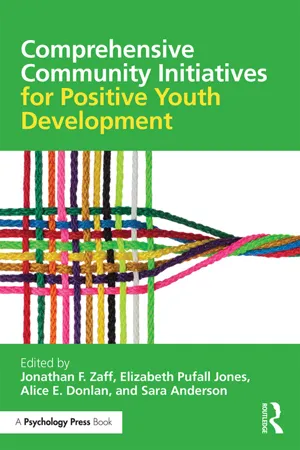
While Comprehensive Community Initiatives (CCIs) provide promising avenues to support the positive development of all young people, research findings assessing the relation between CCIs and community-level child and youth outcomes have been mixed. Although there are exceptions, few evaluations on the impact of CCIs on positive youth development have been conducted. In this edited collection, the authors draw on the field of developmental science to provide a basis for why CCIs are a powerful tool for providing all young people with opportunities to thrive. The collection begins with a brief history of CCIs and their impacts to illustrate why a developmental framework is needed, followed by a discussion of the editors' proposed framework. Each chapter that follows offers some of the most rigorous research and extant knowledge of CCIs. In the final chapter, the editors provide recommendations for future research that can systematically explore the impact of CCIs, better indicating their effectiveness and offering proven strategies that can be implemented in varying contexts. Altogether, this collection offers researchers and practitioners in the field a means by which to better incorporate theory into the vision and practices of CCIs and, as such, the tools to better measure the outcomes of the CCIs.
eBook - ePub
Comprehensive Community Initiatives for Positive Youth Development
- 188 pages
- English
- ePUB (mobile friendly)
- Available on iOS & Android
eBook - ePub
Comprehensive Community Initiatives for Positive Youth Development
About this book
Information
1
Comprehensive Community Initiatives Creating Supportive Youth Systems
A Theoretical Rationale for Creating Youth-Focused CCIs
Consider the following community. During much of the mid-20th century, this community was home to a thriving African American middle-class community. Bolstered by cotton mills and the tobacco industry, the residents built a neighborhood of small businesses and beautiful Victorian houses along tree-lined streets. Today, however, a visit to the hub of the district paints a different picture. The once-landmark building at the corner of the neighborhood’s entrance is covered with a plywood sign advertising a storefront church. The stately Victorians are abandoned, condemned, and overrun with rot and weeds. Poverty, crime, teen pregnancy, and unemployment are part of many residents’ daily lives; high school graduation and academic proficiency rates are among the lowest in the state. As a parent or a young person growing up in this community, you would be hard-pressed to find the high-quality schools, enrichment programs, and green space that are part of the landscape of the leafy suburbs just a few miles away. However, just adding in a “good” school or building a new playground will not resolve the systemic problems of poverty and violence that consume the lives of the young people in this neighborhood. Instead, an “all-in” effort is needed that brings together schools, after-school programs, early childhood care and education providers, health care providers, and others who support children, youth, and families. It is not enough, though, to have “more” or “better” programming. An initiative is needed that starts with the needs and strengths of young people and creates an interconnected system of supports linked across age, context, and time.
A Comprehensive Community Initiative (CCI) is a local, organized group of institutions and individuals interested in coordinating resources as part of a common agenda and towards a common goal (Kubisch et al., 2011). They are tailored to support a given community’s unique strengths and needs, and pursue a common agenda toward a common goal(s) (Kubisch et al., 2011). For example, CCIs can strive to combat the pervasive inequalities that exist in the United States across academic, health, social, and civic outcomes by coordinating efforts across community contexts and stakeholders to amplify results. In particular, CCIs have been used to support youth growing up in low-income and historically disenfranchised communities (Lin & Zaff, 2010).
When implemented correctly, CCIs mobilize the human, institutional, social, and financial capital in a community to resolve a given issue or set of issues in the community. Ideally, stakeholders work together to restrict duplication of services and match community needs to organization capacities (Backer, 2003; Kubisch et al., 2011; Lewin, Scrimshaw, Harrison, Somekh, & McFarlane, 2000), which builds an infrastructure that supports systemic, community-wide change. Indeed, when directed at youth outcomes, a strong community infrastructure enables a community to provide tangible benefits to children, youth, and families. In other words, if one program closes, a CCI can compensate by identifying the need quickly and leveraging other resources to meet it (Mancini & Marek, 2004).
While CCIs provide promising avenues to support the positive development of all young people, research findings assessing the relation between CCIs and community-level child and youth outcomes have been mixed. Although there are exceptions, as described later in this chapter, few evaluations on the impact of CCIs on positive youth development have been conducted. In this introductory chapter, we draw on the field of developmental science to provide a basis for why CCIs are a powerful tool for providing all young people with opportunities to thrive. We propose a youth and family-centered framework to frame the other chapters in this book, as well as to help guide CCI efforts and optimize their impacts on positive youth development. We begin with a brief history of CCIs and their impacts to illustrate why a developmental framework is needed. Next, we discuss our proposed framework. Finally, we introduce the following chapters, which represent the cutting edge of research and theory on youth-focused CCIs.
A Brief History of CCIs and Their Impacts
The history of CCIs begins with organized efforts to change communities. These efforts date back to settlement houses, such as Hull House in Chicago (e.g., Harkavy & Puckett, 1994), which provided multiple social services under one roof. This legacy of place-based, comprehensive supports continued with more systemic efforts such as Model Cities, begun in 1966 as part of President Johnson’s Great Society (Haar, 1975), which sought to mobilize neighborhood-level and city-level actions to improve the physical and economic well-being of neighborhoods, as well as to improve the physical and economic well-being of individuals. These programs often included a focus on improving the lives of young people, or at least preventing them from engaging in delinquent behavior (Haar, 1975). However, these initiatives did not rely on collaborations across a community.
Efforts in the 1980s and 1990s represent the first examples of true CCIs, bringing a convergence between social change efforts for young people and social science research, paralleling those designed to improve public health. Philanthropic organizations like the Annie E. Casey Foundation, Ford Foundation, John S. and James L. Knight Foundation, and Hewlett Foundation all embarked on ambitious, multi-year, multi-million dollar initiatives to support community collaborations to combat poverty and its negative social correlates for young people (Brown & Fiester, 2007; Center for the Study of Social Policy, 1995; Chaskin, Chipenda-Dansokho, & Toler, 2000). Simultaneously, the call for efficiency and accountability in large-scale social programs grew louder from government spending critics (e.g., the National Performance Review efforts spear-headed in 1993 by then Vice President Al Gore; Gore, 1995), as well as from funders.
This convergence between research and social change and the sudden availability of funding for projects produced an increase in research on community change efforts (e.g., Kubisch et al., 2010). For example, the Substance Abuse and Mental Health Services Administration (SAMHSA), a division within the Centers for Disease Control, implemented nationwide initiatives such as the Drug Free Communities Program. This program was created through the Drug Free Communities Act of 1997, providing multi-year grants to community coalitions to implement community-wide initiatives to prevent and reduce rates of drug use and abuse (ICF, 2012). During the 1990s, SAMHSA learned much from how community coalitions function, make decisions, and attempt to impact community-level outcomes. Based on these experiences, and in partnership with multiple research and practice partners, they created the Center for Prevention Training and Technical Assistance to provide support for coalition grantees. This technical assistance center developed the Strategic Prevention Framework, which is similar to prevention systems used by some of the more effective collaboration models (e.g., Communities That Care, described below and in Chapter 8). The Strategic Prevention Framework has iterative steps in the prevention process, including 1. Needs Assessment, 2. Capacity Building, 3. Planning, 4. Implementation, and 5. Evaluation (see http://captus.samhsa.gov/access-resources/about-strategic-prevention-framework-spf for more details).
Since the turn of the 21st century, there have been numerous efforts to catalyze and support CCIs. America’s Promise Alliance’s multiple community efforts, the Forum for Youth Investment’s Ready by 21 initiative, Purpose Built Communities, the Strive Network, and Communities that Care are a few examples of national efforts to promote CCIs. Several federally-funded programs have been implemented based on these models. In addition, inspired by the Harlem Children’s Zone (HCZ; Tough, 2009), the U.S. Department of Education created the Promise Neighborhoods initiative (PNI) in 2010. The PNI was designed to incentivize communities to design and implement CCIs that improve educational and developmental outcomes of the children and youth in the community. More specifically, the PNI framework included creating a college-going culture through the creation of a continuum of academic programs and family and community supports (Tough, 2009). These programs and supports would be aligned across the first two decades of life, from “Cradle to Career.” The first round of planning grants of up to $500,000 were awarded to 21 communities in fall, 2010, with additional rounds in 2011 and 2012. Larger grants, ranging from $1.5 million to $6 million, were awarded to a subset of the planning grant communities for implementation. However, numerous non-funded PNI-inspired communities have continued their work, leveraging local funding sources and supported by nonprofit partners (see www.promiseneighborhoodinstitute.org for examples).
The Department of Housing and Urban Development under the Obama Administration created Choice Neighborhoods (CN) to complement the PNI (Smith, 2010). CN is the next generation of the HOPE VI program, funded by the U.S. Department of Housing and Urban Development, to turn dilapidated public housing into more inviting mixed-income housing (Smith, 2010; see Chapter 2 for a more in-depth discussion). In addition to a focus on housing, CN provides supports and services to youth and families so that the youth have improved educational outcomes, and is dedicated to improving neighborhood conditions so that more businesses will invest in the neighborhoods (Pendall & Hendey, 2013). The first funded communities for CN were announced in 2011, with $122 million awarded to five sites.
In addition to funding strategies, the White House Council for Community Solutions submitted its final report in June, 2012, and recommended that community collaborations should be encouraged as a key lever for community-level change, particularly around issues of youth who are not in school and not in the workforce (White House Council Report, 2012). The recommendations of the White House Council were implemented through the subsequent creation of the Aspen Forum for Community Solutions. At the time of this writing, the Forum has provided planning grants to 21 communities throughout the country to focus on disconnected youth.
Evidence of Effectiveness
While CCIs provide promising avenues to decrease inequality, research on CCIs aiming to improve the well-being of young people has typically focused more on the structure of the collaboration than on effectiveness. That is, there is much discussion in the literature on whether the members of a collaboration communicate well with each other, trust each other, share a set of common goals, and optimally, begin to work together (Granner & Sharpe, 2004; Zakocs & Edwards, 2006). However, there is little research on the implementation of strategies that evolve out of the collaboration and the subsequent outcomes of those strategies (see Hawkins et al., 2009; Spoth, Guyll, Redmond, Greenberg, & Feinberg, 2011 for notable exceptions). Among those evaluations that have examined impacts on community-level child and youth outcomes, the results have been mixed. In addition, other initiatives show great promise and progress, but have not necessarily used methodologies that allow for making causal conclusions. Countless initiatives have anecdotally made great strides, but have not yet employed a systematic evaluation (Kubisch et al., 2010).
The Communities That Care (CTC) system (see Chapter 8 in this book) provides an interesting example of bringing together developmental theory and evidence-based programs to achieve social impact. Conceived by Hawkins and Catalano (1992), CTC created a replicable, science-based program for community coalitions to prevent adolescent drug use and delinquency (Hawkins et al., 2009). A randomized trial of the CTC system yielded statistically significant differences in substance abuse and delinquent behavior in 5th through 8th graders, and found that that students in control communities were 60% more likely to initiate the use of alcohol between grade 7 and 8 than students in CTC communities (Hawkins et al., 2009). The key ingredients for CTC’s success were found to be the use of the developers’ Social Development Model, use of a systematic needs assessment, and the choice and implementation of evidence-based programs based on the needs assessment and Social Development Model (Arthur, Hawkins, Brown, Briney, Oesterle, & Abbott, 2010).
Although CTC sheds light on the possibilities for rigorously evaluated, effective CCIs, the field still lacks an underlying theoretical framework for how CCIs can meet the needs of youth and communities. A strong theoretical frame would help existing CCIs understand and address limited success meeting their goals, as well as help new CCIs create structures and practices to maximize effectiveness. Here, we draw on Ecological Systems theories (Bronfenbrenner, 1989; Spencer, 2006), which stress the importance of youth in their contexts, as well as more applied theoretical frameworks (e.g., five promises [Scales, Benson, Moore, Lippman, Brown, & Zaff, 2008], 40 developmental assets, [Benson, Scales, Hamilton & Sesma, 2006]) to propose a Youth Systems perspective as an appropriate theoretical framework for explaining the rationale for creating CCIs and the ways that programs should be implemented.
Positive Youth Development
CCIs have been proposed as a structure for promoting Positive Youth Development (PYD; Benson et al., 2006). PYD has been used to denote and describe the underlying principles of youth development programs; as a philosophy for how youth should be viewed (e.g., not as problems to be resolved, but as assets to be promoted); and as a framework for positive outcomes or capacities (e.g., academic achievement, prosocial attitudes, and healthy relationships; Hamilton & Hamilton, 2004). Several corresponding developmental models have been proposed to describe PYD (e.g., Benson et al., 2006; Damon, 2004; Larson, 2000; Lerner et al., 2009). Across all of the models and uses of PYD, a consistent premise is that all youth have the potential to thrive (Benson, 1997; Taylor et al., 2002) and that thriving is attained when individual assets of a given young person are aligned with the ecological assets within the contexts surrounding that young person.

Figure 1.1 Positive Youth Development Process
For our purposes, we describe PYD as a developmental process in which a reduction in the probability for risk behaviors and an increase in the probability of thriving results from the alignment of the assets of a young person’s context (e.g., family, school, community, broader society) and the strengths and capacity of that young person (Benson et al., 2006; see Figure 1.1). It is important to note that the process through which PYD unfolds is bidirectional and dynamic, with youth as active agents who help to shape their ...
Table of contents
- Cover
- Title
- Copyright
- Contents
- Contributors
- Acknowledgements
- 1 Comprehensive Community Initiatives Creating Supportive Youth Systems: A Theoretical Rationale for Creating Youth-Focused CCIs
- 2 The Role of Community: Why Place Is Important to Comprehensive Community Initiatives
- 3 The Importance of Alignment Across Levels of a Community
- 4 Using Data to Guide Planning and Action
- 5 Bringing Together Schools and the Community: The Case of Say Yes To Education
- 6 Supportive Relationships With and Among Adolescents as Fundamental Building Blocks of CCI Success
- 7 Youth as Part of the Solution: Youth Engagement as a Core Strategy of Comprehensive Community Initiatives
- 8 From Collaboration, to Action, to Implementation, to Impact, to Scale: Putting All of the Pieces of a Comprehensive Community Initiative Together
- 9 Do We Know Enough to Act? Effecting Community Change Through Comprehensive Community Initiatives
- Index
Trusted by 375,005 students
Access to over 1.5 million titles for a fair monthly price.
Study more efficiently using our study tools.
Frequently asked questions
Yes, you can cancel anytime from the Subscription tab in your account settings on the Perlego website. Your subscription will stay active until the end of your current billing period. Learn how to cancel your subscription
No, books cannot be downloaded as external files, such as PDFs, for use outside of Perlego. However, you can download books within the Perlego app for offline reading on mobile or tablet. Learn how to download books offline
Perlego offers two plans: Essential and Complete
- Essential is ideal for learners and professionals who enjoy exploring a wide range of subjects. Access the Essential Library with 800,000+ trusted titles and best-sellers across business, personal growth, and the humanities. Includes unlimited reading time and Standard Read Aloud voice.
- Complete: Perfect for advanced learners and researchers needing full, unrestricted access. Unlock 1.5M+ books across hundreds of subjects, including academic and specialized titles. The Complete Plan also includes advanced features like Premium Read Aloud and Research Assistant.
We are an online textbook subscription service, where you can get access to an entire online library for less than the price of a single book per month. With over 1.5 million books across 990+ topics, we’ve got you covered! Learn about our mission
Look out for the read-aloud symbol on your next book to see if you can listen to it. The read-aloud tool reads text aloud for you, highlighting the text as it is being read. You can pause it, speed it up and slow it down. Learn more about Read Aloud
Yes! You can use the Perlego app on both iOS and Android devices to read anytime, anywhere — even offline. Perfect for commutes or when you’re on the go.
Please note we cannot support devices running on iOS 13 and Android 7 or earlier. Learn more about using the app
Please note we cannot support devices running on iOS 13 and Android 7 or earlier. Learn more about using the app
Yes, you can access Comprehensive Community Initiatives for Positive Youth Development by Jonathan F. Zaff,Elizabeth Pufall Jones,Alice E. Donlan,Sara Anderson in PDF and/or ePUB format, as well as other popular books in Psychology & Developmental Psychology. We have over 1.5 million books available in our catalogue for you to explore.