This is the first title in a new series called Poetry and Song in the Age of Revolution. This series will appeal to those involved in English literary studies, as well as those working in fields of study that cover Enlightenment, Romanticism and Revolution in the last quarter of the eighteenth century.
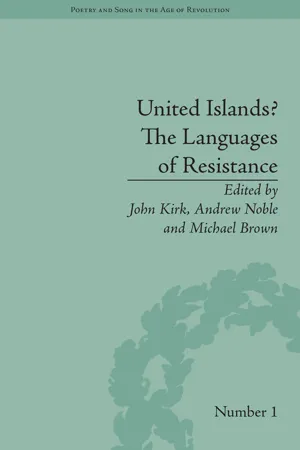
- 288 pages
- English
- ePUB (mobile friendly)
- Available on iOS & Android
eBook - ePub
United Islands? The Languages of Resistance
About this book
1 READING THE ENGLISH POLITICAL SONGS OF THE 1790s
To say that songs performed in public are complex in terms of meaning and affect is little more than stating the obvious. However, a report in the New York Times in the summer of 2009 that the City of New York settled in court for $10,001 with a man who had been arrested in Yankee Stadium for trying to go to the public restroom to urinate during the so-called seventh-inning stretch inadvertently evokes the political atmosphere of the 1790s. The arresting officer informed the man with the full bladder that he could relieve himself only after the song ‘America the Beautiful’ had been completed. Ever since 11 September 2001, ‘America the Beautiful’ rather than the traditional and apolitical ‘Take Me Out To the Ballgame’ had been sung in the seventh inning stretch (a period in a nine-inning game when the fans ritualistically celebrate the moment, usually with a collective song). The practice at Yankee Stadium had been to insist that fans remain standing at their seats during the singing of the song. Astonishingly it took almost a decade before someone finally challenged the practice in court. In the days immediately following 9/11 the singing of America the Beautiful’ would have been a largely spontaneous act of grief, anger, and special respect for the heroic New York City firefighters. As time passed the song would have become something more like a solemn patriotic duty. Somewhat later the song for most people – but perhaps not the stadium guards and police who enforced the rule – would lose its original anchoring in the events of 9/11. That the situation now is different from 2001 is indicated by the lack of any protests about the court settlement and the new Yankee Stadium policy allowing fans to relieve themselves during the seventh-inning stretch.1
Beginning in 1942 all Major League baseball games started with the singing of the National Anthem. This practice, initiated in wartime, has continued up to this day. The hymn-like ‘America the Beautiful’, much easier to sing than the musically challenging anthem, became a favourite song during the seventh-inning stretch at many baseball stadiums in 2001, but as time passed, most cities returned to the Tin Pan Alley song, ‘Take Me Out To the Ballgame’, not at all sombre, not remotely hymn-like, but rather fatalistic and unapologetically physical, referring to eating cheap food like peanuts and cracker jacks. If ‘America the Beautiful’ in fact displaces ‘Take Me Out To The Ballgame’, it will mark yet another traditional practice initiated because of wartime emotions.
During the 1790s at public theatres British Jacobins and loyalists waged their conflict through songs. In Edinburgh in 1794, for example, during a staging of Charles the First, the loyalists’ ‘God Save the King’ was drowned out by the democrats, who also thunderously applauded Cromwell’s speeches and laughed and hissed at those of Charles.2 On other occasions, loyalists singing ‘God Save the King’ taunted and intimidated the outnumbered Jacobins. John Thelwall complained that ‘God Save the King’ ‘has been made the war-hoop of tumult and civil commotion’.3 The French had ‘Ça Ira and the ‘Marseillaise’ but the English democrats, lacking their own iconic song, attached the tune of ‘God Save the King’ to pointedly Jacobin lyrics, including Thomas Spence’s agrarian socialist ‘Jubilee Hymn’, and numerous London Corresponding Society songs.4 Edward Williams, the radical poet from Wales, recast ‘God Save the King’ as ‘War Song of British Savages’.5 Percy Shelley several decades later similarly framed his radical song with the tune of ‘God Save the King’.6 Both sides of the political conflict used the British national anthem to attack their opponents and define themselves. The public singing of songs in this context is a symbolic action to overawe the opposition, strengthen one’s own morale and unity, and bring over the audience to one’s own side. Songs have to be seen here as weapons, and the difference between physical force and verbal performance is not absolute.
Songs were omnipresent in the political culture of the 1790s. There could not be a political gathering at the Crown and Anchor Tavern in London without songs being sung. At London Corresponding Society meetings and large demonstrations, songs were expected. Thomas Spence’s Songbook carried propaganda into the taverns and free and easies where labouring-class radicals enjoyed their ale and sang sedition and socialism. On the other side, loyalists disrupted radical lectures with ‘God Save the King’. The documentary evidence from the newspapers and pamphlets indicates that both sides were prolific producers and consumers of songs, and that the songs, however different ideologically, were largely identical formally, with rhymed popular diction structured into four-beat and three-beat lines. The symmetry was not complete because the loyalist groups, capable of being mobilized to destroy Joseph Priestley’s house in 1791, to burn the effigy of Thomas Paine in 1792–3, or to attempt kidnapping John Thelwall on his lecture tour of 1796–7, depended on government sponsorship and direction. The artful and effective propaganda created by Hannah More’s pamphlets of 1793–7 and William Gifford’s Anti-Jacobin (1797–8) was generously subsidized in contrast with the Jacobins who depended wholly on their own meagre resources and who struggled constantly with libel prosecutions and other forms of repression. In the 1790s the loyalists successfully shadowed and imitated the Jacobins, who did not lack for literary talent and courageous activists but who could not counter the combined weight of traditional Francophobia and a mobilized church and state, all of which produced a popular loyalism at least in England.
Before exploring some 1790s political songs, both loyalist and radical, it is instructive to examine how some writers reflected – and avoided reflecting – on the political song as a subgenre. The form itself of song is in fact a lively topic of discussion in the eighteenth century.
Reflections on Songs and Song-Writing
When Ambrose Philips (1674–1749) wrote about songs in 1713, he considered only certain kinds of songs as truly literary and worth a position in the hierarchy of genres.7 With Sappho, Anacreon and Horace as the classical models, Philips constructed an aesthetic ideal of the epigrammatic, polished, single thought, ‘a little image in enamel’. In his reading of the song genre, Edmund Waller outperformed John Donne and Abraham Cowley, and the French easily overcame the English. His essay has not a single word on the political song, an absence which is explained by the literary historian George Sherburn, who notes that political, drinking and love songs, however popular and commonplace, were viewed as ‘non-literary’.8 Accordingly, the non-literary would not be theorized as literature. With Sappho as a model for the love song, and Anacreon for the drinking song, it would seem plausible to have Horace and Juvenal the classical models for the political song, but in fact those who reflected on songs did not make this fairly obvious connection between satire and political song.
It is surprising that Thomas Percy does not have an extended meditation on the political song in his Reliques of Ancient English Poetry (1765), which has so many political songs. Percy notes, for example, how English monarchs coped with Welsh bards supporting rebellion against the English crown, socially disruptive minstrels, and various songs on political and religious conflicts, but he does not devote a section in An Essay on the Ancient Minstrels in England’ to the political song subgenre. Even more surprising is the neglect of the political song in a later eighteenth-century reflection on the song by John Aikin.
Brother of the poet Anna Barbauld (1743–1825), John Aikin (1747–1822) was the first editor of the influential Monthly Magazine in the 1790s, and was a prominent literary intellectual among the middle-class liberal Dissenters. Aikin’s Essays on Song-Writing (1772) uses Philips’s essay as a template upon which he greatly expands and he also develops in the process an anthology of songs to illustrate his analysis. Published by the London Dissenter Joseph Johnson, Aikin’s text was reprinted several times in the nineteenth century. Like the neoclassicist Philips, Aikin reconciles the popularity of songs with the hierarchy of genres, but he also moves in some Romantic directions. To justify the organization of the anthology and its classes of songs he turns not to classical precedent and its synchronic categories but history and its diachronic orientation. Aikin eventually gets to the neoclassical Big Three – Sappho, Anacreon and Horace – but the move to history is decisively unlike Philips. Aikin’s literary history is plotted according to standard Enlightenment stadial history, beginning with warlike tribes, followed by pastoralism, farming, and finally cities. This historical narrative provides the structuring logic for his three major groupings of songs: the first group, the oldest and most primitive, is ballads and pastorals; the second group assumes the stability of a settled agricultural society to permit the flourishing of love and descriptive songs; and finally urbane witty songs characterize the most civilized stage of history. Reflecting the impact of Macpherson’s Poems of Ossian (1765) and Percys Reliques (1765), Aikin assumes the position of civilized man who needs the exotic and primitive intensities he projects onto the literary productions of simpler, more passionate historical epochs. Referring to the old ballads, Aikin writes that the language is the language of nature, simple and unadorned; their story is not the wild offspring of fancy, but the probable adventure of the cottage; and their sentiments are the unstudied expressions of passions and emotions common to all mankind’.9 Anticipating Wordsworth’s Lyrical Ballads Preface (1800), this passage assumes the ancient ballads are grounded in social actuality and psychological experiences uncorrupted by overly civilized urbane culture. Moreover, the old ballads use an exemplary, natural language the very opposite of the ‘artificial prettinesses of language’ esteemed by Neoclas-sicists like Philips.10 When Aikin finally gets to Sappho it is to praise a model of the love song, while Anacreon provides a model for the drinking song, and Horace for ‘sublime’ expressions.11 While Philips preferred the polished ‘little image in enamel’, Aikin prefers a more naturalistic set of representations. He praises for their realism George Smith’s pastoral poetry and engraved images of English landscapes – modelled after Claude (1600–82) and Poussin (1594–1665). Much acclaimed in his day, Smith of Chichester (1714–76), who was from a working-class Baptist background, was admired at the time for the realism and precision of his representations that avoided what was considered the errors of Dutch realism. Aikin’s norm of realism was narrow by today’s standards, for even when he expresses his distaste for Pope’s pastorals as having the quality of ‘melodious echoes of an echo’, he...
Table of contents
- Cover
- Half Title
- Title Page
- Copyright Page
- Table of Contents
- Acknowledgements
- List of Figures and Tables
- List of Contributors
- Introduction The Languages of Resistance: National Particularities, Universal Aspirations
- 1 Reading The English Political Songs of the 1790s
- 2 Why Should the Landlords Have the Best Songs? Thomas Spence and the Subversion of Popular Song
- 3 ‘Bard of Liberty’: Iolo Morganwg, Wales and Radical Song
- 4 Canonicity and Radical Evangelicalism: The Case of Thomas Kelly
- 5 Charlotte Brooke’s Reliques of Irish Poetry: Eighteenth-Century ‘Irish Song’ and the Politics of Remediation
- 6 Homology, Analogy and the Perception of Irish Radicalism
- 7 Lost Manuscripts and Reactionary Rustling: Was There a Radical Scottish Gaelic Poetry Between 1770 and 1820?
- 8 Virile Vernaculars: Radical Sexuality as Social Subversion in Irish Chapbook Verse, 1780–1820
- 9 Thomas Moore and the Problem of Colonial Masculinity in Irish Romanticism
- 10 Radical Politics and Dialect in the British Archipelago
- 11 ‘Theaw Kon Ekspect No Mooar Eawt ov a Pig thin a Grunt’: Searching for the Radical Dialect Voice in Industrial Lancashire and the West Riding, 1798–1819
- Afterword: Th e Languages of Resistance
- Notes
- Works Cited
- Index
Trusted by 375,005 students
Access to over 1.5 million titles for a fair monthly price.
Study more efficiently using our study tools.
Frequently asked questions
Yes, you can cancel anytime from the Subscription tab in your account settings on the Perlego website. Your subscription will stay active until the end of your current billing period. Learn how to cancel your subscription
No, books cannot be downloaded as external files, such as PDFs, for use outside of Perlego. However, you can download books within the Perlego app for offline reading on mobile or tablet. Learn how to download books offline
Perlego offers two plans: Essential and Complete
- Essential is ideal for learners and professionals who enjoy exploring a wide range of subjects. Access the Essential Library with 800,000+ trusted titles and best-sellers across business, personal growth, and the humanities. Includes unlimited reading time and Standard Read Aloud voice.
- Complete: Perfect for advanced learners and researchers needing full, unrestricted access. Unlock 1.5M+ books across hundreds of subjects, including academic and specialized titles. The Complete Plan also includes advanced features like Premium Read Aloud and Research Assistant.
We are an online textbook subscription service, where you can get access to an entire online library for less than the price of a single book per month. With over 1.5 million books across 990+ topics, we’ve got you covered! Learn about our mission
Look out for the read-aloud symbol on your next book to see if you can listen to it. The read-aloud tool reads text aloud for you, highlighting the text as it is being read. You can pause it, speed it up and slow it down. Learn more about Read Aloud
Yes! You can use the Perlego app on both iOS and Android devices to read anytime, anywhere — even offline. Perfect for commutes or when you’re on the go.
Please note we cannot support devices running on iOS 13 and Android 7 or earlier. Learn more about using the app
Please note we cannot support devices running on iOS 13 and Android 7 or earlier. Learn more about using the app
Yes, you can access United Islands? The Languages of Resistance by John Kirk in PDF and/or ePUB format, as well as other popular books in History & Irish History. We have over 1.5 million books available in our catalogue for you to explore.