eBook - ePub
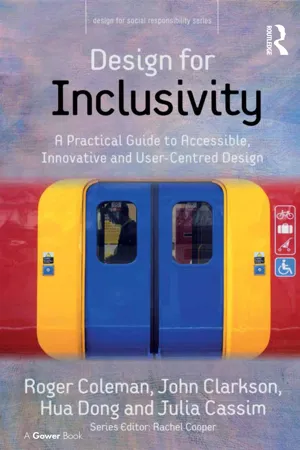
Design for Inclusivity
A Practical Guide to Accessible, Innovative and User-Centred Design
- 268 pages
- English
- ePUB (mobile friendly)
- Available on iOS & Android
eBook - ePub
Design for Inclusivity
A Practical Guide to Accessible, Innovative and User-Centred Design
About this book
Inclusive design not only ensures that products, services, interfaces and environments are easier to use for those with special needs or limitations, but in doing so also makes them better for everyone. Design for Inclusivity, written by a team that has pioneered inclusive design practice internationally, reviews the recent social trends and pressures that have pushed this subject to the fore, and assesses design responses to date in an international context. The authors make the business case for inclusive design and explain the formalisation of the approach in standards and legislation. The text includes case studies which describe transport, product development, IT and service projects, as well as industry-university collaborative projects, and highlights lessons that have been learned. This is very much a practical book. It offers tools, techniques, guidelines and signposts for the reader to key resources, as well as including advice on research methods, and working with users and industry partners.
Information
CHAPTER 1
Introduction
‘We believe that applying an inclusive design approach is good for business as well as for customers. We are proud of our reputation for developing products which can be used by all our customers, regardless of age or ability.’
BT Inclusive Design Toolkit (www.inclusivedesigntoolkit.com)
About This Book
By the time you read this introduction there will be more people living in urban areas than rural, and 60 per cent projected to live in urban areas by 2030 (United Nations, 2005), we can no longer claim to live in a world shaped primarily by nature, but in a designed and constructed environment, shaped by human beings. There is little doubt that as a consequence we are changing the climate, reducing species diversity and consuming natural resources above and beyond replacement rates. We have to think and act at a global level if we are to meet the challenges posed by our success as a species, and ask questions about the role and responsibilities of design and designers in shaping the future. Importantly, we have to recognise that we share the planet with over 6 billion other human beings, and we are not all the same.
Thinking globally means recognising and celebrating human diversity. It means embracing difference, be it physical, intellectual, cultural, aspirational, or of lifestyle. And in an increasingly global marketplace, understanding and catering for difference is crucial to business success. The design challenge is to include, and not to exclude unknowingly. Design for inclusivity, like the other forms of socially responsive design featured in this series, has its origins in the 1960s when a small number of designers, engineers and scientists began to grapple with the implications of a global society. They questioned the assumptions and consequences of modern design and production, and began to make the case for a more socially responsive and responsible approach to design.
Since then, inclusivity has moved from the margins of design thinking to the mainstream. It is increasingly embraced by major companies and there is a British Standard in inclusive design management that gives practical guidance for business leaders, design managers and design teams.
This book comes from an established research team in inclusive design, that brings together the Engineering Design Centre at the University of Cambridge and the Helen Hamlyn Centre at the Royal College of Art, London. The research has been funded in three phases by the Engineering and Physical Sciences Research Council as part of its EQUAL/SPARC programme on extending quality life, and this book is an important outcome from the second phase of that research. It builds on an earlier book that was the result of the first research phase published by Springer-Verlag under the title Inclusive Design, Design for the Whole Population. It is divided into three parts, the first exploring the background and significance of the subject, the second presenting a series of exemplar case studies and initiatives, and the third introducing a range of tools, techniques, resources and guidance. Other books have been published covering the theory, background, history and international aspects of inclusive design, whereas this is very much a practical handbook on the subject. The intention is to cover more of the ‘how’ rather than the ‘why’, and to offer a multiplicity of practical starting points for readers from industry, design, engineering and management, and in particular students of design and business, and their tutors.
Inclusive design grew out of and builds on earlier approaches to design for primarily disabled people that focused very much on access to the built environment. The drive for ‘barrier-free’ and ‘universal’ design in particular in the US, which culminated in the Americans with Disabilities Act (ADA), focused on the right of universal access to buildings and public places. In the UK, through the Disability Discrimination Act (DDA) those rights have been extended to access to services, while in Europe the ‘Design for All’ movement has campaigned for and promoted similar objectives in terms of universal access, extending this concept to include access to information and related services via the Internet and telecommunications media (ICT). This work is well documented and referenced in Inclusive Design, Design for the Whole Population – and also in the Universal Design Handbook (Ostroff and Preiser, 2001) published by McGraw-Hill, New York. There is, however, far less literature dealing with the practicalities of product design, manufacturing and business management with regard to the inclusion of older, disabled and other marginalised groups. The purpose of this book is to redress that balance, and look beyond the changing requirements of legislation towards the business and commercial advantages that flow from an inclusive approach to design and innovation, along with the considerable social and economic benefits that come with social inclusion.
Background and Significance
The first part of the book, Chapters 2 to 4, presents inclusive design as a reaction to the tendency of mass production to exclude significant groups of consumers as it developed over the twentieth century. In Chapter 2, ‘Why Inclusive Design?’, the editors present a brief overview of the origins and development of the subject, and key drivers for it, such as population ageing and the growth of the international disability movement. They discuss how rapid technology development has the potential of including large numbers of people through increased functionality and embedded intelligence, and why this is not being realised. The major failure has been that functionality and accessibility have been addressed separately rather than together. As a consequence, consumer dissatisfaction with technology-driven products has been high.
These challenges can only be properly tackled at the systems level and through better design management and processes, which in turn require high-level management commitment to an inclusive design approach. How this understanding came about is discussed in Chapter 3, ‘A Growing Movement’, where Jeremy Myerson surveys the work and influence of key individuals and organisations. This gives us an understanding of the growth and dynamism of thinking and practice on a global basis, and introduces important considerations for the future, in particular the need for people to remain economically active for longer as the ratio of young to old shifts dramatically with an ageing workforce. Solving the associated design challenges will be a major task for design and industry in the future.
Much progress has been made in recent years in understanding the business case for inclusive design and the management task of delivering more inclusive products and services. Considerable progress has also been made in developing the tools, techniques and resources to support and facilitate an appropriate business response. This is the focus of Chapter 4, ‘The Business Case’, where Roger Coleman, Alan Topalian, John Clarkson and Hua Dong present an exemplar case study of a highly successful US company whose core business strategy is based on an inclusive approach to design and innovation.
This is followed by a discussion of research into industry barriers, drivers and initiatives aimed at encouraging and supporting industry uptake of inclusive design, the most significant of these being the 2005 British Standard guide to managing inclusive design, BS 7000-6. The purpose, structure and key process diagrams of the Standard are introduced, along with other resources for industry developed by the research community. Future design challenges are presented, for example the need to fuse functionality and desirability in more user-aware products and services, and the pressing need to support design management with relevant research into the practicalities of implementing, evaluating and promoting inclusive design. The desired outcome is a better understood and fully professional approach to inclusive design, the importance of which can be seen in the progress made by Japanese companies and the market potential of resulting consumer products.
Case Studies of Inclusive Design Practice
The second part of the book, Chapters 5 to 8, shifts the focus away from broader, contextual factors, and takes an in-depth look at examples of inclusive design in action. Chapter 5, ‘Market Advantage: Practitioners’ Viewpoints’, features a conversation between Hua Dong and design practitioners from the UK and Sweden: Graham Pullin, formerly Senior Interaction Designer at IDEO; Ingelise Nielsen, Head of Public Relations at IDEO in London; Maria Benktzon and Olle Bobjer, partners of Ergonomidesign, Sweden; and Barry Tanner, New Product Introduction Manager of Applied Energy Products Ltd, a UK-based manufacturer of water, heating and ventilation products.
The conversation was centred on four inclusive design projects, their development processes and the market value through practitioners’ eyes. It provides a vivid insight into the motivations and practices of leading design consultancies and their perception of the business case for an inclusive approach to design.
This is followed by Chapter 6, ‘Designer Education: Case Studies from Graduate Partnerships with Industry’, where Julia Cassim and Hua Dong present a series of inclusive design projects undertaken by new graduates of the Royal College of Art with private and voluntary sector partners. Working with disabled and older users who are often excluded from design consideration helped young designers understand the needs of people who are very different from them, and that insight has inspired innovative, user-centred design solutions with mainstream appeal.
Chapter 7, ‘Empowering Designers and Users: Case Studies from the DBA Inclusive Design Challenge’, also by Julia Cassim and Hua Dong, describes how partnerships between designers and severely disabled people can shift the emphasis from the user as passive subject to a more equal interaction between designer and user. Through six case studies from the Design Business Association (DBA) Inclusive Design Challenge, they demonstrate that such partnerships can be both liberating and inspirational for designers, and lead them in new directions towards genuine innovations that reframe design for disability as a driver for new applications, products, services and environments.
The DBA Challenge is an annual design competition organised since 2000 by the Helen Hamlyn Centre at the Royal College of Art, that is gaining international currency. Importantly it facilitates team building and motivates young designers to think out of the box in ways that have real commercial potential; hence the interest of major Japanese and European companies in this model of innovation through design collaboration with disabled and older users.
Chapter 8, ‘Involving Older People in Design’, by Alan Newell and Andrew Monk not only explores ways of understanding the needs of older people, in particular with regard to IT applications; but also tackles the difficult subject of communicating those insights to designers who are on the whole very much younger. Service design is another important subject covered in this chapter, and arguably the most effective way of supporting independence in later life. We have heard much about ‘Smart Home’ technology, yet seen little in the way of concrete results and applications. This chapter demonstrates how a more holistic approach built around enabling support rather than remote monitoring can deliver real benefits to older people.
Tools, Techniques and Resources
The concluding section of this book, Chapters 9 to 14, focuses on practical aspects of delivering inclusive design solutions, and introduces the key issue of design exclusion, how it impacts on both users and business, and how to counter it. Designing for inclusion is not a trivial challenge. On the contrary, it places a high level of demand on both designers and those who commission, manage and implement design and production within industry. In order to ensure that a product or service is genuinely inclusive, user research and understanding is required at the outset, to ensure a level of inclusion that matches the requirements of the target consumer. Design solutions must be evaluated with regard to accessibility and usability, as well as technical fitness for purpose. In taking the design through to production it is important that changes to the specification do not compromise inclusivity in the final realisation, and that advertising, sales, promotion and after sales service all support the inclusive intent of the project.
This approach is set out in BS 7000-6, and covered in detail in Chapter 4. However, in order to fully implement the standard, a range of tools, techniques and other resources is necessary to support the whole design, development and commercialisation process. Much work has already gone into developing such resources, but more remains to be done. This section is therefore more of a work in progress, and readers are encouraged to develop, refine and add to the material described here, and in particular adapt it to their own purposes and disciplines.
The section starts with the rapidly growing field of user research. In Chapter 9, ‘Designer-oriented User Research Methods’, Hua Dong, Colette Nicolle, Robert Brown and John Clarkson first classify the primary types of user-research methods and then discuss how they have been adapted by and for the design community. Examples are cited and guidance is given on how to apply these methods and how to gather data and utilise results. Task analysis is featured as an important way of understanding user demand, while techniques which help designers understand consumer motivations, preferences and lifestyles, such as the use of personas, are outlined. A combination of such techniques can help designers approach the Holy Grail of uniting accessibility and desirability in the form of inclusive, ‘must have’ products and services, that appeal to and can be enjoyed by the widest possible audience.
Chapter 10, ‘Practicalities of Working with Users’, by David Yelding and Julia Cassim, ‘does exactly what it says on the tin’. It offers a practical guide to working with users, not just for designers, but for market researchers, business planning and product/service evaluation. It also covers recruitment, research techniques, costs and ethical considerations and is in itself a mini handbook and essential reference on the subject.
A central tenet in the inclusive design approach is ‘design exclusion’: what happens when we get things wrong. Design exclusion can arise for many reasons. Designers may be unaware of or take a cavalier view of the needs and capabilities of users less able than themselves; they may focus on technology first and usability second, or the product development budget may not stretch to proper user evaluation and assessment. However it arises, design exclusion can damage both reputation and profitability. And in an era of increasing discrimination and equality legislation, it can lead to costly litigation and product withdrawal or modification.
A far better and more cost effective approach is to consider these factors from the outset, in the earliest design thinking and decision making, when investment levels are low, rather than post market, when change is extremely costly. In Chapter 11, John Clarkson tackles these issues head on, with a theoretical analysis of the context, implications, impact and potential for design exclusion, and a very clear exposition of the practical steps we can take to minimise it. Understanding the distribution of capabilities across the population is an important beginning, but the subject is not easy or readily comprehensible, particularly since there is an insufficiency of available high quality data. Clarkson steers the reader through this maze and offers practical guidance with clear and insightful case studies that demonstrate the benefits of exclusion audits and other techniques to help us maximise design inclusion.
So far so good. We have learnt how to work with and understand users and how to consider and counter design exclusion, but how do we know we have achieved a successful and inclusive design? And if we have, how do we communicate that fact? How do we prove to ourselves and others that we have got it right? Evaluation plays an important part in the product development and introduction process, and is a well-understood concept in engineering and industry.
In Chapter 12, ‘Product Evaluation: Practical Approaches’, John Clarkson, along with Ian Hosking of technology development consultancy Sagentia, build on the existing knowledge base in evaluation theory and technique to demonstrate how this can be extended to the evaluation of inclusivity. Importantly they demonstrate that we do not have to reinvent any wheels in this regard, but simply to refocus well-understood processes and techniques, such as the stage-gate approach to product development, on the evaluation of design inclusion and exclusion. Like the new British Standard BS 7000-6, what they outline is an extension of existing good practice, rather than a radical departure from it; an added level of quality that will ensure a better and more successful outcome in new product and service development, a better return on investment, and higher levels of customer satisfaction and brand value.
...Table of contents
- Cover Page
- Title Page
- Copyright Page
- Contents
- List of Figures
- List of Contributors
- Acknowledgements
- Preface
- Chapter 1 Introduction
- Chapter 2 Why Inclusive Design?
- Chapter 3 A Growing Movement
- Chapter 4 The Business Case
- Chapter 5 Market Advantage: Practitioners’ Viewpoints
- Chapter 6 Designer Education: Case Studies from Graduate Partnerships with Industry
- Chapter 7 Empowering Designers and Users: Case Studies from the DBA Inclusive Design Challenge
- Chapter 8 Involving Older People in Design
- Chapter 9 Designer-Orientated User Research Methods
- Chapter 10 Practicalities of Working with Users
- Chapter 11 Countering Design Exclusion: Theory and Practice
- Chapter 12 Product Evaluation: Practical Approaches
- Chapter 13 User Simulation in Product Evaluation
- Chapter 14 Where Do We Find Out?
- Chapter 15 Towards Inclusion: Future Challenges
- Index
Trusted by 375,005 students
Access to over 1.5 million titles for a fair monthly price.
Study more efficiently using our study tools.
Frequently asked questions
Yes, you can cancel anytime from the Subscription tab in your account settings on the Perlego website. Your subscription will stay active until the end of your current billing period. Learn how to cancel your subscription
No, books cannot be downloaded as external files, such as PDFs, for use outside of Perlego. However, you can download books within the Perlego app for offline reading on mobile or tablet. Learn how to download books offline
We are an online textbook subscription service, where you can get access to an entire online library for less than the price of a single book per month. With over 1.5 million books across 990+ topics, we’ve got you covered! Learn about our mission
Look out for the read-aloud symbol on your next book to see if you can listen to it. The read-aloud tool reads text aloud for you, highlighting the text as it is being read. You can pause it, speed it up and slow it down. Learn more about Read Aloud
Yes! You can use the Perlego app on both iOS and Android devices to read anytime, anywhere — even offline. Perfect for commutes or when you’re on the go.
Please note we cannot support devices running on iOS 13 and Android 7 or earlier. Learn more about using the app
Please note we cannot support devices running on iOS 13 and Android 7 or earlier. Learn more about using the app
Yes, you can access Design for Inclusivity by Roger Coleman,John Clarkson,Julia Cassim in PDF and/or ePUB format, as well as other popular books in Design & Design General. We have over 1.5 million books available in our catalogue for you to explore.