- 176 pages
- English
- ePUB (mobile friendly)
- Available on iOS & Android
eBook - ePub
About this book
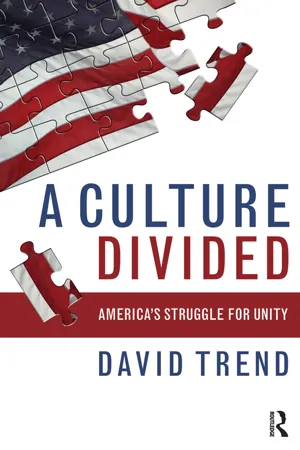
Politicians and pundits make a great deal of the imperative for Americans to put aside political differences and "unite" as a nation. Calls for change and fresh approaches to politics beckon citizens to move beyond partisanship and special interests in a new spirit of togetherness. But how realistic is this desire? Isn't the very nature of democracy a process of taking sides? How unified has America been in its past? A casual look at U.S. history reveals a country riven with discord and disagreement. From fights between American revolutionaries and loyalists to the British Crown, to the bloody differences that caused the Civil War, to controversies over the Vietnam and Iraq Wars, Americans have always argued over important matters of state. A Culture Divided argues that such disagreements have not been evidence of a weakening country or the "fraying of America." Rather, argument and disagreement are precisely the opposite. They are the very essence of a healthy democracy. Grounded in historical and contemporary research, A Culture Divided explores the history of political argument in the United States and asserts that democracy is alive and well in the current disputes in American culture.
Information
Chapter One
One Nation
Divided or United?
WE LIVE IN AN ERA of democratic contradiction. As the Cold War recedes further into history and the apparent triumph of liberal democracy spreads around the globe, the domestic state of democracy within the United States continues to erode. Rather than a nation where citizens feel empowered in their common governance, the United States has become a land where the vast majority of citizens hates its leaders yet rarely votes. Massive anti-incumbency sentiments and resentment toward representative government parallel the rise of grassroots militia movements and media demagogues. Clearly, something has gone wrong with democracy in the United States—or more precisely with the way democracy is understood and exercised. Why else would so many people respond so strongly to promises to “change” the way Washington works?
Not surprisingly, these shifts have produced considerable public tensions, along with a disturbing tendency to reach for quick and easy solutions to problems. Witness rising political extremism and the remarkable popularity of such fringe personas as Ann Coulter, Sean Hannity, Rush Limbaugh, and Bill O’Reilly. Claiming to appeal to populist sentiments, this cadre of would-be demagogues has emerged to push for tough laws, closed borders, and an ever more puritanical set of cultural standards.
Naturally, liberals and conservatives have always fought over political and economic issues. But something has changed recently. Unlike ideological conflicts of the past, which focused on tangible issues, the new political warfare is conducted over the more subjective terrain of identity and representation. Battles once restricted to laws and money are being waged over ideas and symbols. More than ever these struggles entail the discourses through which subjectivity is formed as evidenced in debates over patriotism, political correctness, and the “defense of marriage.”
In the broadest sense, these contests can be construed as issues of culture. They signal efforts to control the ways people learn about who they are and what they can become. This cultural notion was an important element of the political philosophy of Antonio Gramsci, who wrote, “One must speak for a struggle for a new culture, that is, for a new moral life that cannot but be intimately connected to a new intuition of life, until it becomes a new way of feeling and seeing reality.”1 In this context, Gramsci was not simply referring to the forms of culture that one commonly associates with art, literature, and even mass media, but he was writing about the profoundly political process through which citizens are socialized to recognize and validate state power. This process infuses all components of the social apparatus: the office, the home, the school, and the church. If these institutions are recognized as sites of potential ideological persuasion, then all of life becomes a potential political battleground.
This expanded view of culture entails more than simply acknowledging the political implications of everyday actions. It means admitting that many areas that claim neutrality in our lives are in fact sites of profound ideological struggle. Television newscasts, educational syllabi, scientific breakthroughs, and “great” pieces of music—these are not “objective” phenomena that somehow exist outside the realm of politics. They are forms of representation invested with specific interests in every manifestation. Through these cultural objects dominance strives to replicate itself, often disguising its actions in the process. This invisibility of the center is often accompanied by a quiet exclusion of otherness. People may be concerned about the violent suppression of certain dissenting voices, yet at the same time they may be unaware of those consigned to the “structured absences” of discourse. In this sense, every act of education, legislation, management, and creative expression is an act of inclusion and exclusion.
Few could have predicted the speed with which the world would be reconfigured by the events of September 11, 2001. Yet rather than bringing nations together in a sense of common purpose, 9/11 triggered new forms of national chauvinism and regional antagonism. Pick up any newspaper in the United States, and it appears that the nation is facing a democratic crisis. In a post-9/11 era lacking in superpower conflicts, old fears of foreign insurgency have been supplanted by anxieties about fiscal threats and terrorists lurking among us. As social inequities continue to increase, many citizens question government and the master narratives supporting it. Complicating matters further has been the restructuring of global capitalism. As the world evolves into a transnational marketplace, and the production of goods and services has become more fluid and decentralized, the distance between rich and poor nations has continued to widen. Meanwhile, within the United States, communities of color are quickly diminishing a once dominant white majority. Factor in the growing influence of feminism, challenges to the traditional nuclear family, and activism supporting the rights of lesbians and gay men, and it becomes clear that a massive movement, indeed a majority movement, is rising to demand a new kind of politics, and perhaps a new society.
As the U.S. military reigns supreme among world powers, democracy has become subverted in its foreign policy into an excuse to force the will of the United States on other nations. America’s recent adventures in Afghanistan and Iraq have demonstrated the way the U.S. government has used the terms “freedom” and “liberty” as tools to rationalize its advancement of military and business interests throughout the world. There is nothing inherently wrong with a foreign policy to strengthen American security and economic well-being on the global stage. But the relentless exploitation of the nation’s most cherished values for these purposes diminishes their meaning and contributes to a distrust of the United States. On the domestic front, ideological debate has become internalized as it did in the 1950s. Once again, battles that were waged with guns and bullets are now fought with ideas and symbols. And once again access to the debate is a crucial issue, as attempts are made to exclude voices that would contest the status quo. Although identity politics did much to expand the national conversation about pluralism and values, other issues have induced heightened levels of divisiveness and antagonism. Continued strife in the 2000s over border security and gay marriage keep reappearing across the political landscape. The Internet has made more information available to people than ever before, and the electorate finds itself increasingly uninformed and confused. And while democracy is a word that politicians and media personalities bandy about with great alacrity, its usefulness has become all but exhausted by divergent interests it has come to serve.
Rigid divisions between left- and right-wing positions yield little room for the understandings that can grow from genuine dialogue. In part this results from a philosophical legacy that splits every issue into a binary opposition. Often this is caused by patterns in public communication that reduce discussion to superficial sound bites and overheated rhetoric.
A genuine democracy requires more than this. People stick with old-style party politics in the United States because other models don’t seem viable. This is largely due to the self-marginalizing character of most alternatives. Yet as recent events have demonstrated, public dissatisfaction with mainstream institutions stands at an all-time high.
Diverse communities seem willing as never before to reach for new answers to old problems. The roots of these solutions lie in the very democratic principles upon which the United States was founded, although many such principles need to be brought up to date and radicalized. Clearly, the time has arrived to move beyond traditional divisions of left and right. This was the call for unification articulated by Barack Obama in his presidential campaign. While such a vision has proven more difficult to implement in the postelection years, the goal should not be abandoned. This new call for unity should not be confused with demands for a centrist compromise or with a romantic appeal to preindustrial communitarianism. Rather than asking people to surrender their identities in the interest of a national consensus, our purpose should be recognized as an expanded approach to democracy, which stresses the primacy of cultural difference. This means remembering that people are not simple creatures of Republican or Democratic ideology, but they are comprised of complex histories, needs, cultures, and values. To these ends, this newly invigorated democracy—what some would term a “radical democracy”—would reconcile current tensions between national and local governance by reorganizing political constituencies in ways typically considered off limits to politics. By necessity this will entail the creation of “new political spaces” that fall outside traditional definitions of government, civil society, and the family. It will take a good deal of work to put these ideas into practice. Yet the time seems right to spell out some of the ways a radicalized democracy might be applied.
At the height of the conservative ascendancy of the 1980s, controversies flourished over affirmative action, abortion, and failing schools, among other issues. Those cultural conflicts were waged into the next decade, providing fodder for religious ideologues and headline-hungry politicians. Embedded in the early culture wars was a remarkable realization that in the aftermath of economic class conflicts and the civil rights movements, a great change had taken place. The white male power structure—largely supported by Christian conservatives—had been outflanked by feminists, multiculturalists, and liberals of all stripes. Protests, court cases, Vietnam, and Watergate had turned the nation upside down. Waged during the presidencies of Ronald Reagan and George H. W. Bush, the early culture wars were less “wars” between opposing camps than they were assaults by conservative alarmists against perceived patterns of difference and change.
In 1992, conservative commentator Patrick Buchanan warned that the nation was embroiled in “a culture war as critical to the kind of nation we shall be as the Cold War itself, for this war is for the soul of America.”2 In this frequently quoted statement, Buchanan claimed that while conservatives had been busy defending democracy around the globe, leftists had been infiltrating schools, the media, and the art world at home. It’s no secret what happened next, as many legislators, religious figures, and journalists cashed in on the publicity surrounding newly visible cultural conflicts.3 It also should go without saying that progressives never held “all the commanding heights of art and culture,” as Buchanan asserted.4
Nevertheless the myth of a radical juggernaut took hold, manifest in countless outcries over multiculturalism, political correctness, and school curricula. Before long, rhetoric like Buchanan’s had enflamed the country sufficiently to win Republicans the Congress in 1994 the “year of the angry white male.” But the conservative momentum didn’t last long. Years later the expression “culture wars” had all but disappeared from the public lexicon, with many conservative leaders lamenting the slide of American society into self-indulgent secularism. This perception of moral decline reached its breaking point with the 1998 Monica Lewinsky scandal. In a widely quoted “Letter to Conservatives” that year, Paul Weyrich wrote, “I believe that we probably have lost the culture war. That doesn’t mean the war is not going to continue, and that it isn’t going to be fought on other fronts. But in terms of society in general, we have lost.”5 Implicit in Weyrich’s lament was the belief that a new kind of politics was needed. In the wake of bipartisan dismay over the Clinton debacle came a conservative call to arms, specifically a call for Republicans to launch a massive populist movement through local churches and community organizations to build a “Moral Majority.”
Determined conservatives swept a most unlikely candidate into the White House: George W. Bush. Early in the 2000 primaries, many liberals quietly had hoped the awkward former Texas governor would gain the Republican nomination and handily lose to Democrat Al Gore. As election results were tallied Bush did indeed lose the popular vote nationwide, but by so small a margin that the controversial winner-take-all award of Florida’s twenty-five Electoral College ballots gave Bush the presidency. Following the most evenly divided presidential contest in American political history, Bush surprised observers on both sides of the political aisle by proclaiming a “mandate” for conservative reform. Supported by a Republican-controlled congress through 2006, the culture wars began anew with unrelenting fervor. Conflicts multiplied and intensified through the final years of the Bush presidency, with commentators of all ideological stripes expressing alarm over the vast division of the American populous. The 2008 election campaign began with calls for “unity” and common purpose to yield only back-biting and rumor mongering when the going got tough.
Do recent controversies offer new signs of a fracturing America? Or do they emerge from the very core of American culture? Certainly political disagreement and partisan antagonism are nothing new in U.S. history. Social unrest, violent protest, and electoral enmity have been with us since the earliest days of the republic. Is there anything distinctive about the more recent episodes of disagreement and unrest? One notable difference has been a decline in visible class conflict. Globalization, corporate growth, and a weakened labor movement have yielded fewer strikes and even fewer management concessions to labor as minimum wage and nonunion employment have grown. Civil rights laws and equal pay regulations have helped reduce discrimination based on religion, race, gender, and sexual orientation, although the playing field is still far from level. Yet political campaigns still assert dramatic differences within the American public and the perception of a divided America persists.
In recent years, Republicans and Democrats have fought over which party is better suited to heal the divides that separate Americans. In 2004, Democratic candidate John Kerry claimed the mantle of a “uniter,” proclaiming, “When you’re president, you need to talk to all of the people, and that’s exactly what I intend to do.”6 Not long after that George W. Bush asserted that he was “a uniter, not a divider. . . . I refuse to play the politics of putting people into groups and pitting one group against another.”7 Four years later, Barack Obama called himself a “uniter” who could “bring the country back together.”8 Then Republicans claimed that Republican presidential candidate John McCain was a uniter in the mold of the “great uniter Ronald Reagan.” Along the way, other presidential candidates Hillary Clinton, Mike Huckabee, and Mitt Romney became uniters. In the end, Obama won the election, declaring in his acceptance speech that the United States “has never been just a collection of individuals or a collection of red states and blue states. We are, and always will be, the United States of America.”9 All of these claims for uniter status underscore the broad-based fear that America is, in fact, a very divided nation. Implicit in such claims lies the recognition of diverse and often problematically oppositional thinking in contemporary politics.
Divisions in American society have received considerable academic attention. A sampling of recent titles on the topic include the following: America Divided by Maurice Isserman and Michael Kazin (New York and Oxford: Oxford, 2008); Divided America by Earl Black and Merle Black (New York: Simon and Schuster, 2007); A Republic Divided by the Annenberg Foundation (Radnor, PA: Annenberg Foundation, 2007); Divided We Stand by John Harmon McElroy (Lanham, MA: Rowman and Littlefield, 2006); Divided We Fall by Bryce Christensen (New Brunswick: Transaction, 2006); Silent Majority by Matthew Lassiter (Princeton: Princeton University Press, 2006); Divided States of America: The Slash and Burn Politics of the 2004 Presidential Election by Larry J. Sabato (New York: Pearson/Longman, 2006); Michael Moore’s Fahrenheit 9/11: How One Film Divided a Nation by Robert Brent Toplin (Lawrence: University Press of Kansas, 2006); and Divided by God: America’s Church-State Problem by Noah Feldman (New York: Farrar, Straus, and Giroux, 2005).
All of these works argue that a loss of common purpose has overcome the United States. The presumed causes of America’s cultural divide—heightened partisanship, antiwar dissent, religious separatism, regional differences—vary from book to book, but all agree that America is coming apart. ...
Table of contents
- Cover
- Half Title
- Title
- Copyright
- Contents
- Introduction: Culture and Democracy
- 1 One Nation: Divided or United?
- 2 History: A Nation of Immigrants
- 3 Belief: Faith in What?
- 4 Anxiety: Difference and Danger
- 5 Competition: Getting, Spending, and Losing
- 6 Power: Globalization in an Age of Limits
- Notes
- Index
- About the Author
Trusted by 375,005 students
Access to over 1.5 million titles for a fair monthly price.
Study more efficiently using our study tools.
Frequently asked questions
Yes, you can cancel anytime from the Subscription tab in your account settings on the Perlego website. Your subscription will stay active until the end of your current billing period. Learn how to cancel your subscription
No, books cannot be downloaded as external files, such as PDFs, for use outside of Perlego. However, you can download books within the Perlego app for offline reading on mobile or tablet. Learn how to download books offline
Perlego offers two plans: Essential and Complete
- Essential is ideal for learners and professionals who enjoy exploring a wide range of subjects. Access the Essential Library with 800,000+ trusted titles and best-sellers across business, personal growth, and the humanities. Includes unlimited reading time and Standard Read Aloud voice.
- Complete: Perfect for advanced learners and researchers needing full, unrestricted access. Unlock 1.5M+ books across hundreds of subjects, including academic and specialized titles. The Complete Plan also includes advanced features like Premium Read Aloud and Research Assistant.
We are an online textbook subscription service, where you can get access to an entire online library for less than the price of a single book per month. With over 1.5 million books across 990+ topics, we’ve got you covered! Learn about our mission
Look out for the read-aloud symbol on your next book to see if you can listen to it. The read-aloud tool reads text aloud for you, highlighting the text as it is being read. You can pause it, speed it up and slow it down. Learn more about Read Aloud
Yes! You can use the Perlego app on both iOS and Android devices to read anytime, anywhere — even offline. Perfect for commutes or when you’re on the go.
Please note we cannot support devices running on iOS 13 and Android 7 or earlier. Learn more about using the app
Please note we cannot support devices running on iOS 13 and Android 7 or earlier. Learn more about using the app
Yes, you can access Culture Divided by David Trend in PDF and/or ePUB format, as well as other popular books in Politics & International Relations & North American History. We have over 1.5 million books available in our catalogue for you to explore.