- 222 pages
- English
- ePUB (mobile friendly)
- Available on iOS & Android
eBook - ePub
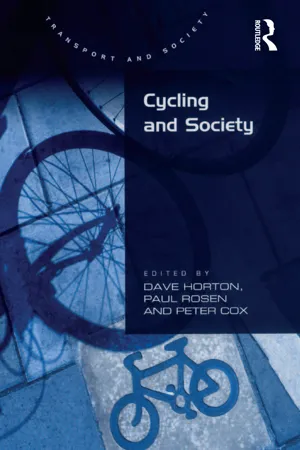
Cycling and Society
About this book
How can the social sciences help us to understand the past, present and potential futures of cycling? This timely international and interdisciplinary collection addresses this question, discussing shifts in cycling practices and attitudes, and opening up important critical spaces for thinking about the prospects for cycling. The book brings together, for the first time, analyses of cycling from a wide range of disciplinary backgrounds, including history, sociology, geography, planning, engineering and technology. The book redresses the past neglect of cycling as a topic for sustained analysis by treating it as a varied and complex practice which matters greatly to contemporary social, cultural and political theory and action. Cycling and Society demonstrates the incredible diversity of contemporary cycling, both within and across cultures. With cycling increasingly promoted as a solution to numerous social problems across a wide range of policy areas in car-dominated societies, this book helps to open up a new field of cycling studies.
Chapter 1
Cycling the City: Non-Place and the Sensory Construction of Meaning in a Mobile Practice
This chapter is born out of my own passion for cycling and the fact that I was lucky enough to receive funding to undertake a PhD studying cycling and mobility in London from 2003 to 2006.1 The central research question of my thesis is what makes people’s movement meaningful to them? Using a largely ethnographic approach this chapter begins to work through one particular strand that has emerged from my empirical fieldwork, relating to people’s sensory experience of place in a mobile practice.
The concept of place as theorised in geographical enquiry has tended to revolve around notions of dwelling, sociality, and the visual qualities of place embodied in the term landscape. Consequently, the spaces of mobility have largely been theorised as relatively meaningless; as simply the line in between A and B. Such thinking has been extended by the social anthropologist Auge (1995), to characterise many contemporary spaces of mobility as ‘non-places’; spaces where people do not meet, where they communicate only through signs and images, and where interactions are structured by rules not defined by the people in them (Auge 1995, 42–78).
My contention however is that when experienced in a different way, such non-places can actually be conceived of as place-like in character. Through the use of ethnographic and case study material, I explore the city by bike to illustrate key points of my argument. Taking a variety of different contexts, I work through sensory experiences of place in order to illustrate how meaning is created moment by moment through a series of fleeting and solitary embodied encounters. I also highlight the role of technology (in this case the bike) in manipulating such encounters.
Consequently I argue that destinations are not the only ‘places’. I contend that meaning is created in the city’s non-places through an embodied and sensory engagement with place which does not rely solely on notions of landscape, dwelling or sociality. Ultimately I want to suggest that meaning and consequently belonging are tied up with processes of enskillment dependent on learned strategies and available technologies. As Ingold suggests, ‘A place owes its character to the experiences it affords to those who spend time there to the sights, sounds and indeed smells that constitute its specific ambience. And these in turn, depend on the kinds of activities in which its inhabitants engage’ (Ingold 2000, 192).
Route Finding
Cities have long been seen as our greatest civilising influence, places of commerce, of belonging, of mixing. Cities, it has been said, are the cultural instrument through which societies attempt a more inclusive concept of humanity (LeGates and Stout 2000, 18). Mobility, according to Sheller and Urry (2000, 738), is as constitutive of modernity as urbanity. Yet the spaces of mobility that form a central part of city life have it seems become increasingly uncivilised for many.
In many nations, mobility is fundamental to the democratic rights of the citizen (Imrie, 2000, 1642), yet mobility is not equally enshrined for all as transport planners and operators make ‘decisions about what kinds of travel are important and which journey purposes and destinations are to be favoured’ (Whitelegg 1997 in Imrie, 2000, 1644). Unrestricted movement is discouraged in and by many of the new urban spaces (Edensor in Bell and Haddour 2000, 126). Indeed, current ‘wisdom’ based largely upon ideas of segregating mobility and the social2 seeks to accommodate predictable and productive mobility rather than conceiving of mobility as a messy, unpredictable and dynamic reality (Imrie, 2000, 1644).
Largely devoted to the rapid movement of people and goods, many spaces of mobility seem only to serve origins and destinations; A and B so to speak. Traditionally, places have been constituted as homes and workplaces; places where social interaction takes place, places that have meaning. Indeed, as Cresswell (2006) points out, the line that connects A to B has traditionally been explained in terms of A and B and the push and pull factors relating to them (Cresswell 2006, 46). Movement seems to have been largely ignored as a social practice generative of meaning in itself.
Ingold (2000, 204) however, argues that there can be no paths without places and vice versa to constitute destinations and departures. Indeed, he argues that the destination can only be understood in terms of moving towards it, otherwise it is not a destination, merely an object. So how we think about destinations and departures constitutes the character of pathways. Yet in no small part thanks to modern planning and engineering bias,3 pathways have somehow been seen as spaces; transitional and transitory, rather than meaningful social places. Indeed, the word transitory speaks volumes about the values we apply to being in transit, as if this is a temporary state of being that does not constitute social life. Yet these places exist: they are real and people live their lives in and through them, increasingly so in ever more mobile societies. So what characterises the spaces of mobility? What makes these places manageable and meaningful?
Constructing Place and Non-Place
An enormous amount of attention has been paid to conceptualising meanings of place in cultural geography, and much work in the humanist vein has added greatly to our understanding of what constitutes a ‘place’ as such (Cosgrove, 1984; Cosgrove and Daniels, 1989; Duncan, 1990; Matless, 1990, 1995; Daniels, 1993; Nash, 1996; Cresswell 2003 to name but a few). Much less explicit research exists on notions of non-place. One notable exception however is the work of social anthropologist Marc Auge in his (1995) book ‘Non-places: introduction to an anthropology of supermodernity’. I want to briefly discuss some of Auge’s ideas and theories because I believe they provide a good starting point from which to interrogate the character of some spaces of mobility.
Auge’s conception of non-place owes much to its opposition to place which according to Auge is characterised by direct communication, being lived in, defended, marked out and controlled by its inhabitants. Whilst there is not the space here to discuss every single aspect of place, I would like to draw attention to three key attributes of place which, as Auge’s definition demonstrates, are dominant in western thinking: sociality, dwelling and landscape.
In contrast to situated notions of belonging and place as the products of fixity and locality (Urry 2000, 133), Auge categorises the spaces of the automobile as non-places; spaces where people do not meet, where they communicate only through signs and images, and where interactions are structured by rules not defined by the people in them (1995, 42 78). He goes on to argue that the real non-places the motorway, the airport lounge are produced by the fact that we come to know the places we pass as text only; that we hear of these places in the paper, or a sign on the motorway tells us about them, yet we never actually experience them (1995, 96). Indeed, Gandy claims that auto-spaces represent a new spatial configuration of society, technology and nature, and promote new forms of leisure and visual pleasure where nature increasingly becomes a panoramic experience: ‘the tactile and olfactory senses subsumed by an emphasis on separation, movement, and visual power’ (Gandy 2002, 122–3).
The crux of Auge’s contention seems to me to revolve around how we construct place meanings. Auge’s argument appears to suggest that because we only pass through these places, because we often experience them in private with no direct social interactions, and because they are experienced largely visually (and often have little visual ‘appeal’), then we do not find these spaces meaningful and hence they fail to become places. However, in line with Evans (2004, 2) I question whether ‘experiences of fleetingness, temporality and ephemerality’ must be meaningless. Whilst I have some sympathy for Auge’s main points I believe his ideas provide the grounds for a fruitful debate I whole-heartedly agree with Evans when she states that Auge ‘… emphasises a particular experience of transit spaces, an experience that is in many ways desired by the agencies operating these spaces. In doing so, Auge only captures a small part of the travelling experience, and consequently neglects or marginalises a range of significant transit experiences and understandings’ (ibid.). I suggest here that one of the primary reasons for this is that Auge, like numerous other theorists of place, neglects the multi-sensory nature of place by focusing largely on the visual and social to produce an account of the spaces of mobility perhaps more typical of dominant ways of experiencing these spaces (for example, in a car). Consequently, I pose the question, would experiences of these non-places be any different if they were experienced in a more embodied way … by bicycle for example?
Place and the Senses
It is a somewhat hackneyed truism to suggest that we live in a visually dominated world and this bias extends into geographical enquiry (see for example Lynch, 1960; Stoddart 1967 in Cosgrove and Daniels, 1989). Consequently, and as many commentators have pointed out (Tuan, 1979; Cosgrove and Daniels, 1989, Jay, 1993, Rodaway 1994 to name but a few), vision has been seen as a means of objectification or at the least, as Ingold argues, has been enslaved to the service of objectification (2000, 253). However, Urry (2000) has suggested that despite the primacy of the visual, there are many spaces and practices which militate against solely visual experiences, where the other senses which cannot be so easily turned off form a large part of experience and a particular way of ‘seeing’. Despite such assertions however, little sustained research has emerged which considers other sensory aspects of experience (notable exceptions include Buttimer, 1976; Tuan, 1979, Buttimer and Seamon, 1980, Seamon, 1993).
When we consider these extra dimensions to socio-spatial relations, the body asserts itself as being of paramount importance. As Rodaway suggests, ‘the body is an essential part of sensuous experience: as a sense organ in itself, as the site of all the other sense organs and the brain, and our primary tool for movement and exploration of the environment’ (1994, 26). Auge is not blind to this and points to a link between embodied experience and place arguing that, ‘as anthropological places create the organically social, so non-places create solitary contractuality’ (Auge 1995, 94). Yet I would suggest that Auge fails to account for the body as the site of multi-sensory potential. Places and non-places alike can be experienced bodily and directly and still fail to register on the perceptual radar. Whether they stand out or not, I suggest that each place or non-place depends upon a level of sensory (dis)engagement by the individual to make it so. Thus, simply being located somewhere is not in itself enough to make it meaningful. We must be sensorily disposed to perceive affordances in the environment to endow it with the characteristics of a place. As Tuan (1977, 18) argues, place only achieves ‘concrete reality’ when it is experienced fully, that is, ‘through all the senses as well as with the active and reflective mind’.
People do not just ‘sense’ however, as Rodaway (1994, 22) affirms when he contends that ‘perceptual sensitivity is learnt and forms part of our socialization into a cultural group … Each sense is not only physically grounded but also its use is culturally defined’. Indeed, for Gibson (1966) perception can never be disinterested what we see is inseparable from how we see, and how we see is a product of the activity in which we are engaged (Gibson in Ingold 2000, 260). Accordingly, the character of a place is dependent upon how we are in a place, and how we perceive and organise sensory input.
Yet it is not only the body that needs to be accounted for in most modern mobile practices; technology also plays a central role in defining the capabilities of the human body. Technology and the body continuously come together; machines come to assume a level of organicism, and bodies are increasingly redesigned using technology (Balsamo 1996, 3). Game (2001) elaborates, pointing out that ‘the human body is not simply human. Through interconnectedness, through our participation in the life of the world, humans are always forever mixed ….’ (Game 2001, 1). Consequently affordances, certainly for humans, are not simply between bodies and environments, they are mediated by other everyday entities and technologies. These reshape the affordances of an environment by allowing new possibilities for the body whilst closing down others (Michael 2000, 112). Whilst technologies are often considered simply as means to meet practical demands, the character of a place depends on ‘how things are made’ or experienced and is consequently determined by the technical realisation of a place (Norburg-Schulz, 1976). Ultimately then, our perceptions of our environment are informed by the goals, skills and technologies available to us.
On your Bike
Little work has been undertaken regarding the more performative and embodied aspects of everyday mobility4 and cycling in particular. My own cycling-related work has to date been focused more on the ‘spectacular’ world of road-racing (Spinney 2006) than the more ‘mundane’ everyday cycling of the city. In this chapter however and please for give the pun I would like to suggest the urban cyclist as a vehicle for exploring the creation of meaning in so-called non-places. As a practice cycling is embodied,5 sensorily open to the environment, technologically oriented, and also arguably escapes much of the disciplining that other forms of mobility are subjected to; it consequently lends itself well to the task in hand. That said, as a mode of transport which really does not ‘belong’ in many of the city’s auto-spaces, it might logically be argued that even less meaning can be created out of such unforgiving environments for the participants. On the contrary though, I suggest that by looking at these auto-spaces through the ‘wrong lens’, as it were, new meanings come into focus.
The rest of this chapter draws on empirical material from fieldwork with 20 cyclists in London.6 There is neither space nor the necessity to give a detailed break down of all case study participants. However, the project of researching and representing the ‘unspeakable’ does pose its problems, and I want briefly to discuss a few of these, in order to contextualise what follows.
One of the difficulties of researching often taken for granted embodied and sensory understandings is the lack of vocabulary available. As Pow points out, it is often difficult for people to express their experience of senses other than vision due to the limited vocabularies associated with non-visual dimensions (2000, 169). This is even more acutely felt when such embodied and fluid experiences are reduced to pen and ink. In order to communicate meaning, experiences must at some point be represented in one form or other, and the lack of vocabulary in sense-worlds makes this a difficult task. Compounding this problem, many sensations such as balance and touch are often fleeting and hidden moments of existence which do not lend themselves to expression or capture in the same way as the visual or aural.
One finding of my research is that the more intense a sensory encounter, the easier it is for participants to articulate their understandings of it. Consequently, whilst I could have focused on less intense experiences, this chapter focuses on quite sensorily-intense cycling encounters, in order to illuminate key points.
In order to better represent the unrepresentable and to keep some sense of the context in which the research was carried out, this chapter employs the strategy of an ethnographic fiction7 to take the reader through a variety of the city’s spaces. One reason to use an ethnographic fictio...
Table of contents
- Cover Page
- Dedication
- Title Page
- Copyright Page
- Contents
- List of Figures
- List of Tables
- Notes on Contributors
- Acknowledgements
- Introduction: Cycling and Society
- 1 Cycling the City: Non-Place and the Sensory Construction of Meaning in a Mobile Practice
- 2 Capitalising on Curiosity: Women’s Professional Cycle Racing in the Late-Nineteenth Century
- 3 Barriers to Cycling: An Exploration of Quantitative Analyses
- 4 Hell is Other Cyclists: Rethinking Transport and Identity
- 5 The Flaneur on Wheels?
- 6 Bicycles Don’t Evolve: Velomobiles and the Modelling of Transport Technologies
- 7 Fear of Cycling
- 8 Men, Women and the Bicycle: Gender and Social Geography of Cycling in the Late-Nineteenth Century
- 9 Bicycle Messengers: Image, Identity and Community
- Index
Trusted by 375,005 students
Access to over 1.5 million titles for a fair monthly price.
Study more efficiently using our study tools.
Frequently asked questions
Yes, you can cancel anytime from the Subscription tab in your account settings on the Perlego website. Your subscription will stay active until the end of your current billing period. Learn how to cancel your subscription
No, books cannot be downloaded as external files, such as PDFs, for use outside of Perlego. However, you can download books within the Perlego app for offline reading on mobile or tablet. Learn how to download books offline
Perlego offers two plans: Essential and Complete
- Essential is ideal for learners and professionals who enjoy exploring a wide range of subjects. Access the Essential Library with 800,000+ trusted titles and best-sellers across business, personal growth, and the humanities. Includes unlimited reading time and Standard Read Aloud voice.
- Complete: Perfect for advanced learners and researchers needing full, unrestricted access. Unlock 1.5M+ books across hundreds of subjects, including academic and specialized titles. The Complete Plan also includes advanced features like Premium Read Aloud and Research Assistant.
We are an online textbook subscription service, where you can get access to an entire online library for less than the price of a single book per month. With over 1.5 million books across 990+ topics, we’ve got you covered! Learn about our mission
Look out for the read-aloud symbol on your next book to see if you can listen to it. The read-aloud tool reads text aloud for you, highlighting the text as it is being read. You can pause it, speed it up and slow it down. Learn more about Read Aloud
Yes! You can use the Perlego app on both iOS and Android devices to read anytime, anywhere — even offline. Perfect for commutes or when you’re on the go.
Please note we cannot support devices running on iOS 13 and Android 7 or earlier. Learn more about using the app
Please note we cannot support devices running on iOS 13 and Android 7 or earlier. Learn more about using the app
Yes, you can access Cycling and Society by Dave Horton,Paul Rosen,Peter Cox in PDF and/or ePUB format, as well as other popular books in Social Sciences & Geography. We have over 1.5 million books available in our catalogue for you to explore.