- 216 pages
- English
- ePUB (mobile friendly)
- Available on iOS & Android
eBook - ePub
About this book
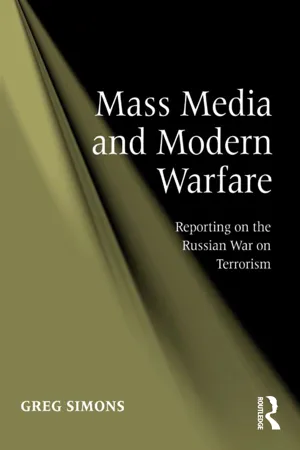
Mass media are essential to democratic society; in contrast, the War on Terror has been interpreted as an assault on democracy and freedom by Islamic fundamentalists. The building and maintenance of public support is essential in modern warfare due to the increasing politicization of warfare, where losses and gains are measured in political rather than military terms. And if progress cannot be demonstrated during a war, then by default one is assumed to be losing. Greg Simons tackles the complicated yet essential role of mass media in society. Taking the Global War on Terror as a prime example, the author adopts a multidisciplinary approach to analyze the various facets of war and the role of the media within it. Assessing in particular the Russian fight against terrorism, this book provides a broader perspective and understanding of contemporary struggles.
Information
1 Politicising the Media or Mediaising the Politician? Media-Political Relations in Russia
DOI: 10.4324/9781315594224-2
This chapter shall focus primarily on the politicisation process in the Russian mass media. It will give a general account of the broader transitions and processes that have, and still are occurring. It should be noted, that due to the constantly changing media and political environment only the more enduring aspects and trends will be noted, which has the possible effect of seemingly simplifying the events. However, greater clarity shall be achieved in the aspects that are studied. A series of critical questions will be examined. Why have the mass media not been able to establish themselves as an independent Fourth Power? How are the mass media viewed by the business and political elite? What means are used to effectively control editorial content and therefore meaning as well?
I shall begin with the late Soviet period, where a significant departure from the “traditional” role for the mass media occurred. University of Edinburgh academic Dr. Lara Ryazanova-Clarke made a statement that supports the above claim, as to the Soviet media's function in society. “In the Soviet period the media was given the honourable role of, and proudly served as, a major conduit of ideological propaganda.”1
The role played by the mass media in the Soviet era is well documented. They served the interests of the State and were in return, rewarded for their services through the use of inducements. Provided that a journalist worked within the accepted (but not necessarily recorded) rules of the time, a comfortable and stable standard of living was to be expected. Mass media were not run as an independent commercial enterprise and were taken care of, financially by the State. Mass media were owned by either; the Soviets, the State apparatus, public organisations (all controlled by the Communist Party), a combination of the three institutions or by the Communist Party directly.2
The effects of the glasnost and perestroika reforms combined with the collapse of the Soviet Union saw the rise of the mass media as a Fourth Power. For a couple of years the media were able to enjoy an era of little interference in editorial matters, dubbed as the Golden Years of Russian journalism. However, the euphoria soon evaporated as the realities of a market economy began to bite. The new owners were the super rich class of “New Russians”, known as the oligarchs. Why did these businessmen invest in the media industry, when the industry was known to be unprofitable?
Another new era came into effect after the March 2000 presidential elections. The relatively unknown newly elected President, Vladimir Putin, began to resurrect a centralised State. One of the first targets of the authorities was mass media assets (especially TV) that were beyond the control of the Kremlin. During the initial clash between the “rogue” oligarchs and the State, there was little public support or reaction to the plight of the mass media. How were the authorities able to frame their actions in a way which was palatable for the public?
A discussion on creating and sustaining a presidential image is then discussed. How and why was this done? The image and perception of connecting with the ordinary person is not a new and innovative tactic. However, the means of achieving this is, Putin used television as his medium of choice, and now Medvedev has begun to use the Internet to reach the target audience.
Lastly, the issue of information security is dealt with. Even by mentioning a term, such as “information security” there is an inbuilt implication that one needs to protect or be protected from a threat that is derived from information. The previous section dealt with the issue of information providing an opportunity, and this section views the flip side of the coin, with information being viewed as a potential or actual threat.
Mass Media in the Late Soviet Period
James Burnham argued that a shift in the mode of production would alter the salient institutions in society, in time this would affect the nature of the ruling elite as they are forced adapt to the new conditions.
… changing technologies and modes of production will alter the rules of the game, thereby altering the sorts of people taking advantage of what becomes the dominant game in each era. Different sections of the elite will respond differently, and with varying degrees of success, to the challenges of the new arrangements. Those responding most successfully become the new winners and so emerge as the new elite.33 Louw, P. E., The Media and Cultural Production, Thousand Oaks, Sage, 2001, p. 58. For Burnham's account of his theory, please refer to Burnham, J., Managerial Revolution, Harmondsworth, Penguin, 1962.
Taking this statement a little further and adapting it to the circumstances of Russia, it is possible to draw yet another possibility. Politicians, who alter the “rules of the game” between themselves and the mass media, create the rules on their own terms. This can ensure that the advantage remains with the politician and can be used to ensure that no political pretenders challenge the existing political hegemony. One could argue that this is what happened to the Soviet elite in the glasnost era of the late Soviet Union. An elite is not necessarily a monolithic and homogenous structure. Events of the period, especially 1990-1991, highlighted the schisms that existed in the Soviet elite. These differences became exaggerated during a period of extreme stress, partly brought about by rapid change.
An impending political and economic crisis forced the Soviet elite, under the stewardship of Mikhail Gorbachev, to try to reinvigorate and renew the Soviet Union so as to ward off the effects of stagnation and decay that had reached Soviet society. It is important to note that the planned changes (glasnost and perestroika) came from within the existing power structure. The kingmaker of Soviet politics was the KGB. They saw the urgency to rejuvenate the economy, more so than the Party, government bureaucracy or the military. Gorbachev was brought to power under the patronage of Andropov (an ex-director of the KGB) and with the support of the KGB.4 Gorbachev took the concept of rejuvenation further when he came to power and started to institute a form of bottom-up communication.
Gorbachev argued from the outset that popular access to honest and reliable information was crucial to generating popular activism and support for the party and its programmes.55 Gill, G. and Markwick, R. D., Russia's Stillborn Democracy? From Gorbachev to Yeltsin, Oxford, Oxford University Press, 2000, p. 33.
This statement by Gorbachev would imply that initiatives for societal change were not originating from the masses, but from society's political elite. Change that is initiated in this manner may imply that the elite intended to manage and control any forthcoming reforms.
The impetus thus came from above with the implication that the boundaries of such discussion could be set and the room for initiative from below was limited.66 Ibid.
Mass media were at the forefront of the drive to reform, acting in the dual capacity of “selling” the proposed reforms to the public and ridding Gorbachev of political opposition. The Kremlin placed a great deal of responsibility in the hands of a select few publications. If they were to have “reliable” media outlets, “reliable” personnel were required to head these organisations. As the government was tasked with selection of key staff, they had the opportunity to place “their” people in the top positions.
Individuals in key positions in mass media organisations also affect media production. They earn their roles because of a fit between themselves and various organisational agendas.77 Turpin, J., Reinventing the Soviet Self: Media and Social Change in the Former Soviet Union, Westport, Connecticut, Praeger, 1995, p. 132.
A war of ideology developed between media loyal to Gorbachev and media which were loyal to his conservative/extremist nationalist opponents. Some of the media who were aligned to Gorbachev included Moscow News and Ogonyok. Opposition media included Sovyetskaya Rossiya, Literaturnaya Rossiya and Nash Sovremenik.8
Glasnost's impact upon the media was significant, but the reforms never entirely reached their full potential. “The impact of glasnost on the Soviet press ... has been considerable, but as the test cases show, it has been limited”.9 This may have been partly due to the bitter political fighting between various factions. Each of these factions (the reformers and the conservatives) was equally determined to exert control over the media to achieve their ends. Some media were able to take advantage of the political split in the late Soviet period. They aligned themselves to various powerful political patrons, who would look after the media's interests if the media publicised their interests.
… an increasingly fractured institutional base ultimately served to strengthen media pluralism and autonomy. ... individual media officials, generally at the level of newspaper editor or television department chief, were able to advance more radical or more conservative agendas by entering into working alliances with Politburo patrons of their political hue. In the television sector this meant dramatically different programming policies in different divisions seeking the protection of different Kremlin authorities.1010 Gunther, R. and Mughan, A. (Editors), Democracy and the Media: A Comparative Study, New York, Cambridge University Press, 2000, p. 95.
The main contenders in the political struggle, which culminated in the August 1991 coup, seemed to be the Gorbachev camp versus the Communist hardliners. However, in the end both of these sides lost out to the shrewd and opportunistic Boris Yeltsin. He was able to outmanoeuvre both sides in the conflict and through skilful use of the mass media, able to gain the Russian presidency. He knew how to handle the media and present a favourable image to the public, which was Yeltsin as a man of the people. The mass media and Yeltsin formed a close relationship with each other, one of the few political relationships to endure during the early 1990s.11
The “Golden Years”
In the immediate aftermath of the collapse of the Soviet Union, with the disintegration of social, political and economic order, a form of vacuum existed. In this vacuum, the mass media found that they were able to briefly carve out a measure of freedom, which had not existed before. They were free from governmental manipulation or control, as the central government was in a severely weakened state, financially and politically, therefore not in a position to interfere with the mass media.
In fact the new Russian government simply registered the existing mass media, allowing them to escape their ‘founders’ – various political and social institutions of the Soviet era. In the first Soviet media law of 1991 property rights were not mentioned, so the new Russian press at once emerged completely free.1212 Zassoursky, I in Nordenstreng, K., Vartanova, E. and Zassoursky, Y. (Editors), Russian Media Challenge, Helsinki, Kikimora Publications, 2001, pp. 73-91, p. 74.
Nor did they particularly need to, the President Boris Yeltsin had used the media to rise to power and a “honeymoon” period existed between the President and the mass media. This period is looked upon with some measure of nostalgia and is referred to as The Golden Years by the media industry. The former Dean of Moscow State University's Department of Journalism, Professor Yassen Zassoursky backs up some of these points.
The Golden Age of our journalism was not long – I think it was in the period from 1991 to 1992, when our journalists freed themselves from the heavy hands of State censors and the Communist Party, and had not yet fallen into the stronger hands of press owners – those so-called oligarchs.1313 Feifer, G., Russia: 300th Anniversary Celebrated, JRL 7031, 24 January 2003. www.cdi.org/russia/johnson/7031-10.cfm, 23 February 2004.
The Rise of the Oligarchs
Although the mass media were for the most part, free from censorship (excluding such matters as national security or inciting forms of intolerance or hatred) and control via state or business ownership, they found the hectic transition from the Soviet system to a free market economy to be very difficult. There was no time given for the mass media industry to adapt to their new political and economic environment. Attempts made by the media industry to become a viable economic enterprise met with little success. The situation forced them to seek a sponsor, as the government was in no financial position to offer any form of effective help this left one other option, big business or the so-called oligarchs.
Initially, the mass media industry heads thought that it would be able to gain financial support from the oligarchs, but still retain editorial control over their individual outlets. However, the oligarchs were unlikely to give financial support for nothing in return and the process of mediacracy began.14 Media outlets began to be integrated into large corporate structures. The distinction between business and politics became extremely blurred during this period. Iosif Dzialoshinsky, a professor in Moscow University's journalism faculty, says that business and politics are related.
Table of contents
- Cover
- Half-Title Page
- Dedication Page
- Title Page
- Copyright Page
- Table of Contents
- Acknowledgements
- Introduction
- 1 Politicising the Media or Mediaising the Politician? Media-Political Relations in Russia
- 2 Factors Motivating and Determining Censorship in the Russian Media
- 3 The Use of Rhetoric and the Mass Media in Russia’s War on Terror
- 4 The Russian Media at War: Reporting on Russia’s War on Terror
- 5 Terrorism in Cyberspace: Kavkazcenter and Virtual Terrorism
- Conclusions
- Bibliography
- Index
Trusted by 375,005 students
Access to over 1.5 million titles for a fair monthly price.
Study more efficiently using our study tools.
Frequently asked questions
Yes, you can cancel anytime from the Subscription tab in your account settings on the Perlego website. Your subscription will stay active until the end of your current billing period. Learn how to cancel your subscription
No, books cannot be downloaded as external files, such as PDFs, for use outside of Perlego. However, you can download books within the Perlego app for offline reading on mobile or tablet. Learn how to download books offline
Perlego offers two plans: Essential and Complete
- Essential is ideal for learners and professionals who enjoy exploring a wide range of subjects. Access the Essential Library with 800,000+ trusted titles and best-sellers across business, personal growth, and the humanities. Includes unlimited reading time and Standard Read Aloud voice.
- Complete: Perfect for advanced learners and researchers needing full, unrestricted access. Unlock 1.5M+ books across hundreds of subjects, including academic and specialized titles. The Complete Plan also includes advanced features like Premium Read Aloud and Research Assistant.
We are an online textbook subscription service, where you can get access to an entire online library for less than the price of a single book per month. With over 1.5 million books across 990+ topics, we’ve got you covered! Learn about our mission
Look out for the read-aloud symbol on your next book to see if you can listen to it. The read-aloud tool reads text aloud for you, highlighting the text as it is being read. You can pause it, speed it up and slow it down. Learn more about Read Aloud
Yes! You can use the Perlego app on both iOS and Android devices to read anytime, anywhere — even offline. Perfect for commutes or when you’re on the go.
Please note we cannot support devices running on iOS 13 and Android 7 or earlier. Learn more about using the app
Please note we cannot support devices running on iOS 13 and Android 7 or earlier. Learn more about using the app
Yes, you can access Mass Media and Modern Warfare by Greg Simons in PDF and/or ePUB format, as well as other popular books in Politics & International Relations & Politics. We have over 1.5 million books available in our catalogue for you to explore.