The presentation of mental illness at work has different implications and consequences depending on the specific nature of the job, work context, regulatory framework and risks for the employee, organisation and society. Naturally there are certain occupational groups where human factors and/or mental illness could impair safety and mental acuity, and with potentially devastating consequences. For pilots, the medical criteria for crew licensing are stipulated by regulatory aviation authorities worldwide, and these include specific mental illness exclusions. The challenge of assessment for mental health problems is, however, complex and the responsibility for psychological screening and testing falls to a range of different specialists and groups including AMEs (authorised aviation medical examiners), GPs and physicians, airline human resources departments, psychologists, human factor specialists and pilots themselves.
Extending and developing the ideas of Aviation Mental Health (2006), which described a range of psychological issues and problems that may affect pilots and the consequences of these, this book presents an authoritative, comprehensive and practical guide to modern, evidence-based practice in the field of mental health assessment, treatment and care. It features contributions from experts in the field drawn from several countries, professions and representing a range of aviation-related organisations, displaying a range of different skills and methods that can be used for the clinical assessment of pilots and in relation to specific mental-health problems and syndromes.
Robert Bor, Carina Eriksen, Margaret Oakes and Peter Scragg
In March 2015, mental health issues among pilots became headline news when a pilot, who was later identified as having significant psychological difficulties, deliberately flew a passenger aircraft on a commercial flight into the ground killing all on board. Worldwide, the airlines and their regulators acknowledge that psychological problems within the pilot population are a potential threat to safety. Well below the severity level at which we might hypothesise about pilot suicide, psychological distress and mental health issues can cause a significant impairment to pilot performance and therefore flight safety. Psychiatric disorders are not uncommon among the general population but are frequently under recognised. Severe psychological disturbance among pilots is rare but, nonetheless, they may suffer from a range of psychological difficulties just like anyone in any other occupational group.
In this chapter, we provide an overview of current theory and practice relevant to the understanding, identification and management of mental health issues among pilots. We start with the psychological aspects of the environment in which pilots work. This is fundamental to understanding the ways in which standard clinical assessment and practice may need to be adapted for this specific occupational group. We also outline the regulatory environment in which clinical work with pilots must take place and the recommendations produced by the European regulator, European Aviation Safety Agency (EASA) in the aftermath of March 2015. We then discuss psychological assessment and its use in selecting the ‘right’ pilots and identifying and anticipating psychological disorders. The reader may be somewhat disappointed to learn that one cannot offer nor provide a perfect clinical tool that will predict and/or identify any and every potential psychological disorder. Psychology draws extensively on scientific methods but it is not a precise science. We recognise that pilots are subjected to the same challenges and vicissitudes in life as anyone in the general population. There are, however, some useful clinical tools, methods and skills that, when used together, can provide a robust and comprehensive psychological assessment. We present these and discuss their application to flight crew.
Pilots’ psychological environment
Pilots are in many ways a unique, and at times unusual, occupational group. Their working environment and shift patterns are psychologically and physiologically challenging (Bor and Hubbard, 2006). They also face unusual psychosocial challenges at work and home. It has been suggested that people who fly for a living may also have health concerns above and beyond those that work on the ground (Brown et al., 2001; Richards et al., 2006). An understanding of pilot mental health therefore requires us to consider the specific environment in which they work.
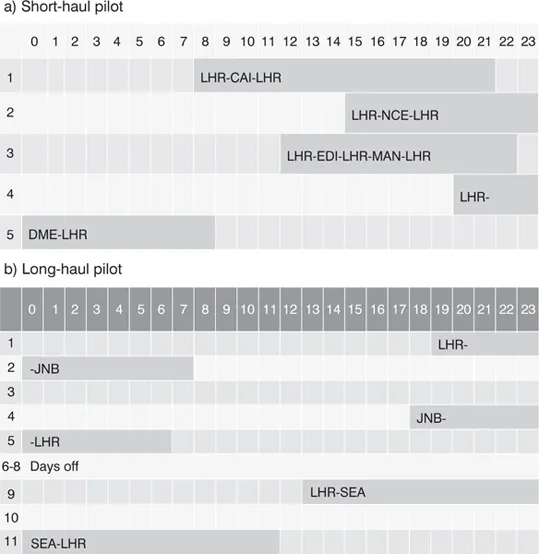
The major physiological challenges of aircrews’ working environment centre on the aircraft environment, disruption to circadian rhythms, shift work, rostering anomalies and stresses, disruption to regular social support and sleeping difficulties. The immediate workplace environmental challenges are well documented elsewhere but centre on air quality, noise and restricted movement (Gradwell and Rainford, 2016). The result may be physiological stress. Depending on the type of flying undertaken, pilots can experience jet lag, multiple early starts or late finishes, limited recovery time and shifts exceeding 12 hours. Figure 1.1 shows typical schedules for a long-haul and short-haul pilot. All of these factors combine to create a significant potential for fatigue (Caldwell, 1997). Any screening or assessment process focused on pilot mental health must therefore take these physiological influences into account. At recruitment, the aim will be to identify flexible and robust individuals who will be able to handle these challenges well. When screening for possible psychological difficulties, the extent to which these physiological stressors have contributed to the presenting issue must be considered. This is apart from assessing for underlying, pre-existing or emerging mental health problems.
Fatigue is a significant factor in long-term physical and psychological well-being. Pilot fatigue has also been identified as a contributing factor in some airline incidents including a Northwest Airlines flight in October 2009 when the captain and first officer fell asleep and were unresponsive to air traffic control for ninety minutes, and the fatal Flydubai crash in Rostov-on-Don, Russia, in March 2016. The regulatory environment we describe later imposes maximum shift lengths, minimum rest periods and fatigue reporting systems. The aim is to avoid the accumulation of fatigue for those in safety critical roles; and in Europe, cabin crew and pilots are now governed by identical rules and share responsibility for fatigue management with their employer. The employer must schedule crew in accordance with the fatigue-avoiding regulations. Crew are expected to manage their time at work and away in order to be properly rested.
Imagine for a moment being one of the pilots following the schedules in Figure 1.1 living about 40 minutes from their base airport with a family including school age children. For both pilots, some of the working days will almost certainly cover weekends. On Day 1, our short-haul pilot must negotiate rush-hour traffic before completing a 12-hour shift, returning home after everyone else is asleep. Days 2 and 3 provide opportunities for a lie in but what is everyone else at home doing? The morning school run or dash to work? What interruptions might occur? If they are at home and their partner works, surely it is their turn for the school run? How much sleep is possible at home before the long night flight starting on the evening of Day 4? What are the implications for family relationships and social interactions if the pilot insists on sleeping when others are active or noisy? The point is that pilots, like most other people, have obligations and dependencies outside of work. The shift patterns in Figure 1.1 illustrate challenges related to these, which are not typical of many shift patterns.
Long-haul pilots face similar challenges trying to rest at home before a night flight on Day 1 and must then find ways of resting and maintaining contact with home in an unfamiliar hotel room to be fit for another night flight home on Day 4. On a trip that length, their social interactions are probably limited to the crew they work with – potentially rewarding, but also potentially shallow or even creating friction at home. By the time they return home, having battled rush-hour traffic on Day 5, they will have been awake for a minimum of 16 hours. Do they isolate themselves from the social groups they left days ago by going to sleep, or join in ‘normal’ routines, probably not at their best and potentially upsetting those who missed them? Days 9–11 pose similar challenges again with the addition of time differences imposing jet lag and narrow windows of opportunity for contact with home.
Figure 1.1 Example pilot schedules
Columns 0–23 indicate UK time of day; rows indicate successive days, not necessarily starting on Monday; shaded blocks are flying duties
This brief overview and illustration is not to suggest that all pilots are unhappy or do not live fulfilling lives. They are highly motivated; their role is practically and psychologically rewarding and reasonably high status and they generally manage these challenges well. When mental health issues arise, however, the impact of their working patterns on their physiological and psychological state and the psychosocial environment we discuss below must be considered when assessing and managing the underlying clinical problem. Asking them about how they manage these challenges may be revealing. It is also an important factor to address in the professional support and treatment of temporarily or permanently grounded pilots. If they have been used to the shift patterns we have just described, they may need detailed guidance and support in adapting to different routines, standard sleeping patterns and maintaining social and intimate relationships when barriers to contact and communication may have been removed.
The psychosocial environment in which pilots work is also an unusual one (Butcher, 2002). In their professional roles, they generally operate with different colleagues, on different routes and at different times every time they come to work, especially if they work for a large airline. Pilots spend very little time in traditional ground-based offices, and in medium to large airlines will have very little contact with their management team. They are also among the most examined professions of all. Typically, a pilot will complete several days of simulator tests, a medical, a written examination and a flight under supervision every year. Failing any of these tests can result in stressful additional training and testing, disciplinary action and, ultimately, dismissal. Pilots are also specifically trained and encouraged to monitor each other’s performance as well as their own. A typical pilot will be critical of their own performance and very aware that their colleagues are evaluating their actions. These factors combine to encourage self-criticism and reduce the possibility of social support and networking at work. Again, at recruitment, screening aims to identify individuals who will thrive in these conditions and it is another important consideration in assessing psychological difficulties.
Away from work, variable shift patterns, the need to sleep before or after unsocial shifts, and lack of advance notice can combine with frequent absences from home to disrupt relationships outside work. There is evidence that this pattern of absence from home can create difficulties in relationships with partners and families in a form sometimes referred to as ‘intermittent spouse syndrome’ (Taylor et al., 1985). In brief, the working patterns of flight crew tend to impose a requirement for both partners in intimate relationships to adapt frequently and quickly to changing roles when separated and together. Of course, the exact way a couple deals with such transitions will depend on the strength of the relationship as well as each partner’s ability to manage the frequent separations.
Relationship difficulties can cause stress and emotional upset (Eriksen, 2009). This can have a negative impact on performance including concentration, ability to think clearly and decision-making. There are relatively few studies demonstrating a causal link between relational problems and pilot performance, but anecdotal evidence from pilots is strong. Further investigations may be needed to assess the degree to which flight-deck duties are negatively affected by couple or family discord. Another issue to consider is whether lack of support from a spouse, friends or family could potentially reduce a pilot’s ability to cope with the many stressful aspects of their jobs. Imagine, for example, the partner left at home who has had to deal with family illness or domestic flooding only to be criticised by the returning partner for some of the decisions made. Or the absent partner who generally manages family finances but finds that the family budget has been disrupted by their partner replacing an expensive broken household item while they were away. Outwardly trivial, these issues have the potential to cause arguments and diminish the enjoyment of reunions. There is a plethora of research suggesting stable relationships can have a positive impact on (pilot) mental health.
When there is a link between relational, financial or the myriad of other personal problems that can occur in anyone’s life, and changes in a pilot’s behaviour, it is important that pilots do not undertake further flying duties until their normal levels of functioning have been restored. This may occur when, for example, a confident and experienced captain who is usually able to make decisions becomes overly hesitant and anxious whilst operating on a flight. Jones and colleagues (1997) suggest that family issues could very well have a negative impact on pilot performance and they argue that such family issues must be addressed and resolved before allowing the pilot to resume flying. Other studies have found a link between interpersonal problems, financial difficulties and career strains to aircraft mishaps (Little et al., 1990). Moreover, Raschmann and colleagues (1990) studied the psychosocial lives of pilots and observed that pilots who suffered enduring and extensive marital distress reported a reduced ability to concentrate effectively on their piloting duties and responsibilities.
Some research has demonstrated the importance of relationship support in predicting pilot performance (Levy et al., 1984; Rigg and Cosgrove, 1994), but it may also be equally true that individual work competency leads to a happier domestic life. In a study on spousal support, Karlins and colleagues (1989) recognised that a stable and happy relationship with a partner could strengthen pilots’ existing coping mechanisms to deal with work stress. On the other hand, disruption to personal relationships was thought to weaken a pilot’s ability to manage the more stressful aspects of their jobs. This indicates that spousal relationship can buffer the effects of work stress and they may therefore play an important role in reducing the likelihood of unsafe acts in flight (Morse and Bor, 2006). The same may be true for other kinds of supportive relationships including friends, family and colleagues. Sloan and Cooper (1986) studied the coping strategies of commercial airline pilots and found a close association between mental health problems and fatigue, lack of social support and lack of work autonomy.
Selection and mental health assessments need to consider the long-term ability of pilot recruits to manage these challenges as an important part of the assessment of pilots presenting with mental health issues.
Regulation and training
As one would expect in a safety critical industry, aviation is highly regulated. Most countries have established national regulators who define operating standards for airlines and aircraft manufacturers and issue licences to pilots. Other smaller countries place themselves under one of the larger regulators. For an industry with its roots in the 1940s, international regulation is remarkably consistent, but any assessment of a pilot must comply with the national regulations governing their employer and their licence. Readers should consult their local aviation regulator for a copy of the regulations governing crew licensing.
In Europe, national regulators have come together under the umbrella of the European Air Safety Agency (EASA). EASA regulations define, among other issues, psychological standards for flight crew (EASA n.d.). In the USA, the Federal Aviation Administration (FAA) guide for aviation medical examiners includes specific guidance regarding psychiatric diagnoses and aerospace medical disposition. The guidance can be accessed via the FAA website (FAA, 2016). Likewise, in the United Kingdom, it is the UK Civil Aviation Autho...
Table of contents
Cover
Half Title
Title Page
Copyright Page
Table of Contents
List of figures
List of tables
List of Contributors
Foreword
1 Pilot mental health in the modern era: headlines and reality
Part I Pilot selection assessments
Part II Pilot clinical assessments
Part III Mental health, well-being and support for pilots
Index
Trusted by 375,005 students
Access to over 1.5 million titles for a fair monthly price.
Study more efficiently using our study tools.
Frequently asked questions
Yes, you can cancel anytime from the Subscription tab in your account settings on the Perlego website. Your subscription will stay active until the end of your current billing period. Learn how to cancel your subscription
No, books cannot be downloaded as external files, such as PDFs, for use outside of Perlego. However, you can download books within the Perlego app for offline reading on mobile or tablet. Learn how to download books offline
Perlego offers two plans: Essential and Complete
Essential is ideal for learners and professionals who enjoy exploring a wide range of subjects. Access the Essential Library with 800,000+ trusted titles and best-sellers across business, personal growth, and the humanities. Includes unlimited reading time and Standard Read Aloud voice.
Complete: Perfect for advanced learners and researchers needing full, unrestricted access. Unlock 1.5M+ books across hundreds of subjects, including academic and specialized titles. The Complete Plan also includes advanced features like Premium Read Aloud and Research Assistant.
Both plans are available with monthly, semester, or annual billing cycles.
We are an online textbook subscription service, where you can get access to an entire online library for less than the price of a single book per month. With over 1.5 million books across 990+ topics, we’ve got you covered! Learn about our mission
Look out for the read-aloud symbol on your next book to see if you can listen to it. The read-aloud tool reads text aloud for you, highlighting the text as it is being read. You can pause it, speed it up and slow it down. Learn more about Read Aloud
Yes! You can use the Perlego app on both iOS and Android devices to read anytime, anywhere — even offline. Perfect for commutes or when you’re on the go. Please note we cannot support devices running on iOS 13 and Android 7 or earlier. Learn more about using the app
Yes, you can access Pilot Mental Health Assessment and Support by Robert Bor, Carina Eriksen, Margaret Oakes, Peter Scragg, Robert Bor,Carina Eriksen,Margaret Oakes,Peter Scragg in PDF and/or ePUB format, as well as other popular books in Psychology & Psychiatry & Mental Health. We have over 1.5 million books available in our catalogue for you to explore.