eBook - ePub
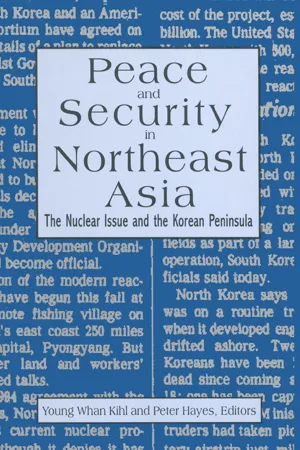
Peace and Security in Northeast Asia
Nuclear Issue and the Korean Peninsula
- 512 pages
- English
- ePUB (mobile friendly)
- Available on iOS & Android
eBook - ePub
Peace and Security in Northeast Asia
Nuclear Issue and the Korean Peninsula
About this book
This work provides an analysis of North Korea's nuclear controversy from a variety of perspectives, including: nuclear reactor technology and technology transfer; economic sanctions and incentives; confidence-building measures; environmental challenges; and the views of Korea and the major powers.
Trusted by 375,005 students
Access to over 1.5 million titles for a fair monthly price.
Study more efficiently using our study tools.
Information
__________________________ 1
Introduction: A Road Map for Korean Security and Peace Building
This book addresses the important policy questions of how to bring about peace and security in Northeast Asia. In a geopolitical sense, the Korean Peninsula occupies a pivotal location—the strategic place where the major powers’ interests converge. The initiative for Korean security and peace building must start with an effort to reduce chronic tensions in Korea. There is a pressing need today to turn the heavily armed and fortified Korean Peninsula into a nuclear-free peace zone.
The challenge in post-Cold War Northeast Asia is, indeed, to resolve the dilemma—and the irony—that, in an unresolved Cold War legacy, Korea remains divided. Inter-Korean relations are as frozen as ever. Today, the Korean Peninsula is still one of the world’s dangerous tension spots long after the conclusion of the Korean War (1950–53). The 1.1 million–nstrong heavily armed North Korean army confronts an equally strong well-equipped South Korean army of 650,000 soldiers, together with 38,000 U.S. combat troops.
The security of Korea—a primary topic of this book—was the focus of world-wide attention and headline news in 1993–95 when a crisis was precipitated by North Korea’s “suspected” nuclear weapons program. North Korea resisted international pressures by defying the International Atomic Energy Agency (IAEA) safeguard measures and inspection of the nuclear reactor facilities in Yongbyon, 60 miles north of Pyongyang. In May 1994, North Korea went ahead with the removal of 8,000 fuel rods from its 5 megawatt electrical experimental nuclear reactor. This move led the U.S. Clinton administration to issue a warning that North Korea’s extracted fuel rods could be processed into purified plutonium for manufacturing five to six nuclear bombs.
This standoff, dubbed by some as the first post–Cold War nuclear crisis, was triggered by the United Nations Security Council’s move to impose economic sanctions on North Korea. Although the crisis was defused on time by diplomatic means, the nuclear time bomb in Korea continues to tick and remains under close international surveillance. The Agreed Framework, signed on October 21, 1994, in Geneva, by the United States and the Democratic People’s Republic of Korea (DPRK), is discussed in several chapters in parts one and three. It stipulates that North Korea will “freeze” and “terminate,” in due course, its nuclear program in exchange for U.S. guarantee to provide North Korea with two light-water reactors (LWRs) by the year 2003.
Peace, Security, and Conflict Issues: A Comprehensive View
This book examines North Korea’s nuclear controversy from the perspective of a variety of policies and alternatives. These include a discussion of nuclear reactor technology and technology transfer (Part One), economic sanctions and incentives as well as the environmental (external) challenges posed by the nuclear issues and the nuclear-free zone for Korea (Part Two), strategic calculus and confidence-building measures (Part Three), and international perspectives of the major powers and South Korea (Part Four).
To highlight the centrality of the DPRK’s nuclear threat, this book utilizes a broad and all-inclusive analytical perspective that reflects an interdisciplinary orientation. The purpose here is to cast the conceptual net widely so as to capture the sense of urgency regarding the threat of horizontal nuclear proliferation that North Korea’s nuclear capability poses to the Northeast Asia region in the post–Cold War era. The following key assumptions underlie the present study of peace and security:
First, peace and security are inseparable. Not only are they intertwined as human activities, but they are also interrelated in the global and regional contexts. What happens in the Northeast Asian corner of the globe, for instance, is not confined to the region but has ramifications for the larger community of East Asia and the Asia-Pacific region. Opposing nuclear arms proliferation in the Korean context will spill over beyond the region to other regions and parts of the world. Hence, strengthening horizontal nuclear nonproliferation in Asia promotes both the regional and global security agendas.
Second, peace is indivisible as a set of ideas but the strategy for peace-building must start from the concrete issues and problem areas that are readily identifiable. Hence, a “peace by pieces” strategy reflects a more sensible and realistic approach to the problem solving of the peace and security agenda in the region. Peace in the post–Cold War era involves more than the hardware and technology of military security and deterrence, which reflects a conventional and restrictive perspective. Peace is also a matter of promoting cooperation among the people and nations of the world, which reflects a more positive and inclusive perspective.
Third, peace and security in the nuclear age reflect both high and low political dimensions of national security. The difference between these dimensions may be exploited to promote ecologically sustainable development. We must address not only the hardware aspect of nuclear weapons deployment by the region’s nuclear weapons states—including the United States, China, and Russia—but also the software strategy of how to dissuade the nuclear ambitions of non-weapon states and also to promote the reduction of nuclear weapons stockpiles and their eventual elimination. These challenges of how to promote confidence-building measures involving both nuclear and conventional weapons in the region (high-politics issues), in turn, may be combined with a sense of concrete and practical measures to promote regions economic and ecological developments (low-politics issues).
This is why peace and security in Northeast Asia will not come about unless and until the welfare issues of the environment and economic development are settled while the questions of horizontal nuclear nonproliferation and confidence-building measures are worked out as well.
Armed with these analytic tools and approaches to peace, this book provides a road map for Korean security and peace building. Readers will be exposed to a variety of obstacles and rugged terrain, in several steps and stages, before reaching the final destination of establishing a nuclear-free peace zone for the Korean Peninsula.
Two Track Approaches to Development and Security
Track One: Sustainable Energy Development and Security
Nuclear power—often promoted in Japan, the ROK, and the United States—as a cleaner alternative to coal—poses its own environmental and security-related problems. Since demand for energy in Northeast Asia will grow exponentially in the coming decades, the need to develop feasible, least-cost policy and technology alternatives is urgent.
Electricity generation in APEC Asian states is projected to increase from its 1991 level of 235 GWe to 1,000 GWe in 2010—an annual 8 percent increase. This projected increase will require some $297 billion over the 1991–2000 period; and an additional $557 billion from 2000 to 2010. About 62 percent of this demand is projected to be in China. It is highly improbable that China can sustain this rate of rapid investment in electric power plants which amounts to an average of $26 billion/year. Moreover, the investment required to control China’s sulfur emissions with the best available technology would amount to $34 billion per year (see Table 1.1 below)
| China: | $34.2 billion |
| Japan: | $6.1 billion |
| DPRK: | $3.1 billion |
| ROK: | $3.8 billion |
| Taiwan: | $3.0 billion |
Note: Resolution Level, Projected 2020 Emissions Using Best Available Technology: (BAT): = 50%.
Source: M. Amann, J. Cofalia, “Scenarios of Future Acidification in Asia: Exploratory Calculations,” RAINS-ASIA report, May 1995.
The critical missing link in many discussions of the energy–environment dilemma in Northeast Asia is how much it would cost to achieve sulfur emission and greenhouse gas reductions in China using best available energy efficiency technology rather than primarily emission control technology. If acid rain in China can be reduced by energy efficiency, cleaner coal and control technologies, and a combination of fuel switching (natural gas supplemented by renewables), then a substantial fraction of the annual costs referred to above could be avoided. The potential gains may persuade China to accept substantial “green” and efficiency investment by Japan and other donor states. On the other hand, the threat of China’s acid rain may induce Japan and South Korea to lead in innovative financing of the energy sector in China (and North Korea) in ways that provide more energy at lesser cost.
Given these voracious capital demands, is nuclear power compatible with the trend toward privatization of energy utilities? Are there proliferation-related issues, and if so, can these be managed? How serious is the risk of energy supply cutoff given diverse supply markets? What is the best technological and economic response to the risks of cutoff? Table 1.1 is an estimation of annual costs of emission control for five countries in the region projected into the year 2020.
A serious discussion about alternatives to both dirty coal and nuclear power in Northeast Asia has barely begun. Early studies suggest that investment in clean coals, fuel switching, and energy efficiency may be optimal on financial, as well as environmental and security grounds. Multilateral collaboration spearheaded by the ROK and supported by the United States and Japan to promote ecologically sound and secure energy development in Northeast Asia would be a crucial step in energy development in the region as a whole. Before the governments make such a commitment and crystallize it in the form of joint initiatives, a consensus must emerge among key thinkers and opinion makers in the two countries. Scholars play an important image framing or “epistemic” role in setting such agendas. Non-governmental organizations can move speedily to formulate and pose such questions to governments in ways that are politically potent.
The recognition of a shared regional and global environment could generate a new stimulus for regional cooperation based on an emerging concept, “environmental security.” By building the foundation for institutionalized environmental governance in the region, countries will initiate the habit of dialogue so crucial to confidence building at the geopolitical level.
Track Two: Elimination or Control of Nuclear Weapons
United States security alliances in Asia were built around U.S. nuclear hegemony. Mutual Assured Destruction, for instance, provided a legitimating ideology for forward deployment and various doctrines pertaining to the use—and non-use—of U.S. nuclear weapons. Deep institutional integration developed around nuclear weapons deployed on host nations at U.S. bases, in command posts, in joint targeting, during exercises, and in de facto sharing of nuclear weapons (as in the U.S.-ROK artillery forces to deliver nuclear weapons against the DPRK). American nuclear weapons were a unique capability that underpinned the ideology and institutional integration in each bilateral alliance in Asia.1
In the post Cold War period, the rationale for American extended deterrence is obscure. The weapons themselves have been withdrawn from theater forces. Many of theater and battlefield weapons have been dismantled, and the organizational infrastructure decertified or demobilized. In short, the United States unilaterally (and largely unnoticed) virtually abolished extended deterrence.2 It still asserts rhetorically that it holds a nuclear umbrella over allies such as Japan and the ROK. But does anyone seriously believe that the United States would use any nuclear weapon except to deter direct nuclear threats or as weapons of last resort with which to respond to direct nuclear attacks against the United States itself?
It is incumbent, therefore, to examine not only what will be the post Cold War but also the post-nuclear regional security system in Northeast Asia. The nascent ASEAN Regional Forum cannot serve as a framework for a security system in Northeast Asia built around con...
Table of contents
- Cover
- Half Title
- Title Page
- Copyright Page
- Table of Contents
- Foreword
- Preface
- 1. Introduction: A Road Map for Korean Security and Peace Building
- Part 1. Technology: Nuclear Reactor and Technology Transfer
- Part 2. Economics: Sanctions, Incentives, or Development?
- Part 3. Strategy: Calculus and Confidence-Building Measures
- Part 4. External Challenges: Korea and the Major Powers
- Appendix A: Text of the 1994 Geneva Agreed Framework
- Appendix B: Charter of the KEDO (Korean Peninsula Energy Development Organization)
- Appendix C: Joint U.S.-DPRK Press Statement, Kuala Lumpur, June 13, 1995
- Appendix D: Agreement on Supply of a Light-Water Reactor Project to the Democratic People’s Republic of Korea Between the Korean Peninsula Energy Deveopment Organization and the Government of the Democratic People’s Republic of Korea
- Appendix E: A Chronology of the Nuclear Controversy, 1993–95
- Select Bibliography
- The Editors and Contributors
- Index
Frequently asked questions
Yes, you can cancel anytime from the Subscription tab in your account settings on the Perlego website. Your subscription will stay active until the end of your current billing period. Learn how to cancel your subscription
No, books cannot be downloaded as external files, such as PDFs, for use outside of Perlego. However, you can download books within the Perlego app for offline reading on mobile or tablet. Learn how to download books offline
Perlego offers two plans: Essential and Complete
- Essential is ideal for learners and professionals who enjoy exploring a wide range of subjects. Access the Essential Library with 800,000+ trusted titles and best-sellers across business, personal growth, and the humanities. Includes unlimited reading time and Standard Read Aloud voice.
- Complete: Perfect for advanced learners and researchers needing full, unrestricted access. Unlock 1.5M+ books across hundreds of subjects, including academic and specialized titles. The Complete Plan also includes advanced features like Premium Read Aloud and Research Assistant.
We are an online textbook subscription service, where you can get access to an entire online library for less than the price of a single book per month. With over 1.5 million books across 990+ topics, we’ve got you covered! Learn about our mission
Look out for the read-aloud symbol on your next book to see if you can listen to it. The read-aloud tool reads text aloud for you, highlighting the text as it is being read. You can pause it, speed it up and slow it down. Learn more about Read Aloud
Yes! You can use the Perlego app on both iOS and Android devices to read anytime, anywhere — even offline. Perfect for commutes or when you’re on the go.
Please note we cannot support devices running on iOS 13 and Android 7 or earlier. Learn more about using the app
Please note we cannot support devices running on iOS 13 and Android 7 or earlier. Learn more about using the app
Yes, you can access Peace and Security in Northeast Asia by Peter Hayes,Young Whan Kihl in PDF and/or ePUB format, as well as other popular books in Política y relaciones internacionales & Seguridad nacional. We have over 1.5 million books available in our catalogue for you to explore.