- 397 pages
- English
- ePUB (mobile friendly)
- Available on iOS & Android
eBook - ePub
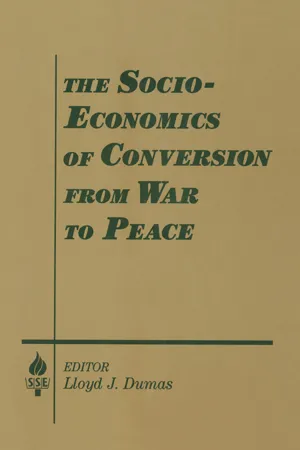
The Socio-economics of Conversion from War to Peace
About this book
This text discusses the economic, social and political implications of redirecting labour and capital from a military-based to a post-Cold War economy.
Part I
The Underlying Issues
1
Finding the Future: The Role of Economic Conversion in Shaping the Twenty-first Century
Expenditure, Investment, and Military Spending
After more than a decade of rapidly increasing federal budget deficits under administrations claiming to be fiscally conservative, it is no wonder that by the mid-1990s, the general public had become suspicious of deficit-reduction proposals. To avoid further antagonizing the public in this environment of skepticism and mistrust, Democrats and Republicans outdid themselves (and each other) in proposing budget cuts intended to show their determination to limit tax increases. Having more than quadrupled the national debt between 1980 and 1992, the United States clearly could not indefinitely continue to run up the national MasterCard bill. So there was tremendous pressure from all sides to narrow the gap between federal revenues and outlays, and at least to slow the rate of increase in the national burden of debt.
In all of this, two critical matters seem to have been lost: (1) the key economic difference between expenditure and investment; and (2) the enormous excess in the military budget.
In general, there is little or no distinction in government budgeting between expenditures and investments. A dollar of outlay is a dollar of outlay. Yet, from an economic point of view, expenditures and investments are entirely different. Expenditures are outlays that exchange money (or other resources) for goods and services that accomplish a particular present goal. After the money has been paid out and the goods and services received, the transaction is over. Investments, however, are outlays of current resources made in the hope and expectation of generating a future return. That is, investments are undertaken not to achieve an immediate goal, but to increase the resources available to the investor in the future.
This distinction is an important part of the difference between an economist’s or enlightened businessperson’s approach to dealing with red ink, and that of an accountant. To an accountant, overcoming deficits—whether in budgets, trade, or balance of payments—calls for reducing outflows and increasing inflows. It does not really matter which outflows are reduced or which inflows are increased. A businessperson or an economist, on the other hand, might recommend increasing outflows in the form of investments in order to generate much larger future inflows that will turn the deficit into surplus. For example, a retail business that is losing money might be best advised to increase its outlays on advertising in order to build its customer base, rather than simply cutting staff. As the saying goes, “You have to spend money to make money”—that is, as long as the “spending” is in the form of investment.
During the long Cold War, the military budget was the largest single category of federal expenditure on goods and services. For nearly half a century, with the armed might of a rival military superpower as a foil, the budget supported a large military establishment, serviced by an unparalleled system of laboratories and industrial facilities. The military budget is an expenditure, not an investment. As such, it had a particular though vaguely defined goal, to provide for the nation’s security. Now the Cold War is over, the Soviet Union is no more, and the United States is the only global military superpower.
Although much has been made of the threats of international terrorism and Third World conflict by those who seek to maintain as large a military as possible, these threats, such as they are, were no less serious before the demise of the Soviet Union. The “Soviet threat” was indisputably the main driver and rationale for those huge Cold War budgets, and it no longer exists. Thus, apart from the issue of whether there was ever any justification for the huge military budgets that characterized the Cold War, it is inconceivable that the continuation of military spending at anywhere near that level is justifiable today. Furthermore, many large and expensive military systems, from the MX missile to the B1 (and B2) bomber to the Trident submarine, have absolutely no relevance to dealing with Third World conflict or international terrorism.
Arguments for an even-handed approach to budget reduction, balanced between military spending and domestic programs, are simplistic and make no sense. They are appealing because they have the appearance of fairness. But fairness is not the issue. Fairness may be an appropriate criterion for judging what levels of support make sense for programs of income transfer that benefit one or another segment of the population, but it is wholly inappropriate in the case of mission-oriented programs such as education, roadbuilding, or the military. Within the bounds of affordability, levels of support for the military should be based on what is needed to achieve the mission of securing the nation against real and significant external military threats. According to such a criterion, disproportionately large cuts in the military budget are entirely sensible and justifiable. That is not a matter of ideology, it is a matter of common sense.
This situation does not call for 5 or 10 percent cuts in military spending. A military budget no larger than half, and probably more like a quarter to a third of the Cold War average, properly spent, will give us a military force strong enough to provide as much security as military forces are capable of providing in the present and foreseeable future. In any case, by some estimates more than half the United States’ Cold War military budget was designed to defend other nations with standards of living comparable to our own, against a threat that no longer exists. Why then, even with all the pressures to cut the federal budget deficit, are we so reluctant to recognize the enormity of excess in present military expenditures and to do what so obviously needs doing?
This is a classic case of a set of vested interests resisting every attempt to move decisively into the future. These interests have become so intertwined with the existing political and socioeconomic structure that it is extremely difficult to disentangle them. Like a tumor that has attached itself to the body’s vital organs, it cannot be safely removed by simply chopping it away. It must be detached with the care and precision of a skilled surgeon’s knife. Rough across-the-board policies will not work. Generalized macroeconomic stimulation is not the answer. Achieving the real benefits of the long-promised peace dividend is not merely a matter of changing some programs or shifting piles of money around, it is a matter of fundamental structural change. It requires a well-thought-out, careful structural approach.
Economic conversion is just such a careful structural approach. Conversion reaches into the economy and redirects human and capital resources from military to civilian-oriented activity. It involves the retraining and reorientation of work forces and the restructuring of organizations and facilities that have been serving the military sector so that they can efficiently produce civilian goods and services. It is a way of reassuring the individuals, companies, and communities whose income, profits, and economic base are currently locked into the military system that the realization of the dream of peacefully ending the Cold War need not be the beginning of an economic nightmare for them. It is a way of removing obstacles to change, of helping them let go.
But it can be much more than that. Economic conversion can play a critical role in directing key economic resources to the kinds of investment that are so important to rebuilding the competitiveness of U.S. industry and generating real economic growth that can help put an end to our trade and budget deficits. To fully understand why conversion is at the fulcrum of this important change of direction, it is first necessary to understand why the military budgets of the Cold War were so peculiarly damaging to our economic well-being.
Military Spending and Economic Decay
The predominant view among economists is that money value is the arbiter of economic value. As a reflection of this, the most commonly used measure of the total economic output of a society, the gross national product (GNP) (or its close relative, the gross domestic product—GDP), includes only goods and services for which money has been paid. That goods and services produced without money exchange (for example, within the household) can be useful is not denied. But they are clearly not considered part of the “economy,” and are therefore not counted as part of economic output. On the other hand, all goods and services (that are legal) for which money has been paid are part of economic output, whatever their function or purpose. If the economy is defined as the system of production and exchange of goods and services for money, then money value is the appropriate arbiter of economic value. This is not, however, the most useful or insightful way to define economic activity.
It is more productive to define the economy as that part of the society whose central function is to provide material well-being. It generates and distributes both the goods and services that directly satisfy material needs (i.e., consumer goods, such as televisions and furniture) and the means required to supply them (i.e., producer goods, such as metal-cutting machines and industrial furnaces). This definition of the economy means that money value is no longer the same as economic value. The proper criterion of economic value becomes the extent to which a good or service contributes to material well-being. A bookcase made at home is just as much a part of economic output as a comparable bookcase bought from a furniture store. Whether or not it has money value, any activity that results in such a good or service contributes to the economy’s goal of improving material well-being. Therefore, it makes sense to call that activity economically “contributive.”
On the other hand, not all goods and services with money value add to the material standard of living. Some goods and services are created to satisfy other human wants and needs. Churches are not constructed and bibles printed to provide material well-being, but to help fulfill the need for spiritual guidance; courthouses and law books are not aimed at increasing the material wealth of society, but at providing political order and control; battle tanks and missiles do not themselves add to the material standard of living, they are produced to enhance physical security. Though these goods may carry a very hefty money price, and may be very useful for the purposes they serve, they do not directly contribute to the central purpose of the economy and so do not have any economic value. It is logical, then, to classify activities that result in goods or services that do not have economic value as economically “noncontributive.”1
Although noncontributive activities are without economic value, to the extent that they use productive resources they do have economic cost, in terms of opportunities foregone. In other words, the economic cost of a noncontributive activity is measured by the economic value that could have been created by using the same labor, machinery, and equipment to produce goods and...
Table of contents
- Cover
- Half Title
- Title Page
- Copyright Page
- Table of Contents
- List of Tables
- Preface
- Introduction
- Part I: The Underlying Issues
- Part II: Conversion and Adjustment Experience in the United States
- Part III: Conversion and Public Policy
- Part IV: Conversion in the Former Socialist Countries
- Index
- Contributors
Trusted by 375,005 students
Access to over 1.5 million titles for a fair monthly price.
Study more efficiently using our study tools.
Frequently asked questions
Yes, you can cancel anytime from the Subscription tab in your account settings on the Perlego website. Your subscription will stay active until the end of your current billing period. Learn how to cancel your subscription
No, books cannot be downloaded as external files, such as PDFs, for use outside of Perlego. However, you can download books within the Perlego app for offline reading on mobile or tablet. Learn how to download books offline
Perlego offers two plans: Essential and Complete
- Essential is ideal for learners and professionals who enjoy exploring a wide range of subjects. Access the Essential Library with 800,000+ trusted titles and best-sellers across business, personal growth, and the humanities. Includes unlimited reading time and Standard Read Aloud voice.
- Complete: Perfect for advanced learners and researchers needing full, unrestricted access. Unlock 1.5M+ books across hundreds of subjects, including academic and specialized titles. The Complete Plan also includes advanced features like Premium Read Aloud and Research Assistant.
We are an online textbook subscription service, where you can get access to an entire online library for less than the price of a single book per month. With over 1.5 million books across 990+ topics, we’ve got you covered! Learn about our mission
Look out for the read-aloud symbol on your next book to see if you can listen to it. The read-aloud tool reads text aloud for you, highlighting the text as it is being read. You can pause it, speed it up and slow it down. Learn more about Read Aloud
Yes! You can use the Perlego app on both iOS and Android devices to read anytime, anywhere — even offline. Perfect for commutes or when you’re on the go.
Please note we cannot support devices running on iOS 13 and Android 7 or earlier. Learn more about using the app
Please note we cannot support devices running on iOS 13 and Android 7 or earlier. Learn more about using the app
Yes, you can access The Socio-economics of Conversion from War to Peace by Lloyd J. Dumas,Amitai Etzioni in PDF and/or ePUB format, as well as other popular books in Economics & Labour Economics. We have over 1.5 million books available in our catalogue for you to explore.