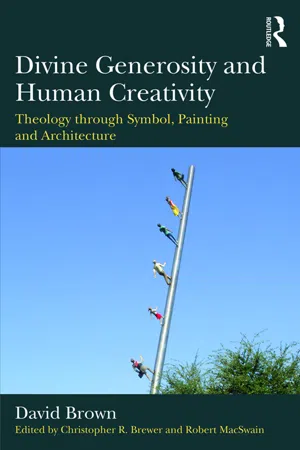
Partly in a desire to defend divine freedom and partly because it is seen as the only way of preserving a distinctive voice for theology, much contemporary theology has artificially restricted revelation and religious experience, effectively cutting off those who find God beyond the walls of the Church. Against this tendency, David Brown argues for divine generosity and a broader vision of reality that sees God deploying symbols (literary, visual and sacramental) as a means of mediating between the divine world and our own material existence. A sustained argument for divine interaction and more specifically the ways in which God speaks in the wider imaginative world, this volume calls for a careful listening exercise since symbols are richer and more open in their possibilities than their users often suppose. Not only is this true of the imagery of Scripture, even inanimate objects like buildings or hostile but creative artists can have important things to say to the believing Christian. An ideal introduction that also moves the conversation forward, this volume addresses foundations, the multivalent power of symbols, artists as theologians and meaning in religious architecture.
eBook - ePub
Divine Generosity and Human Creativity
Theology through Symbol, Painting and Architecture
- 208 pages
- English
- ePUB (mobile friendly)
- Available on iOS & Android
eBook - ePub
Divine Generosity and Human Creativity
Theology through Symbol, Painting and Architecture
About this book
Trusted by 375,005 students
Access to over 1.5 million titles for a fair monthly price.
Study more efficiently using our study tools.
Information
Part I
Foundations
Introduction
In contemporary teaching of Christian doctrine in seminaries and universities the earlier term ‘dogmatic theology’ has been largely replaced by ‘systematics’ or ‘systematic theology’, with the emphasis clearly on the notion of Christian belief as a series of interconnected ideas that can be seen as an overall, coherent system for viewing the world and God’s relation to it. This move has brought undoubted benefits but there has also been a price to pay, in the uncoupling of any tight connection with other parts of the discipline of theology and, more relevant here, with questions of impact on actual Christian living and practice. Thus it is surely no accident that the rise in systematics has gone with a corresponding decline in study of worship and preaching, with liturgy now almost unknown as an academic discipline in British universities, though the history of spirituality fares somewhat less badly. Where the situation has changed for the better in both British and American universities is in an increasing interest in the arts, with a number of centres focusing sometimes on the arts in general but, more commonly, on one or another in particular (for example, literature, film or the visual arts).
Yet to my mind the process has still not gone far enough, for the assumption still prevails that the role of the arts can be at most illustrative and not innovative, that is, with their contribution perceived as entirely subject to conclusions that have been reached elsewhere. This is no doubt why some of my friends or erstwhile colleagues judged my move to writing about the arts as also a move to the margins of theology. As Brian Hebblethwaite kindly, though revealingly, observed of a recent book of mine on the incarnation, ‘Brown’s return to mainstream Christian theology is greatly welcomed.’1 But it is precisely that assumption that I wish to challenge in this book, not only with regard to contemporary reflection but also in terms of how the entire history of divine interaction with the world should be viewed. Even in the period prior to the growth of modern scholarship about origins of Scripture, there were clear signs of the divine address being wider than the people of Israel or the later Church. Why else does the Bible open with the creation of the world, while periodically we find interactions extending well beyond the community of faith, as in the stories of Balaam’s ass and Job, or again in the rebuke to Jonah for his attitude to the people of Nineveh.2 Equally, in the New Testament Jesus is shown engaging with those of quite different cultural and religious assumptions, among them Roman soldiers and other foreigners, while the declaration that ‘God so loved the world …’ suggests a generosity of concern that might well see in those wishing to confine the divine address to Scripture a similar misuse of the keys to knowledge condemned by Jesus.3 That said, such considerations are surely greatly strengthened by the discoveries of modern scholarship, where Israel is seen developing its faith not in isolation from surrounding cultures but in interaction with them.4 In other words, it was by listening, however implicitly, that perspectives were broadened and new discoveries made, in everything from monotheism to life after death.5 This is not to suggest simple dependence. The community of faith then shaped such beliefs to their own experience and understanding of God. But it is to acknowledge a debt, and in large part that seems to have been mediated imaginatively. That is to say, it was through the myths and metaphors and ritual practices of the surrounding cultures being adapted and transformed that our own particular inheritance of faith was created. It therefore behoves us as present-day Christians to continue to pay heed to how God might be speaking to us not only through the Bible and Church but also in the wider imaginative world where God continues to be at work, even if seldom adequately acknowledged.
To see how such claims might be worked out in practice, the reader could turn either to my five volumes written for Oxford University Press between 1999 and 2008,6 or, more quickly though on a narrower range of issues, to Parts II through IV of this work, where examples from the power of symbols (Part II), artists as theologians (Part III) and meaning in religious architecture (Part IV) are all addressed. The essays in each section derive from a number of different sources. Some could have been easily accessed elsewhere, but for the most part they consist of papers published in some specialised forum, invited lectures appearing here for the first time, or material specially written for the occasion. All have been revised to ensure an integrated volume that can be read consecutively. In deciding what to include and in ensuring a form suitable for publication I have been greatly helped by the two editors, Chris Brewer and Rob MacSwain, former research students of mine now working in the United States, who have made what could have proved a rather tedious task a delight as friendly critique and alternative directions were proposed. I am most grateful to them both.
Two-thirds of Part I is published here for the first time, a matter of some importance as it is here that the question of foundations is most directly addressed. While the third essay seeks to provide specific examples of the divine at work beyond the explicitly Christian, the first two are more theoretical. The second is perhaps the more ambitious of the two in that it seeks to replace customary philosophical groundings of theology with various artistic and imaginative arguments. However, the essay ‘In the Beginning was the Image’ is placed first because it presents more conventional types of foundation, in appeals to Bible and experience. I hasten to add that this title is not intended to challenge one of the most profound verses in the Bible but rather how it has so often been interpreted, for it cannot be denied that in its long history there has been no shortage of theologians ready to declare that Christianity is essentially a religion of the word. While primarily true, the actual strength of the contention is easily exaggerated. So that essay begins by pointing out the various ways in which all the arts can lay claim to a biblical foundation, with even ‘word’ itself in a scriptural context closer to a form of art than to the sort of words that find their proper place in philosophical or scientific treatises.7 The second half of the essay then goes on to indicate what Christianity has lost by retreating from the once intimate connection between religion and the arts, where Christian belief found fresh grounding in the experiences of almost every aspect of life. Consideration is also given to the question of what can be done to reactivate some of the power to nourish and inspire the community of faith that such experience once brought.
The second essay then turns to still deeper questions about the nature of doctrine as such, and offers four arguments for believing that, so far from any art, insofar as it is legitimate, being entirely dependent on theology, theology itself actually needs the arts, if it is adequately to secure its own intellectual foundations in the changed climate of modernity. Four changes in particular are discussed: the collapse of the traditional arguments for God’s existence, decline of belief in dualist accounts of an immaterial human soul, acceptance of cultural conditioning and strict limits to human knowledge. The final essay then returns to a theme already implicitly raised in the opening essay, the question of whether what is fed back from the arts need also in itself always be explicitly Christian. Perhaps ‘Learning from Pagans’ is an unnecessarily provocative title but its choice was intended to draw attention to the issue of what implications may be drawn from the openness of divine action as mediated through the arts. If the divine intention was to open people to the possibility of experiencing God or, if not that, at the very least some form of related aesthetic experience, then it would seem reasonable to expect that, even where God remains unacknowledged, something of his mind and purposes might still shine through. So I end this part of the book as I began, with a generous God seen at work in human creativity that always bears the potential to speak of the divine, and sometimes does indeed do so.
Notes
1In his generous endorsement of Divine Humanity (London: SCM; Waco, Tex.: Baylor University Press, 2011).
2Balaam was probably a prophet from Ammon (so the Samaritan Pentateuch for Numbers 22:5), while the Uz of the opening verse of Job is sometimes identified with Edom but perhaps more commonly as existing beyond the Euphrates, as in the Dead Sea War Scroll.
3Luke 11:52; Matthew 23:13.
4See, for example, Kenton L. Sparks, Ancient Texts for the Study of the Hebrew Bible: A Guide to the Background Literature (Peabody, Mass.: Hendrickson, 2005); or for the much later influence of Greek culture, Erich S. Gruen, Heritage and Hellenism: The Reinvention of Jewish Tradition (Berkeley: University of California Press, 1998).
5Both notions occur elsewhere in the Middle East before their first appearance in Israel.
6Tradition and Imagination (Oxford: Oxford University Press, 1999); Discipleship and Imagination (Oxford: Oxford University Press, 2000); God and Enchantment of Place (Oxford: Oxford University Press, 2004); God and Grace of Body (Oxford: Oxford University Press, 2007); and God and Mystery in Words (Oxford: Oxford University Press, 2008). For commentary on and critique of these five volumes, see Robert MacSwain and Taylor Worley, eds, Theology, Aesthetics, and Culture: Responses to the Work of David Brown (Oxford: Oxford University Press, 2012).
7And so appropriate justifications extend well beyond traditional appeals to Bezalel and Oholiab: Exodus 31:1–6 and 35:30 to 36:1.
1In the Beginning Was the Image
This essay proceeds by two stages. The first is concerned to challenge the common Protestant assumption that the role of the arts within Christian faith cannot pretend to any deep basis in the biblical foundations upon which such faith is based. So used are we to hearing the claim that Christianity is a religion of the word that it is very easy to assume that this is the only lens through which scripture should be read, not least when we recall the attack on images in the second commandment and the apparent abandonment of refined architecture and music with the move away from the Jewish Temple. But such assertions, as we shall see, conceal a more complex and interesting reality that fully legitimates a biblical foundation to whichever of the arts we may wish to consider.
The first part of my discussion will have argued for a much deeper foundation for the arts in biblical revelation than is commonly acknowledged even among the arts’ advocates, with the Bible now seen as itself a literary work of art, the incarnation functioning as a visual image for God, and music a potential vehicle for divine presence. That perspective is then widened to detect similar patterns across all of human experience, with the arts containing real sacramental potential for such encounters. Admittedly, over the centuries theology gradually retreated from any proper consideration of such possibilities. While noting some of the reasons for this retreat (good as well as bad), I shall argue that the move was decidedly on balance a mistaken one. I end, therefore, by exploring what it might mean for theology once more seriously to re-engage ...
Table of contents
- Cover
- Endorsement
- Half Title
- Title Page
- Copyright Page
- Contents
- Editor’s Introduction
- Part I Foundations
- Part II The Power of Symbols
- Part III Artists as Theologians
- Part IV Meaning in Religious Architecture
- Index
Frequently asked questions
Yes, you can cancel anytime from the Subscription tab in your account settings on the Perlego website. Your subscription will stay active until the end of your current billing period. Learn how to cancel your subscription
No, books cannot be downloaded as external files, such as PDFs, for use outside of Perlego. However, you can download books within the Perlego app for offline reading on mobile or tablet. Learn how to download books offline
Perlego offers two plans: Essential and Complete
- Essential is ideal for learners and professionals who enjoy exploring a wide range of subjects. Access the Essential Library with 800,000+ trusted titles and best-sellers across business, personal growth, and the humanities. Includes unlimited reading time and Standard Read Aloud voice.
- Complete: Perfect for advanced learners and researchers needing full, unrestricted access. Unlock 1.5M+ books across hundreds of subjects, including academic and specialized titles. The Complete Plan also includes advanced features like Premium Read Aloud and Research Assistant.
We are an online textbook subscription service, where you can get access to an entire online library for less than the price of a single book per month. With over 1.5 million books across 990+ topics, we’ve got you covered! Learn about our mission
Look out for the read-aloud symbol on your next book to see if you can listen to it. The read-aloud tool reads text aloud for you, highlighting the text as it is being read. You can pause it, speed it up and slow it down. Learn more about Read Aloud
Yes! You can use the Perlego app on both iOS and Android devices to read anytime, anywhere — even offline. Perfect for commutes or when you’re on the go.
Please note we cannot support devices running on iOS 13 and Android 7 or earlier. Learn more about using the app
Please note we cannot support devices running on iOS 13 and Android 7 or earlier. Learn more about using the app
Yes, you can access Divine Generosity and Human Creativity by David Brown, Christopher R. Brewer,Robert MacSwain,Christopher Brewer, Christopher R. Brewer, Robert MacSwain in PDF and/or ePUB format, as well as other popular books in Theology & Religion & Religious Architecture. We have over 1.5 million books available in our catalogue for you to explore.