- 325 pages
- English
- ePUB (mobile friendly)
- Available on iOS & Android
eBook - ePub
About this book
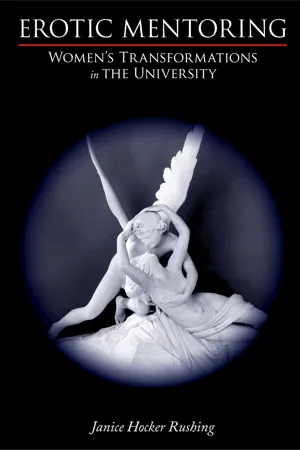
They're everywhere in the academy: young, bright women mentored by older scholars, usually men, who attempt to mold them into their own masculine ideals. Janice Hocker Rushing's study of over 200 women and their life transformations is the subject of this eloquent book. Using the tropes of mythology and Jungian psychology, the author characterizes the many paths these women's academic lives take: as Muse for a faltering older scholar, as Mistress or wife, as the dutiful academic daughter. Their resistance to this power differential also takes many forms: as a Veiled Woman, silent in public but active in private, or the Siren, using her sexuality to beat the system. Ultimately, Rushing arrives at the myth of Eros and Psyche, where women's self understanding and personal development turns her erotic mentoring into an autonomous, whole, and free life, unfettered by any man. These women's stories and Rushing's literary and literate framing of their lives will ring true to many in the university.
Information
Part One
The Man-Made Maiden
Women often form personal relationships in academia with men who attempt to mold them to fit their own masculine ideals. Such relationships quickly became a dominant leit-motif in my conversations with women. Partly because the higher ranks in academia are still overwhelmingly populated by men, many romantic pairings still occur between an older man, such as a professor, and a younger woman, such as a student or assistant professor. The pivotal myth that helps enlighten such relationships is "Pygmalion and Galatea," the story of a beautiful woman sculpted by the hands of an exacting master who falls in love with her. What I have called the "Maiden Lover" springs from the romantic love between Pygmalion and his Galatea.
Galatea also blends her voices with those of other mythological characters in the women's stories. The "Muse" aestheticizes romance, inspiring the man to re-create himself, often giving her own poetic powers over to him. Pygmalion owns the "Mistress" as an object of his physical pleasure, and she tends to lose her creative self to his attempts to dominate her. Pygmalion, or more centrally, Zeus, gives birth to an Athenian "Brainchild" as a perfect mirror image of his masculine intellect—one unstained by the messiness that is the feminine flow of life. These four voices—Maiden Lover, Muse, Mistress, and Brainchild—take their names from the man's projections onto the woman—that is, they are more the reflections of his search for his own soul than they are the woman as she is herself. She may identify with a role and try to live it out, project her own complementary image onto him, or reject his demands and struggle to define herself. Together, these roles narrate a progression front incipient radiance to loss of self, although not everyone I interviewed went through all the phases, or in this order.
Chapter 1
Alma Mater
Al'ma Ma'ter [L. alma mater, bounteous mother.] A title given by the Romans to several goddesses, especially to Ceres and Cybele, and transferred in Eng. to Universities and schools regarded as "fostering mothers" to their alumni.
Oxford English Dictionary
When I was four, I had a ritual I performed exactly the same way each time, never missing a step, as if my life depended on it. I would remove the drawers from the small painted chest holding my clothes in the bedroom my older sister and I shared. Placing a pillow and a blanket in the bottom and lining the back and sides with Little Golden Books, I climbed inside and spent blissful hours reading, away from whatever cares might have troubled a prekindergartner. In the words of my father's favorite song, I "let the rest of the world go by."
My family did me the great honor of taking this observance seriously. My sister Joyce, herself an astonishing reader who carried home her quarry from the public library in an orange crate each week, never ridiculed me, even though this bureau held her clothes too. When asked why I wasn't at the dinner table, she would say "Janice can't come, she's in the chest." They simply resumed the meal without me, perhaps understanding that this particular hiding place was my temple, a sacred space, an alma mater where my love of learning could be felt body, mind, and soul. Virginia Woolf could have a room of her own; I wanted a chest of drawers, and this one fostered me like any good mother would. It was my first school.
While writing my PhD dissertation a couple of decades later, I became a "freeway professor*" driving to the furthest reaches of greater Los Angeles to teach classes at three different colleges. This was not the life of the mind, but the grind of the road; not the Ivory Tower, but a fast-imploding Edsel. My first husband traded his piano to an Indian for this car while driving down a back road in New Mexico. He kept a screwdriver under the floor mat for when the gear shift lever came off in my hand between first and second, which was often enough. My favorite songwriter Guy Clark's "If I could just get off of this L.A. freeway/Without getting killed or caught" became my eight-track refrain. At least as a graduate student at the University of Southern California, I had been able to wait out the freeway hours with my peers and professors at the 901 Club, a foul-smelling bar held together with duct tape and chewing gum. The pitchers were lite, the conversations heavy, and the drunk pissing just outside the screen door lent an odor of solidarity with the oppressed that complemented our awakened leftist sensibilities. Now, here on the 405,1 yearned for the ivy-covered walls that were my birthright.
Miraculously, I landed a full-time job at UCLA the next year. I was only a lecturer with no prospect of tenure, and my first assignment was teaching the introductory course in Communication Studies to five hundred students. "Comm 10," as it was called, had become a monster draw because its first teacher, the wife of a famous Hollywood producer, had the performance skills and timing of Richard Pryor. Facing a disappointed ocean of faces from an elevated stage and trying not to trip over the microphone cord, I heard my opening joke fall flatter than the Texas Panhandle. It was going to be a long quarter. But I soon learned from my more-experienced TAs that "teaching is the lowest form of showbiz," and I slowly improved. Unaware that Proposition 13 would soon cost me my job, I had begun to realize my dream. Walking one perfect day from Royce Hall to the student union across expansive lawns connecting the archetypally collegiate buildings, I felt I was in one of those Hudson River Valley paintings where the beneficence of God shines down through the clouds, surrounding the tiny human figure with an otherworldly column of light. "This is it," I thought. "I've arrived."
I have to admit that not all my academic episodes have been so mystical—even those expressly designed to evoke such a feeling. At the commencement ceremony for my PhD, I sat on the front row of the soon-to-be-hooded elite and threw up, right after "Pomp and Circumstance." The best slant I can put on this is that it was outdoors. The faces on the people sitting next to me struggled between compassion and repulsion, the latter gaining an edge as I helplessly wretched on the green grass of USC. Since I was not sick before or after the exercises, this ill-timed eruption has long been something of a mystery. By all accounts, I had a fulfilling stint in graduate school, despite the inevitable stresses of concentrating on papers rather than life for five years. So, ruling out medical explanations, I have to entertain the possibility of regurgitation as metaphor. Maybe I was not as completely nourished as I had thought—perhaps not everything I took in agreed with me—and my stomach was suggesting what my mind could not yet entertain.
I have remained in school, on one side of the desk or the other, all my life. Whenever the stacks of papers filling my weekends get thicker than my patience, I consider other callings—practice dummy for a massage therapy school might be nice. But reasoning from sign, perhaps academia is the best place for me. I don't understand the inner essence of Power Point or the profit motive, and nine-to-five would drive me to misdemeanors. I do still love a classroom buzzing with nascent epiphanies, as well as "the life of the mind," even though I often have to trick myself into believing that's more than a platitude.
Even so, higher education has not always been an alma mater, as with each successive grade and professorial rank I learned to separate academic performance from the warmth and safety of my early self-made cave. A critic of popular culture by trade, I am sufficiently versed in the Oedipal complex to know that everyone, even a girl, must inevitably climb out of the womb, separate from a sticky dependence on Mother, and attain a thick enough skin to enter the properly phallic world of the Fathers. Nowhere is this more true than in academia, where to succeed we must engage in single-combat warriorship—grasping for renown by driving a sword into the scholarly contributions of another and producing prominent protégés who will carry on our legacies for at least a few years before doing the same thing to us.
I have managed these initiation-into-manhood tasks reasonably well. But now that I am a full professor they are not sustaining me in this second half of life. It is painful to realize that academia envisions the mother image, not as a secure foundation, but as a hazardous trap that should be buried by the Ivory Tower, altogether and for good. We may sing the alma mater tearfully at football games, but it is not the main event. Somewhat rankled herself about the status of the maternal, Simone de Beauvoir once wrote, "Man is in revolt against his carnal state, he sees himself as a fallen god: his curse is to be fallen from a bright and ordered heaven into the chaotic shadows of his mother's womb."1
At the university this fear of things feminine remains, despite the considerable advances of feminism. After all, as Jean Markale points out, Plato's Allegory of the Cave, a pillar of the academy's philosophy "portrays men as prisoners chained up in a cave, their backs turned towards the entrance so that they cannot see the reality of the outside world except as shadows on the opposite wall." Water castles and caves are, in fact, some of the most common symbols for the womb in mythology.2 They are the perpetual dwelling places of dangerous and alluring figures, those who once were princesses and queens, but later got demoted into witches and sirens. I was as impressed with Plato's parable as anybody else when Professor Gus Ferre, a brilliantly wild-eyed Swede, told it to us in freshman philosophy with a tone both reverential and ecstatic. We knew the code: if he gestured hazardously with his glasses and his yellow hair rose impossibly from his six-inch forehead, it was going to be on the test. Surely, this is a great meditation on the veils of Maya that separate us from the truth of existence. But could it also be significant that Plato represents illusion in terms of the mythic feminine—as the snare of the enlightened man?
This book is about my experiences as a woman in academe—mostly as a professor, but reaching back for perspective into grade school and forward through college and graduate school. It is also about other women's experiences, some of which I have observed on my own and many that they have told me. I have found that our stories must be buried in order for us to be "successful." Certainly they should be hidden from those who evaluate us and whose esteem we seek, but also from ourselves. It is too hard to succeed, especially on a tenure track, when we allow our USD A non-approved "feminine" lives to intrude on this tightly constrained path. Like bulges of unsightly fat, they must be exercised away or squeezed into Body by Victoria.
But traces of what we've kept in the dark come to light in our night dreams, our longings, our bodily eruptions, and our emotional rebellions. Sometimes we surreptitiously air our misgivings to each other in the hallways—like last week when three of us profs spontaneously lamented our chronic insomnia and the next day exchanged remedies tightly wrapped in foil. Or we type our dis-ease on e-mail, where we can pepper it with expletives and feel a semblance of insurrection. For the most part, however, we stay under control, couching even our feminism in ready-lor prime time terms, acceptable to refereed journals and university presses.
Some have published eloquent first-person accounts of their navigations through academia and relationships to people within it; a few who I have found inspiring are bell hooks' Teaching to Transgress: Education as the Practice of Freedom; Carolyn Ellis' Final Negotiations: A Story of Love, Loss, and Chronic Illness; Jane Tompkins' A Life in School: What the Teacher Learned; and Arthur Bochner's "It's About Time: Narrative and the Divided Self."3
At first I thought I'd better read everything relevant, and as friends discovered what I'm writing about they helpfully suggested more titles. Assuming I could actually accomplish this, though, I'd probably never get around to writing myself. I also didn't want, as my husband Tom puts it in his Research Methods seminars, to "sew a new teat on the udder of knowledge" because, in academic conventions, this means you need to savage someone else (see above on the "single-combat warrior"). One of Tom's graduate students actually did this—sewed on a new teat, that is. She presented him with a perfectly stitched pillow, a satin cow's udder with four attached teats in light pink and one in bright fuchsia; across the surface she had printed in large block letters, udder of knowledge. It is his favorite visual aid. Whenever I pass by Tom's classroom and see him earnestly explaining this to his red-faced students, I still think about her subtle feminization of the ritual by which one cements one's study atop the road-kill of somebody else's. Or, in the words of Abby, a professor who was thinking of quitting her job as director of a large research center, "Writing a research article is so penetrative: you have to find a hole and fuck it!"
"All the good stories are out there waiting to be told in a fresh, wild way," Anne Lamott says about writing. "Life is like a recycling center, where all the concerns and dramas of humankind get recycled back and forth across the universe. But what you have to offer is your own sensibility, maybe your own sense of humor or insider pathos or meaning. All of us can sing the same song, and there will still be four billion different renditions."4
Maybe I'm not absolutely free of guilt over not providing a complete literature review; as a student I never failed to turn in my home work—not even once. Or perhaps by the time I get to the end of these pages, I will mercifully give it a rest. You can decide which is appropriate. Meanwhile, I'll proceed with my "archaeological" project—an attempt to dig up shards of what lies beneath the surface, piece them together into whole figurines, and make inferences about a culture that still remains mostly in the dark.
I am concerned here with what are often considered "feminine" ways of valuing and knowing that are absent from the collective vision of academe. The book is about women, but I hope to also touch what men call, usually with self-reassuring mockery, their "feminine sides"—what they, too, have to suppress in order to make it in this manly arena. And it is more generally about an absence of feminine soul in the academy as an institution. I believe academia is ailing from its one-sided insistence on rationality and intellect, like the Fisher King whose groin wound festers while his kingdom dries up into a Wasteland. The Ivory Tower is all "up" and no "down." The "scholarly" and the "collegiate" depend upon the suppression of what lies beneath, which is, ironically, the very thing that could coax it to life. But mostly, I'd just like to help real women I know and some I don't to have an easier time of it at the university.
Floating
This is the place in the introduction where, as a good academic, I should tell you how I went about my work. I will do that, but in a bit of a roundabout way, since that is how this book came about. When I hit mid-life at the same time as I published a book and made full professor, I crashed hard, finally realizing what a product of the academic patriarchy I was, working almost all the time to prove my worth. My beleaguered body cried "Foul!" at my nonstop pace, as if finally fulfilling the yucky prophecy of my graduation ritual ad museum. I looked back upon the "body of work" that constituted ...
Table of contents
- Cover Page
- Half Title Page
- Title Page
- Copyright Page
- Table of Contents
- Dedication
- Foreword
- Part I: The Man-Made Maiden
- Part II: Fatal Attractions
- Part III: One-In-Herself
- Notes
- Bibliography
- Index
- About the Author
Trusted by 375,005 students
Access to over 1.5 million titles for a fair monthly price.
Study more efficiently using our study tools.
Frequently asked questions
Yes, you can cancel anytime from the Subscription tab in your account settings on the Perlego website. Your subscription will stay active until the end of your current billing period. Learn how to cancel your subscription
No, books cannot be downloaded as external files, such as PDFs, for use outside of Perlego. However, you can download books within the Perlego app for offline reading on mobile or tablet. Learn how to download books offline
Perlego offers two plans: Essential and Complete
- Essential is ideal for learners and professionals who enjoy exploring a wide range of subjects. Access the Essential Library with 800,000+ trusted titles and best-sellers across business, personal growth, and the humanities. Includes unlimited reading time and Standard Read Aloud voice.
- Complete: Perfect for advanced learners and researchers needing full, unrestricted access. Unlock 1.5M+ books across hundreds of subjects, including academic and specialized titles. The Complete Plan also includes advanced features like Premium Read Aloud and Research Assistant.
We are an online textbook subscription service, where you can get access to an entire online library for less than the price of a single book per month. With over 1.5 million books across 990+ topics, we’ve got you covered! Learn about our mission
Look out for the read-aloud symbol on your next book to see if you can listen to it. The read-aloud tool reads text aloud for you, highlighting the text as it is being read. You can pause it, speed it up and slow it down. Learn more about Read Aloud
Yes! You can use the Perlego app on both iOS and Android devices to read anytime, anywhere — even offline. Perfect for commutes or when you’re on the go.
Please note we cannot support devices running on iOS 13 and Android 7 or earlier. Learn more about using the app
Please note we cannot support devices running on iOS 13 and Android 7 or earlier. Learn more about using the app
Yes, you can access Erotic Mentoring by Janice Hocker Rushing in PDF and/or ePUB format, as well as other popular books in Psychology & Research & Methodology in Psychology. We have over 1.5 million books available in our catalogue for you to explore.