eBook - ePub
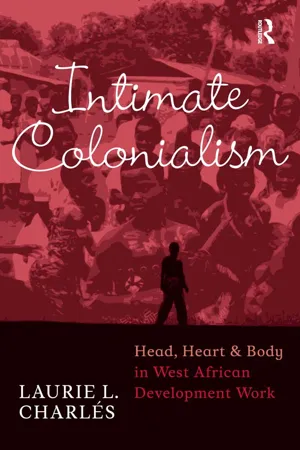
Intimate Colonialism
Head, Heart, and Body in West African Development Work
- 256 pages
- English
- ePUB (mobile friendly)
- Available on iOS & Android
eBook - ePub
About this book
Laurie Charlés finished her Ph.D., then took off to West Africa as a Peace Corps volunteer. Asked to create programs to help adolescent girls stay in school, she found herself enmeshed in the politics and cultural barriers that prevent these girls from creating a better life. But that was not all that was enmeshed. Charlés found love, sexual fulfillment, sexual harassment, and gender discrimination, all of which further complexified her stated mission. Her candid assessment of life and work in Africa, the intimate relationships that gave hope to the possibility of change, the emotional and physical highs and lows that affected her ability to function, all become factors affecting her success in improving the lives of African girls. This eloquent narrative should be of interest both to those doing development work and to those interested in autoethnographic exploration of the self.
Information
Chapter 1
A Question of Mentalité
Maman Diore looks me right in the eye and explains, “When wives tell their polygamous husbands that they shouldn’t go out with other women because they will get le SIDA (AIDS), the men may think that the wife is jalouse (jealous). It’s a problem of mentalité,” she says. “Men think only of eux-mêmes (themselves), not of the kids, or of SIDA. They do not understand and they do not want to understand. They think only of eux-mêmes.”
Maman speaks with great determination and, at the same time, a hint of resignation. She also speaks very slowly for me. Although I now study between three and six hours of French every day, I am still a beginner in this language I’ve not practiced since college. I watch Maman’s lips very closely to help decode her French accent as she sums up her points with a phrase I will hear over and over again during my time in Togo: En Afrique, c’est comme ça. That’s how it is in Africa.
As a Peace Corps trainee assigned to the country of Togo, in West Africa, I am also a temporary resident of the town of Kpalimé and a guest of my host family. the Diores, where I have lived now for one month. In another two months, I will be dispatched to my village to launch a new Peace Corps program to improve girls’ education in the developing world. Togo is the first country to have the program; my training group is the first to implement it. “You’ll be pioneers,” my Peace Corps recruiter told me.
Maman’s comments remind me how overwhelmed I am with the subject of men and women—indeed, of the complexity of all issues related to gender—in West Africa. Also overwhelming is the difficulty of grasping these issues in a language not my own. This afternoon what I find most remarkable is that I understand Maman at all—my French has not been good enough to have a real conversation with her until today. Normally, I talk to the Diore family—Maman, Papa, 11-year-old Kuku, 17-year-old Marguerite, and 20-year-old Alix—in the immature French of a child; I am forced to use sign language when I get stuck. Only Marguerite and Papa are fluent in English, however, they refuse to use it with me, so determined they are that I learn French.
In Togo, I soak up all I learn, experience, and witness, through my various identities: circumspect development worker, 30-something Latina1 female, and ethnographic researcher. I am acutely aware (as are the fifty-three other Peace Corps trainees in my staging group) that I have recently earned a doctorate in the field of family therapy.
In this I am not the norm. Most of my fellow trainees have recent bachelor’s degrees. Our first night together in Lomé, Togo’s capital, I must have explained my dissertation—a discourse analysis of a hostage negotiation at a high school—nearly twenty times. Fortunately for me, of the eighteen women I see every day, three are already established professionals, with master’s level graduate degrees, and are also in their mid-thirties.2
Today in our training class Jon, a business volunteer who has already served in Togo for a year, presents a talk on transparent accounting. He makes an interesting comment: “The French education system is one of rote learning. It is didactic. The Togolese, most recently colonized by France, maintain this system. Thus, students learn to mimic what the professor says. They do not learn how to think. It is difficult when they are put in situations where they must think. It’s not done.”
Considering gender roles in Togo from a different angle, Jon says the Togolese women with whom he works may intuitively know things about money, but they have not learned to put patterns together, they can’t analogize. He adds, “Men don’t do commerce here in Togo. Commerce is seen as women’s work.” Jon says if he haggles with a man, the man will say, “We’re acting like a couple of women here.” Not surprisingly, Togolese men don’t work at the marché. The men you do find doing market enterprise are rarely Togolese. Thus Jon works almost exclusively with women.
After dinner one night I have a French lesson with my 11-year-old host sister, Kuku. We go over indirect and direct objects, the passé composé, and le négatif. I try to reciprocate this sweet lesson by teaching her a little English, which she, like many Togolese young people, is so eager to learn. We both laugh when I try to help her with the “th” sounds in Anglais (although, the, fourth) because Kuku cannot make the sound very well; the th sound is foreign to her French tongue. I have the same problem with words like reveillerai, which Kuku tries to teach me to say correctly without much success. My mouth has difficulty with the veill sound in the word; my tongue has not mastered the little curl it must make to say the veill part of reveillarai. The sound does not exist in my English tongue, just as the th does not in Kuku’s French one.
During the lesson, Kuku writes down the following sentence to help me with the conditional tense:
“If she is nice, she’ll marry a rich man.”
I don’t realize that my surprise at the idea shows on my face until Kuku quickly adds C’est ma professeur qui ecrire ça phrase. My teacher wrote that phrase. Then she adds Ce n’est pas vrai. C’est faux. It’s not true. It’s false.
I nod, agreeing with her in halting French. C’est pas une bonne phrase. Not a good phrase.
When I am at home with the Diores, I spend most of my time with Marguerite, Kuku’s 17-year-old sister. Marguerite was given primary responsibility for me by the Diore family for the three months I will stay with them. Marguerite speaks four languages (German, French, Ewé, and English) and plans to be an interpreter for the United Nations. She is assertive and has taken charge of my French lessons at home. We work every evening and weekend on my French.
One day in the marché, on the way home after my day of training, I run into Marguerite and see that she is upset with me. “Why didn’t you come home at lunch? Will you be home by 6? After 6?”
Inwardly, I smile at her indignation but outwardly I match her seriousness. À dix-huit heure, I reply. At six.
J’espère, she says with exasperation. I hope so. Then she bikes away.
Shoshana, a trainee who is with me in the marché, comments that my host sister is feisty. I agree wholeheartedly. When I get home, I delight in trying to explain “feisty” to Marguerite; it is a perfect descriptor for her.
“Shoshana has said something about you for which I must chercher (look for) the translation,” I report. “Feisty” is not in the dictionary, but there is something similar. I tell Marguerite she has fire (feu) in her. Only I mispronounce the word as “foo,” not feu.
Marguerite frowns and says fou means crazy. I find “fire” in the dictionary to show Marguerite. Mollified, she says the word out loud, feu. Then she looks at me, exasperated again, and exclaims, “Your pronunciation!” Feu, comme veut, she says, correcting me again.
I can’t help smiling at this, because Marguerite is being feisty again. Still, I don’t give up. I try to find another, similar word to describe her and look up “attitude.” I tell Marguerite she has etat d’esprit. Marguerite laughs, and her face relaxes. She asks, “Why did Shoshana say this about me?”
“Because of what you said to me at the marché,” I tell her. Marguerite laughs again, and so do I.
My nickname for Solange is La Loi, The Law. Solange is the supervisor of all the Peace Corps language formateurs. (All the language trainers are Togolese.) I love being with Solange. She has a commanding presence; she is beautiful, well-dressed, and large—just as the Togolese expect their women to be. Solange wears her size perfectly, and when she is present it is as if someone famous, someone important—someone to be reckoned with—is in the room. Thus, La Loi.
Solange also tries to perfect my French. She tries to teach me not to pronounce the letters at the end of every word, for instance, to say marchande without pronouncing the “e” at the end. “For example, it’s not Solangeé,” she says. We laugh together. Solange says, J’aime la classe avec Laurie.Je ne sais pas pourquoi! I like the class with Laurie. I don’t know why. We laugh some more.
I realize that Solange has paid me a lovely compliment, both in what she says and the way she says it. Usually she is very serious and does not joke or laugh openly with volunteers. I think Solange appreciates my being near her age, in my thirties, and she likes my sense of humor. Our Togolese instructors have been asked by Peace Corps to refrain from forming personal relationships with us during training, so all of the formateurs remain somewhat guarded behind their big smiles and politesse.
I’ve received many compliments in the last two days, on my clothes, my colors, my legs, and my personality. An especially funny observation comes from our American Peace Corps trainer, Dani, who tells me, “You’re a woman who looks as if she can handle her liquor.” I love that! Cory, a business volunteer, says Larisa (one of the other 30-somethings in the group) and I are awesome because we can admit that we aren’t ready to have children. I love being part of this group of women.

Fifi Rafiatu, a Togolaise chanteuse, is performing in Kpalimé tonight. I take Marguerite and her boyfriend Ahmet, who is 20 years old. Fifi arrives one hour late and sings one song before going back to her hotel for a break. During the interlude, a DJ plays various African dance tapes, and I dance in the back of the hall with some U.S. volunteers. A few young Togolese girls watch us timidly, but we can tell they want to dance. At Fifi’s concert all the men dance, completely free and without timidity, but we avoid them and encourage the girls to join us instead. Dancing freely with them is a lovely experience. Many men try to break us up, but we don’t let them into our little circle.
Maxim and Vincent, two of our formateurs, show up at the concert. I have developed an intense crush on Maxim, as have many of the other volunteers. While I have tried to keep my crush private, other trainees openly swoon, “Maxim! Maxim!” whenever he walks into class. Tall and lean, with a toothy smile and a charming manner, always dressed immaculately and stylishly, Maxim is popular with our all-woman training group. It has been about six weeks since we arrived in Togo. We are missing men and need someone like Maxim to fixate on.
As Fifi returns to the stadium, Maxim catches my eye and waves slightly. In a long-sleeved purple shirt, black slacks, with his shirt slightly unbuttoned, Maxim looks amazing. Just gorgeous. I had seen him earlier in the day, and told him I thought the shirt was cool.
Fifi, about to start her next set, asks four volunteer couples to join her on stage. The man in the aisle behind me, who has been yelling all night for ...
Table of contents
- Cover
- Half Title
- Title Page
- Copyright Page
- Dedication
- Table of Contents
- Cast of Characters
- Introduction
- Chapter 1 A Question of Mentalité
- Chapter 2 The Little Things That Matter
- Chapter 3 One of the Crowd
- Chapter 4 Back in the World of Ideas
- Chapter 5 Lust, Passion, and Tactical Adoration
- Chapter 6 A Change of Future
- Chapter 7 Sex, Love, and Other Demanding Parasites
- Chapter 8 Diplomacy au Village
- Chapter 9 Togo Postscript, Five Years Later
- Chapter 10 Constructing an Intimate Text
- Notes
- References
- Index
- About the Author
Trusted by 375,005 students
Access to over 1.5 million titles for a fair monthly price.
Study more efficiently using our study tools.
Frequently asked questions
Yes, you can cancel anytime from the Subscription tab in your account settings on the Perlego website. Your subscription will stay active until the end of your current billing period. Learn how to cancel your subscription
No, books cannot be downloaded as external files, such as PDFs, for use outside of Perlego. However, you can download books within the Perlego app for offline reading on mobile or tablet. Learn how to download books offline
Perlego offers two plans: Essential and Complete
- Essential is ideal for learners and professionals who enjoy exploring a wide range of subjects. Access the Essential Library with 800,000+ trusted titles and best-sellers across business, personal growth, and the humanities. Includes unlimited reading time and Standard Read Aloud voice.
- Complete: Perfect for advanced learners and researchers needing full, unrestricted access. Unlock 1.5M+ books across hundreds of subjects, including academic and specialized titles. The Complete Plan also includes advanced features like Premium Read Aloud and Research Assistant.
We are an online textbook subscription service, where you can get access to an entire online library for less than the price of a single book per month. With over 1.5 million books across 990+ topics, we’ve got you covered! Learn about our mission
Look out for the read-aloud symbol on your next book to see if you can listen to it. The read-aloud tool reads text aloud for you, highlighting the text as it is being read. You can pause it, speed it up and slow it down. Learn more about Read Aloud
Yes! You can use the Perlego app on both iOS and Android devices to read anytime, anywhere — even offline. Perfect for commutes or when you’re on the go.
Please note we cannot support devices running on iOS 13 and Android 7 or earlier. Learn more about using the app
Please note we cannot support devices running on iOS 13 and Android 7 or earlier. Learn more about using the app
Yes, you can access Intimate Colonialism by Laurie L Charlés in PDF and/or ePUB format, as well as other popular books in Social Sciences & Anthropology. We have over 1.5 million books available in our catalogue for you to explore.