- 208 pages
- English
- ePUB (mobile friendly)
- Available on iOS & Android
eBook - ePub
Triumph and Trauma
About this book
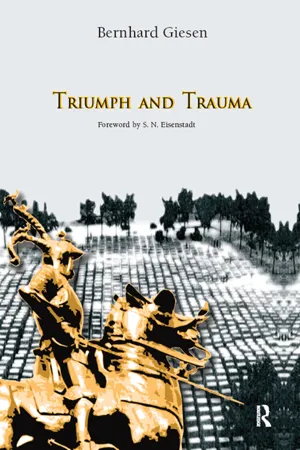
This book deals with triumphant and tragic heroes, with victims and perpetrators as archetypes of the Western imagination. A major recent change in Western societies is that memories of triumphant heroism-for example, the revolutionary uprising of the people-are increasingly replaced by the public remembrance of collective trauma of genocide, slavery and expulsion. The first part of the book deals with the heroes and victims and explores the social construction of charisma and its inevitable decay. Part 2 focuses on a paradigm case of the collective trauma of perpetrators: German national identity between 1945 and 2000. After a time of latency, the legacy of nationalistic trauma was addressed in a public conflict between generations. The conflict took center stage in vivid public debates and became a core element of Germany's official political culture. Today public confessions of the guilt of the past have spread beyond the German case. They are part of a new post-utopian pattern of collective identity in a globalised setting.
Information
Chapter 1Triumphant Heroes
Between Gods and Humans
DOI: 10.4324/9781315631455-2
The Social Construction of Heroes
“No More Heroes” was the title of a famous song of the seventies.1 Indeed, after the war in Indochina the ideal of the hero was widely questioned because of its association with military bravery and virtue. As is not uncommon in the aftermath of war and defeat, those who had been praised as heroes before, were afterwards considered as victims whose self-sacrifice was devoid of any meaning, or they were regarded as perpetrators, as icons of evil, as embodiments of demonic madness. In death and defeat, heroism exhibits its ambivalences, the fragility of its foundations, the tension between trauma and triumph.
The idea of the “hero” as it originated in ancient Greek or Oriental literature,2 was, indeed, associated with the extraordinary deed of the warrior who followed the call of adventure, ventured out into the unknown, withstood tests and temptations and returned full of glory to his people (Campbell 1991, p. 151).3 War represented the fringe of the social order, the challenge of crisis, the frontier against the uncommon and superhuman that could not be dealt with by ordinary means. The heroes Achilles, Hercules and Theseus in ancient Greek mythology were, therefore, imagined as warriors of superhuman force, liminal figures who could cross the boundary between everyday life and the realm of Gods and demons. They were depicted as half-divine, as descendants of a minor Goddess, as tempted by a Goddess in disguise or even as married to a half Goddess.
The idea of the hero, although originally couched in the myth of the warrior, extends, of course, far beyond the battlefields. It is at the core of many charismatic constructions of collective identities. Among the various transformations of the hero described by Joseph Campbell (1971, 1974, 1988), at least one other stands out: the hero as the founder of religion, who retreats from everyday life to meet God in solitude and to bring the new message of salvation back to his people. The Buddha and Moses, Christ and Mohammed are exemplars of these redeeming heroes.
But the idea of the hero has not been confined to warriors or to the founders of religions—the hero has, indeed, “a thousand faces” (Campbell 1974), and the face reflects and expresses a particular cultural foundation of a community. Intellectual heroes like Confucius (Kung fu tse), Plato, Newton and Hegel coined a classical tradition for a community of scholars. Since the eighteenth century, aesthetic heroes like Michelangelo, Shakespeare, Mozart and Goethe have been revered as geniuses whose pathbreaking exceptionalism transcends the level that can be achieved by regular education and common effort—and this cult of the genius responded to the spread of education and enlightenment in the civil society of the eighteenth century. In communities that value compassion and charity, exceptionally altruistic persons like the medieval noblewoman Elizabeth of Thuringia and the contemporary Mother Theresa are considered as saints or angels. Political communities focus on popular leaders or on heroes of resistance like Gandhi and Martin Luther King, who were explicitly opposed against military violence, whereas others like the French maiden Jeanne d'Arc, George Washington and Che Guevara, have led military movements against the reigning authorities. Youth movements that oppose mainstream culture heroify stars like James Dean or John Lennon, sport fans remember legendary performers like DiMaggio, Muhammad Ali and Jesse Owens—indeed, to repeat again Campbell's felicitous phrasing, the hero has a thousand faces.4
Heroes embody charisma, they fuse the sacred into the profane world, they establish a mediating level between the humans and the Gods. The myth of the hero ended the original myth in which Gods and humans could meet each other without mediation. In this way, it is a transitory stage located halfway between the direct communication between Gods and humans as represented in magical thinking on the one hand, and the fully developed axial age civilizations on the other. In between the realm of Gods and the realm of humans, affected by the earthly problems and overcoming them with supernatural powers, heroes are doublefaced subjects. This position between Gods and humans is reflected in the mythical account of the birth of the hero (Rank 1910). The mythical hero is of divine or royal descent but, as a child, is cast off by his parents into swamps or forests and raised by fishermen, herdsmen or even animals, i.e., by people or creatures of low descent. Moses and Christ, Romulus and Perseus, Cyrus and even Sargon of Akkad, the first Sumerian king, are only the most famous examples of this mythical move of the hero from high to low, from Gods to humans (Rank 1910, p. 12). Here heroes represent still the personal embodiment of the sacred, but the gap between both poles is already widening, the tension between the evanescence of the sacred and its local embodiment is already unfolding. It requires constant mediation and remembering. This mode of mediation is deeply affected by the transition to axial age civilizations: axial age civilizations are based on the tension between an impersonal principled transcendental order and a mundane sphere of acting persons and contingent worldly reasoning, of power and money (Schwartz 1975; Eisenstadt 1982, 1986). In axial age civilizations, the sacred center of society is disembodied and finally even depersonalized and conceived of by abstract principles. Hence the post-axial age hero can no longer be related by kinship and direct encounter to personal Gods; instead, he or she is considered to be the pure embodiment of transcendental principles, of virtue and reason, morality and valor. Societies that emphasize impersonal principles and virtues are, therefore, less fertile grounds for the creation of heroes than societies that put a high premium on a distinctive personal aura of public appearance. Heroes are public figures; they represent the collective identity of a community. In the nineteenth century, when the separation between the public and the private realm was increasingly marked, heroism withdrew from the private virtues and was limited to the public realm or to exceptional situations in which the boundary between the private and the public sphere was blurred (Todorov 1996, p. 52). We will return to this issue at the end of this chapter.
The classical hero (before the axial age tension) has a face, a voice and a place in the center of a social community that reveres him, commemorates him and imagines him. His or her presence marks the charismatic center of society. As Max Weber's famous definition notes, charisma is constituted by the belief of followers in the extraordinary qualities of an individual.5 The extent and the mode of this embeddedness in a community of followers may vary and change, but no charismatic hero can exist without it. Therefore, many sociological studies on charisma focused more on the charismatic movement than on the figure of the hero himself.6 In the following chapter, we will outline this relationship between the hero and his or her community, but we will center less on the internal structure of the charismatic community than on the different modes and rituals of representing and remembering the charisma of the hero. We will not, however, regard charisma as a simple reflection of institutional practices of memory, but instead treat the cultural core of charisma as an independent reference.7 Neither can the symbolic structure of the myth be reduced to a mere reflection of rituals, nor can the ritual be reduced to the simple performance of the cultural script of a myth.
Relics and rituals, monuments and memorials construe not only close links, but also distance8 between the community and the hero. Heroism dissolves if looked at from a close range. Hence the reconstruction of this blending of distance and proximity is at the core of many shifts in the cult of the charismatic hero. If it fails and the hero is continuously entangled in ordinary life he will end up in tragic failure—as will be shown in chapter four.
Heroes as Triumphant Subjectivity
Heroes are the triumphant embodiments of collective identity. As individual figures, they symbolize the community's ties to the sacred, the possibility of human beings to rise above ordinary and mundane affairs and to partake in divine perfection and immortality (Otto 1917; Durkheim 1991). In between the realm of Gods and the realm of humans, affected by earthly problems and overcoming them by supernatural powers, heroes are double-faced subjects.9 Beyond the narrow rules of ordinary life, disdaining routines and breaking conventions, heroes represent the extraordinary and charismatic; they do not perform according to the rules, instead they constitute them. Like the rule that needs the exception to become visible as a rule (Wittgenstein 1980), the social order of mundane life also cannot be constituted without referring to its opposite—the sacred (Durkheim 1991)—and the society cannot construct its collective identity without any form of imagining subjectivity. The charismatic hero embodies this subjectivity in a triumphant way. He stands above the law, he “breaks the crust of a mechanism grown rigid through repetition” (Agamben 1995), he represents the ultimate sovereign who decides about the state of exception. In this respect, the hero lives, indeed, in a constant state of war, in a preconstitutional situation before the regular norms apply, before the social standards of comparison become valid, before the political game among humans begins. The hero is incomparable; his uniqueness as a subject corresponds to the exceptionalism of his situation
Although they are of divine descent, heroes have a place within a mundane community: they embody the sacred in this world.10 Yet, because they act in a realm where neither personal advice from others nor self-interested strategies can pattern and support their decisions, heroes are rightly depicted as lonely. Beyond or before the bonds of humaneness, he is crazy, cruel (Nietzsche 1977b) and commands a “divine violence” (Benjamin 1978, p. 59). Heroes can and must disregard strategic advantages and scarcity of resources, and because of this ignorance for mundane contingencies, they can—like the medieval knight Perceval—even appear as the sacred fool or as fallen into temporal madness, like Achilles and Hercules in ancient Greek myths. In contrast to them, ordinary humans are moved by the fear for a mortal body (Arendt 1978, p. 134). This madness of the hero becomes fully visible only from an outside perspective. Crossing the boundary between the inside and outside shows the deep ambivalence of heroism. What insiders revere as the embodiment of the sacred is considered by outsiders as ridiculous, crazy, mad or even horrible and demonic. Viewed from outside, the heroic revolutionary, the martyr, the suicide bomber is a terrorist, a madman, a criminal.
As the Weberian conceptualization of charisma already noted, real persons are not heroes by themselves. Heroes are, in fact, social constructions of particular communities, cultural imaginations of supreme individuality, collective projections of sovereign subjectivity, of the sacred on particular persons and their lives. In constructing the hero, a community overcomes not only profane constraints and mundane contingencies, but also, most importantly, the threat of death. Thus the construction of heroes creates a social bond that transcends the confines of individual life and the limits of strategic reasoning. For the community of followers, the hero who defies pain and disregards death achieves immortality that was the mark of Gods before. Like Gods, heroes do the unprecedented and create a new perspective on the world. By this unique and creative act they constitute themselves as supreme subjects (Fichte 1961) and provoke awe and admiration among ordinary men and women. Many attempt to follow their example, but nobody will ever be able to reach it; many travel the path they have broken, but nobody will be able to be the pathbreaker again. The very novelty and uniqueness of the heroic act impedes its repetition.
However, heroes are fragile constructions. If there is or has been a real person whose life is heroified, it is often easy to erode—if not to shatter—the monumentality of the hero by presenting the profane and humane details of his or her life. This total dependence on the admiration of the community makes also for the hero's partial independence from nonfollowers, from outsiders, from the public perspective. The community can, and frequently does, just ignore the evidence presented in order to deconstruct the hero. In contrast to the victim, the hero can be constructed by the community of followers alone.
But this independence from the approval of outsiders engenders also volatility and ambivalence; if the charismatic appeal to followers cannot stand the test of time, if it collapses suddenly or fades away in the routines of ordinary life (Weber's famous notion of Veralltäglichung), the hero is dethroned and sometimes turned into a perpetrator not just by outsiders but also by what was his own community before. What was considered as a charismatic exceptionalism and divine violence before is discovered afterward as demonic cruelty, as madness and ruthlessness.
One way of preventing the routinization of charisma consists of killing the mortal hero in order to keep the sacred charisma alive. The semidivine kings of ancient African kingdoms had to undergo ritual death or self-sacrifice if they became old or if their charisma was evidently wearing out (Eliade 1959)...
Table of contents
- Cover Page
- Half Title Page
- Series Page
- Title Page
- Copyright Page
- Table of Contents
- Acknowledgments
- Foreword
- Introduction
- 1 Triumphant Heroes: Between Gods and Humans
- 2 Victims: Neither subjects nor objects
- 3 The Tragic Hero: The Decapitation of the King: Triumph and Trauma in the Transfer of Political Charisma
- 4 The Trauma of Perpetrators: The Holocaust as the Traumatic Reference of German National Identity
- 5 Postscript: Modernity and Ambivalence
- References
- Index
- About the Author
Trusted by 375,005 students
Access to over 1.5 million titles for a fair monthly price.
Study more efficiently using our study tools.
Frequently asked questions
Yes, you can cancel anytime from the Subscription tab in your account settings on the Perlego website. Your subscription will stay active until the end of your current billing period. Learn how to cancel your subscription
No, books cannot be downloaded as external files, such as PDFs, for use outside of Perlego. However, you can download books within the Perlego app for offline reading on mobile or tablet. Learn how to download books offline
Perlego offers two plans: Essential and Complete
- Essential is ideal for learners and professionals who enjoy exploring a wide range of subjects. Access the Essential Library with 800,000+ trusted titles and best-sellers across business, personal growth, and the humanities. Includes unlimited reading time and Standard Read Aloud voice.
- Complete: Perfect for advanced learners and researchers needing full, unrestricted access. Unlock 1.5M+ books across hundreds of subjects, including academic and specialized titles. The Complete Plan also includes advanced features like Premium Read Aloud and Research Assistant.
We are an online textbook subscription service, where you can get access to an entire online library for less than the price of a single book per month. With over 1.5 million books across 990+ topics, we’ve got you covered! Learn about our mission
Look out for the read-aloud symbol on your next book to see if you can listen to it. The read-aloud tool reads text aloud for you, highlighting the text as it is being read. You can pause it, speed it up and slow it down. Learn more about Read Aloud
Yes! You can use the Perlego app on both iOS and Android devices to read anytime, anywhere — even offline. Perfect for commutes or when you’re on the go.
Please note we cannot support devices running on iOS 13 and Android 7 or earlier. Learn more about using the app
Please note we cannot support devices running on iOS 13 and Android 7 or earlier. Learn more about using the app
Yes, you can access Triumph and Trauma by Bernhard Giesen,S. N. Eisenstadt in PDF and/or ePUB format, as well as other popular books in Social Sciences & German History. We have over 1.5 million books available in our catalogue for you to explore.