eBook - ePub
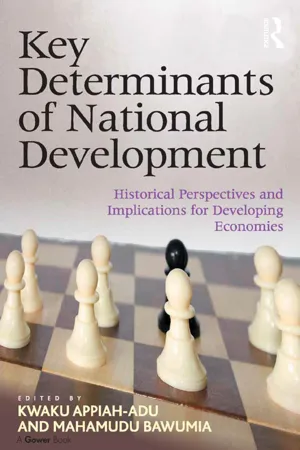
Key Determinants of National Development
Historical Perspectives and Implications for Developing Economies
- 420 pages
- English
- ePUB (mobile friendly)
- Available on iOS & Android
eBook - ePub
Key Determinants of National Development
Historical Perspectives and Implications for Developing Economies
About this book
For those wishing to acquire knowledge on national development issues, this comprehensive compendium traverses a spectrum of subjects that the audience ought to be well acquainted with. The Editors provide instructive findings regarding national development, economic growth and their determinants, but they also offer historical perspectives on the subject and the implications for developing countries. The book addresses a suite of critical themes regarded by development experts to be germane in considering the pertinence of policies and their effective execution. These seven general thematic areas are explored: ¢ Leadership, governance, policy and strategy ¢ Public sector and public financial management ¢ Culture, institutions and people ¢ Natural resources ¢ Science, technology and infrastructure ¢ Private sector and financial markets ¢ Marketing, branding and service delivery This thematic approach enables the contributors to explore the impact of the constituents of each subject area on national development, within the context of a developing economy. The significance of the findings for the relevant stakeholders is consequently reviewed. The combination of theory and practice makes the book and its contents unique.
1
Introduction
This book focuses on key determinants of national development, drawing on historical perspectives and examining the implications for developing economies. Against the background of global developments and experiences as well as those within the national setting, factors that are considered crucial to the achievement of national development in a developing country economy are explored. The book addresses a suite of critical themes regarded by development experts to be germane in considering the pertinence of policies and their effective execution. Seven general themes are explored.
Thematic Areas
• Leadership, governance, policy and strategy
• Public sector and public financial management
• Culture, institutions and people
• Natural resources
• Science, technology and infrastructure
• The private sector and financial markets
• Marketing, branding and service delivery
Underlying all of the above themes are the concepts of economic growth and national development. Economic growth is a multi-dimensional concept. It refers to the increase in a specific measure such as real national income, gross domestic product (GDP) or per capita income. National income or product is commonly expressed in terms of the aggregate value-added output of the domestic economy, which is called GDP. When the GDP of a nation rises, economists refer to it as economic growth. Economic growth also describes an increase in the productive capacity of an economy as a result of which the economy is capable of producing additional quantities of goods and services. National development is described by the World Bank as the transformation of an economy for enhanced growth and job creation in order to support the delivery of social services to the people of that country, regardless of their geographical location or social and economic circumstances.
Leadership, Governance, Policy and Strategy
CHAPTERS
2. Leadership, Governance and National Development
3. Strategic Thinking and Economic Development
4. Policy Management and National Development
Theme one provides the opportunity to consider the contribution of leadership, good governance, policies and strategies to national development based on strategies and experiences across the globe. Chapter 2 discusses the leadership challenge facing developing nations and the various styles of leadership. Next, the principles and features of good governance are explored. Also addressed are the concept of national development and the challenges faced by developing countries as they make concerted efforts to achieve growth and advancement in various areas of their economies. Chapter 3 examines the significance of strategic management for economic development in developing economies and provides an array of techniques for assisting executives to adapt organizations to the marketplace in order to achieve their key objectives. Chapter 4 explores government and public policy followed by policy management reform as a development strategy. In an effort to understand the policy management concept, the roles of different policy actors and, in particular, the executive and legislature arms of government are discussed. To appreciate the policy process in detail, an in-depth analysis of the steps involved in policy conceptualization, analysis, formulation, implementation, monitoring and evaluation as well as feedback on objective setting is undertaken. Furthermore, examples of the policy cycle are drawn from advanced countries, emerging economies and developing nations to illustrate how robust the system must be for a government to reap the full benefits of effective policy management processes.
The Public Sector and Public Financial Management
CHAPTERS
5. The Public Sector as an Enabler of National Development
6. The Impact of Sound Public Financial Management on National Development
The second theme concentrates on the public sector’s contribution to national development. Chapter 5 examines the ways in which the public sector enables national development, in part by exploring the ways in which in developing countries it is failures or lack of capacity in the public sector that are seen as the main barriers to development. The public sector is generally understood as that part of the economy which is publicly owned – in practice, government and government-controlled entities – and which provide benefits and services (public goods) to all. These services, particularly those which create a fair and regulated environment for production and trade, are clearly necessary to the development and growth of the private sector: enterprises and industries which produce and trade in goods and services, employ citizens and generate revenue, some of which returns to the public sector in the form of taxes and fees. Hence, the public sector is inherently an enabler of development. Subsequently examined are: the role of the public sector as an enabler of development; what steps are taken to improve its functioning and remove barriers to development; and how a public sector may respond in practice to ‘enable development’, with the particular example of its role in labour markets. Chapter 6 provides an understanding of the concept of public financial management and establishes the significance of public financial management systems. Subsequently, an effort is made to relate national financial management and national economic development. Finally, the implications of sound public financial management for national development are espoused, drawing on examples from industrialized nations, emerging economies and developing countries. In this regard, selected public financial management policies and their individual effects or combined effects with other policies are examined with recommendations as to what the best permutations and combinations could be for developing countries.
Culture, Institutions and People
CHAPTERS
7. Institutional Building and National Development
8. National Culture and Economic Development
9. Human Capital and National Development
Theme three examines how culture, institutions and people contribute to national development. In this context, Chapter 7 examines the rationale for strong institutions in a country, followed by a discussion of national development strategy as a subject. Also investigated is how effective national institutions can contribute to national development and, in this regard, an effort is made to achieve a deeper understanding between strong institutions and national development. Furthermore, a detailed analysis of institutions that impact on growth and national development is undertaken, including a productive and proactive public sector, strong labour market institutions, rule of law and protection of property rights, integrity of governance and social inclusion that results in political stability. Chapter 8 examines the importance of national culture and whether certain cultures perform better economically. Within this context, the concepts of values and attitudes are discussed. Subsequently, there is a focus on how these issues are pertinent to the economies of the developing world, with an attempt to determine how national development can be propelled through culture. The focus of Chapter 9 is that the creation of an excellent human capital base that is skilled, knowledgeable, healthy, flexible and mobile is central to the vision of leapfrogging from a developing nation status to one that is fully developed. It examines how governments over the years have embarked on various initiatives that aim to transform the way in which human capital is developed to achieve national development. It uses the evaluation of the perspectives provided by various philosophers and economists on human capital as an excellent platform for lessons of invaluable resource to policy makers, administrators and educationists.
Natural Resources
CHAPTERS
10. Harnessing Land Resources for Economic Development
11. Management of Energy Resources for National Development
12. Mineral Resource Policy Dynamics and the Contribution of Mining to Ghana’s Development
The fourth theme explores how best natural resources may be utilised for national development. In this context, Chapter 10 investigates how land resources may be harnessed for economic development. It is contended that land is the basic asset on which the wealth of most nations is built. Indeed, the concept of land is a complex phenomenon that is not regarded simply as an economic or environmental asset, but also as a social, cultural and ontological resource which defines the construction of social identity, the organization of traditional religious life, and the production and reproduction of culture. The contribution of land and its resources to economic development lies in the property rights that exist in the land. These rights define the ownership, control, use and management of land. In addition, the complex relationship between property rights, land administration, land governance and economic development is explored, and critical challenges that militate against unleashing the full potential of property rights for a country’s social and economic development of the country are identified, alongside key recommendations to build a land administration infrastructure and improve upon the land governance system. The central concerns of Chapter 11 are: first, how developing economies with characteristic flagship primary export industries can enhance their sustainability and diversify their economies; and, second, how these countries/economies capture more of the value that they create in a manner that allows them to diversify and sustain their economies. This chapter illustrates that economic activity, including schemes of attracting foreign direct investment, must be orchestrated in a coordinated and targeted manner towards the goals of developing indigenous strategic and technological human resource capability, the engendering of local ownership and control of the nation’s economic and productive assets, and the engendering of a learning environment. In this light, a framework of analysis is suggested that can guide developing nations towards the ideal of sustainable economic growth. Chapter 12 adds to the debate on whether the exploitation of natural resources, particularly, mineral resources, contributes to the development benefit of host countries and discusses a range of issues that have a bearing on how such countries can harness the benefits of their natural resource extraction for national development. Using Ghana as a case study, the chapter discusses why it is essential to ensure effective impact in the actual mining communities and underscores the imperative for managing the seemingly exaggerated expectations of how mineral exploitations can carry the burden of development. The chapter challenges both critics and supporters of the mining industry to improve their understanding of the mechanisms that allow for increased developmental benefits of mining and advocates for the deepening of integration of mining into the economy through local supply chain development.
Science, Technology and Infrastructure
CHAPTERS
13. The Role of Science, Technology and Innovative Industries in National Development
14. Information Technology and National Development
15. The Impact of Sound Infrastructure on National Development
Theme five investigates the contributions of science, technology and infrastructure development to the advancement of nations. Within this field, Chapter 13 explores the role of science, technology and innovative industries in national development. Many European and Asian countries offer pertinent learning experiences worth considering by developing nations. Typically, such economies have little or no natural resources, but have emerged as economic giants within a few decades. These nations have thrived on the formulation and execution of strategic policies that are based on technologies and innovations. Such policies have included the establishment of forward-looking public institutions that deal with scientific research and technological development, the expansion of the countries’ educational systems to create a literate society with highly skilled personnel, and robust research and development culture to support its pursuit of nurturing a new system of economic growth based on technologies and innovations. Chapter 14 discusses the role of Information and Communications Technology (ICT) in national development against the backdrop of the wide recognition that the future of the world depends upon our willingness to harness ICTs to advance our development. This chapter discusses the theoretical perspectives on ICT and national development and, using Ghana as a case study, pertinent institutional policy and regulatory frameworks are presented. In addition, trends in ICT development are discussed alongside the identification of the country’s experience in using ICTs to promote and enhance national development. The chapter identifies the application of ICTs to specific economic sectors and highlights lessons learnt through these applications. Finally, it identifies the challenges in implementing ICTs for the country’s development and makes recommendations on ways of addressing these challenges. Chapter 15 contends that infrastructure is the mainstay of any country and that, without it, economic growth will be severely inhibited. It asserts that African countries that are able to reduce their infrastructure deficits in terms of transportation, energy, water and sanitation can grow their competitiveness to a similar level to that observed in Asia and the Middle East. Developing adequate and efficient infrastructure will enable African economies to increase productivity, especially in manufacturing and service delivery. Improved and efficient infrastructure has contributed to social development in healthcare and education, and reduced societal inequalities through a more equitable distribution of wealth. This chapter suggests how policy makers can fix the infrastructure problem and also addresses a number of options for financing infrastructure.
Private Sector and Financial Markets
CHAPTERS
16. The Private Sector as an Engine of Economic Growth
17. The Effect of Global Capital Markets on Developing Countries’ Economic Growth
18. The Role of Stock Markets in National Development: The Case of the Ghana Stock Exchange
19. The Role of the Central Bank in Reforming the Financial Sector
The sixth theme examines the roles of the private sector, financial markets and central banks in economic growth and national development. Under this theme, Chapter 16 explores the significance of the private sector in economic growth, highlighting the origins of the private sector and economic growth, and the highs and lows of the private sector through different economic cycles. This is followed by an examination of the perceived notion that the private sector has always been a dominant force in national economies. Subsequently, the chapter presents how a strong private sector could be built in a developing economy, with a focus on Ghana and how the sector could contribute to national growth. Finally, conclusions are drawn for the attention of developing economy governments, policy makers and private sector organisations and the relevant stakeholders. Chapter 17 examines the trends in emerging market growth over the last few decades. It begins with a discussion of the development of markets specifically in Africa as well as the growth and contribution of these markets to the global economy. In addition, it explores the prospects and potential of African markets as developing economies continue to evolve into stronger and more influential forces in the future on the global stage. Subsequently, it assesses the likelihood of Africa being the hotspot f...
Table of contents
- Cover Page
- Half Title page
- Title Page
- Copyright Page
- Contents
- List of Figures
- List of Tables
- About the editors
- About of Contributors
- Acknowledgements
- Foreword
- Preface
- 1 Introduction
- Part I: Leadership, Governance, Policy and Strategy
- Part II: The Public Sector
- Part III: Culture, Institutions and People
- Part IV: Natural Resources
- Part V: Science, Technology and Infrastructure
- Part VI: The Private Sector and Financial Markets
- Index
Trusted by 375,005 students
Access to over 1.5 million titles for a fair monthly price.
Study more efficiently using our study tools.
Frequently asked questions
Yes, you can cancel anytime from the Subscription tab in your account settings on the Perlego website. Your subscription will stay active until the end of your current billing period. Learn how to cancel your subscription
No, books cannot be downloaded as external files, such as PDFs, for use outside of Perlego. However, you can download books within the Perlego app for offline reading on mobile or tablet. Learn how to download books offline
Perlego offers two plans: Essential and Complete
- Essential is ideal for learners and professionals who enjoy exploring a wide range of subjects. Access the Essential Library with 800,000+ trusted titles and best-sellers across business, personal growth, and the humanities. Includes unlimited reading time and Standard Read Aloud voice.
- Complete: Perfect for advanced learners and researchers needing full, unrestricted access. Unlock 1.5M+ books across hundreds of subjects, including academic and specialized titles. The Complete Plan also includes advanced features like Premium Read Aloud and Research Assistant.
We are an online textbook subscription service, where you can get access to an entire online library for less than the price of a single book per month. With over 1.5 million books across 990+ topics, we’ve got you covered! Learn about our mission
Look out for the read-aloud symbol on your next book to see if you can listen to it. The read-aloud tool reads text aloud for you, highlighting the text as it is being read. You can pause it, speed it up and slow it down. Learn more about Read Aloud
Yes! You can use the Perlego app on both iOS and Android devices to read anytime, anywhere — even offline. Perfect for commutes or when you’re on the go.
Please note we cannot support devices running on iOS 13 and Android 7 or earlier. Learn more about using the app
Please note we cannot support devices running on iOS 13 and Android 7 or earlier. Learn more about using the app
Yes, you can access Key Determinants of National Development by Kwaku Appiah-Adu,Mahamudu Bawumia in PDF and/or ePUB format, as well as other popular books in Economics & Business General. We have over 1.5 million books available in our catalogue for you to explore.