- 326 pages
- English
- ePUB (mobile friendly)
- Available on iOS & Android
eBook - ePub
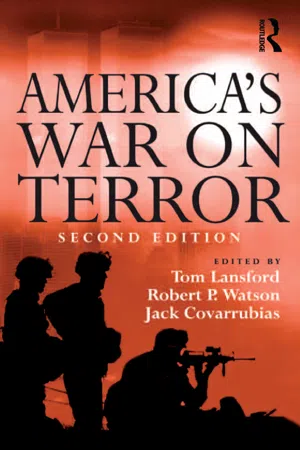
America's War on Terror
About this book
Developing ideas established in the successful first edition, this new version of America's War on Terror updates and expands the original collection of essays, allowing the reader to fully understand how the causes of the war on terror, both the domestic and foreign policy implications, and the future challenges faced by the United States have moved on since 2003. Features include: "
Information
Chapter 1
The Politics and History of Terror
Robert P. Watson
Introduction
On the morning of September 11, 2001, four US commercial aircraft were hijacked and used as weapons of mass destruction by 19 terrorists of the radical Islamist terror network, al-Qaeda.1 After seizing control of the planes, terrorists crashed two of them into the twin towers of the World Trade Center in New York City, while another plane was flown into the Pentagon in the US capital city. After learning of the fate of the other three aircraft from loved ones by cell phone, passengers of the fourth plane struggled for control of the aircraft and succeeded in diverting it from its intended target. The plane crashed into the ground in western Pennsylvania, killing all aboard but not a single individual beyond those on the flight. These tragic events produced a death toll reaching into the thousands and marked the start of America’s War on Terror.2
As horrific as the events of September 11 were, the sad reality is that they were merely the latest in a long history of terrorism.3 Even though the 9/11 tragedy prompted America’s War on Terror and were the first acts of foreign aggression of considerable magnitude on US soil since the War of 1812, or on a US territory since the Japanese strike on Pearl Harbor in 1941, numerous terror incidents have been directed against US targets and citizens.4
Terrorist attacks again the United States also predate the attacks of September 11. In April of 1983, for example, the US Embassy in Beirut, Lebanon was bombed, killing 63. Later that same year, in October, the US Marine Corps barracks in Beirut were attacked, killing 299. Some years later, another US military complex, this time in Riyadh, Saudi Arabia, was bombed and 19 were killed. Other US embassies in Nairobi, Kenya and Dar-es-Salaam, Tanzania were bombed in August of 1998, resulting in 223 deaths. Almost one year before the 9/11 attack, 17 were killed when the USS Cole was bombed while in port in Aden, Yemen in October of 2000.
Throughout human history there have been threats to safety and security, losses of life and property, large scale displacements of populations and the spread of illness and disease as tools of terror. Perhaps the first use of the word terror to define what is now understood to be terrorism occurred during France’s Reign of Terror from 1793 to 1794, when revolutionary forces tried to identify and kill those deemed to be traitors to the cause. In the ensuing years, the word would be synonymous with state violence such as torture, imprisonment and the dreaded guillotine.5
The start of modern international terrorism is widely seen as occurring on July 22, 1968, when three terrorists of the Popular Front for the Liberation of Palestine (PFLP) hijacked an El Al airliner en route from Rome, Italy to Tel Aviv, Israel.6 The plane was carrying 38 passengers plus 10 crew members and was commandeered to Algiers by the terrorists. Unlike the trend it started and so many recent terrorist events, this hijacking did not end in tragedy, as negotiators were eventually able to obtain the release of the passengers and crew. The hijacking did, however, usher in a new approach and a new element to international terrorism, especially by Islamic extremists; that being dramatic mass attacks designed to generate publicity (and intense coverage by the international media) and employing modern instruments (such as aircraft).
One of the most infamous incidents of terrorism before the 9/11 tragedy occurred during the 1972 Munich Olympics when Palestinian terrorists—in front of a worldwide audience—infiltrated the Olympic compound and killed Israeli athletes. Such terror incidents strike bloody and symbolic blows against not only the foes of terrorists, but also the international community of nations, using violence, publicity and the lives of innocent people to achieve their objectives.
Defining Terrorism
Terrorism is a worldwide plague that knows no state borders. In the modern era of international terror, starting with the El Al hijacking in 1968, terrorism has frequently involved airline hijackings and bombings. For instance, terrorists were responsible for an Air India wreck in June of 1985 over the Irish Sea that killed 329, a Pan Am flight that crashed over Lockerbie, Scotland in December 1988 killing 270, the Union des Transports Aériens (UTA) flight over Chad in September 1989 which resulted in 170 deaths, and many others.
Indeed, many international terrorists have attempted commercial airline hijackings. But the 9/11 tragedy might have marked yet another historic turning point just as the El Al hijacking by Palestinian terrorists did. Both involved an aircraft and a radical Islamic group seeking to make a statement and inflict terror. Yet this time the aircraft was used not just as the means for drawing attention but also as a weapon. As such, 9/11 can be seen as the perversely inevitable outgrowth of the suicide bombing trend.
The aircraft remains a powerful symbol of modernity, a source of publicity and a mechanism not bound by geography (like terrorism itself). As was mentioned in the opening paragraphs, international terrorism is undergoing a metamorphosis even though some of the old practices and causes remain. New technologies aid terrorists in spreading destruction and fear while at the same time helping law enforcement bodies in fighting them.
There are many types and forms of terror, from camouflaged guerrilla combatants in the jungles of Colombia and Peru, to the Irish Republican Army (IRA) in the streets of Northern Ireland, to right-wing militia groups in rural parts of the United States. As the US learned so tragically in April of 1995, terrorism can be “homegrown.” Timothy McVeigh, a military veteran who was also an adherent of the ultra right-wing militia movement, detonated a bomb in front of the Alfred P. Murrah Federal Building in Oklahoma City killing 168. Likewise, a hermit with a PhD nicknamed the “Unabomber” by the press, terrorized the country by mailing explosive devices to his victims. It should also be said that the ugly history of slavery and the actions of white supremacists in the American South in the years before and after abolition, and during the Civil Rights Movement, mark a long history of acts that meet the definition of terrorism.
There is no universally accepted definition of terrorism, in part because there are so many varieties of terror incidents, such as assassinations, bombings, hijackings, kidnappings, and new trends involving biological, chemical, or radiological weapons and even cyber attacks against computing systems and telecommunications.7 Moreover and politically, one person’s terrorist might be another person’s freedom fighter.
Accordingly, diplomats and governments often disagree on how to define terrorism and on which incidents fit the definition. There are, however, some basic tenets that are central to defining and understanding the phenomenon. Most dictionaries and reference books offer standard definitions that describe terrorism as:
The unlawful use or threatened use of force or violence by a person or an organized group against people or property with the intention of intimidating or coercing societies or governments, often for ideological purposes.8
Key to any definition are concepts such as civilians being targeted by violence during times of peace or when the party attacked is not engaged in war. Yet, terrorism can occur during times of war if it targets civilians or noncombatants. This definitional threshold can be extended to include military personnel if they are unarmed or not on duty, or if attacks on military facilities or personnel are performed when the nation is not at war or engaged in hostilities. One view of terrorism is offered by the US Federal Emergency Management Agency (FEMA), which considers terrorist acts as involving three characteristics:
1. to create fear;
2. to try and convince citizens that their government is unable to protect them or prevent terror attacks; and
3. to gain publicity.9
US federal statute offers another helpful definition of terrorism:
The term “terrorism” means premeditated, politically motivated violence perpetrated against non-combatant targets by sub-national groups or clandestine agents, usually intended to influence an audience … and involving citizens or the territory of more than one country.10
The United States also classifies a terrorist group as “… any group practicing, or that has significant subgroups that practice, international terrorism.” The US Immigration and Nationality Act offers a definition of terrorist activity that includes a number of examples. This is listed in Table 1.1.11
Table 1.1 Operational definition of terrorism
• The hijacking or sabotage of any conveyance (including aircraft, vessel, or vehicle);
• the seizing or detaining, and threatening to kill, injure, or continue to detain, another individual in order to compel a third person (including a governmental organization) to do or abstain from doing any act as an explicit or implicit condition for the release of the individual seized or detained;
• a violent attack upon an internationally protected person of the United States;
• an assassination;
• the use of any: biological agent, chemical agent, or nuclear weapon or device; explosive or firearm (other than for mere personal monetary gain), with intent to endanger, directly or indirectly, the safety of one or more individuals or to cause substantial damage to property;
• a threat, attempt, or conspiracy to do any of the foregoing: the term “engage in terrorist activity” means to commit, in an individual capacity or as a member of an organization, an act of terrorist activity or an act which the actor knows, or reasonably should know, affords material support to any individual, organization, or government in conducting a terrorist activity at any time, including any of the following acts:
a. the preparation or planning of a terrorist activity;
b. the gathering of information on potential targets for terrorist activity;
c. the providing of any type of material support, including a safe house, transportation, communications, funds, false documentation or identification, weapons, explosives, or training, to any individual the actor knows or has reason to believe has committed or plans to commit a terrorist activity;
d. the soliciting of funds or other things of value for terrorist activity or for any terrorist organization;
e. the solicitation of any individual for membership in a terrorist organization, terrorist government, or to engage in a terrorist activity.
Types of Terrorism
Increasingly, terrorists since the El Al hijacking in 1968 have been motivated by one of two general—and at times a hybrid of both—factors: religious extremism and ethnic nationalism. Both are important factors in understanding contemporary terrorism. The perpetrators of the hijacking in 1968, as is the case of those attacking the United States on 9/11 and the other incidents mentioned in the opening of this chapter, were Islamic extremists of Arabic or Middle Eastern identity. As shall be discussed below, there are many forms of terrorism and equally as many types of terrorists. It is important that any assessment of terrorism does not make the mistake of ignoring other forms and perpetrators of terrorism. It is equally important that students of terrorism—as well as policymakers—do not equate Islam with terrorism, as the religion is far from monolithic in practice and interpretation.
Even within the profile of radical Islamic terrorism, it is inaccurate to describe the phenomenon as monolithic. For instance, Sunni terrorists are more likely to be individual, militant Islamicists acting apart from the state, while Shiite terrorists are at times more collective in their actions and have supported regimes such as the Iranian government. Indeed, states do sponsor terrorism, with governments in Libya, Sudan, Syria, and elsewhere having connections to terrorists through fund-raising, offering safe havens, and so forth.
It would appear that, among the mistakes made by the Bush Administration in prosecuting the War on Terror, were such decisions as focusing almost singly on Islamic fanaticism to the neglect of other types of terror and alienating much of the Muslim world because of insensitive and, at times, sweeping statements and actions.12
There are several identifiable characteristics and forms of terrorism which makes contemporary threa...
Table of contents
- Cover Page
- Dedication
- Title Page
- Copyright Page
- Contents
- List of Figure and Tables
- Notes on Contributors
- Preface
- 1 The Politics and History of Terror
- PART 1 ORIGINS OF THE WAR ON TERROR
- PART 2 DOMESTIC IMPLICATIONS
- PART 3 FOREIGN POLICY IMPLICATIONS
- PART 4 FUTURE CHALLENGES
- Appendix A
- Appendix B
- Bibliography
- Index
Trusted by 375,005 students
Access to over 1.5 million titles for a fair monthly price.
Study more efficiently using our study tools.
Frequently asked questions
Yes, you can cancel anytime from the Subscription tab in your account settings on the Perlego website. Your subscription will stay active until the end of your current billing period. Learn how to cancel your subscription
No, books cannot be downloaded as external files, such as PDFs, for use outside of Perlego. However, you can download books within the Perlego app for offline reading on mobile or tablet. Learn how to download books offline
Perlego offers two plans: Essential and Complete
- Essential is ideal for learners and professionals who enjoy exploring a wide range of subjects. Access the Essential Library with 800,000+ trusted titles and best-sellers across business, personal growth, and the humanities. Includes unlimited reading time and Standard Read Aloud voice.
- Complete: Perfect for advanced learners and researchers needing full, unrestricted access. Unlock 1.5M+ books across hundreds of subjects, including academic and specialized titles. The Complete Plan also includes advanced features like Premium Read Aloud and Research Assistant.
We are an online textbook subscription service, where you can get access to an entire online library for less than the price of a single book per month. With over 1.5 million books across 990+ topics, we’ve got you covered! Learn about our mission
Look out for the read-aloud symbol on your next book to see if you can listen to it. The read-aloud tool reads text aloud for you, highlighting the text as it is being read. You can pause it, speed it up and slow it down. Learn more about Read Aloud
Yes! You can use the Perlego app on both iOS and Android devices to read anytime, anywhere — even offline. Perfect for commutes or when you’re on the go.
Please note we cannot support devices running on iOS 13 and Android 7 or earlier. Learn more about using the app
Please note we cannot support devices running on iOS 13 and Android 7 or earlier. Learn more about using the app
Yes, you can access America's War on Terror by Robert P. Watson, Tom Lansford in PDF and/or ePUB format, as well as other popular books in Politics & International Relations & National Security. We have over 1.5 million books available in our catalogue for you to explore.