eBook - ePub
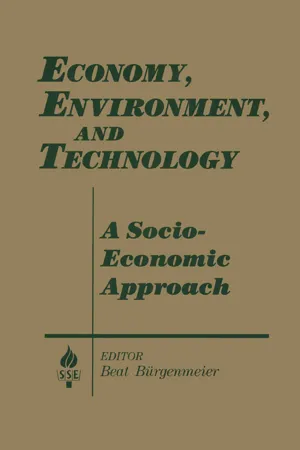
Economy, Environment and Technology: A Socioeconomic Approach
A Socioeconomic Approach
- 224 pages
- English
- ePUB (mobile friendly)
- Available on iOS & Android
eBook - ePub
Economy, Environment and Technology: A Socioeconomic Approach
A Socioeconomic Approach
About this book
A study of local government and politics in China, exploring when and why local government officials comply with policy directives from above. The author draws on interviews with government officials in various municipalities and a review of county records and other government documents.
Part I
The Behavioral Sciences Facing Environmental Protection
1
GARDNER BROWN
Estimating Nonuse Values Requires Interdisciplinary Research
Introduction
There is a sea change under way, driven by forces unlikely to diminish in magnitude or direction for a good many years. The phenomenon I refer to is the need for and inclusion of other social scientists in research programs in several critical areas of environmental economics. Such research programs involve estimating nonmarket and nonuse values and conducting risk assessment or risk-benefit analysis. Other social scientists include cognitive psychologists who know how people perceive and make decisions and survey or market researchers who have special knowledge about survey design instruments.
In recent years, population growth, technology, and tastes have conspired to place enormous and increasing economic importance on goods and services not traded in markets. Water and air quality or hazardous waste disposal from a local and international perspective, as well as the specter of rapidly vanishing species, are public policy issues in which the underlying externalities and public goods militate against straightforward marketlike solutions. One such example is the design of a property rights scheme to facilitate optimal resource allocation and distribute the rights in an equitably acceptable fashion. Even if such a property rights system is feasible, in some instances quantitative measurements of the gains and opportunity costs would be required in order to know how many rights to issue. The estimated value of the right surely will play a role, in many cases, in deciding how the rights should be distributed, that is, in deciding who should or should not get the rights and limits, if any, or whether to use per capita distribution.
By the very nature of these goods, there is no organized or approximate market in which we can accurately register our willingness to pay for nonmarket goods such as preservation of the blue whale. Thus, we must turn to indirect methods such as contingent valuation (CV) studies in which values are elicited by survey methods.1
When we leave the realm of the market, we can no longer estimate demand or marginal values from observed behavior but must confront people with hypothetical situations and elicit or coax marginal values from them. It is an adventure into realms in which economists have had woefully inadequate professional preparation. While it is possible to use travel cost and hedonic methods to recover use values not traded in the market, the frequently very significant nonuse values (existence and bequest) simply have no reliable reflection in behavior, so surveylike CV methods are unavoidable. In the ensuing pages I will show how badly we need noneconomists by sketching the four problems I think are of utmost importance for CV survey methods. Arguments about the comparative advantages and gains of specialization dictate that we call on those with specialized knowledge about how to elicit nonuse values from the mental constructs of the sampled population.
The problems in order of presentation are embedding, framing, subjective versus objective probability, and discrete versus continuous methods of consumer choice (matching the way people think about and choose between options with the appropriate estimation techniques).
Embedding
Embedding is perhaps the most serious difficulty confronting practitioners of the CV method. Embedding occurs when a subject, asked to value a particular good or service, in fact gives a response that reflects the value of a more general good that embraces the constituent element There are several explanations for embedding. If I were asked to value the quality of a specific groundwater aquifer in the context of hazardous waste contamination of the aquifer, I may be unable to make a clear mental distinction between the more general problem of environmental water quality and my valuation of the particular aquifer. Therefore, the value I report is for a more inclusive good and therefore yields an overestimation of the value of the particular good.
Kahneman and Knetsch (1992) argue that when moral satisfaction is an important part of the welfare gain, the willingness-to-pay (WTP) value of a public good is not the equivalent of the value of a private consumption good. While suggestively valid, it cannot be precisely correct because people voluntarily purchase higher-priced consumer goods that differ from the lower-priced counterparts only in their kindness to the environment, such as greater biodegradability or use of recycled materials.
One reason for the mental joint product is that the amenity in question symbolizes or is part of one’s more general moral concern for a better environment Utility is increased directly by contributing to the improvement of a particular amenity and indirectly by improving the aggregate component, environmental integrity, in the utility functions. Often the substantial symbolic content of an issue gives rise to CV studies: oil spills, hazardous waste contamination, habitat destruction that endangers species, and activities that cause large-scale water or air pollution. In these circumstances survey design is crucial; for example, the order of the questions greatly matters. Smith (1991a) paraphrases Cummings’s (1989) conjecture that individuals will “ ‘dump… the contents of their good cause account’ on the first valued cause posed to them in a [contingent value] CVM question.”
Finally McClelland et al. (1991a) argue that survey respondents may believe that a public program will necessarily have a broader compass than the survey designers state. McClelland et al. (1991a) found in their debriefing of subjects that some “viewed health and visibility improvements as joint products” (p. 9), thus corroborating the arguments of cognitive psychologists Fischhoff and Furby (1988). Thus, any contribution that improves one element (say, visibility) would necessarily improve other things positively valued in the utility function of the program. Despite attempts of researchers to identify and separate goods, respondents may believe and respond as if there is a technological interdependence, which, to emphasize the parallelism, is distinct from the mental joint product and the interdependence of tastes cited above. One can understand why the phenomenon addressed here is also called part-whole, symbolic, or disaggregation effect (Cummings, Brookshire, and Schulze 1986; Mitchell and Carson 1989).2
Before illustrating the quantitative significance of embedding, which some may wish to skip, the key point of this section should be set forth. Embedding is the grist for the cognitive psychologists’ mill. It has long been a worrisome topic of concern for them. Economists are latecomers to this dialogue. Conceptually, embedding is founded in the mind, a realm in which economists have traditionally been proud to disclaim any expertise. Economists study observable behavior. Its empirical dimensions turn on proper survey design, which is very much the domain of noneconomists, as Mitchell and Carson (1989), Smith (1991a), and others make clear.
In an unpublished study (Rowe et al. 1991), subjects were asked how much they would be willing to pay for a public program that prevents the occurrence of a particular environmental impact on a particular natural resource in a particular region. Subjects were subsequently asked to comment, if they wished, and to judge the accuracy of their response. (The survey researchers suggested—on the basis of focus groups and intensive debriefing of subjects who had filled out earlier versions of the questionnaire—that some subjects may find it difficult to think about paying for a very specific pollution prevention program.) Each subject was asked (the percentage response to each motivation is included parenthetically; the numbers do not sum to 100 due to rounding) if the amount reported earlier was:
for the specific event described earlier (22)
partly for that event and partly for all similar events in a broader region (36)
partly for the generic event and broader environmental causes (20)
primarily a contribution to all good causes (23)
Only 22 percent of the respondents stated that their answer was consistent with the question asked. All others responded as though there was embedding. Respondents were then given an opportunity to apportion the share of the reported value in the earlier question to the specific abatement program. Embedding accounted for 42 percent of the original total value.
In a second study (Doyle et al. 1991), eighty subjects filled out a survey about groundwater values in a laboratory situation. Each subject was asked his (her) willingness to pay through an increase in water charges for groundwater treatment. After an intervening question, subjects were asked the following two questions:
| Q-46 | In questions Q-41 and Q-44 you were asked to state the dollar amounts you would be willing to pay for Complete Groundwater Treatment. Would you say that the dollar amounts you stated were | |
| (2/3) | 1. | JUST FOR THE STATED GROUNDWATER PROGRAM… |
| 2. | SOMEWHAT FOR THE GROUNDWATER REFERENDUM AND SOMEWHAT A GENERAL CONTRIBUTION TO ALL ENVIRONMENTAL CAUSES. | |
| 3. | BASICALLY A CONTRIBUTION TO ALL ENVIRONMENTAL CAUSES. | |
| 4. | OTHER (Please specify) | |
| Q-47 | About what percent of your dollar amount was just for the stated groundwater program? NONE SOME HALF MOST ALL 0 10% 20% 30% 40% 50% 60% 70% 80% 90% 100% | |
The responses indicate that one-third of the subjects were embedding.3 Adjusting for the embedding reduced the value by 15 to 20 percent (p. 30).
The quantitative results of these two studies differ for a variety of reasons. One may be that the payment vehicle in the groundwater survey involves an increase in water charges, which a subject may perceive she (he) is more likely to bear, compared to an industry product price increase ...
Table of contents
- Cover Page
- Half Title page
- Series page
- Title Page
- Copyright Page
- Dedication
- Contents
- Figures
- Introduction
- Part I The Behavioral Sciences Facing Environmental Protection
- Part II Bioeconomics
- Part III Sustainable Development
- Part IV The Policy Implication
- Index
- Contributors
- About the Editor
Trusted by 375,005 students
Access to over 1.5 million titles for a fair monthly price.
Study more efficiently using our study tools.
Frequently asked questions
Yes, you can cancel anytime from the Subscription tab in your account settings on the Perlego website. Your subscription will stay active until the end of your current billing period. Learn how to cancel your subscription
No, books cannot be downloaded as external files, such as PDFs, for use outside of Perlego. However, you can download books within the Perlego app for offline reading on mobile or tablet. Learn how to download books offline
Perlego offers two plans: Essential and Complete
- Essential is ideal for learners and professionals who enjoy exploring a wide range of subjects. Access the Essential Library with 800,000+ trusted titles and best-sellers across business, personal growth, and the humanities. Includes unlimited reading time and Standard Read Aloud voice.
- Complete: Perfect for advanced learners and researchers needing full, unrestricted access. Unlock 1.5M+ books across hundreds of subjects, including academic and specialized titles. The Complete Plan also includes advanced features like Premium Read Aloud and Research Assistant.
We are an online textbook subscription service, where you can get access to an entire online library for less than the price of a single book per month. With over 1.5 million books across 990+ topics, we’ve got you covered! Learn about our mission
Look out for the read-aloud symbol on your next book to see if you can listen to it. The read-aloud tool reads text aloud for you, highlighting the text as it is being read. You can pause it, speed it up and slow it down. Learn more about Read Aloud
Yes! You can use the Perlego app on both iOS and Android devices to read anytime, anywhere — even offline. Perfect for commutes or when you’re on the go.
Please note we cannot support devices running on iOS 13 and Android 7 or earlier. Learn more about using the app
Please note we cannot support devices running on iOS 13 and Android 7 or earlier. Learn more about using the app
Yes, you can access Economy, Environment and Technology: A Socioeconomic Approach by Beat Burgenmeier in PDF and/or ePUB format, as well as other popular books in Economics & Environmental Economics. We have over 1.5 million books available in our catalogue for you to explore.