- 328 pages
- English
- ePUB (mobile friendly)
- Available on iOS & Android
eBook - ePub
About this book
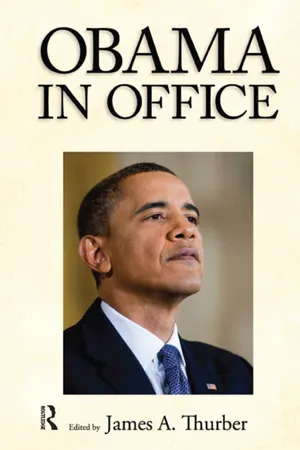
Barack Obama entered office on a wave of popular expectation; will he exit at the hands of a Tea Party inspired populist tsunami or return for four more years? Obama in Office brings together well-established political scientists and journalists to offer the first detailed assessment of President Obama and his first two years in office. This book covers the range of policy tests which the administration has faced during this period, including the recession and its jobless recovery, health care reform, financial regulation, the BP oil leak in the Gulf of Mexico, and the ongoing war in Afghanistan. Looking beyond the midterms, Obama in Office considers the results of 2010, the impact of the Tea Party, and the prospects for 2012.
Information
CHAPTER 1
An Introduction to an Assessment of the Obama Presidency
Coming out of the 2012 presidential election, Barack Obama continued to face divisive political confrontations and major economic, social, environmental, and foreign policy challenges. But his first term had yielded significant victories on both the domestic and foreign fronts, and a key opportunity of a second term is the release from electoral pressure. This book assesses Obama’s first term achievements and outlines the prospects of four more years in shaping his legacy and place in history.
How much of Obama’s success and failure have been affected by the economic and political realities he inherited? What is the continuing impact of Obama’s personality, policy preferences, and political style on governing? Will the polarized Congress, the Tea Party, the Occupy movement, and the 2010 midterm landslide for House Republicans spoil the sense of mandate and renewal embedded in the 2012 presidential electoral victory? How will world politics, winding down the war in Afghanistan, threats from Iran and North Korea, the Arab Spring, new regimes in Egypt and potentially Syria, global economic competition from China and India, and other political realities continue to affect Obama’s ability to govern? These are just some of the important questions addressed in this book. The chapter authors here employ a variety of policy and political perspectives, including approaches from history, law, political science, public administration, psychology, sociology, policy analysis, survey research, and media studies, as they assess Obama’s presidency.
President Obama has had a major impact on America; voters have reacted to his accomplishments as shown in the historic 2010 midterm election. His major legislative accomplishments are impressive, yet controversial: the Lilly Ledbetter Fair Pay Act, American Recovery and Reinvestment Act (ARRA, the economic stimulus legislation), Affordable Care Act (ACA, health care reform), Wall Street/financial institutional reform, reauthorization and funding the Troubled Asset Relief Program (TARP), funding the deployment of 30,000 more troops to Afghanistan, and several significant legislative victories in the Lame Duck Congress. The tax bill, extension of unemployment compensation, food safety reform, repeal of the “don’t ask, don’t tell” policy in the military services, and approval of the START II treaty in the Lame Duck session of the 111th Congress are historic policy achievements by themselves. These accomplishments may define President Obama’s place in history, but there are other factors to be taken into account when assessing his presidency after only two years.
Because the authors here include presidential and congressional scholars, media and interest group specialists, domestic and foreign policy experts, public administration experts and policy analysts, practitioners and academics, each brings a unique perspective to bear. No single analytic approach or dominant ideology reigns. The chapters focus on public opinion, voting behavior, Obama’s personality, his organization of the White House, his relationship with congressional leadership, his legislative strategy, his domestic and foreign policy achievements (and challenges), his relationship with interest groups, lobbyists, and the media, his communications strategy, his regulatory strategies, his focus on the federal debt and deficits, and many other policy accomplishments and failures. Only this diverse group of authors could address such a myriad of issues.
FACTORS INFLUENCING THE ASSESSMENT OF PRESIDENT OBAMA
An appraisal of President Obama’s first two years starts with his 2008 campaign. Presidential campaigns are a test of a candidate’s style and leadership and a way for voters to judge what policies they will attempt to implement. Obama’s 2008 campaign was the longest, most expensive, and one of the best presidential campaigns in the history of the United States. The first African American president of the United States had a “mandate,” but he inherited one of the worst economic crises in the history of the United States. Campaigns and governing do not occur in a vacuum; they are influenced greatly by economic and political circumstances. President Obama’s responses—the passage of the $787 billion economic stimulus three weeks into his presidency and his introduction of a transformational $3.6 trillion federal budget a month into his administration—were as swift and historic as was his election.
Obama’s campaign had a clear message: “hope and change”—change the failing economy and change the party in the White House. This message mobilized party loyalists, “the base,” and swing voters who are often moderate and ideologically in the middle. After taking office, President Obama tried to govern in the same way. He attempted to build a solid base of votes from his party in Congress and then show post-partisanship by reaching out for votes from moderate Republicans.
Starting on Inauguration Day, January 20, 2009, President Obama used his “political capital” from his successful election campaign—the size of his election victory (53 percent), his popularity as shown in early high poll ratings, job approval ratings in the mid-80 percent range in his first few days in office and in the mid-65 percent range after three months, and the natural surge of partisan support inherent in unified party government—to build a strong relationship with the Democratically controlled Congress. However, Obama’s presidential “political capital” decayed rapidly, as will be described by several authors in this book. His political momentum was undermined by events, the staggering economic crises in the US and the world, the wars in Iraq and Afghanistan, and the unified and intransigent political opposition of the Republican congressional leadership to his policy agenda.
Well-run governing strategies start with a plan, a theme, and a message. The goal is to maximize resources (particularly the president’s time), reduce liabilities by marginalizing opposition, and establish a set of objectives that, when achieved, will maximize the probability of getting the votes needed to pass the president’s legislative agenda in Congress. This sounds simple, but the key elements of a presidential leadership strategy and plan are complex and dynamic, as President Obama quickly discovered. Governing must take into account a vast number of factors, such as the president’s personality and charisma, the constituencies in the nation and on the Hill, the policies being advocated, the party organization or lack of it, the strength of party leadership, the economic situation, and the political capital available. The authors in this book have analyzed the impact of all these institutions, events, and circumstances.
President Obama’s leadership and policy achievements must be viewed in a constitutional context. As with all presidents, the framers of the Constitution set the framework for President Obama. By fragmenting power between the national government and the states, federalism, and among the executive, legislative, and judicial branches (separation of powers), they guaranteed that President Obama would struggle to achieve his policy goals. The framers bequeathed to Americans one of the most enduring rivalries in government: that between the president and Congress. They also divided legislative powers by creating two coequal houses, a bicameral Congress with different constituencies, which further magnifies rivalry and conflict. The effects are shown in the deadlock between the House and Senate on a variety of Obama’s policies, including energy cap and trade legislation, which was stopped by the Senate, and health care reform, in which the House bill was stopped until a completely revised Senate version passed using reconciliation. Although divided, Congress was designed to be independent and powerful, able to check the power of the executive and to be directly linked with the people through popular, periodic elections. The Constitution, in the way it divided power between the two branches, created an open invitation for conflict, which President Obama immediately experienced and will likely feel more acutely with the 112th Congress.
Other factors influencing President Obama’s relationship with Congress and contributing to his successes were electoral motivations and competitiveness, and different terms of office, both of which are discussed by this book’s authors. The Constitution mandates different terms of office: representatives serve for two years, senators hold office for six-year terms, and the president is elected every four years. Constituency bases are different, too, with the president elected by the nation, the senators by their states, and representatives by their districts. Presidents have only four years, possibly eight, in which to establish their programs. They are expected to set the national policy agenda and usually move rapidly in the first year before their inevitable decline in popularity. President Obama has followed this formula. Members of Congress are driven by the short-term motivation to be re-elected rather than long-term goals of a president, and they rightly see their futures as less important to their leader. The “shellacking” Obama and his Democratic colleagues experienced in the 2010 midterm election is a perfect example of these competing goals. The decision-making pace of Congress and of the president is not the same because of their different terms of office, electoral bases, and perceived constituency mandates.
Another dynamic influencing President Obama’s relationship with Congress is that of the state-based political parties. These parties allow members of Congress to be independent from the president, but because they are decentralized, they exercise little control over recruitment of candidates who run under their party label. Senators and representatives usually run their own races with their own financing. The way they respond to local conditions has little to do with national party platforms or presidential politics. Members often freely pursue their own interests without fear of discipline from the president. Independence from political parties and the president enables legislators to seek benefits for their own constituents and to serve specialized interests.
President Obama, however, was the beneficiary of exceptionally cohesive party unity among Democrats. The cohesion of the majority Democrats enabled him achieve his legislative goals. Those legislative achievements were even more remarkable because of strong Republican party unity against him and because there were few Republicans in the middle, ideologically, with whom he could work. Although President Obama wanted to be the post-partisan president, reaching out to the opposition party, party-voting patterns revealed the parties to be too unified, ideological, and polarized for the president to achieve that goal.
Whether party government is unified or divided has a major impact on the relationship between the president and Congress, as shown in the first two years of the Obama administration. With the 2008 election of President Obama and a Democratic Congress, unified party government returned to Washington. A major electoral impediment to legislative-executive cooperation is divided government, as shown by the dramatic election of 1994 (and now, 2010). Divided government does not always mean that the two branches will fight. However, it is generally easier for presidents to govern during periods of unified party government, as was shown in the first two years of the Obama administration. The midterm election of 2006 forced President Bush to work with the opposition party in the House and Senate in the 110th Congress, as will the 2010 midterm election for President Obama in the 112th Congress. The 2010 Lame Duck session foreshadowed what may happen in the 112th Congress: more cross-party cooperation. There are two varieties of divided government (the condition that exists when the majority party in either or both houses of Congress differs from the party of the president): divided party control of Congress and split control of Congress and the White House. The outcome of the 2010 midterm election gave President Obama a troublesome split control of Congress with a narrow majority of Democrats in the Senate for the 112th Congress. From 1901 through 2012, the United States has had unified party control of government for 67 years (60 percent of the time) and divided party control of government for 45 years (almost 40 percent of the time), a contextual factor that was not ignored by President Obama. President Obama continued the historic trend of being more successful with his legislative agenda with unified party government (2009–2010) than he will be with divided government (2011–2012). This trend has been especially true since the post-1980 resurgence of party-line voting and party cohesion in Congress.
President Obama’s legislation is only part of his story. His successful Supreme Court appointments, organization of the White House and appointment of policy czars, aggressive regulatory actions, management of crises such as the BP oil leak in the Gulf, command of the two wars, and leadership on the international scene are all important parts of his presidency.
What are the challenges facing President Obama in the 112th Congress after losing the House of Representatives to the Republicans? They are monumental and include the economy and job creation, the debt and deficit, tax reform, appropriations allocations, environmental and energy policy, immigration reform, reauthorization of No Child Left Behind, redeployment of troops in Iraq and Afghanistan, threats from Iran and Korea, the revolution in Egypt, trade agreements, and keeping promises to change the way Washington works (ethics, lobbying reform, stopping earmarks, campaign finance [DISCLOSE Act], partisanship, and breaking gridlock), to name just a few. Divided party government will likely include little voter and congressional consensus about the public problems and threats facing the United States, especially the economy, health care reform, education reforms, energy/environmental policy, immigration, and the war in Afghanistan. There may be little consensus on solutions to these problems, especially if there is little consensus about the nature of the problems. There may be a unified and strong opposition party that is interested in making sure he is a one-term president and strong interest groups that will disagree about problems and solutions. There will be limits on resources in the budget and time to deal with the looming and dangerously large deficits and federal debt. With divided party government and the upcoming 2012 presidential election, President Obama may see his central core of political authority decay very rapidly. Much depends upon his ability to communicate to and persuade the American people to support his politics.
Will the 112th Congress be patterned like 1995–1996, when Clinton and the Republicans worked together, or will it be a continuation of partisan deadlock? Will compromise and moderation rule or will permanent partisan campaigns with wedge issues and mean-spirited confrontation? Presidential-congressional relations in the post-2010 election Lame Duck Congress revealed that cooperation and historic legislative productivity can occur. The authors in this book assess President Obama’s performance in the first two years and comment on what it may mean for his leadership and relationship with the American public, the media, interest groups, Congress, and the world during the next two years.
HOW THE BOOK IS ORGANIZED AND WHAT TO LOOK FOR
This book includes 16 independent assessments of the Obama administration from a variety of perspectives. It is organized around campaigns, public opinion and voting, personality, governmental and political institutions, and domestic and foreign policy in five parts: Part I: From Campaigning to Governing; Part II: On the Hill and Off; Part III: Obama and the Media; Part IV: Obama and Domestic Policy; and Part V: Obama and Foreign Policy.
Part I: From Campaigning to Governing
This part of the book begins with Gary Jacobson’s Chapter 2, “Obama and the Polarized Public,” a foundation for understanding his accomplishments and failures. He evaluates President Obama’s attempt to bridge the wide partisan and ideological divide that has emerged in American politics. Jacobson argues that Obama has failed to be the post-partisan president he wanted to be in his first two years in office, despite extensive courtship of the Republicans. Congressional Republicans voted almost unanimously against Obama’s most important domestic initiatives—his economic stimulus and health care reform packages—and adopted resolute opposition and obstruction as their strategy for party revival. They viewed Obama’s failure as a prerequisite for their retaking control of Congress. Jacobson shows that the strategy was largely successful; the 2010 midterm gave Republicans their largest majority in the House of Representatives since 1946. Jacobson concludes that the 2010 election results virtually guarantee even deeper partisan divisions in Washington in the 112th Congress. His analysis reveals that the American public has become thoroughly divided along party lines in evaluations of Obama and his policies. Jacobson shows that after Obama’s brief period of post-election popularity, popular assessments of his job performance have trended downward, dipping below 50 percent in early 2010 and ending up at in the mid-40 percentile on Election Day. He describes the wide partisan differences in presidential approval. Democrats continued to rate his performance quite highly, but Republicans approvers dropped by half during Obama’s first six months in office and continued to decline rapidly thereafter. Jacobson argues that the partisan divide by the 2010 election had grown wider than under any president prior to President George W. Bush. Jacobson describes how Obama’s presidency provoked an increase in conservative populism, represented most prominently by the 2010 Tea Party movement. A majority of the 66 newly elected Republicans were associated in some way with the Tea Party movement. Jacobson predicts that if they remain loyal to their Tea Party roots, the House Republicans’ center of ideological gravity will move to the right. The result would be the most polarized House on record. Moreover, the Republicans’ principal objective for the new Congress, openly articulated by Senate minority leader Mitch McConnell, is to make Obama a one-term president. Their vow to repeal Obama’s signature health care reforms (as well as to roll back financial and environmental regulations) is part of their strategy for doing so. Jacobson concludes that an electorate that detests partisan bickering has unintentionally created the circumstances for intense partisan trench warfare.
Richard Boyd in Chapter 3, “Obama and the Public Mood,” analyzes the sources of Obama’s victory in 2008 and then extends Jacobson’s analysis by interpreting the sharp fall in Obama’s job approval rating in terms of two related themes. Boyd’s theme concerns the multiple meanings of change in election campaigns. He analyzes the meaning of change in Obama’s victory in 2008 and the Republican resurgence in 2010. Boyd argues that legislative success did not improve the public’s confidence in Obama, in Congress, or in the congressional parties. He shows that this has been true since the late 1960s. Voters have remained mistrustful and disaffected no matter who is in power. Boyd concludes that Obama hoped he could raise the quality of political discourse and increase trust in leaders and institutions (change Washington), but he has failed. He thinks that the goal of civility and nonpartisanship will likely prove elusive, both for his administration and for his successors.
Shifting from public opinion, voting, and elections to the personality of President Obama, Stephen Wayne in Chapter 4, “Obama’s Personality and Performance,” evaluates the impact of President Obama’s personality on his leadership style. He explores the topic of the influence of Obama’s personality on governing. Wayne addresses the question of whether President Obama been a transformational or charismatic leader. A charismatic leader has an ability to draw others to his side and move them to accomplish a cause bigger than themselves. A charismatic approach is transformational if it invokes a permanent change in the people who embrace the leader’s vision. Other authors in this book will show that Obama has formulated a more multilateral leadership style with other countries, thinking not only of the US’s interests, but also of the interests of the other nations as well. Wayne and other authors show that President Obama at times seems to be a “contingency leader,” giving great deference to congressional leaders. Obama has responded to various situations using different types of leadership styles for different challenges. Professor Wayne addresses why Obama took so lo...
Table of contents
- Cover Page
- Half Title page
- Title Page
- Copyright Page
- Dedication
- Contents
- Preface and Acknowledgments
- Chapter 1 An Introduction to an Assessment of the Obama Presidency
- Part I From Campaigning to Governing
- Part II On the Hill and Off
- Part III Obama and the Media
- Part IV Obama and Domestic Policy
- Part V Obama and Foreign Policy
- References
- Index
- About the Contributors
Trusted by 375,005 students
Access to over 1.5 million titles for a fair monthly price.
Study more efficiently using our study tools.
Frequently asked questions
Yes, you can cancel anytime from the Subscription tab in your account settings on the Perlego website. Your subscription will stay active until the end of your current billing period. Learn how to cancel your subscription
No, books cannot be downloaded as external files, such as PDFs, for use outside of Perlego. However, you can download books within the Perlego app for offline reading on mobile or tablet. Learn how to download books offline
Perlego offers two plans: Essential and Complete
- Essential is ideal for learners and professionals who enjoy exploring a wide range of subjects. Access the Essential Library with 800,000+ trusted titles and best-sellers across business, personal growth, and the humanities. Includes unlimited reading time and Standard Read Aloud voice.
- Complete: Perfect for advanced learners and researchers needing full, unrestricted access. Unlock 1.5M+ books across hundreds of subjects, including academic and specialized titles. The Complete Plan also includes advanced features like Premium Read Aloud and Research Assistant.
We are an online textbook subscription service, where you can get access to an entire online library for less than the price of a single book per month. With over 1.5 million books across 990+ topics, we’ve got you covered! Learn about our mission
Look out for the read-aloud symbol on your next book to see if you can listen to it. The read-aloud tool reads text aloud for you, highlighting the text as it is being read. You can pause it, speed it up and slow it down. Learn more about Read Aloud
Yes! You can use the Perlego app on both iOS and Android devices to read anytime, anywhere — even offline. Perfect for commutes or when you’re on the go.
Please note we cannot support devices running on iOS 13 and Android 7 or earlier. Learn more about using the app
Please note we cannot support devices running on iOS 13 and Android 7 or earlier. Learn more about using the app
Yes, you can access Obama in Office by James A. Thurber in PDF and/or ePUB format, as well as other popular books in Politics & International Relations & Economic Policy. We have over 1.5 million books available in our catalogue for you to explore.