- 296 pages
- English
- ePUB (mobile friendly)
- Available on iOS & Android
eBook - ePub
About this book
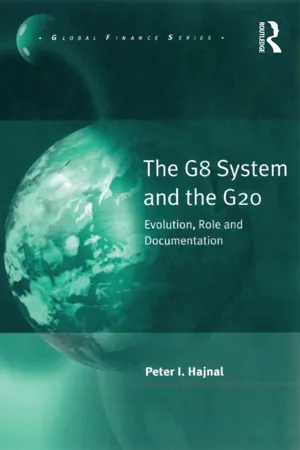
The Group of Eight has become a central actor in global governance with a steadily expanding role and agenda. The leaders' summits remain at the apex of the G8 system, but the leaders' work is complemented by intensifying and expanding networks of ministerial fora as well as various task forces and expert groups. Some of these entities, initially launched by the leaders, have taken on a life of their own with an agenda that diverges from the main concerns of the summits. Following on from Hajnal's acclaimed book The G7/G8 System, this volume discusses the origins, characteristics, evolution, role and agenda of the G7 and G8 system, including a systematic survey of its components. It introduces the major debates about the G7 and G8, looks at proposals to reform the G8-G20 and provides a detailed study of the complex, elusive and changing patterns of documentation of the broader G8-G20 system, including electronic information.
Information
Chapter 1
Introduction
The Group of Seven/Group of Eight (G7/G8) – launched in 1975 originally as G6, turning into the G7 in 1976 and the G8 in 1998 – has become one of the central components of global governance. It plays an expanding role, bringing together seven major industrial democracies (France, the United States, the United Kingdom, Germany, Japan, Italy and Canada) and – since 1998 – Russia, as well as the European Union. Unlike more structured international organizations that are based on intergovernmental agreements and permanent secretariats, the G7 and G8 have remained relatively informal and less encumbered by bureaucracy. This has enabled the leaders of member countries to develop good personal relationships and to understand one another’s respective domestic political and economic circumstances and constraints. It has also provided them with a unique means to achieve policy co-ordination and to co-operate on policy initiatives in an ever-greater number and variety of issue areas. During its more than thirty years of existence, the G7/G8 has achieved respectable results on many economic, political, security and other global issues, although its performance has not been consistently high. It continues to draw criticism because of its lack of representativeness and (real or perceived) lack of legitimacy and efficiency. Increasingly, it has also inspired reform proposals ranging from abolishing the G8 altogether, through restricting or expanding its agenda, and increasing, reducing or changing its membership. Non-state actors (civil society and business) are increasingly active in promoting such ideas, influencing the agenda of G8 meetings, and lobbying for more fundamental reforms.
Over the years, an elaborate system has evolved around the annual summits that are still the foundation of the G8. Related meetings take place several times each year to discuss and make decisions on summit-related issues. The leaders’ summits remain at the core of the G7 and G8 system, but the leaders’ work is complemented by an expanding network of ministers, sherpas (the leaders’ personal representatives), African Personal Representatives, and (ad hoc or continuing) working groups and task forces. Some of these, initially launched by the leaders, have taken on a life of their own either with an agenda that diverges from the main concerns of the summits, with different composition, and others that no longer have direct ties with the G7 and G8. The book discusses these ‘G8+’ entities (for example, the Financial Action Task Force and the Digital Opportunities Task Force or DOT Force). Particularly interesting is the now several years-old G20 finance ministers’ forum which is the model for recent proposals of a leaders’-level group of 20 that would either supplement or replace the G8 and concentrate on a carefully focused agenda. Such an L20 is seen by its proponents as making the institution more representative and democratic by including important countries that are not at present members of the more restrictive G8 club.
The complex system of institutions related to or originated by the G7 and G8 has generated a great deal of varied and often significant information (usually embodied in documents) in the course of its work. Its own documentation is the principal primary source of information about the broader G7 and G8 (including the G20) and its activities, but because of the absence of a central G8 secretariat to pull together, disseminate and analyze the document output, there is a great need for making this source material known and available, and to assess it carefully and systematically. As well, there now exists an impressive corpus of analytical and descriptive work, along with personal recollections of major participants and, increasingly, material that is becoming accessible in the archives of member countries, at least for the earlier years of the G7. The documents in these archives throw much additional light on the financial/economic origins of the G7 and provide lessons for the future of the G8-G20.
Objectives of this Work
This book has four main objectives.
• To discuss the origins, characteristics, role and agenda of the G7 and G8 system, including a systematic survey of its components, and to introduce the major debates and questions about the G7 and G8 in the scholarly literature;
• To review changes that have occurred in recent years in G8 membership, agenda, modus operandi, and outreach to non-G8 countries, international organizations and non-state actors (business and civil society);
• To examine proposals to reform the G7/G8 and the G20; and
• To provide a detailed study of the complex, elusive and changing patterns of documentation of the broader G7 and G8 system and the G20, including electronic information, and to describe archives and other sources of information on the G7 and G8.
What is the G7/G8?
The Group of Seven/Group of Eight (G7/G8) is an unorthodox international institution. Traditional international governmental organizations (IGOs) are based on a founding charter or an international treaty or agreement among the founding governments; and they have a secretariat charged with the implementation of policies and other decisions of the governing body of the organization. The G7/G8 is a less structured international arrangement; it was not established by formal international agreement, and it has no secretariat. The UK government, prior to hosting the 1998 Birmingham summit, characterized the G8 as ‘an informal organisation, with no rules or permanent Secretariat staff’ (UK 1998). The G7/G8’s informal modus operandi and the fact that it is relatively unencumbered by bureaucracy have enabled the leaders of its member countries to get to know one another on a strong personal basis and to understand one another’s domestic political and economic constraints and priorities. It has also given them a forum and venue for policy co-ordination, joint initiatives and interaction with other actors, state and non-state.
Occasional proposals to establish a form of permanent, continuing machinery have met with stiff resistance from at least some members. Nonetheless, the G7/G8 has become an important and influential actor on the international scene and has evolved into a broader G7 and G8 system. The best-known part of that system is the series of annual meetings of heads of state or government. These annual summit meetings are covered in great detail, albeit unevenly, by the news media and increasingly by scholarly and other specialized writing, but the resulting documentation is not widely understood. This book explores the context, typology and evolution of that documentation; beyond that, it discusses the nature of G7 and G8 information not reflected in public documents.
‘G7’, and later ‘G8’ or ‘G7 and G8’ or ‘G7/G8’ – depending on the context – have become the predominant terms when referring to the institution and the system around it.1 Earlier the annual meeting was called the economic summit, the summit of industrialized countries, the Western economic summit, and the seven-power summit.2 None of these names was ever completely accurate. For many years, the summit has not been merely economic; political questions and a whole gamut of global issues have taken on increasing importance on the agenda. Prior to 1998, it had not always been strictly a summit of the seven; the first summit had six participants, only the second had seven, and subsequent meetings had seven countries plus the European Union (EU; formerly European Community (EC)). Beginning with the 1994 Naples summit (following post-summit meetings with the USSR in 1991 and then Russia in 1992 and 1993), Russia became directly associated with the political aspects of the summit which, for this purpose, came to be termed the P8 (‘Political 8’). In 1997, Russia’s association with the G7 deepened, forming the ‘Summit of the Eight’ and leaving only financial and certain other economic issues to the core G7. In Birmingham in 1998 the G7 became officially the G8, with Russia as a full member, although the G7 configuration continued not only to survive but to thrive alongside the G8 for a number of years, especially for financial and other economic matters (the G7 finance ministers’ forum still exists). Because of the participation of the EU, the ‘G8’ is not precisely the G8, either. The term ‘Western’ is accurate in a geopolitical rather than a geographic sense; Japan is a founding member and Russia is an Asian as well as European state. Finally, some major industrialized and democratic countries remain outside.
There are several scholars who affirm the unique character and growing importance of the G7/G8. John J. Kirton wrote in 1995: ‘the G7 system of institutions is the late twentieth century global equivalent of the Concert of Europe that helped produce peace among the great powers, and prosperity more widely, from 1818 to 1914’. He argued that ‘the G7 Summit system has become the effective centre of global governance, replacing the order earlier provided by the 1919-1945 [League of Nations and] United Nations and [from] 1947 Atlantic family of institutions, and recurrently creating consensus and inducing compliance among its members and other states and international institutions’ (Kirton 1995: 64-65).3 Cesare Merlini (1994), on the other hand, in 1994 expressed the view that the G7 ‘is not an international institution in the real sense of the term .... [It is] a quasi institutional structure ... semi-personal and at the same time semi-institutional.’ In the same year, Philippe Moreau Defarges (1994), stating a French view, wrote: ‘the G-7 summit cannot and must not be a Western council’; Michael R. Hodges (1994) gave the British view that the G7 ‘is a forum rather than an institution’. In a speech he gave just before the Birmingham summit, the late Dr. Hodges remarked that ‘an institution has a cafeteria and a pension plan’ and the G8 has neither. If he were writing today, he would likely add that an institution also has a website (the G8 as such has no website, although the G8 countries, particularly the host country, do).
Andrea de Guttry (1994: 68), viewing the dynamic development of the institutionalization of the summit, notes ‘the total absence of a fixed summit structure or any kind of administrative/bureaucratic support’ at the summit’s beginnings, and the gradual process whereby, over the years, ‘the structure of the summit has slowly, almost unconsciously, become more complicated’. Nicholas Bayne and Robert D. Putnam (1995: 1-2) contrast the ‘stand-alone’ G7 summit with other kinds of summits which had become common and which depend on a parent international organization for their existence, such as the United Nations (UN) ‘Earth Summit’ in 1992, or the periodic summit meetings of the EU, the Commonwealth and the Francophonie. G. R. Berridge (1995: 83-84) lists G7 summits among the category of ‘serial summits’, in contrast with ad hoc (usually one-time only) summits and with a third type, high-level exchanges of views. Bayne (1995: 494) observes that ‘[t]he G7 Summit is at the same time an institution and an anti-institution. This ... may be the secret of its survival.’ For practical reasons, this book refers to the G7/G8 as an institution or forum.
Its leaders declare from time to time that the G8 is not a directoire, an executive board. Yet, it is often perceived by the media and the public as just that. Writing just before the 2005 Gleneagles summit, one observer noted that the eight leaders ‘are now the de facto world executive committee’ and a permanent political mechanism, moving in to fill the vacuum left by a ‘moribund and scandal-ridden United Nations’, an EU that is unable to agree on a constitution or a budget, and a WTO that is still struggling to establish a viable trade framework for the world. The observer, George Kerevan (2005: 26), marshals three reasons for the G8’s success: democratic legitimacy (given that the leaders are dependent on their electorate), the clear capacity to act, and the newly acquired popular mandate ‘via Sir Bob Geldof’. The only two gaps, according to Kerevan, are the absence of China and of the security dimension.
Drawing on a number of analyses, Kirton (2005c: Appendix 15-1, 15-2; 255-56) distinguishes nine models of the G7/G8 and its performance:
• The ‘American leadership’ model, as developed by Putnam and Bayne (1984; 1987), stipulating the ability and willingness of the US to assume leadership, with the support of at least a second G7 leader.
• The ‘concert equality’ model, assuming that the member states have equal capabilities (but that collectively they can predominate), equal vulnerability to external shocks, common principles of democracy, sufficient domestic control and political capital, and restricted participation in the G7 (Wallace 1984; Kirton 1989a).
• ‘False new consensus’: declining G7 performance in the 1990s, due to the false new consensus that economic globalization makes governments impotent (Bergsten and Henning 1996).
• ‘Democratic institutionalism’: increased level of performance due to effective multilateral organizations controlled by the G7; institutionalization of the G7 at ministerial and official levels; strong bureaucracies in G8 governments; commitment of the leaders to international co-operation; and popular support for the leaders (Ikenberry 1993).
• ‘Neoliberal hegemonic consensus’: G8 performance that is increasingly effective, yet contested by globalization, financial market dominance and other factors (Gill 1999).
• ‘Collective management’: increasingly effective G7/G8 performance, due to new global problems, the inadequacy of other global institutions, constraints imposed by globalization on independent action by major powers, and the institutionalization of the ‘leaders only’ format and focused agenda of the G8 (Bayne 2000; 2005b).
• ‘Ginger Group’ (caucusing group): increasingly effective performance of the G8, due to the globalization of financial markets, and the G8’s being a small private club with a common world view (Hodges 1999; Baker 2000).
• ‘Group hegemony’: constantly high performance due to the G8’s concentration of power, group identity, economic liberalism, system of interaction and other factors (Bailin 2001; 2005).
• ‘Meta-institution’: increasingly high performance, due to the concerted power of G8 members and the failure of the established international organizations (Pentillä 2003).
Other models can be added to this list. One of the most persuasive is the ‘network of networks’ concept of Anne Marie Slaughter (2004: 16, 19, 54). She argues that financial regulators, for example, prefer to think of the new financial architecture as a combination of networks: the G7, G8, the Basel Committee, IOSCO (International Organization of Securities Commissions) and others. Finance ministers hold regular meetings under the auspices of the G7, the G20 and the IMF Board of Governors. Many of the groups spawned by the G7 and G8 have grown in membership beyond the G7 and G8, thus networking within larger groups. All this shows the G7 and G8 as networking with various other specialized groups in a broader international context.
Chapter Summaries
Chapters 2 through 6 may, in a sense, be considered to be the core of this book. Chapter 2 traces the events, circumstances and various national positions leading to the eventual launch of the leaders’ meetings that have become annual summits; sketches the main economic developments that drove the need for such summits; and discusses the history of the meetings of G5 finance ministers – a series of get-togethers that predated the summits. It concludes that the five major democracies – France, West Germany, the UK, the US and Japan (later joined by Italy) recognized their common vulnerability to economic shocks and other major international developments, and saw the need to find solutions to these problems in a co-ordinated fashion, in a way that existing international institutions could not. Therefore, they instituted the periodic meetings of their finance ministers. These meetings laid the groundwork for later summits and eventually an expanded system of ministerial and other fora.
Chapter 3 surveys the summit meetings over 32 years, discusses the deliberative, direction-giving, decision-making, global governance-related and domestic political management role of the G7 and G8, and illustrates the perspectives and personal reflections of leaders and other present and former officials of the G7 and G8. It shows how summits have evolved from the first, one-time, meeting to an elaborate annual event whose...
Table of contents
- Cover Page
- Title Page
- Copyright Page
- Contents
- List of Tables
- Foreword
- Preface
- Acknowledgements
- Abbreviations and Acronyms
- Chapter 1 Introduction
- Chapter 2 Origins of the G7 Summit
- Chapter 3 The Summit Meetings
- Chapter 4 The Players: Members, Potential Members, and Unofficial Associates
- Chapter 5 The G7 and G8 Summit Agenda
- Chapter 6 The G7 and G8 System
- Chapter 7 G7 and G8 Relations with International Organizations
- Chapter 8 G7 and G8 Relations with the Business Sector
- Chapter 9 The Role of Civil Society
- Chapter 10 Evaluating the Summits
- Chapter 11 The G20 and its Documentation
- Chapter 12 Reform of the G7, G8 and G20
- Chapter 13 Documentation of the Summits
- Chapter 14 Documentation of Ministerial Fora, Task Forces, Working Groups and Expert Groups
- Chapter 15 Other Sources of Information about the G7 and G8 System and the G20
- Chapter 16 Conclusion
- Bibliography
- Index
Trusted by 375,005 students
Access to over 1.5 million titles for a fair monthly price.
Study more efficiently using our study tools.
Frequently asked questions
Yes, you can cancel anytime from the Subscription tab in your account settings on the Perlego website. Your subscription will stay active until the end of your current billing period. Learn how to cancel your subscription
No, books cannot be downloaded as external files, such as PDFs, for use outside of Perlego. However, you can download books within the Perlego app for offline reading on mobile or tablet. Learn how to download books offline
Perlego offers two plans: Essential and Complete
- Essential is ideal for learners and professionals who enjoy exploring a wide range of subjects. Access the Essential Library with 800,000+ trusted titles and best-sellers across business, personal growth, and the humanities. Includes unlimited reading time and Standard Read Aloud voice.
- Complete: Perfect for advanced learners and researchers needing full, unrestricted access. Unlock 1.5M+ books across hundreds of subjects, including academic and specialized titles. The Complete Plan also includes advanced features like Premium Read Aloud and Research Assistant.
We are an online textbook subscription service, where you can get access to an entire online library for less than the price of a single book per month. With over 1.5 million books across 990+ topics, we’ve got you covered! Learn about our mission
Look out for the read-aloud symbol on your next book to see if you can listen to it. The read-aloud tool reads text aloud for you, highlighting the text as it is being read. You can pause it, speed it up and slow it down. Learn more about Read Aloud
Yes! You can use the Perlego app on both iOS and Android devices to read anytime, anywhere — even offline. Perfect for commutes or when you’re on the go.
Please note we cannot support devices running on iOS 13 and Android 7 or earlier. Learn more about using the app
Please note we cannot support devices running on iOS 13 and Android 7 or earlier. Learn more about using the app
Yes, you can access The G8 System and the G20 by Peter I. Hajnal in PDF and/or ePUB format, as well as other popular books in Politica e relazioni internazionali & Relazioni internazionali. We have over 1.5 million books available in our catalogue for you to explore.