eBook - ePub
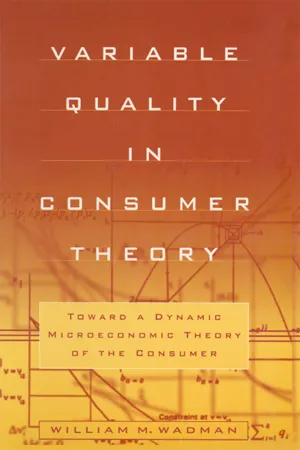
Variable Quality in Consumer Theory
Towards a Dynamic Microeconomic Theory of the Consumer
- 324 pages
- English
- ePUB (mobile friendly)
- Available on iOS & Android
eBook - ePub
Variable Quality in Consumer Theory
Towards a Dynamic Microeconomic Theory of the Consumer
About this book
Examines consumer decision-making on products and services of variable quality at the level of retail markets. Addresses for the first time consumer-producer interaction at the level of the individual consumer; issues of quality, consumption experience, and willingness-to-pay, as exhibited by individual consumers; and how these issues affect the decision-making process.
Part 1
Evolution of Variable Quality in Economic Thought
Antecedents to a New Theory of Consumption
Chapter 1
Introduction
When I began this project I was simply interested in presenting a brief history of the manner in which economists addressed the topic of variable quality. That was over fifteen years ago.
My interest in the theoretical issues of variable quality arose initially from my work as a health economist in the California State Department of Health. During that time I became acutely aware of the need to understand better the relationship of quality to efficiency, specifically as these concepts applied to health care service. Efforts to reduce health care costs of the California Medicaid program, known as MediCal at that time, were intended to save taxpayers’ money, while at the same time having no adverse effects on Medicaid recipients. As continues to this day, the critical issue was whether the quality of publicly funded health care programs was maintained, while efficiency of the programs improved. In other words, did “savings” generated by the MediCal Reform Program arise from improved efficiency of the state’s Medicaid program, or did “savings” arise from a deterioration in the quality and quantity of health care services rendered to Medicaid recipients?
In an effort to understand these issues, I began to examine how economists defined and measured quality. I sought a similar understanding of the definitions and measures of quality employed by physicians and other health care professionals. What I found was considerable variation and obtuseness in the theory, definitions, and measurement techniques of both groups.
The present work does not address the issues of quality and efficiency in the health care sector. My approach is much more limited. As it turns out, however, even the more limited topic is extensive. What I set out to do was gain a better understanding of how economists define and measure quality—specifically, the quality of goods and services transacted in retail markets. As with the case of physicians, economists have many different interpretations, or points of view, regarding what constitutes quality. I am no exception.
In the process of trying to understand the contributions to variable quality made by earlier economists, and in an effort to synthesize those contributions, I began to realize that a new, dynamic version of consumer theory was gradually unfolding. It grows out of those earlier works on variable quality.
In part 1, the contributions of economists, from the classical period to the work of John Muellbauer, are presented. Many of the ideas that form the basis of the new theory evolve in this early stage. As the reader will discover, many contemporary ideas regarding “quality” are, in fact, quite old. In similar fashion, many of the current debates, or alternative interpretations of “quality,” are not new. The book builds throughout part 1 in preparation for part 2.
A rather large portion of part 1 is devoted to the contribution of Hendrik Houthakker. Many authors in the field of variable quality view Houthakker’s work as the foundation for the hedonic technique and for other theoretical issues associated with quality. Part 1 compares the contributions of Hendrik Houthakker and Henri Theil. Most important, chapter 4 identifies a problem within the Houthakker constraint, when the model is forced away from its initial solution—that is, away from Houthakker’s basic price system. Comparison of Houthakker and Theil reveals that unless the Houthakker model can function away from its initial basic solution, it becomes, in effect, the same model as that developed by Theil.
As is well known, Houthakker is credited with one of the first applications of indirect utility. Interestingly, he also provided a technique to identify the “quantity” unit of measure of a product or service (i.e., to separate quantity from the numerous dimensions of quality). Separation of quantity from quality is essential to any theory of variable quality, and to the ability to compare and rank-order levels of quality. Not all economists are in agreement on this point, however.
Part 1 concludes with the works of John Muellbauer, Franklin Fisher, Karl Shell, Zvi Griliches, Jack Triplett, and others. Inasmuch as the characteristics approach to consumer theory frequently is linked to issues of variable quality, part 1 also covers the works of two authors in this field: Kelvin Lancaster and Duncan Ironmonger.
In part 2 the nature of the Houthakker constraint is examined at length. In the effort to understand better his constraint, an entirely new approach to variable quality is developed. The new model, which is a variation on the original work by Houthakker, takes a consumer approach. The model incorporates material from fields outside economics. Research findings from neuroscience and psychology, specifically on the topics of perception, cognition, generation of self, and self-awareness, are included. Mathematical developments in nonlinear dynamics, particularly the theory of attractors, are utilized. A Feigenbaum model of human decision making is presented. The model is based on a phase space that examines the interaction of human perception and expectation with experience and learning.
In the revised model, consumer perception of quality is assumed unique to each consumer. Like beauty, quality is assumed to exist in the eye of the beholder. A consumer’s concept and perception of self are seen as playing a central role in the processes of perception and evaluation of the quality of products and services purchased and consumed. From a consumer perspective, quality is defined and measured in terms of a product or service’s ability to enhance consumer self-image and/or to protect that self-image. As self-image changes over the life span of a consumer, so does the perception, evaluation, and ranking of quality. The relationship of a consumer’s consumption technology to his or her self-image is discussed.
Within this context, the existence of a single ranking of quality across all consumers is unlikely. In fact, the maintenance of a single “theory of the consumer” is viewed as unrealistic and impractical. With the perception of quality based on, and influenced by, individual consumer perception of self, the aggregation of consumers to create quality indices becomes more difficult, but not impossible. Issues of separability and aggregation likewise become more complex.
Because of the heavy emphasis on the individualistic and subjective nature of quality, the new model argues that sampling techniques utilized to investigate consumer behavior should be restricted to stratified-clustered samples drawn on numerous cohorts of consumers. In other words, there is no single “Representative Consumer,” but rather a representative consumer for each cohort of consumers under examination. The tighter the stratification and clustering of characteristics of a cohort population, the greater the ability to control for and study the effects of variable quality.
To the extent possible, consumers should be subdivided into cohorts based on age, sex, income, geographical location, level of education, occupation or profession, worldview, culture, religion, and so forth. Under conditions of variable quality, the application of a general theory of the consumer may lead to statistical results that obfuscate the impact of quality or generate mixed results. The model identifies circumstances wherein such conditions might arise.
A particularly unusual feature of the new model is the assumption that consumer decision making regarding variable quality requires consumer participation in both the objective function and the constraint, both of which operate in a more complex consumption space. Participation in the constraint is based on a new interpretation of the parameters in the original Houthakker constraint. Specifically, the new theory posits the existence of willingness-to-pay components within that constraint. One of the willingness-to-pay components is based on a redefinition of Houthakker’s bi. In the new model, bi reflects consumer expectation of quality (from a specific product or service) and consumer consumption experience (learning) derived from consumption of that product or service. Several different forms of learning and interaction with willingness-to-pay are examined.
Consumption experience is assumed to be unique to each consumer, interpreted by each consumer within the context of the consumer’s self-image, and his or her expectation of quality. A gap or inconsistency between the consumer’s expectation of quality and the interpreted consumption experience of quality is assumed possible. A loopy system of human perception, based on an interaction of expectation and experience, is assumed capable of explaining the existence of such inconsistencies and of finding possible solutions. This approach is similar to the C-D gap of Ronald Heiner, yet with significant differences.
In the world of variable quality it is furthermore assumed that the constraint and objective function may become truncated, that consumer decision making might occur only within neighborhoods along a spectrum of variable quality, and that the constraint and objective function may be dynamic (e.g., the constraint may vibrate in xixj consumption space). The dynamic behavior of objective function and constraint arises from learning processes within the consumer. Learning reduces inconsistencies between consumer expectation and consumption experience. The implications for individual consumer demand curves are correspondingly unusual. The model assumes that consumers do not “know” the entire length of their individual demand curves. Only neighborhoods, where consumers have consumption e...
Table of contents
- Cover
- Half Title
- Title Page
- Copyright Page
- Dedication
- Table of Contents
- List of Figures
- Acknowledgments
- Part 1 Evolution of Variable Quality in Economic Thought: Antecedents to a New Theory of Consumption
- Part 2 A New Economic Theory of the Consumer: Variations on a Theme by Houthakker
- Appendices
- Notes
- References
- Index
Trusted by 375,005 students
Access to over 1.5 million titles for a fair monthly price.
Study more efficiently using our study tools.
Frequently asked questions
Yes, you can cancel anytime from the Subscription tab in your account settings on the Perlego website. Your subscription will stay active until the end of your current billing period. Learn how to cancel your subscription
No, books cannot be downloaded as external files, such as PDFs, for use outside of Perlego. However, you can download books within the Perlego app for offline reading on mobile or tablet. Learn how to download books offline
Perlego offers two plans: Essential and Complete
- Essential is ideal for learners and professionals who enjoy exploring a wide range of subjects. Access the Essential Library with 800,000+ trusted titles and best-sellers across business, personal growth, and the humanities. Includes unlimited reading time and Standard Read Aloud voice.
- Complete: Perfect for advanced learners and researchers needing full, unrestricted access. Unlock 1.5M+ books across hundreds of subjects, including academic and specialized titles. The Complete Plan also includes advanced features like Premium Read Aloud and Research Assistant.
We are an online textbook subscription service, where you can get access to an entire online library for less than the price of a single book per month. With over 1.5 million books across 990+ topics, we’ve got you covered! Learn about our mission
Look out for the read-aloud symbol on your next book to see if you can listen to it. The read-aloud tool reads text aloud for you, highlighting the text as it is being read. You can pause it, speed it up and slow it down. Learn more about Read Aloud
Yes! You can use the Perlego app on both iOS and Android devices to read anytime, anywhere — even offline. Perfect for commutes or when you’re on the go.
Please note we cannot support devices running on iOS 13 and Android 7 or earlier. Learn more about using the app
Please note we cannot support devices running on iOS 13 and Android 7 or earlier. Learn more about using the app
Yes, you can access Variable Quality in Consumer Theory by W.M. Wadman in PDF and/or ePUB format, as well as other popular books in Economics & Business General. We have over 1.5 million books available in our catalogue for you to explore.