eBook - ePub
Available until 4 Dec |Learn more
The Principles of Islamic Marketing
This book is available to read until 4th December, 2025
- 260 pages
- English
- ePUB (mobile friendly)
- Available on iOS & Android
eBook - ePub
Available until 4 Dec |Learn more
The Principles of Islamic Marketing
About this book
The Principles of Islamic Marketing fills a gap in international business literature covering the aspects and values of Islamic business thought. It provides a framework and practical perspectives for understanding and implementing the Islamic marketing code of conduct. It is not a religious book. The Islamic Economic System is a business model adopted by nearly one quarter of the world's population. Baker Alserhan identifies the features of the Islamic structure of International Marketing practices and ethics. Adherence to such ethical practices elevates the standards of behaviour of traders and consumers alike and creates a value-loaded framework for meaningful cooperation between international marketers and their Muslim markets. His book provides a complete guide for an organization when managing its entire marketing function or when customising part of its offering to suit Muslim customers. It addresses the challenges facing marketers involved in business activities with and within Islamic communities, the knowledge needs of academic institutions, and the interest of multinationals keen on tapping the huge Islamic markets. Along the way, Baker Alserhan provides insights into key elements such as, distribution channels, retailing practices, branding, positioning, and pricing; all within the Muslim legal and cultural norms. This second edition brings the book up to date and features a number of new case studies and two additional chapters on Maqasid Al Shariah and the Islamic economy, and a strategic perspective on Islamic marketing and branding.
Frequently asked questions
Yes, you can cancel anytime from the Subscription tab in your account settings on the Perlego website. Your subscription will stay active until the end of your current billing period. Learn how to cancel your subscription.
At the moment all of our mobile-responsive ePub books are available to download via the app. Most of our PDFs are also available to download and we're working on making the final remaining ones downloadable now. Learn more here.
Perlego offers two plans: Essential and Complete
- Essential is ideal for learners and professionals who enjoy exploring a wide range of subjects. Access the Essential Library with 800,000+ trusted titles and best-sellers across business, personal growth, and the humanities. Includes unlimited reading time and Standard Read Aloud voice.
- Complete: Perfect for advanced learners and researchers needing full, unrestricted access. Unlock 1.4M+ books across hundreds of subjects, including academic and specialized titles. The Complete Plan also includes advanced features like Premium Read Aloud and Research Assistant.
We are an online textbook subscription service, where you can get access to an entire online library for less than the price of a single book per month. With over 1 million books across 1000+ topics, we’ve got you covered! Learn more here.
Look out for the read-aloud symbol on your next book to see if you can listen to it. The read-aloud tool reads text aloud for you, highlighting the text as it is being read. You can pause it, speed it up and slow it down. Learn more here.
Yes! You can use the Perlego app on both iOS or Android devices to read anytime, anywhere — even offline. Perfect for commutes or when you’re on the go.
Please note we cannot support devices running on iOS 13 and Android 7 or earlier. Learn more about using the app.
Please note we cannot support devices running on iOS 13 and Android 7 or earlier. Learn more about using the app.
Yes, you can access The Principles of Islamic Marketing by Baker Ahmad Alserhan in PDF and/or ePUB format, as well as other popular books in Business & Business General. We have over one million books available in our catalogue for you to explore.
Information
Understanding Islamic Marketing
Chapter 1
Maqasid Al Shariah and the Islamic Economy: An Introduction
And if only they upheld [the law of] the Torah, the Gospel, and what has been revealed to them from their Lord, they would have consumed [provisions] from above them and from beneath their feet. Among them are a moderate community, but many of them – evil is that which they do (Quran 5: 66).
Learning Objectives
After reading this chapter, you should be able to:
• Define the terms Islamic economy and Maqasid Al Shariah.
• Understand the general economic guidelines of the Shariah.
• Understand Maqasid Al Shariah and its categories.
• Understand the characteristics of the Islamic economy.
• Understand that faith and behaviour in Islam are inseparable.
An Expert’s Perspective
Islamic Economic Thought
Islamic Economic Thought
Professor Dr Ekrem Erdem, Dean
Faculty of Economics and Administrative Sciences
Erciyes University, Turkey
Faculty of Economics and Administrative Sciences
Erciyes University, Turkey
Economic agents in Islamic tradition follow social purposes by considering others in consumption, saving, investment, employment and other economic activities. Those social purposes aim to maintain the needs of all mankind, equilibrium and justice, stability and economic development. Muslim individuals are responsible for refraining from consuming non-Halal food and from extravagance. Therefore, the main perspective of Islamic economic studies needs to aim at realizing the spiritual, moral, social and material well-being of individuals in this life and the hereafter – from production to consumption of scarce resources in a morally guided market economy. For this purpose, the core question of what to produce and consume is totally determined by a comprehensive understanding of human nature and needs; not by self-interest or pleasure, but mainly by the pleasure of Allah because His pleasure needs to be maintained by safeguarding not only Muslim individuals and their nations but also others (all humankind) – spiritually, morally, socially and materially. Thus, the key point in the perspective of Islamic economic thought is that human well-being cannot be defined from a hedonic perspective; rather, it is defined from a spiritual, moral and social perspective.
Introduction
Muslims believe that Islam is a religion for life, and as such it has a superior and independent economic system which is different from other systems. It is the duty of every Muslim to ensure that this system is universally applied. This belief is shared by many non-Muslims. For example, Professor Jacques Austruy wrote in 1968 that:
An economy based on the precepts of the Qur’an would necessarily be a ‘moralised’ economy. Such moralisation could give a new meaning to the idea of value and would fill the spiritual void which the mechanisation of everyday life is in danger of creating (Austruy 1968, p. 7).
He also states that the Islamic economic system will prevail in the future because it is a complete way of life. The Orientalist Raymond Charles states that Islam draws a distinctive way for progress (Alassal and Abdalkareem 2010). In production for example it honours work and declares all types of exploitation Haram. Regarding distribution, he also states that under Islamic rules the state should ensure everyone gets what they need. Moreover, according to Raymond Charles, everyone is entitled to what they gain by working.
This way of life is governed by what is known as Islamic Shariah, which has clear guidelines that cover all aspects of a Muslim’s life. Each of these guidelines or rules is meant to achieve specific goals, called Maqasid. The implementation of the rules is never meant for its own sake, but for the sake of the outcomes of such implementation.
What is Maqasid Al Shariah?
Stating the obvious, all rules are meant to achieve specific goals, and these goals are the reasons the rules were created in the first place. This fact applies to all rules, whether they are of divine origin such as the religious teachings or of human origins such as the rules applied in today’s secular societies. The Islamic Shariah (way of life according to Islam) which covers all aspects of life also aims to achieve specific goals (Maqasid) for the individuals and groups who believe in and apply them.
So what is Maqasid Al Shariah? The term is related to two interlinked sets of rules: those that clarify the Islamic belief system; and those that regulate the actual behaviour of the Muslim people. The aim of these rules is to establish man as Allah’s authority on earth and to worship Him therein. In other words to make earth a godly place or a heaven on earth since it is run by God’s successor who adheres to and applies God’s rules.
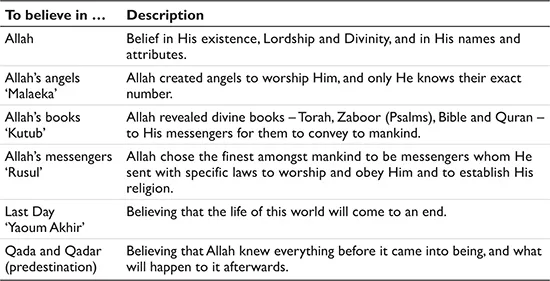
The rules that are related to Islamic beliefs are mostly clarified in the six pillars of faith as stipulated by Islam (Table 1.1).
Table 1.1 The six pillars of faith in Islam
The faith-related teachings aim to achieve many goals, as explained in many verses throughout the Quran. An obvious goal is peace of mind and heart: ‘Those who have believed and whose hearts are assured by the remembrance of Allah. Unquestionably, by the remembrance of Allah hearts are assured’ (Quran 13:28). Moreover, beliefs form the underlying motivations for behaviour, that is, believe in it and practise it. Even for the Islamic teachings which are clearly supported by the most advanced knowledge that people have achieved today, it would be very hard to convince most people to do the right things just because they are the right things to do. A clear example is the benefits of Ramadan, the annual one-month dawn-to-dusk fast practised by Muslims. It would be very difficult for the average person to stop eating, drinking and having sex during that time if there was no strong faith underlying their decision to commit to such a practice. The same applies to performing ablutions several times a day, showering every time after sex, waking up at dawn to pray. The list goes on. The point here is that faith is the basis on which behaviour is based.
Understanding Maqasid is of the utmost importance because of the application and behavioural aspect of the Shariah. As will be explained later throughout this book, to engage Muslim consumers competitively it would not be enough for firms to see the salient behaviours of Muslims and act upon them. The underlying motivations of these behaviours must be uncovered. That is where the true competitive advantage in the Islamic market lies. While any firm can make its processes Halal, only the visionary one can understand the true Halal consumption motivations.
To help readers understand the concept of the Halal consumption motivation, Figure 1.1 loosely tries to capture the framework of the Muslim consumer’s mind in this regard. Basically a Muslim searches for, purchases and consumes Halal. In doing so there are several levels or layers of motivation. The most apparent motive to consume Halal is because a Muslim is supposed to do so – that is, consume Halal and nothing else. Consumption at this level is motivated by not consuming Haram. It is deeply affected by the prevalent perception among Muslims that anything that is not Halal is inherently ‘dirty’ and not fit for consumption.
At a deeper level, Muslims consume Halal as part of doing good deeds. Since it is God who ruled that only Halal must be consumed, believing in what God ruled and behaving accordingly will make them feel better for doing something that is pleasing to God and that will make them feel like a better person, a more benevolent Muslim.
A third and much deeper level is the one where Muslims hold that believing, and behaving accordingly, will result not only in improving one’s own immediate status – that is, consuming healthier food or feeling more righteous – but also in a better planet for all. This last point is the main aim of the Shariah – Maqsad (singular) vs Maqasid (plural); in other words, Allah’s successor abiding by Allah’s rules to create and maintain life on earth in all its forms. At this level, a Muslim is preserving that which Allah entrusted him with – that is, life.
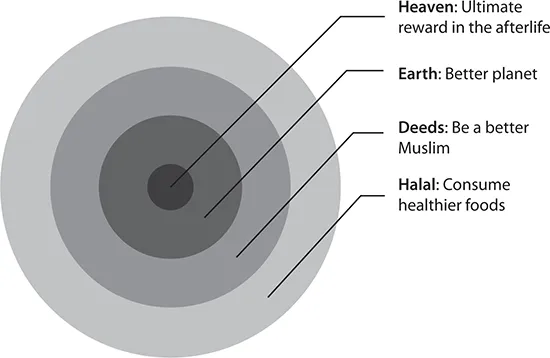
Figure 1.1 A framework of the mind of the Muslim consumer: Motivations to consume Halal
Table 1.2 illustrates the understanding and application of these different layers of motivation. The strongest degree of motivation is generated at the layer where a Muslim’s behaviours are aimed at achieving the ultimate reward, that is, heaven in the afterlife. The lowest level of motivation occurs at the layer where Halal is consumed and Haram is avoided out of custom, tradition or upbringing. Unfortunately the majority of firms operate at this outer layer, and thus they become involved in endless and costly pursuit of competitiveness through doing what everyone else is doing. For example, they adopt a Halal logo and show women in Islamic attire in their promotions. Obviously any firm can do that, but what most cannot do is dive deeper and understand other layers of motivation that have a stronger impact on a Muslim consumer’s behaviour.
Table 1.2 Relationship between level of motivation and competitiveness in the Muslim market
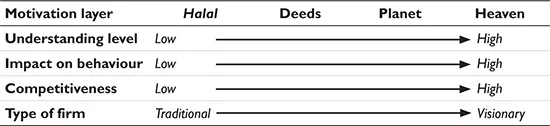
What firms must understand is that faith is not a logo or an item of attire. These are mere reflections of faith. Traditional firms operate at this level, and as a result they could never sustain any competitive advantage they might gain as a result of being an early entrant for example, or from other similar sources because other firms can do the same – that is, get the logo and show less female skin in their promotions. On the other hand, visionary firms play at an entirely different field where it is very costly and time-consuming for other firms to follow suit. They understand the difference between the reflection and the faith.
To summarize, firms should look at these layers of motivation that affect the behaviour of the Muslim consumer before developing their marketing strategies. A deeper understanding of these motivations will enable firms to design high-impact marketing programmes that address several areas of concern for Muslim consumers.
Table 1.3 Aims (Maqasid) of the Shariah
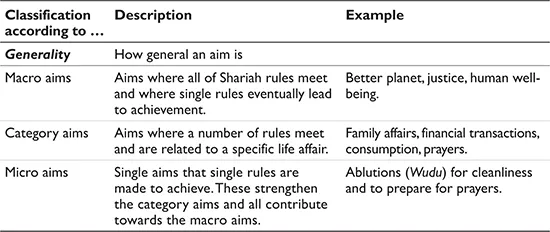
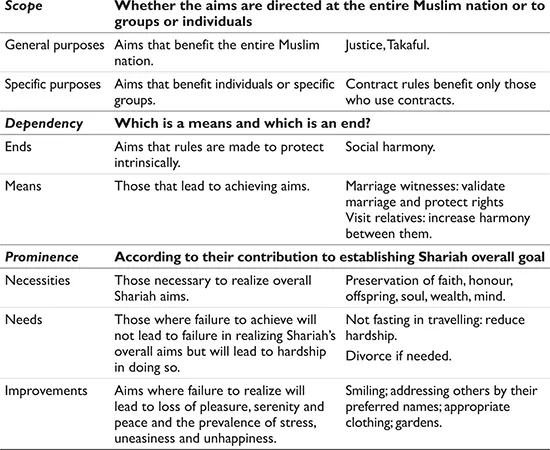
Table 1.3, which was compiled from the Arabic version of Abdelhajid Najar’s (2006) book on the aims of the Shariah, describes how the Maqasid of the Shariah can be classified. It is important to note here that these classifications do describe the same things but from different perspectives, and that they support each other. The difference between them depends on the angle from which a particular scholar views them.
What is an Islamic Economy?
It is the economic system of the religion of Islam. It shows the Islamic way of organizing the economic part of Muslim people’s lives according to the general guidelines expressed in the Quran and the Sunnah (teachings of the Prophet Mohammad). This way expresses itself according to the environment in which it is being implemented: that is, a Muslim community can engage in present economic activities as long as those activities are within the parameters of Islam. This definition includes two main parts: the first is related to the fixed guiding principles, and the second to the environment in which these principles are applied. The general guidelines include, but are not limited to the following:
1. Work is Halal and freedom to work.
2. Trade is Halal but usury is Haram.
Those who consume interest cannot stand [on the Day of Resurrection] except as one stands who is being beaten by Satan into insanity. That is because they say ‘Trade is [just] like interest’. But Allah has permitted trade and has forbidden interest (Quran 2:275).
Even before Islam, usury was not considered a good deed within Arabian society. In about ad 605 the Arab tribes in Makkah (Mecca) decided to rebuild the Kaaba (Ka’aba) – literally ‘the cube’ in Arabic – which is an ancient stone structure built and rebuilt by prophets as a house of monotheistic worship. The dominant tribe in Makkah then collected money for the construction but made sure that only donations from households not involved in usury or prostitution were accepted. This is so that no Haram money is used to rebuild the Kaaba.
3. The fruits of labour go to the labourer, and men and women are equal in that regard.
And do not wish for that by which Allah has made some of you exceed others. For men [it] is a share of what they have earned, and for women [it] is a share of what they have earned. And ask Allah of his bounty. Indeed Allah is ever, of all things, Knowing (Quran 4:32).
4. The state has the power to redistribute wealth in society in case of grave disparities.
And what Allah restored to His Messenger from the people of the towns – it is for Allah and for the Messenger and for [his] near relatives and orphans and the [stranded] traveller – so that it will not be a perpetual distribution among the rich from among you (Quran 59:7).
5. It is Haram to transgress against a Muslim’s wealth in any way.
All of the Muslim is Haram to the Muslim; his blood, honour, and wealth (Hadith).
The basic feature of these guidelines is that they are not subject to change or replacement; they also transcend time, place and degree of social economic development. However, these are different from the civil laws that were devised under guidance from Shariah. Civil laws are bound by time and place. They represent the means to achieve the aims (Maqasid) of the Shariah as explained in the following section. The second part of the definition of Islamic economy, which is related to the environment of application of these rules, means the applications and economic solutions which Muslim scholars or others devise as life progresses. Examples include showing:
• what is usury and is not;
• what investments are Halal;
• what new ingredients or processes are acceptable;
• what is Zakah1 in a certain country or community;
• how to achieve balance with society, and so on.
It also allows the use of new developments and concepts in accordance with the teachings of Islam. The main characteristic of these applications, unlike the general Shariah guidelin...
Table of contents
- Cover Page
- Dedication
- Title Page
- Copyright Page
- Contents
- List of Figures and Tables
- Preface
- PART I UNDERSTANDING ISLAMIC MARKETING
- PART II THE ISLAMIC MARKETING MIX
- PART III ISSUES IN ISLAMIC MARKETING
- Index